What’s actually slowing this PC down?
Pick the symptom - the matching free tool is one click away.
The best wood look-alike depends on where it will be used. Choose wood-look porcelain tile when water, cleaning, heat, or outdoor exposure matters most; luxury vinyl plank or WPC flooring when you want a softer, quieter floor with spill resistance; laminate when realistic plank texture is the priority in a suitable dry or controlled-moisture room; composite decking for exterior horizontal surfaces; polymer or PVC products for exterior siding and trim; and faux-wood blinds for humid rooms and easy-care window coverings.
These products reproduce some combination of wood’s color, grain, plank shape, embossing, or visual warmth. They do not reproduce every property of solid wood. A wood-look floor, deck board, exterior trim product, blind, and decorative film are different solutions with different installation requirements, failure modes, and warranties.
As an Amazon Associate I earn from qualifying purchases.
What is a wood look-alike?
A wood look-alike is a non-solid-wood product designed to imitate some visible or tactile characteristics of wood. Common materials include porcelain, vinyl, laminate, composite, polymer, PVC, and adhesive films. The resemblance may come from a printed grain pattern, color variation, plank proportions, embossed texture, matte finish, beveled edges, or a combination of those features.
The phrase describes appearance, not performance. A tile may resemble oak while behaving like tile: hard, cool, water-resistant, and highly cleanable. A composite deck board may imitate stained lumber while remaining subject to heat buildup and installation requirements. A faux-wood blind may look like painted or stained wood but be better suited to humidity. The right comparison is therefore not “Is it as good as wood?” but “Which properties of wood matter for this application, and which compromises are acceptable?”
#1 Best Overall
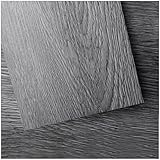
- Stylish - Authentic wood looking and grain texture, adding timeless feature for your home
- Easy DIY - Just peel and stick down on a flat floor for installation, no power tools, no experience, no glue, no accessoies
- Superior Property - Rigid surface and hard core, 100% waterproof, fire proof, wear resistant, scratch and abrasion resistant, high strength, no expansion, stable
- Wide Application - Besides as flooring, it can be applied to wall, ceiling, cabinet by adding extra glue (liquid nail)
- Exceptional Customer Service - We offer full service 24/7 for our customers for any product related issues, 2-year warranty
Wood look-alikes at a glance
| Application | Best reason to choose the substitute | Main compromise |
|---|---|---|
| Interior or exterior-rated porcelain tile | Water, cleaning, and hard-wearing performance | Harder and cooler underfoot; installation is less forgiving |
| LVP or WPC flooring | Softer feel, spill resistance, and installation options | Quality and performance claims vary considerably by product |
| Laminate flooring | Realistic plank appearance and tactile texture | Water protection is range-specific, and moisture management still matters |
| Composite decking | Wood-like exterior appearance with less staining and sanding | Can cost more than basic wood and may become hot in direct sun |
| Polymer or PVC siding and trim | Exterior wood appearance with moisture and maintenance advantages | Less natural material feel; installation and coating rules are product-specific |
| Faux-wood blinds | Wood appearance in humid rooms with easier upkeep | Not genuine wood; accurate sizing and mounting decisions are essential |
| Wood-grain film or contact paper | Low-cost, low-commitment decorative refresh | Surface treatment only—not flooring, siding, decking, or structural material |
Interior flooring alternatives
Wood-look porcelain tile: the water- and wear-focused option
Wood-look porcelain tile is usually the strongest choice where water exposure, frequent cleaning, heat, or outdoor conditions matter more than a soft and warm feel underfoot. Current tile assortments include long plank formats such as 6-by-24, 6-by-36, 8-by-48, 9-by-47, 10-by-60, and 12-by-72 inches. Depending on the line, buyers may find glazed or unglazed surfaces, matte finishes, rectified edges, frost-resistant products, and products rated for indoor, outdoor, or indoor/outdoor use.
Long planks can create a convincing hardwood visual, especially when the surface includes variation rather than repeating the same grain at regular intervals. Examples found in current assortments include Daltile Trace Meadow, Daltile Suttongrove Oak, MSI Modena Natural, MSI Benson Park, and Lifeproof Revere Wood. These are examples of product lines, not timeless recommendations: model availability, ratings, price, inventory, and color names should be verified before ordering.
Important water-resistance distinction: porcelain itself is highly water-resistant, but a tiled floor or wall is an assembly. Grout, the substrate, waterproofing where required, movement joints, perimeter details, drainage, and installation quality all affect how the completed installation handles water. “Wood-look tile is waterproof” is therefore too broad unless the claim is carefully limited to the tile and the tested assembly.
- Choose it for: bathrooms, kitchens, mudrooms, heavily cleaned areas, heat-prone locations, and exterior applications where the exact tile is rated for the exposure.
- Expect: a hard, cool surface, more impact noise than resilient flooring, and a demanding installation that depends on a flat and stable substrate.
- Check: frost resistance, slip-related specifications, wet-area suitability, edge profile, grout requirements, movement-joint details, and whether the installation is indoors, outdoors, or both.
Luxury vinyl plank and WPC: softer and more forgiving underfoot
Luxury vinyl plank, commonly called LVP, is a resilient floor with a printed visual layer and a textured wear surface. It is not a wood product. Its appeal is that it can provide a convincing plank appearance while generally feeling softer and quieter than tile, with installation methods that may be more accessible to homeowners.
WPC is one type of rigid or semi-rigid vinyl construction, using a wood-plastic composite-style core rather than solid wood. For example, COREtec’s Originals collection describes waterproof WPC construction, attached underlayment on many styles, embossed-in-register texture, beveling, and stain resistance. Its Spirit Oak, Virtue Oak, and Tranquil Oak styles illustrate how manufacturers publish product-specific dimensions, wear-layer information, core construction, and installation methods.
The word “waterproof” must remain product-specific. Do not transfer one manufacturer’s claim to every LVP product. Even when the flooring material is rated for spills or moisture, the subfloor, seams, perimeter, transitions, plumbing leaks, and installation method remain important. COREtec also documents a PVC-free mineral-core line with embossed-in-register wood visuals and a stated residential scratch warranty, showing that newer wood-look floors can differ materially from conventional PVC-based LVP.
Recommended Free Tools
- Choose it for: living areas, bedrooms, kitchens, entryways, homes with pets, and rooms where a softer walking surface and spill management are useful.
- Expect: variation in wear layers, core construction, surface texture, attached underlayment, warranty language, and permitted installation locations.
- Check: the exact wear layer, subfloor-flatness tolerance, acclimation instructions, underlayment requirements, installation method, grade suitability, scratch warranty, and restrictions on standing water or heavy loads.
Subfloor preparation still matters. Irregularities can telegraph through resilient flooring, and sharp loads, dragging furniture, or concentrated point pressure can damage the surface or locking system. A product that is easy to click together is not necessarily easy to install correctly.
Rank #2

- 【NAACOO UNIVERSAL FLOOR KIT】 4 IN 1 Portable KIT--Tapping Block has unique combination edge design for use with most types of flooring, push tongue and groove wood floor together creating a tight seam, Match Spacers create a uniform gap between the wall. Pull Bar Flooring Tool suitable for work close to a wall, corner, closets or in tight spaces, closing the gaps and seams in laminate floors without causing damage. Rubber mallet can be used with pull bar hook and tapping block, which makes it easier to complete the floor installation work.
- 【Usage Scenarios 1 - MORE TYPES of FLOOR】UNIVERSAL BLOCK Suitable for TONGUE & GROOVE or CLICK-LOCK FLOOR.Just put portable tapping block on the floor tongue, then tapping it, make the tongue and groove or edges of resilient vinyl planks, laminate or hardwood, joins flooring planks creating tight seam.
- 【Usage Scenarios 2 - MORE THICKNESS of FLOOR】UNIVERSAL BLOCK With 3 DIFFERENT THICKNESS EDGES--to meet multiple size of flooring. The 1.5mm edge can install with a floor thickness of 3.5 mm ~ 5.5 mm. The 2.5mm edge can install with a floor thickness of 6mm~3/8in. The 3.5mm edge on the other side can install with a floor thickness of 10 mm ~ 12 mm. The 1.5mm edge (Thinnest one) of tapping block with an inclined angle, can hook the floor and prevent the floor from moving during knocking.
- 【STEEL PULL BAR】 Suitable for work close to a wall, corner, loser or in tight spaces. Adopt quenching process to treat. Made from premium 45# steel with frosting and matt coating. Better than A3 steel. Soft pads on the back can protect the floor from scratch.
- 【40pc WEDGE FLOORING SPACERS】The kit comes with 40 pieces of flooring spacers which are "slope design" and "non-slip design". The spacers have “serrated” edges that lock them into the correct position once a board is placed against them. The spacers are easy to insert and remove from the floor, making them a breeze to work.
Laminate: convincing texture with range-specific moisture protection
Laminate remains a useful wood look-alike when realistic plank appearance, tactile surface structure, and a lower-commitment alternative to hardwood are priorities. Modern products may use deep texture, matte finishes, beveled edges, and varied shades and grains to avoid a flat printed appearance.
Pergo describes AquaSafe technology on applicable products as creating a watertight surface through the bevels, with protection against water penetration for up to 72 hours. That is a specific tested and marketed claim for applicable ranges, not a description of all laminate. Wet-area warranty coverage also varies by product line.
For any laminate installation, ask four questions: Is this range rated for the room? How long may standing water remain? Does the wet-area warranty apply to this exact product? What subfloor, expansion, edge-sealing, and cleaning requirements must be followed? A small spill wiped promptly is a different situation from recurring dampness, a leaking appliance, or water entering an unprotected perimeter.
- Choose it for: dry rooms and controlled-moisture spaces where plank realism and tactile texture matter.
- Expect: a firmer feel than LVP and greater sensitivity to moisture outside the product’s tested claims.
- Check: the exact AquaSafe or equivalent claim, wet warranty, edge and bevel construction, expansion requirements, and maintenance instructions.
Flooring decision: which one fits the room?
| If your priority is… | Start by comparing… | Do not overlook… |
|---|---|---|
| Maximum cleanability and water exposure | Wood-look porcelain tile | Waterproofing, grout, movement, substrate, and the hard feel underfoot |
| A softer, quieter plank floor | LVP or WPC | Wear layer, core, subfloor flatness, seams, and product-specific water claims |
| Deep texture and a wood-like floating floor | Laminate | Wet warranty, standing-water limits, and edge protection |
| Outdoor wood appearance | Exterior-rated composite decking or tile | Temperature, drainage, framing, fasteners, ventilation, and local exposure |
Before committing to a full room, order flooring samples and view them in the actual lighting. A small sample can reveal whether the grain repeats, whether gray or warm undertones dominate, and whether the texture feels appropriate. For a large or technically demanding installation, compare a qualified quote for professional flooring installation with the cost and risk of doing the work yourself.
Composite decking: the main exterior horizontal substitute
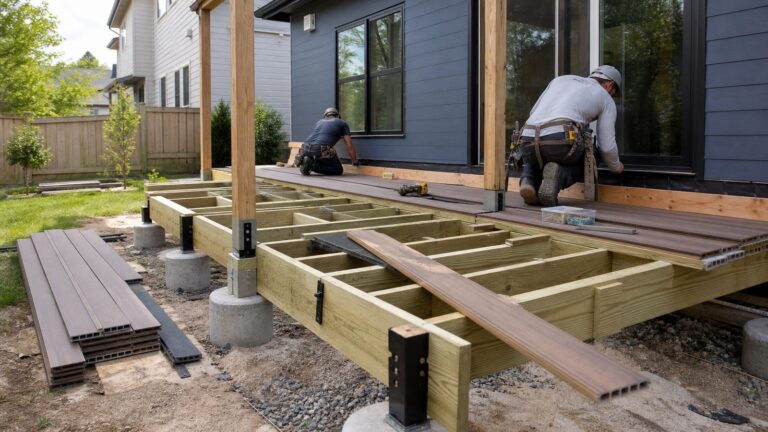
Composite decking is the clearest wood look-alike for decks and other exterior horizontal surfaces. Capped and uncapped products combine plastic and wood-derived or other composite materials with printed or molded grain, multi-tone coloring, and matte or textured finishes. They are designed to reduce some of the recurring work associated with staining, sanding, and sealing wood, but they are not maintenance-free in the absolute sense.
Trex Select, for example, is documented as using recycled plastic film and reclaimed sawdust and as carrying a 35-year limited residential fade-and-stain warranty. Trex Enhance is positioned as an authentic wood-grain alternative with composite durability and scalloped boards intended to reduce weight. Those details belong to the named product lines; they should not be generalized to every composite board.
Composite still needs cleaning, correct fastening, drainage, ventilation, and adequate clearance. Framing condition and joist spacing matter when resurfacing an existing deck. Color variation, board expansion, fastener selection, edge details, and manufacturer-specific installation rules also affect the finished result.
Rank #3

- Coverage, Dimensions & Loss Factor Guide - Includes 36 precision-cut planks per box, each measuring 36" x 6" with a 0.08" solid thickness, covering 54 sq. ft. total. Engineering Recommendation: Due to perimeter cuts and pattern matching, calculate room square footage with a standard 10% cutting loss (Effective net coverage: ~48 sq. ft./box). To prevent batch-to-batch color variance, order all required boxes in a single shipment.
- Commercial-Grade Wear Resistance - Engineered with a heavy-duty protective wear layer over a high-density 0.08" thick vinyl core, providing exceptional resistance against furniture scuffs, high foot traffic, and pet claws. Formulated to prevent surface denting and scratches, ensuring structural integrity in residential and light commercial spaces.
- Rental-Friendly & Residue-Free Removal - Pre-applied with a commercial pressure-sensitive adhesive that bonds firmly to clean, flat, and dry subfloors (plywood, concrete, existing vinyl) with no extra glue needed. Designed for rental properties and temporary renovations, peeling off cleanly without damaging the underlying subfloor or leaving stubborn chemical residue.
- Textured Wood Grain & Anti-Slip Safety - Crafted with a 3D embossed, tactile wood grain surface that accurately replicates natural hardwood texture while enhancing underfoot traction. Delivers superior slip resistance (even when wet) for kitchen, bathroom, and entryway applications.
- Impermeable Waterproofing & Easy Maintenance - Non-porous vinyl composite structure completely repels spills, standing water, and household stains. Requires zero specialized sealing agents or proprietary floor cleaners—simply clean with a damp microfiber mop, broom, or neutral PH household cleaner.
Heat is a real trade-off. Composite decking can become hot in direct sun, including products marketed with heat-mitigating technology. Climate, color, shade, ventilation, and orientation influence the experience. A dark board in full sun may be a poor choice for bare feet, pets, or a frequently used south-facing deck even if its maintenance needs are attractive.
- Choose it for: homeowners who want a wood-like deck appearance with less routine staining and sanding.
- Expect: a higher material cost than basic wood in many projects, potential heat buildup, and a system that still requires cleaning and careful installation.
- Check: the exact warranty, fade-and-stain terms, board profile, heat guidance, joist and fastener requirements, drainage, ventilation, and whether the existing framing can support the resurfacing plan.
Because decking is a project-scale purchase involving framing, freight, fasteners, and installation, a composite decking estimate from a local dealer or installer can be more useful than choosing boards from a photograph alone. Review climate suitability and warranty requirements before ordering.
Polymer and PVC siding, soffit, beadboard, and trim
Polymer and PVC exterior products extend the wood-look category beyond floors and decks. Current AZEK exterior offerings document products intended to reproduce cedar shingles, stained lumber, beadboard, and wide-plank architectural details. The Alpine Collection is described as using polymer materials with warm woodgrain finishes for ceilings, soffits, porches, and gazebos. Polymer shingle siding is positioned as a craftsman-style cedar appearance with panelized installation and PVC durability.
These products can be useful where the desired visual language is wood but recurring moisture exposure or maintenance makes some wood applications less attractive. They are not universal replacements for lumber. A decorative soffit, beadboard ceiling, siding panel, and structural framing member perform different functions, and a wood-look cladding product should not be treated as structural material unless its documentation expressly says so.
The Tool Desk
Outbyte PC Repair FREEClear out junk files and repair common Windows errorsFree Scan →Outbyte Driver Updater FREEFix the driver behind crashes, sound loss and screen glitchesFind Drivers →Before specifying polymer or PVC siding and trim, verify the complete installation system:
- required substrate and fastening pattern;
- flashing, drainage, and ventilation details;
- clearances around roofs, windows, doors, and heat sources;
- local fire-performance and building-code requirements;
- allowances for expansion and contraction;
- approved paints, primers, colors, and coating systems; and
- whether the product is intended for the specific vertical, soffit, ceiling, porch, or trim application.
The visual result also depends on corner details, transitions, trim widths, and installation alignment. A realistic grain pattern cannot compensate for poor flashing or visibly inconsistent joints.
Faux-wood blinds for humid rooms
Faux-wood blinds are one of the most direct consumer examples of a wood substitute. Bali describes faux-wood blinds with woodgrain colors and moisture-resistant slats for locations such as kitchens, bathrooms, and laundry rooms. Hunter Douglas distinguishes genuine hardwood blinds from alternative-wood products and describes its EverWood faux-wood line as suitable for bathrooms or sunrooms and resistant to fading, yellowing, warping, or bowing.
Rank #4

- Stylish - Authentic wood looking and grain texture, adding timeless feature for your home!
- Easy DIY - Just peel and stick down on the floor for installation, no power tools, no experience.
- Superior Property - Rigid surface and hard core, 100% waterproof, fire proof, wear resistant, scratch and abrasion resistant, high strength, no expansion, stable.
- Wide Application - Besides as flooring, it can be applied to wall, ceiling, cabinet by adding extra glue (liquid nail).
- Packaging Detail - Plank dimension: 6" width x 36" length, pack of 36 pcs, covers 54 sq.ft
Those are manufacturer-specific descriptions, not a guarantee that every imitation-wood blind performs identically. Compare slat material, moisture guidance, color stability, cleaning instructions, lift system, headrail, warranty, and the suitability of the blind for direct sun or frequent condensation.
Measurement is more important than the product photograph. Before ordering, determine:
- the exact inside width and height of the window recess;
- whether the blind will use an inside mount or outside mount;
- the required finished width, rather than relying only on a nominal size;
- slat width and desired light control;
- lift style and child-safety requirements; and
- whether the included brackets and hardware suit the frame or wall surface.
Standard-size faux wood blinds can work well for ordinary windows when measurements and mounting instructions match. Nonstandard openings, large windows, unusual recesses, or coordinated whole-home orders are better candidates for custom faux wood blinds, where measurement support, color samples, and mounting choices are part of the purchase. The U.S. Department of Energy treats wood and faux-wood horizontal blinds as established window-covering categories, but the energy and light-control result still depends on fit, slat position, window orientation, and how the blind is used.
Decorative wood-grain films and contact paper
Wood-grain contact paper, adhesive film, and peel-and-stick wallcoverings are legitimate low-commitment treatments for refreshing furniture, small wall areas, cabinet fronts, or other suitable smooth surfaces. They can deliver a wood visual quickly without the cost or permanence of a construction material.
They should be treated as finishes, not substitutes for flooring, decking, siding, trim, or structural wood. A film can lift at seams, telegraph surface defects, discolor in heat or sunlight, or fail in damp conditions if the exact product is not rated for that exposure. Before applying one, verify adhesion to the substrate, removability, cleaning tolerance, heat and moisture limits, seam technique, and whether the surface is clean, smooth, dry, and stable.
Do these 3 things before closing this tab:
1Scan for outdated or missing drivers - takes under a minute2Clear out junk files and repair common Windows errors3Fix the driver behind crashes, sound loss and screen glitchesFor renters and small DIY projects, the key benefit is reversibility and limited commitment. The key risk is expecting a decorative film to withstand the abrasion, loads, water, and temperature changes that a purpose-built building product is designed to handle.
Independent reader supportYour contribution helps us test, update, and keep practical guides available for everyone.How to choose the right wood look-alike
1. Start with the application, not the color
Identify whether the product will be installed on a floor, deck, wall, soffit, trim component, window, piece of furniture, or another surface. A product that looks convincing in a catalog may be unsuitable for the location because it lacks the required water, impact, heat, UV, slip, fire, or structural rating.
- Water-exposed floor or wall: compare porcelain tile with a resilient product explicitly rated for the room and exposure.
- Interior floor with spills and pets: start with LVP or WPC, then compare the exact wear layer, core, seams, and warranty.
- Dry room where texture is important: laminate can be a strong candidate if its moisture limits fit the room.
- Deck or deck resurfacing: compare exterior-rated composite systems and inspect the framing, heat exposure, drainage, and fasteners.
- Siding, soffit, or trim: use an exterior-rated polymer or PVC system and follow its flashing and fastening details.
- Bathroom or laundry window: compare moisture-resistant faux-wood blinds, measured for the actual opening.
- Furniture or a small decorative area: consider a suitable wood-grain film rather than a construction product.
2. Decide which wood characteristic matters
Color and grain are relatively easy to reproduce. Warmth, acoustic softness, natural variation, repairability, and the changing character of real wood are harder to imitate. Tile may deliver the most durable clean surface but feel cold and echoing. LVP may feel more comfortable but have a less natural edge and aging pattern. Composite can reduce staining and sanding but may not have the same variation or barefoot temperature as wood. Faux-wood blinds can handle humidity better but do not have genuine wood’s material character.
Best Value

- Realistic Wood Look: Get the authentic look of real wood with grain texture. These floor planks blend seamlessly into any decor style, adding a touch of timeless elegance to your home.
- Easy to Install--Peel & Stick: The vinyl flooring is designed to be applied directly to a clean, flat floor surface using its self-adhesive backing. No tools and no underlayment required. Just clean, peel, and stick for instant transformation.
- Secure Adhesion: No curling, no shifting. The advanced adhesive keeps these floor tiles firmly in place, ensures a secure, lasting hold and a flawless finish.
- Superior Performance: Rigid surface and hard core. 100% waterproof, fireproof, scratch-resistant, and abrasion resistant. Durable and stable, these vinyl floor tiles won't expand or warp, even in tough conditions.
- Versatile and Stylish: These peel and stick flooring can be applied for floors, walls, ceilings, or cabinets (extra glue needed for vertical surfaces). Perfect DIY flooring for bathrooms, living room, kitchens, basements, RV camper upgrades.
3. Define acceptable maintenance
Most alternatives reduce some form of maintenance rather than eliminating it. Tile still needs grout care and cleaning. LVP and laminate need appropriate cleaning and protection from damaging loads or moisture. Composite decking needs cleaning and correct drainage. Polymer trim still relies on correct installation and may have product-specific painting rules. Blinds need dusting and suitable cleaning. Films need gentle handling and a compatible substrate.
Quick wins for a faster PC:
Scan for outdated or missing drivers - takes under a minuteDriver Scan →Clear out junk files and repair common Windows errorsFree Scan →Fix the driver behind crashes, sound loss and screen glitchesFind Drivers →4. Identify the likely failure mode
| Product | Failure or limitation to plan for | Preventive check |
|---|---|---|
| Porcelain tile | Cracking, lippage, or water problems if the assembly moves or is poorly prepared | Stable, flat substrate; correct waterproofing, grout, movement joints, and installation details |
| LVP or WPC | Telegraphing subfloor irregularities, damage from sharp loads, or overstated water expectations | Check flatness, wear layer, core, seam, grade, and exact warranty |
| Laminate | Swelling or edge damage from moisture outside tested claims | Review wet-area rating, standing-water limit, perimeter details, and cleaning rules |
| Composite decking | Heat buildup, drainage problems, color variation, or fastener issues | Review sun exposure, board profile, framing, ventilation, fasteners, and warranty |
| Polymer or PVC exterior products | Movement, water intrusion, or coating problems from incorrect installation | Follow product-specific flashing, fastening, ventilation, clearance, and painting rules |
| Faux-wood blinds | Poor fit, obstructed operation, or unsuitable mounting | Measure exact width and height and select inside or outside mount deliberately |
| Decorative film | Peeling, bubbling, seam failure, or damage to the underlying surface | Test adhesion and verify substrate, heat, moisture, and removability limits |
5. Compare the complete project, not just the material
Material price is only one part of the decision. Add underlayment or substrate work, trim and transitions, fasteners, grout, waterproofing, delivery, waste, tools, labor, permits where applicable, and the cost of correcting an installation problem. Bulky flooring, decking, siding, and tile can also involve freight, damaged shipments, color-lot consistency, and local availability concerns. Samples and local installation advice are often more valuable for a large project than an apparently low online price.
Claims that should not be generalized
No wood look-alike should automatically be labeled waterproof, maintenance-free, eco-friendly, non-toxic, fire-safe, slip-resistant, or suitable for outdoor use. Those statements depend on the exact product, rating, installation assembly, climate, and jurisdiction. Even a product with a strong manufacturer warranty does not eliminate the need to follow installation instructions.
Likewise, “looks just like real wood” is subjective. Examine the plank width, repeat pattern, edge treatment, embossed texture, color variation, sheen, and transitions. A product can look excellent in a small sample and appear repetitive across a large wall or floor. Order samples, inspect them in natural and artificial light, and compare them with the surrounding finishes before making a full purchase.
Final buying checklist
- Confirm the location: interior, exterior, wet area, horizontal surface, vertical surface, window, furniture, or wall treatment.
- Read the exact specification: material, dimensions, finish, core, wear layer, rating, permitted grade, and installation method.
- Separate product claims from assembly performance: especially for tile waterproofing, flooring moisture resistance, and exterior cladding.
- Inspect samples: check grain repetition, undertone, texture, sheen, and color-lot consistency.
- Calculate the whole project: include preparation, accessories, waste, freight, labor, and maintenance.
- Plan for the known failure mode: substrate movement, moisture, heat, poor drainage, incorrect flashing, or inaccurate measurements.
- Verify local requirements: building codes, climate exposure, fire performance, permits, warranty conditions, and qualified installation.
- Recheck volatile details: inventory, price, lead time, dimensions, ratings, and warranty language before ordering.
Frequently Asked Questions
Is wood-look porcelain tile waterproof?
The porcelain tile itself is highly water-resistant, but the completed floor or wall is an assembly. Grout, substrate preparation, waterproofing where required, movement joints, drainage, and installation quality determine how the installation handles water. Verify the exact product and assembly rather than assuming every wood-look tile installation is waterproof.
PC Slower Than It Used to Be?
A free scan shows the junk files, broken settings and background clutter dragging Windows down - then fixes them in one click.Free scan · Windows 10 & 11Crashes, No Sound, or Screen Glitches?
Random freezes, missing sound and display glitches usually trace back to one bad driver. Find and replace yours safely.Free scan · under a minuteIs all wood-look LVP waterproof?
No. Waterproof, scratch, wear, underlayment, and warranty claims are product-specific. Check the exact core, seam system, installation instructions, subfloor requirements, and limits on standing water before buying.
Can wood look-alikes be used outdoors?
Only when the exact product is rated for the intended exterior application and exposure. Some porcelain tile, composite decking, and polymer/PVC products are designed for outdoor use, while many flooring products and decorative films are not. Confirm frost, UV, heat, drainage, fire, fastening, and code requirements.
Are faux-wood blinds suitable for bathrooms?
Many faux-wood blinds are marketed for humid areas because their slats resist some moisture-related problems better than genuine wood. Suitability still depends on the exact product, ventilation, condensation, mounting, and cleaning instructions. Measure the window carefully and verify the manufacturer’s moisture guidance.
The Bottom Line
There is no single best wood look-alike. Use porcelain tile for water and hard wear, LVP or WPC for a softer resilient floor, laminate for textured plank realism in an appropriate room, composite for a lower-maintenance wood-look deck, polymer or PVC for exterior cladding and trim, faux-wood blinds for humid-room windows, and adhesive film only for decorative refreshes. Let the application, installation assembly, and exact product warranty—not appearance alone—make the final decision.
Free tools Windows power users keep installed
One-click scans. No signup required.
Quick Recap
Product prices and availability are accurate as of the date/time indicated and are subject to change. Any price and availability information displayed on Amazon at the time of purchase will apply.