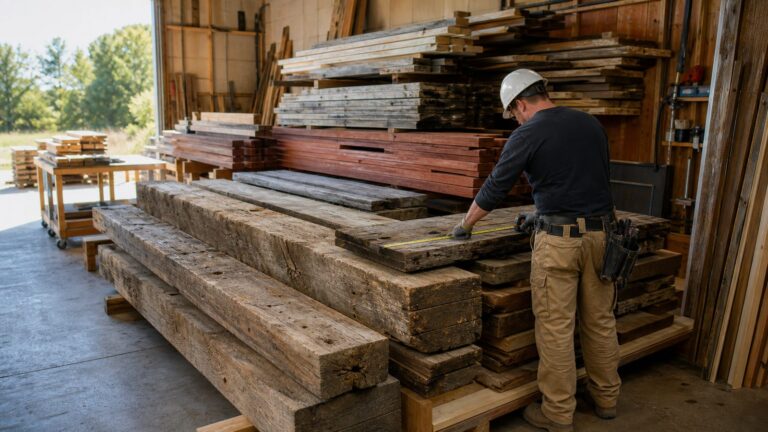
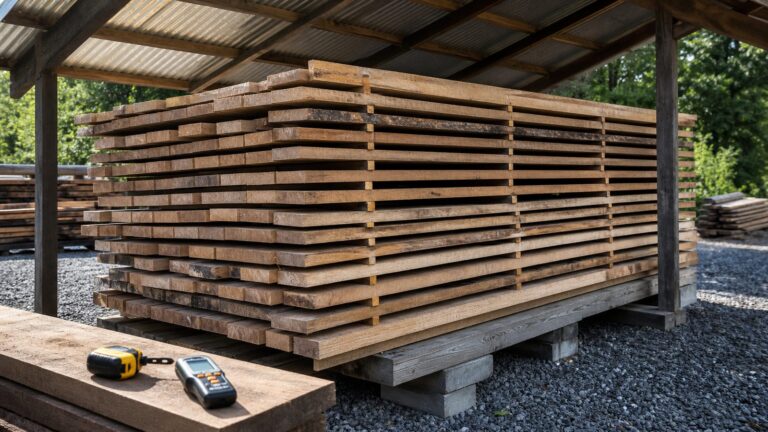
Reduce building material costs by first defining the performance and finish each part of the project must deliver, then checking quantities, design choices, waste, purchasing terms and long-term costs against those requirements. The cheapest item is not a saving if it causes rework, delays, premature replacement or a failure to meet code. There is no universally cheapest material or reliable savings percentage: results depend on the project, location, market, specifications and execution.
Set the quality floor before looking for savings
For each assembly—such as a roof, wall, floor or structural frame—write down the requirements that a material choice must preserve. Depending on the project, these may include structural capacity, weather resistance, fire or acoustic performance, durability, appearance, and applicable code or specification requirements. Distinguish required performance from optional finishes or upgrades so you know what can be reconsidered and what cannot.
As an Amazon Associate I earn from qualifying purchases.
Keep those requirements visible when reviewing estimates, bids and substitutions. Compare like with like: a lower price does not establish equivalent performance. The Whole Building Design Guide (WBDG) advises balancing scope, desired quality and budget throughout a project rather than managing price in isolation. Its cost-management guidance was reviewed or updated May 14, 2026: Utilize Cost and Value Engineering Throughout the Project Life Cycle.
The Tool Desk
Outbyte PC Repair FREERepair Windows errors before they cause bigger problemsFix Now →Outbyte Driver Updater FREEFix the driver behind crashes, sound loss and screen glitchesFind Drivers →Ask the project’s designer, engineer, contractor or inspector to review any proposed change that could affect safety, compliance or the intended performance. Do not make structural changes by simply relaxing a load, factor or deflection limit: engineering assumptions need to remain consistent and be coordinated with the client and supply chain.
#1 Best Overall

- ★ HIGH ACCURACY & UNIT SWITCHABLE ★ With unique 2 Bubble Levels, providing more precise measurement compared to one bubble;With laser precision technology, accuracy ups to ±1/16inch, measuring distance extends to 165 feet; Switchable among M/In/Ft for free adjustment
- ★ LCD BACKLIGHT & MUTE SETTING ★ Large backlight screen provides you with a better visibility in dark areas; Mute setting allows you turn on or off the measure beep at your will, suitable for using in library, classroom and other quite places,the laser level is ideal for home, construction and industries, especially in large areas such as rooms, apartments, buildings, real estates, factories, warehouses, etc
- ★ MULTIPLE MEASUREMENT FEATURES ★ Area, distance, length, volume, continuous measurement, Pythagorean method-three points; Addition and subtraction; Low battery indication; 20 groups data memory; Manually delete data; Auto shut down after 150s without any operation to save power
- ★ DURABLE AND HANDY DESIGN ★ IP54 waterproof level and dust-proof function protect the laser distance measure to the maximum extent; Portable size provides a good grip; Wrist strap lets you hold the meter steady and carry easily
- ★ WHAT YOU GET ★ Rockseed Laser Measuring Device 165Ft; 1.5V AAA Batteries; User Manual; Hand Strap; Package Box; (Ideal thanksgiving gifts and christmas gifts for family and friends)All ROCKSEED products are certified by international standards including CE, FCC and ROHS, with an IP54 rating (splash and dust resistant). We provide 2 years of technical support and after-sales service for laser measuring tools in the United States.
A useful starting point is to make a short requirements list for each assembly before asking suppliers for alternatives. One option may look less expensive because it omits a finish, installation component or performance requirement included in another quote. If you identify the non-negotiable requirements first, you can ask whether an alternative meets them rather than asking only whether it costs less. Keep the budget, scope and quality floor together as decisions change; a cost reduction that shifts work elsewhere or removes a necessary function is not a true like-for-like saving.
Check the estimate and material quantities before ordering
An estimate is only as useful as its assumptions. Project size, location, site access, procurement method, specified quality and market conditions can all affect costs and quantities. Request an itemized estimate and check the basis of the numbers against current drawings and verified site conditions.
- Confirm the quantities and units for each material against the current plans, including openings, dimensions and details that affect the takeoff.
- Identify allowances, exclusions, waste factors, delivery charges and any assumptions about access or handling.
- Check that competing bids include the same specification, scope and quantity. If one bidder has priced a different grade, finish, thickness or installation scope, the totals are not directly comparable.
- Resolve drawing or site discrepancies before committing to an order. An inaccurate takeoff can produce both shortages and costly surplus.
Review quantities assembly by assembly instead of relying only on a single total. Trace the estimate back to the relevant drawing dimensions and note any assumptions that are not visible on the plans. For example, a quote may rely on a particular site-access condition or material handling arrangement; if that assumption does not match the site, the price may not describe the work you will actually need. Clarify those points with the estimator or contractor before treating one bid as cheaper.
Recommended Free Tools
Preliminary room or opening measurements can help you check dimensions before requesting quotes, but they do not replace current plans, site verification or a professional takeoff review where one is needed. A laser distance meter is one optional way to take preliminary measurements; it is an aid, not a guarantee of an accurate takeoff. Confirm dimensions against the plans and conditions at the site, and seek professional review when the estimate or project requires it.
When the estimate changes, ask what changed: quantity, specification, delivery, waste allowance or another assumption. This makes it easier to distinguish a genuine saving from a lower figure that simply leaves an item out. Keep the approved drawings and the estimate basis aligned so that later supplier comparisons use the same scope.
Reduce material demand through design and layout
Often the most durable savings come from using less material to achieve the same required result—not from buying a lower-performing product. Review whether dimensions, details and construction methods can be made more efficient while preserving the project’s design and performance requirements.
Use dimensions that make efficient use of stock
Where the design allows, align dimensions with standard material sizes and plan layouts to limit awkward cuts and offcuts. Standardization can improve utilization, but it should fit the design; forcing an unsuitable detail to match a stock size can create problems elsewhere.
Rank #2

- ACCURATE: This laser measuring tool features long range measuring with extreme accuracy. It measures distances up to 100 feet to within 1/16 inch, in meters, feet, inches, with fractions or decimals
- EASY-TO-USE: This laser measure features a simple, user-friendly layout with two-button operation: one for measuring, one for rounding
- CLASS II LASER: Specs for this laser distance measuring tool are 635 nm; <1 mW
- PORTABLE: This compact laser measurement tool is easy to carry and fits in your pocket
- DISPLAY: BOSCH Blaze laser measure features a backlit display with large icons that allows measurements to be easily read, even in dark areas. It is brighter than its predecessor, the GLM20
Look at the layout as a whole rather than optimizing one cut in isolation. A dimension that reduces scrap in one area may increase it in another or complicate the assembly. Review how stock lengths, sheet sizes or component dimensions fit the actual drawings and construction sequence. The aim is to make efficient use of material without introducing an unsuitable detail or compromising the desired appearance or performance.
Revisit assumptions with the right people
The Institution of Structural Engineers recommends revisiting design assumptions and improving material utilization. Changes that affect structural assumptions or limits require consistent application and agreement with the client and supply chain. Its guidance on minimizing waste in design and construction was published October 16, 2019: Minimising waste in design and construction.
This is not a reason to make informal engineering changes to save material. If an assumption or limit is being reconsidered, the people responsible for the design need to review it, and the agreed approach must carry through the project and supply chain. Do not let separate bids or trades work from conflicting assumptions about the same structural requirement.
Coordinate modular dimensions and prefabrication
Where appropriate, modular dimensions, efficient framing or prefabricated components can reduce cutting, offcuts and on-site handling. Consider them early enough to coordinate with the design, suppliers and construction sequence. They are not automatic savings: suitability, availability, delivery and the work required to integrate them all matter.
What’s actually slowing this PC down?
Pick the symptom - the matching free tool is one click away.
Ask whether a proposed method actually fits the project’s dimensions and procurement plan. A component that reduces on-site cutting may still require different coordination or delivery arrangements. Check that its dimensions and required performance match the design, and consider the full work of getting it to the site and integrating it. The comparison should be between complete, suitable approaches—not an isolated material price.
The EPA’s guidance on source reduction describes measures such as optimizing design and cutting practices to reduce scrap: Onsite Source Reduction: Cutting the Scrap. The AIA’s economy framework likewise treats design decisions as a way to use resources efficiently: Design for Economy—AIA Framework for Design Excellence.
Prevent waste during purchasing and construction
Material that is damaged, lost, cut unnecessarily or ordered too early can erase a low unit price. Treat waste prevention as part of the material plan, not a cleanup task after construction.
Rank #3

- POCKET-SIZED LASER MEASURE: This laser distance measure fits into a pocket or tool belt, and the blaze pro measurer still has 165 ft. range, a backlit display, multiple measuring features and a 10-measurement storage capability
- EASY-TO-READ BACKLIT DISPLAY: This laser distance meter illuminates numbers with distinct resolution, allowing work in low-light or no-light conditions
- DEFAULT REAL-TIME MEASUREMENT MODE: This laser distance measuring tool immediately provides accurate measurement that automatically adjusts closer to or farther from the target
- ADD/SUBTRACT MEASUREMENTS: This laser measurement tool allows the user to add or subtract measurements
- MULTIPLE MEASURING FEATURES: BOSCH Blaze laser measure calculates distance, square footage, volume and indirect measurements
- Plan cuts before work begins. Review cutting layouts and identify suitable offcuts that can be used elsewhere in the project. Keep reused pieces appropriate to their new application.
- Sequence orders and deliveries. Match deliveries to the construction schedule so stock is not exposed to weather, damaged by handling or left obstructing the site. Just-in-time ordering can reduce storage and damage, but delivery timing must still protect the work from shortages or disruption.
- Protect materials and completed work. Coordinate trades and storage so materials are less likely to be damaged or require rework.
- Ask about packaging and surplus before ordering. Check whether packaging can be reduced and whether the supplier accepts returns or takeback of unused material. Do not assume return terms exist; confirm them in advance.
- Track what is actually used. Comparing actual use with the takeoff can reveal avoidable waste or an estimate assumption that needs correcting on future orders.
The AIA’s resources framework recommends estimating expected construction waste, using just-in-time ordering, reducing packaging and reusing offcuts: Design for Resources—AIA Framework for Design Excellence.
Crashes, No Sound, or Screen Glitches?
Random freezes, missing sound and display glitches usually trace back to one bad driver. Find and replace yours safely.Free scan · under a minutePC Slower Than It Used to Be?
A free scan shows the junk files, broken settings and background clutter dragging Windows down - then fixes them in one click.Free scan · Windows 10 & 11Make waste planning specific to the work. Identify which offcuts are suitable for reuse and where they may be needed, rather than assuming every leftover piece can be used. Coordinate delivery timing with the people handling and installing the material so stock is not placed in the way or left exposed before it is needed. If a delivery schedule or return arrangement is important to the budget, confirm it with the supplier before the order is placed.
Track surplus and damage as work proceeds. If actual use differs from the takeoff, find out whether the difference came from a plan change, a site condition, cutting practices or an estimate assumption. That review can inform remaining orders and help the team avoid repeating the same waste. It also provides a clearer basis for deciding whether a later purchase needs to be adjusted.
Compare suppliers on landed cost, not just unit price
Request comparable quotes using the same specification, quantity and delivery requirements. A low price per unit can be outweighed by shipping, handling, minimum order quantities, extra waste, a long lead time or restrictive return terms.
| What to compare | Why it matters |
|---|---|
| Specification and performance | Confirms that each quote covers material meeting the same required standard and intended use. |
| Delivered and handled cost | Adds shipping, handling and any site-access costs to the quoted material price. |
| Quantity and expected waste | Shows whether the quote assumes the validated takeoff and a reasonable cutting or waste plan. |
| Availability and lead time | Helps assess whether delivery timing could delay work or force an unplanned substitution. |
| Minimum orders and surplus terms | Reveals whether purchasing needs exceed the project’s requirement and whether unused stock can be returned. |
| Durability and maintenance | Identifies costs that may arise after installation, beyond the initial invoice. |
| Reuse and end-of-life options | Helps account for suitable salvage, reuse or disposal where relevant to the project. |
For a useful comparison, put the quotes beside the same takeoff and list what each supplier includes. Confirm that quoted quantities match the validated requirement and that delivery, handling and any minimum order are clear. If one supplier has stock available sooner, consider whether the timing fits the schedule; if another has a longer lead time, consider whether it could affect the work or increase the risk of an unplanned substitute. Those are project-specific trade-offs, so verify them rather than assuming a unit-price difference tells the whole story.
Quick wins for a faster PC:
Scan for outdated or missing drivers - takes under a minuteDriver Scan →Clear out junk files and repair common Windows errorsFree Scan →Prices, availability and building requirements vary by location and date. The relevant sources establish methods for evaluating costs, not local prices or a single cheapest option; check current supplier quotes and applicable local requirements for your project.
Consider reclaimed or recycled materials only when they fit
Used, salvaged or recycled products may reduce the need to buy new material and may avoid some disposal, but they are conditional options—not guaranteed bargains. Before specifying or purchasing them, verify that the material’s condition, dimensions and performance suit the intended application and that the design and local requirements permit its use.
Rank #4

- ★ HIGH ACCURACY & UNIT SWITCHABLE ★ With unique 2 Bubble Levels, providing more precise measurement compared to one bubble;With laser precision technology, accuracy ups to ±1/16inch, measuring distance extends to 328 feet; Switchable among M/In/Ft for free adjustment
- ★ LCD BACKLIGHT & MUTE SETTING ★ Large backlight screen provides you with a better visibility in dark areas; Mute setting allows you turn on or off the measure beep at your will, suitable for using in library, classroom and other quite places,the laser level is ideal for home, construction and industries, especially in large areas such as rooms, apartments, buildings, real estates, factories, warehouses, etc
- ★ MULTIPLE MEASUREMENT FEATURES ★ Area, distance, length, volume, continuous measurement, Pythagorean method-three points; Addition and subtraction; Low battery indication; 20 groups data memory; Manually delete data; Auto shut down after 150s without any operation to save power
- ★ DURABLE AND HANDY DESIGN ★ IP54 waterproof level and dust-proof function protect the laser distance measure to the maximum extent; Portable size provides a good grip; Wrist strap lets you hold the meter steady and carry easily
- ★ WHAT YOU GET ★ Rockseed Laser Measuring Device 328Ft; 1.5V AAA Batteries; User Manual; Hand Strap; Package Box; (Ideal thanksgiving gifts and christmas gifts for family and friends)All ROCKSEED products are certified by international standards including CE, FCC, and ROHS, with an IP54 rating (splash and dust resistant). We provide 2 years of technical support and after-sales service for laser measuring tools in the United States.
- Inspect condition and establish whether testing, documentation or professional review is needed.
- Confirm that available dimensions and quantities work with the design without creating excessive cutting or rework.
- Check code, specification and approval requirements with the appropriate project professional.
- Verify stock, delivery timing and the cost of transport and handling before relying on availability.
The EPA identifies used and recycled products, source reduction, preservation and reuse as construction and demolition material-management strategies: Best Practices for Reducing, Reusing, and Recycling Construction and Demolition Materials. These strategies do not establish that reclaimed stock will be cheaper for a particular project; condition, inspection, supply and delivery determine whether it is practical.
If reuse may suit the project, involve the designer or contractor early enough to check what kinds of material are acceptable and what evidence or inspection is needed. Then confirm what is actually available and whether its dimensions, quantities and delivery timing fit the job. A local reclaimed-material supplier or salvage exchange may be a place to investigate, but availability and suitability need to be checked for the specific project. Do not design around an unverified source or assume a reclaimed item can replace a specified product without approval.
Compare whole-life cost when alternatives differ
When material options have different service lives or upkeep, compare more than the purchase price. Include installation, expected maintenance, operating impacts such as energy or water use where relevant, replacement cycles and end-of-life costs. A more durable option can offer better value over time while costing more upfront; whether it does depends on the project and the assumptions used.
Write down the comparison period and assumptions so the alternatives are judged consistently. Include anticipated safety and regulatory costs where applicable. The American Society of Civil Engineers’ Policy Statement 451, adopted July 18, 2024, frames lifecycle cost analysis across planning, financing, design, construction, operation, maintenance and decommissioning: Life-cycle cost analysis.
A simple comparison can list the initial material and installation cost alongside expected upkeep, relevant operating impacts, likely replacement needs and end-of-life handling. Use the same period and assumptions for each option. If the service life or maintenance needs are uncertain, make that uncertainty visible rather than treating an estimate as a guarantee. A higher upfront price is not automatically better value, just as the lowest initial price is not automatically the best choice: the result depends on what the project needs and how long the material is expected to serve it.
Keep this analysis proportionate to the decision. If two options have similar service life and upkeep, the initial and delivered costs may be the central comparison. If they differ in durability, maintenance or operating effects, those differences are reasons to consider costs beyond installation. ASCE’s lifecycle framing also includes financing and decommissioning, as well as safety and regulatory costs where anticipated; include the categories that are relevant to the project rather than assuming every comparison has the same cost profile.
A practical decision sequence
- Define the requirements. List required performance, appearance and compliance conditions for each assembly; separate them from optional upgrades.
- Validate the estimate. Check the takeoff, assumptions, allowances and exclusions against current drawings and site conditions.
- Review design efficiency. Look for suitable standard dimensions, efficient layouts, framing or prefabrication options, with necessary design and engineering coordination.
- Plan waste prevention. Set cutting, storage, delivery, protection, offcut reuse and surplus-return plans before materials arrive.
- Compare equivalent purchasing options. Use the same specification and quantity, then compare delivered and handled cost, lead time, minimums and return terms.
- Evaluate conditional alternatives. Check reclaimed or recycled products for condition, dimensions, performance, code acceptance and dependable availability.
- Compare lifetime value where relevant. Add maintenance, operating, replacement and end-of-life costs when service life or upkeep differs.
- Approve changes before committing. Have the appropriate project professional confirm that a substitution or design change preserves safety, code compliance and required performance.
Use the sequence again when the scope, drawings or market conditions change. A revised design can affect quantities; a changed delivery plan can affect storage and handling; a material substitution can affect performance or code acceptance. Recheck the relevant assumptions before approving a new order rather than relying on an earlier comparison that no longer matches the work.
Best Value

- 4× Brighter Green-Beam Laser - Experience a laser dot 4x brighter than standard red laser. Powered by Green-beam Laser Measure Technology, S50 enhances targeting convenience for long-range measurements, particularly in outdoor conditions.
- Consistent Precision, Hyper Speed — Powered by MILESEEY PowerBurst Technology, the S50 delivers stable, high-precision measurements up to 400 ft (120 m), performing reliably in dust, mist, high&low temperature, or on low-reflective surfaces. Measures up to 8 times per second for fast, precise, and dependable results.
- Advanced P2P Technology & 18 Modes - Handle any scenario with 18 intelligent modes, covering area, volume, and other indirect measurements without the hassle of switching tools. The Point-to-Point (P2P) mode lets you measure between any two points from a single location with ease and precision.
- 4 References & 8 Units - Flexible measuring made simple—switch between 4 references (front, back, tripod, side-laser) and 8 units (ft, 0'00'' 1/32, 0'00'' 1/16, in1/32, in1/16, cm, m) with ease. The Red Side-Laser Alignment projects marking visible at 1m, helping you align, layout, and set up faster and more accurately.
- 2.4" IPS Backlit Display - Bright, high-resolution screen with switchable black/white background adapts to lighting conditions for crystal-clear readings in both sunlight and low light.
Frequently asked questions
How can I reduce building material costs without lowering quality?
Define the required performance and finish first. Then validate quantities, review design and layout for efficient material use, prevent avoidable waste, compare supplier quotes on the same specification and consider whole-life costs when options differ in durability or upkeep. Have appropriate project professionals review changes that could affect safety, compliance or performance.
Is the cheapest building material always the best value?
No. A low unit price may not include the same specification, delivery, handling or quantity as another quote, and it does not account for installation, maintenance, replacement or end-of-life costs. Compare equivalent options and include the costs relevant to the project.
Can reclaimed or recycled materials save money?
They may reduce the need for new purchases or disposal, but they are not guaranteed to cost less. Check condition, dimensions, performance, code and specification acceptance, quantity, availability, inspection needs and delivery costs before relying on them.
Free tools Windows power users keep installed
One-click scans. No signup required.
How do I check that a material quote is comparable?
Confirm that quotes use the same required specification, quantity and scope. Check what is included or excluded, including delivery, handling, minimum orders, expected waste and return terms. Also compare availability and lead time, since timing can affect whether the material fits the construction schedule.
Can I use a laser distance meter to estimate material quantities?
A laser distance meter can help with preliminary room or opening measurements, but it does not prove that a takeoff is accurate. Check dimensions against current plans and site conditions, and get a professional takeoff review when the project requires one.
How much can I expect to save?
There is no general savings percentage supported for every project. Results depend on scope, location, market conditions, specifications, procurement and execution. Validate the project’s quantities and compare actual, equivalent options rather than relying on a generic savings promise.
The Bottom Line
Bottom line: Protect the project’s required performance first, then look for savings in validated quantities, efficient design, reduced waste, comparable supplier quotes and whole-life value. Treat substitutions and reclaimed materials as options to verify—not shortcuts—and get appropriate professional approval before changing anything that affects safety, compliance or performance.
Quick Recap
Product prices and availability are accurate as of the date/time indicated and are subject to change. Any price and availability information displayed on Amazon at the time of purchase will apply.