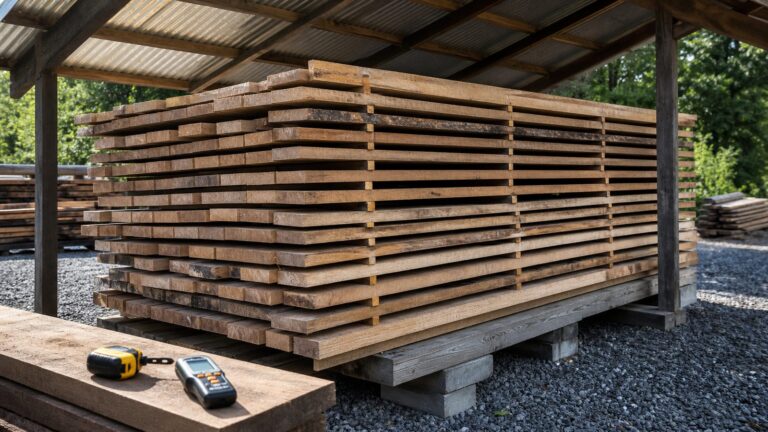
Choose materials by comparing functionally equivalent options across the whole life cycle, not by relying on a material label or a production-stage carbon figure. First reduce demand by retaining or adapting what can be reused; then assess products against the project’s performance needs, representative data, transport, construction, operation, replacement and end-of-life assumptions. Report each building and shared system distinctly, and check the rules that apply in the project’s jurisdiction.
What makes a material choice sustainable at masterplan scale?
For a large mixed-use development, a material choice is only meaningful in relation to the service it must provide and the project boundary used to assess it. A structural product, façade assembly or interior finish cannot be judged fairly by a single product number if the alternatives have different quantities, performance, service life, maintenance needs or replacement cycles.
As an Amazon Associate I earn from qualifying purchases.
Whole-life assessment matters because impacts arise at several stages: product manufacture and transport; construction, including delivery and wastage; building operation; maintenance and replacement; and demolition, reuse, recycling or disposal. A low production-stage footprint is not automatically a lower whole-life result if the alternative requires more material, is replaced more often, changes operational energy needs or has a different end-of-life outcome.
Recommended Free Tools
For a mixed-use masterplan, the boundary also matters. Residential, retail, office, hospitality and civic buildings may have different functions and operating requirements. Shared energy facilities, site infrastructure and external works can make material contributions that disappear from view if the assessment reports only a combined total or only individual buildings. Define what is included, then show project totals and asset-level results in a way that lets decision-makers see both.
#1 Best Overall

- Valued Carpenter Pencil Set: You will get 2 pcs solid carpenter pencils with 26 piece 2.8 mm refills, 1 replaceable sharpener, 1 plastic storage box.The complete carpenter pencils combination allows you to finish your work faster and more easily
- Deep Hole Marker Pencil: The deep-hole construction pencils adopts 45mm elongated tip design, which is more convenient to mark in the small hole or in other tight areas that other carpenter markers cannot reach
- Carpenter Pencils with Sharpener: The sharpener is screwed into the top of the work pencil, which won't get lost either. Built-in pencil sharpener that keep the lead with pointed and smooth to Improves line of sight in fine work
- Stronger Solid Lead: This work pencil is matched with a 2.8 mm thick lead , which is much thicker and stronger during the drawing process of construction work, it will not break or damage easily
- Marks on Various Surfaces: 3 colors solid construction pencil can marks on various surfaces,such as metal, plastic, wood, paper etc. Ideals for woodworkers, contractors, craftsmen, builders, merchants and masons
There is no universal ranking that makes timber, concrete, steel or another material the sustainable choice in every project. The defensible choice is the option that meets the project’s requirements and performs well under a consistent, adequately evidenced whole-life comparison.
How to choose materials: a project sequence
- Set the brief and assessment boundary. Record each use, expected service life, structural and fire requirements, acoustic and thermal needs, maintenance strategy, accessibility needs and applicable planning or building-code requirements. Define the buildings, shared energy facilities, site works and off-site enabling works included in the assessment.
- Reduce demand before choosing substitutes. Check whether existing assets can be retained, adapted, repurposed or converted. Review layouts, spans, structural grids and façade design for opportunities to meet the same function with less new material, without compromising safety or performance.
- Compare equivalent services. Set the functional unit and compare options that provide the same required service over the assumed service life. Keep quantities, replacement assumptions and life-cycle boundaries consistent.
- Use the most representative evidence available. Prefer data for the specified product and its supply context when available. Where it is not, use a relevant regional collective or generic dataset, disclose any proxy and adjustment, and show the resulting uncertainty.
- Assess delivery and the full life cycle. Include quantities, transport, construction-stage effects and wastage, use and replacement assumptions, and end-of-life scenarios. Improve the assumptions as design and procurement become more specific.
- Report buildings and shared systems distinctly. Present the masterplan total and external works at project scale while separately reporting each building and district facility at asset level.
- Confirm local rules and targets. Check national regulation, planning requirements, client targets and the scope of any certification or assessment used for the actual project.
1. Set a boundary that reflects the whole development
Define what the assessment covers
Before comparing materials, agree what is inside the assessment. At a minimum, identify the assets and shared elements under consideration, the life-cycle stages included, the assumed service life and how external works are treated. Clarify whether shared facilities, such as an energy centre, are assessed as district assets, allocated to buildings or both for distinct reporting purposes. The method should make that treatment visible rather than silently shifting impacts between assets.
RICS masterplan guidance calls for reporting that distinguishes total project emissions and external works from individual buildings and district facilities. Use that distinction to answer two different questions: what is the overall masterplan impact, and how do the component assets compare? A single total can conceal variation; a set of building-only figures can omit shared infrastructure. Both views are useful when their boundaries are explicit.
Set requirements before looking for a preferred material
For every major element, establish the service it must deliver. A structural system, for example, is constrained by the building’s function, spans, fire and acoustic requirements, and expected durability; a façade must satisfy the project’s thermal, acoustic, safety and maintenance needs. The relevant requirements depend on the building and local rules, so they should be defined by the project team rather than assumed from a generic material comparison.
Include accessibility, maintenance and replacement planning in the brief. An option that is not functionally equivalent is not a valid direct substitute, even if its product-stage environmental figure appears lower. The comparison should describe the same service, quantities and time horizon for each alternative.
2. Reduce new material demand before substituting products
Test retention, adaptation and conversion
Start by asking whether the project needs to demolish or build new at all, and whether existing assets can be retained, adapted, repurposed or converted. The European Commission’s March 2026 guidance identifies renovation, repurposing and conversion as demand-side measures and highlights reducing unnecessary demolition and demand for new materials as routes to lower emissions.
This is a direction to assess, not a guarantee that reuse is optimal in every case. Compare the project-specific whole-life consequences, including the required performance, the work needed to adapt the asset and the impacts of any remaining construction. Do not treat reuse as automatically preferable without examining what the actual project entails.
PC Slower Than It Used to Be?
A free scan shows the junk files, broken settings and background clutter dragging Windows down - then fixes them in one click.Free scan · Windows 10 & 11Outdated Drivers Are Slowing You Down
One free scan finds every outdated or missing driver and matches the right update for your exact hardware.Free scan · exact hardware matchRank #2

- Ergonomically Designed: Work in tight areas with a compact design that gets into tough spots
- Compact and Lightweight: Both tools are designed to fit into difficult to reach spaces. The 1/4" impact driver has a length of 5.55 in. and weighs just 2.8 lbs, while the 1/2" drill/driver measures only 7.5 in. and weighs 3.6 lbs
- Both the DEWALT impact driver and electric drill driver feature integrated LED work lights with a convenient 20-second delay, ensuring enhanced visibility in dimly lit or challenging work areas
- One-Handed Loading - Keep one hand free with a 1/4 in. hex chuck that accepts 1 in. bit tips
- Power drill cordless with 1/2" single sleeve ratcheting chuck provides tight bit gripping strength, making bit changes faster and more secure
Review design choices that drive quantities
Once the functional brief is clear, examine the layout, spans, structural grid and façade design for ways to meet it with less material. This is a demand-reduction question, not just a product-selection question: a product with favorable data may still lead to a higher project impact if the design requires substantially more of it. Estimate quantities consistently and revisit them as the design develops.
Keep the material decision connected to the building’s use. The same development can contain different asset types with different functions and requirements; a decision made for one building should not be copied across the masterplan without checking equivalence. Report asset-level results so the effect of design changes can be seen where it occurs.
3. Compare options that provide the same service
Fix the comparison before reviewing results
For each decision, document the functional unit, quantities, assumed service life, replacement frequency, included life-cycle stages and end-of-life scenarios. Apply the same assumptions to each candidate. If one option is assessed over a different period, with different quantities or with different boundaries, the resulting figures do not provide a like-for-like comparison.
Include operational energy as well as embodied impacts where the assessment covers both. The Commission defines a building’s global warming potential as its contribution to greenhouse gas emissions over its whole life cycle, including operational and embodied emissions. Product manufacture alone cannot tell the project team whether an option leads to a better whole-building outcome.
What’s actually slowing this PC down?
Pick the symptom - the matching free tool is one click away.
Use a consistent set of comparison axes
When credible alternatives are available, compare them against the same questions rather than choosing the option with the most attractive single figure. Consider whole-life carbon under consistent system boundaries; whether the environmental data represents the specified product, technology and geography; expected service life, maintenance and replacement; transport and construction-stage impacts; and the end-of-life scenario, including any assumed reuse, recycling or disposal. Finally, check that each candidate meets the project’s local performance requirements.
This set of axes helps explain why a comparison can be inconclusive. One candidate may have more representative product data while another has a different replacement assumption; a result may also shift when quantities or end-of-life scenarios change. Record those distinctions instead of forcing an overall winner where the evidence does not support one. The reviewed guidance supports a method for comparing real alternatives, not a universal ranking of material types.
Consider more than the product’s factory-stage figure
Track impacts from product manufacture and transport through construction, use, replacement and end of life. Transport and construction effects—including wastage—belong in the project assessment, not in an unexamined footnote. During use, account for maintenance and replacements under the stated assumptions. At end of life, be clear about whether the scenario assumes reuse, recycling or disposal rather than treating recovery as certain without evidence.
Rank #3

- 【Great Compatibility】This Katerk 1/4 inch hex shank bit holder is specifically designed for 1/4 inch hex shank drill bits. It's compatible with most 1/4 fast hex handles, hex sockets, various electric screwdrivers, and handheld screwdrivers. The bit holder makes it a valuable addition for any handyman.
- 【Secure and Safe】Built with a secure backup nut design, each drill bit holder securely locks onto your bits, ensuring they stay firmly in place. Additionally, our bit holder incorporates a high-quality steel ball rolling design that holds up to several kilograms of weight, ensuring your various drill bits don't fall off.
- 【Easy One-Handed Operation】The bit holder for impact driver allows you to change bits single-handedly, simplifying your workflow. Its multi-color design further allows for quick identification of the drill bit you need.
- 【Compact and Convenient】Thanks to its compact size, this 1/4 inch bit holder is easy to carry around. The bit holder allows for easy attachment to various tools, making this a convenient addition to your construction accessories. The Katerk bit holder is cast from high-quality alloy material, promising a long product lifespan. Despite its rugged strength, the bit holder remains lightweight, making it portable.
- 【Cool Christmas Gift For Men Stocking Stuffers】 This screwdriver bit holder, driver bit holder, impact bit holder, can be given as a gift to your loved one, especially for anyone involved in construction or electrical work. It's a must-have for stocking stuffers for men and women, tools gifts for dad, tech gadgets for men, gifts for dad, gifts for him, gifts for husband, gifts for boyfriend, cool gadgets for men, and cool gifts for dad.
As design and procurement mature, update estimated quantities and generic values with measured or actual quantities and more specific data when available. RICS guidance says data and scenarios should reflect the project phase; early estimates should not be presented with the confidence of later, project-specific information.
4. Judge the quality and fit of environmental data
Prefer representative data, not just a precise-looking number
A carbon figure is evidence with a confidence level, not a universal property of a material. RICS identifies geographical, technological and temporal representativeness, as well as verification, as relevant data-quality considerations. A figure for a different production technology, region or period may be a poor stand-in for the product and supply chain actually specified.
As design progresses, aim for data that represents the actual product and supply. RICS identifies manufacturer-specific data as the normal aim in later stages. If that information is unavailable, a relevant regional collective environmental product declaration (EPD) or generic dataset can be used. A proxy from a different manufacturer should carry lower confidence, and the proxy choice and any adjustment should be disclosed.
Make uncertainty visible in decisions
Record the source and type of data used for each option, how well it represents the geography and technology, whether it is current and verified, and any adjustments made. Distinguish product-specific evidence from collective or generic data in the comparison. Where uncertainty could change the ranking, say so plainly and identify the assumption that needs better evidence as the design or procurement decision advances.
This is especially important when options appear close. A small difference between two headline figures may not be meaningful if one is based on a specific product and the other on a weak proxy, or if their service-life and replacement assumptions differ. The answer is not to hide the uncertainty, but to explain how it affects confidence in the decision.
Do these 3 things before closing this tab:
1Scan for outdated or missing drivers - takes under a minute2Repair Windows errors before they cause bigger problems3Fix the driver behind crashes, sound loss and screen glitches5. Report results so the masterplan can be managed
Report total project emissions and external works at masterplan scale, and show each building and district facility separately at asset level. Include the boundary and the treatment of shared systems so readers can understand what is included and avoid interpreting totals as directly comparable when their scope differs.
Asset-level reporting makes the mixed-use character of a development visible. It allows decision-makers to distinguish the results for residential, retail, office, hospitality or civic components rather than allowing one asset’s profile to stand in for all. Keep shared energy facilities and other district systems visible as well, particularly where their impacts may otherwise be absorbed into a masterplan total.
Rank #4

- Long Nib and Deep Hole Marker: Our mechanical carpenter pencil with 45mm nib is designed for easy marking of deep holes or narrow areas. These construction pencils are the great choice for woodworking tools, construction tools, carpenter tools, contractor tools, wood carpentry tools and architect tools
- Extra Refills in 2 Colors for Versatile Marking: The construction mechanical pencil comes with 12 extra 2.8mm refills, including 6 red and 6 black refills. The black refill is suitable for light surfaces, while the red wax is perfect for dark surfaces. Our carpenter mechanical pencil makes sure that you'll have an ample supply for extended use
- Built-in Sharpener: Our construction pencil comes with a built-in sharpener to ensure the mechanical pencil tip is always sharp and ready for use. Never buy an extra pencil sharpener again. A great tool for any woodworker pencil, contractor pencils. The refill can easily be extended or retracted with a simple click of the pencils mechanical, allowing you to work more efficiently and accurately
- Portable Clip Design: Our deep hole construction pencil features a portable clip design, easy to carry and attach to your pocket or tool box, so that you can keep the carpenter pencils mechanical close at hand, making it a convenient tool to have on the go. Great gifts choice for carpenters
- Stronger Pencil Lead: The black refills are made of lead, sturdy and smooth. The red refills are made of wax, clear and light. These marking pencils are much thicker and stronger than normal pencils during the marking process of construction work, suitable for various surfaces, such as glasses, metal, boards, floors, walls, furniture, etc. The written marks can be easily wiped with a wet paper towel when needed
Maintain a record of assumptions alongside the results: quantities, data sources, proxy adjustments, life-cycle coverage, replacement and end-of-life scenarios, and the project phase at which values were estimated. Update those assumptions as the design, specification and procurement evidence improve. This makes a comparison useful for decisions rather than simply a number attached to an early design.
Independent reader supportYour contribution helps us test, update, and keep practical guides available for everyone.6. Check regulations and targets for the project’s jurisdiction
EU buildings
The European Commission’s current EPBD summary gives a staged timetable for life-cycle global warming potential disclosure: the requirement applies to new buildings over 1,000 m² from 2028 and to all new buildings from 2030. The Commission also says member states must publish roadmaps for introducing life-cycle GWP limits by 2027. These dates describe EU requirements; they are not a universal rule for projects elsewhere. Confirm national implementation and calculation rules for the specific project.
UK infrastructure and built-environment practice
NISTA’s March 2026 Whole Life Carbon Management guidance supports good practice in line with PAS 2080:2023 for UK infrastructure and the built environment. Check the project’s applicable requirements and the scope of any client target or certification separately; a method or target used in one jurisdiction or contract does not automatically govern another project.
Other locations and project-specific requirements
For projects outside the EU, do not apply the EU timetable as though it were local law. Check the relevant national planning, building-regulation and disclosure requirements, along with client commitments and any specified certification scope. Where the project team reports against more than one framework, state which boundary and calculation rules belong to each result.
What the wider building context says—and does not say
The European Commission’s 2026 building-stock page attributes 18% of total whole-life-cycle emissions from the EU building stock to new construction, while new construction represents 1% of total floor area. The same page attributes 40% of waste generated in the EU to construction and demolition waste. The underlying reference year for those shares is not specified on the page, so they are useful as broad context rather than a project-level estimate.
In a March 2026 announcement, the Commission also described about 50% of total EU greenhouse gas emissions as linked to the building stock, explicitly as a general estimate. That broad figure should not be interpreted as the expected share for an individual development or as a material-specific comparison. These EU-wide figures explain why whole-life assessment and demand reduction matter; the project decision still depends on its own requirements, quantities, data and boundaries.
Free tools Windows power users keep installed
One-click scans. No signup required.
A practical checklist for a material decision
- Is there an existing asset that can be retained, adapted, repurposed or converted?
- Does the option meet the same structural, fire, acoustic, thermal, maintenance, accessibility and functional requirements as the alternative?
- Are the functional unit, quantities, service life, replacement assumptions and life-cycle boundaries consistent across options?
- Does the assessment include transport, construction and wastage, operation, replacement and end-of-life scenarios where relevant to its scope?
- Does the data represent the specified product, technology, geography and time period, and is its verification status clear?
- Are generic or proxy values identified, with adjustments and uncertainty disclosed?
- Are masterplan totals, external works, individual buildings and district facilities reported distinctly?
- Have local rules, planning requirements, client targets and certification scope been confirmed for this project?
Use the checklist as a record of the decision, not just a final approval gate. For an early design choice, document what is known, which values are estimates, and what information should be improved before specification or procurement. Later, revisit the same questions with more specific product and supply data and measured or actual quantities where available. This keeps the comparison aligned with the project phase and makes it easier to see whether a change in ranking reflects a real design improvement or simply better evidence.
Best Value

- Milwaukee Ink all Fine Point Marker, Black, 4 Per Pack
- 4 per pack Features Clog Resistant Marker Tip Writes through Dusty, Wet and Oily Surfaces Durable Marker Tip for Writing on Concrete, OSB and Rough Surfaces
- Clog resistant tip writes on dusty, wet and oily surfaces and is optimized for rough surfaces such as OSB, cinderblock and concrete
- Hard hat clip- attaches for easy access
- Quick dry time with reduced smearing and marking
Conclusion
The soundest material choice is the one that meets the actual building function and performs well across a consistently assessed whole life, with evidence representative enough to support the confidence claimed. For a mixed-use masterplan, that means reducing unnecessary demand first, comparing equivalent services, including delivery and end-of-life effects, and keeping project totals distinct from asset-level results. Treat material labels and isolated product-stage figures as starting points for assessment—not as verdicts.
Frequently Asked Questions
Is one material type always the most sustainable choice for a mixed-use development?
No. The reviewed guidance does not support a universal ranking of timber, concrete, steel or other materials. Compare functionally equivalent options using consistent quantities, service-life assumptions, life-cycle boundaries and representative data, then assess the project-specific result.
What should a whole-life materials comparison include?
Include product manufacture and transport, construction-stage impacts and wastage, operational impacts where the assessment covers them, maintenance and replacement, and end-of-life scenarios. Keep the boundary and assumptions consistent across alternatives.
The Tool Desk
Outbyte PC Repair FREEClear out junk files and repair common Windows errorsFree Scan →Outbyte Driver Updater FREEScan for outdated or missing drivers - takes under a minuteDriver Scan →What if product-specific environmental data is not available?
Use an appropriate regional collective EPD or generic dataset when suitable, and disclose its source, representativeness, adjustments and uncertainty. A proxy from another manufacturer should be treated with lower confidence than data for the specified product and supply.
Should an existing building always be retained instead of demolished?
Not automatically. Test whether assets can be retained, adapted, repurposed or converted, then compare the project-specific whole-life consequences, including the work needed to achieve required performance and any remaining construction.
When do EU life-cycle GWP disclosure requirements apply to new buildings?
The European Commission’s current EPBD summary says disclosure applies to new buildings over 1,000 m² from 2028 and all new buildings from 2030. It also says member states must publish roadmaps for introducing limits by 2027. Confirm national implementation and calculation rules; these dates are EU requirements, not universal rules.
How should a large mixed-use project report its results?
Show total project emissions and external works at masterplan scale, while separately reporting each building and district facility at asset level. Make the treatment of shared systems clear so totals and component results can be understood together.
Quick Recap
Product prices and availability are accurate as of the date/time indicated and are subject to change. Any price and availability information displayed on Amazon at the time of purchase will apply.