A stair lift carries one seated person along a staircase; a home elevator carries people between floors in an elevator car. The right choice depends on the intended user’s mobility and ability to transfer, the home’s layout, the installation work, and the ongoing service obligations—not on a universal claim that one option is safer or cheaper. Start by assessing the person’s needs and the house, then compare written, site-specific proposals.
How the two options differ
These are separate equipment categories, not two versions of the same solution. The U.S. Access Board identifies private residence elevators and private residence inclined stairway chairlifts separately in its accessibility standards material. A stair lift follows the stairs and transports a rider on a seat. An elevator provides between-floor travel in a car. The distinction matters because each requires a different kind of user transfer, installation space, building work, and maintenance plan.
As an Amazon Associate I earn from qualifying purchases.
It helps to frame the decision around two separate questions: can the intended user use the equipment as proposed, and can the equipment be installed appropriately in this particular house? A device that appears to solve the travel problem may not fit the person’s routine, while a device that seems suitable for the person may require building work the house cannot accommodate. Neither product category, by itself, answers both questions.
Free tools Windows power users keep installed
One-click scans. No signup required.
Stair lift: seated travel along the stairs
A stair lift is worth investigating when the person can get onto and off its seat safely, remain seated during travel, and use the controls or receive the assistance they need. Think through the whole trip, not only the ride: getting to the seat, transferring, positioning any mobility aids, fastening any restraint provided, and getting off at the destination are all part of the use case. The cited standards material does not assess an individual’s medical condition or determine whether a transfer is safe for them; ask an appropriate mobility or health professional when that is uncertain.
#1 Best Overall

- Battery Powered
- Self Installable - 15ft. of track included
- 350 lb Maximum Weight Capacity
- Safety Features: Swivel Seat Flip-Up Seat and Armrests, Footrest Safety Sensor
- Wireless Call Stations at Both Top and Bottom of Your Stairs
Consider what happens at both ends of the trip. The person needs a workable way to approach the seat, transfer onto it, ride, and get off at the destination. Ask whether help from another household member is expected and whether that help will reliably be available whenever the person needs to use the stairs. If the user has difficulty with the transfer, balance, positioning, or remaining seated, do not treat the existence of a stair lift as evidence that those needs are resolved.
The equipment is installed along a suitable stairway. A site visit is necessary to determine whether the particular stairs and surrounding space can accommodate it, and what effect the installation has on access to the stairs. Do not assume that a product description or photograph proves a specific staircase will fit.
Home elevator: travel between floors in a car
A home elevator may be a better fit to investigate when the user cannot or should not transfer to a stairway seat, or when a household needs travel between floors in an elevator car. Suitability still depends on the elevator’s actual configuration and the user’s needs. Ask the installer to verify the car dimensions, door and entry arrangement, controls, and whether the person’s mobility equipment can be accommodated; do not infer those details from the word “elevator.”
Describe the user’s actual travel needs rather than asking only whether an elevator is “accessible.” The relevant details include who will ride, what mobility equipment or belongings need to travel, how the user will approach and enter the car, and how they will exit at each floor. Ask the installer to document the proposed clear space and entry arrangement so the household can judge that configuration against its needs.
An elevator needs a suitable location and an installation designed for the house. Depending on the proposed system and building, work may involve a runway or hoistway and structural changes. The exact scope cannot be established without a site assessment. The proposal should describe both the equipment and any building, electrical, permitting, and inspection work needed for that particular installation.
Compare the choices against your actual needs
| Decision point | Stair lift | Home elevator |
|---|---|---|
| How travel happens | The rider sits on a seat and travels along the stairs. | The user travels between floors in an elevator car. |
| User assessment | Confirm the user can manage the necessary transfer onto and off the seat and the seated ride. | Confirm the car configuration and entry work for the user and any mobility equipment. |
| Home fit | Requires a suitable staircase and installation along it; the installer must measure the site. | Requires an appropriate location and elevator installation; a runway or hoistway and structural work may be involved. |
| Installation proposal | Ask for site-specific installation details and how stair access is affected during use. | Ask for equipment, building work, electrical needs, permits, and inspection scope. |
| Ongoing ownership | Confirm maintenance, service, warranty, and parts availability. | Confirm maintenance, service, warranty, parts availability, and emergency procedures. |
| Price evidence available here | AARP gave a historical example of about $2,200 for a straight-run stair lift including the lift and installation in 2015. It is not a current quote or a general price. | No current, comparable elevator price is established by the cited sources. |
| Rules to check | Confirm the requirements for the specific home and jurisdiction. Access Board material references standards for lifts in covered contexts. | Confirm the requirements for the specific home and jurisdiction. Access Board material discusses private residence elevators in specified covered dwelling contexts. |
This table is a screening framework, not a substitute for a mobility assessment, measured site visit, engineering review, local code check, or installer quote. Neither option can be declared universally safer, cheaper, or more suitable from the available evidence.
Use the comparison to identify questions and gaps, rather than to award an automatic win to one category. A stair lift’s use of the existing stair route does not establish that it is suitable for a given user or that installation will be straightforward. Likewise, an elevator’s car does not guarantee that the user, mobility equipment, and household routine will be accommodated. The details of the person, house, installation, and service proposal decide whether either option is workable.
Quick wins for a faster PC:
Scan for outdated or missing drivers - takes under a minuteDriver Scan →Repair Windows errors before they cause bigger problemsFix Now →Fix the driver behind crashes, sound loss and screen glitchesFind Drivers →Which option may fit different household situations?
Consider a stair lift when the seat and transfer are workable
If the person can safely make the required transfer and travel seated, and an installer confirms the stairs can accommodate the equipment, a stair lift may address the specific problem of getting between floors without requiring an elevator installation. Verify how the person will reach and leave the seat at both ends, what help they need, and how the stairs remain usable for other household members. A stair lift is not an answer to a transfer problem merely because it follows the existing stairs.
Ask the provider to explain what the installation means for access to the stairway, both while the equipment is in use and as part of everyday household traffic. The route is shared space in many homes, so consider how other people will use the stairs and how the rider will reach the seat at each end. Have those site-specific points addressed in the proposal instead of assuming that a stair lift leaves every stairway equally usable.
Rank #2
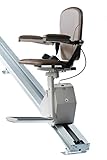
- Made in America! 3 Safety Mechanisms. Wireless Remote. 350lb Capacity. Warranty
- Folds up flat to wall - easy to still use the stairs! Installs on either side of stairs.
- Comes with 15 Feet of Track - Plenty for typical one-floor installations.
- Power Cord plugs directly into your regular AC outlet - NO Wiring required.
- Internal Rechargeable Battery Backup- runs up/down 20+ times if power is out
Investigate an elevator when a stairway chair is not appropriate
If transferring to a seat is not workable, ask a qualified elevator installer to assess whether a car-based system can meet the user’s needs and fit the house. This is an investigation, not an assumption that an elevator will accommodate every wheelchair, mobility aid, or household layout. Request measurements and a description of the proposed entry, controls, and usable car space.
Because an elevator may involve a dedicated location, runway or hoistway, and structural work, ask early whether the proposed location is feasible and what construction it entails. A broad statement that an elevator can be installed in a home is not a site assessment. Request a description of anticipated work and any unresolved conditions that could affect the final scope.
When the person’s needs or the house are uncertain
Do not choose from a generic comparison alone if the user’s transfer ability is unclear, the home has limited space, or building changes may be substantial. Get the relevant professional assessment and site review before narrowing the choice. If a proposal does not explain how the user will enter, travel, and exit—or what construction is required—it is not detailed enough to support a decision.
It is also reasonable to pause if proposals answer different questions. One provider might address equipment only while another includes construction or service. Ask for clarifications in writing and compare equivalent scopes. If an important user need, site condition, or ongoing responsibility is still unresolved, treat that as a decision gap rather than filling it with an assumption.
What does a stair lift or home elevator cost?
The only price figure established by the sources here is AARP’s 2015 example of about $2,200 for a straight-run stair lift, including the lift and installation. That is a dated example, not a current estimate, national average, or promise of what a particular home will pay. It does not provide a valid price comparison with a home elevator. No current or comparable installed elevator figure is established here, so avoid using a guessed range to decide which option is affordable.
The AARP figure is specifically for a straight-run stair lift and includes the lift and installation in that historical example. It does not establish a price for other configurations, a current market price, or what additional work a particular site might need. Do not use it as a live budget number or as proof that a stair lift will cost less than an elevator in a particular home.
The Tool Desk
Outbyte Driver Updater FREEScan for outdated or missing drivers - takes under a minuteDriver Scan →Outbyte PC Repair FREERepair Windows errors before they cause bigger problemsFix Now →For either system, request a current written quote for the actual house. Compare the scope, not just a headline equipment price. Ask the provider to identify what is included and what is excluded, including any building work, electrical work, permits, inspections, service arrangements, and maintenance charges. If two proposals cover different work, their totals are not directly comparable.
For a useful comparison, separate the initial installation proposal from the terms of owning and servicing the equipment. Ask what the quote covers at installation, what ongoing maintenance or service arrangements are offered, and whether warranty terms or parts support are specified. The sources do not supply a universal maintenance price, service schedule, or current installed-price range; those details must come from written proposals for the equipment and home under consideration.
How to evaluate the home and the user before choosing
- Describe the person’s complete travel routine. Identify the floors they need to reach, how often they travel, what mobility equipment they use, and what assistance is available. For a stair lift, explicitly assess transfer onto and off the seat. For an elevator, specify what the user and any equipment need to fit through the entry and within the car.
- Ask for the right professional input. Where transfer ability, positioning, or safe use is in question, consult an appropriate health or mobility professional. Ask a qualified installer to inspect and measure the house. One assessment does not replace the other: user suitability and building suitability are different questions.
- Have the proposed route and location measured. For a stair lift, have the provider assess the staircase and explain the installation and its effect on stair access. For an elevator, have the provider identify the proposed location, space requirements, and any anticipated structural or electrical work. Require site-specific findings rather than a fit assurance based only on photographs or a general product description.
- Request a written, itemized proposal. It should identify the equipment and installation scope, building work, electrical work, permit and inspection responsibilities, exclusions, warranty terms, and the expected maintenance and service arrangements. Ask who is responsible for each item, including work handled by other contractors.
- Check local requirements before authorizing work. Contact the relevant local building or permitting authority, and ask the installer which elevator, building, electrical, permit, and inspection rules apply to this project. Requirements depend on the jurisdiction and context; an accessibility standards page is not a complete private-home code checklist.
- Compare proposals on the same basis. Line up included work, exclusions, service terms, and the proposed user configuration. If an important item is missing or unclear, get a written clarification before comparing totals or signing.
These steps are useful because they keep user suitability, home fit, project scope, and cost from being collapsed into a single yes-or-no question. A professional assessment of the user does not establish whether the building can accommodate equipment; a measured site visit does not establish whether the intended user can use it. Obtain the information needed for both decisions before committing to a design or price.
Rank #3

- 【ALUMINUM ALLOY STEEL】Electric Stair Climbing Dolly adopts strong precision aluminum alloy steel frame, which can be used for lifting goods, while the foldable toe board and non-slip rubber tires can reduce the swaying of goods in the process of delivery to ensure the safety of goods, and at the same time, reduce the force and risk of climbing stairs, reduce the possibility of back injuries, so as to make your lifting safer and more reliable
- 【1250W SUPERB MOTOR】 - Stair climber Dolly equipped with 1250W of superb power, slow 30 steps/min, fast 40 steps/min, which can be seamlessly adjusted to meet your needs, standby time of up to 8 hours, and max load up to 900 lbs. Meanwhile, the battery adopts plug-and-play design with independent switch and visual battery level, which simplifies the charging process and allows you to move heavy loads easily and efficiently
- 【FULL-POINT TOUCH】 - Our stair climber dolly adopting full point-touch buttons, dual-speed control switch, you can easily adjust the climbing speed according to the load and environmental adjustments, do not have to worry about the knob leads to speed failure, equipped with a telescopic handle allows you to freely adjust the height of the multi-angle, equipped with a multi-safety belt, to further enhance the security of the process of use
- 【SECURITY UPGRADE】 - Stair Equipped with 2 premium rubber wheels, a 22'' L x 11.81'' W supportable bottom plate, and thicker wheel links and S-shaped support arms to ensure your items are stable during transportation and extend the product's lifespan
- 【MULTIBLE APPICATION】 - This heavy duty hand truck meets a wide range of needs, making heavy loads easy to handle while maximizing control of the load being moved. It is the preferred choice for homes, factories, hospitals, supermarkets, etc., and is ideal for transporting building materials, bathroom fixtures, household appliances, office supplies, industrial equipment, factory materials, and moving goods
Permits, standards, and safety responsibilities
Accessibility standards and local construction requirements are related but not interchangeable. The U.S. Access Board’s ADA materials address specified covered settings. Its standards page says that private residence elevators provided in dwelling units required to provide specified mobility features must comply with Section 409 and ASME A17.1. That statement has a defined covered context; it should not be read as a universal checklist for every private residence or as proof that a particular installation meets local rules.
Recommended Free Tools
The Access Board’s lift guidance describes ASME A18.1 as addressing design, construction, installation, operation, inspection, testing, maintenance, and repair of lifts intended to transport people with disabilities. The Board’s ADA Standards page also states: “Building owners are reminded that the ASME A18 Safety Standard for Platform Lifts and Stairway Chairlifts requires routine maintenance and inspections.” Applicability depends on the covered context and governing requirements, so confirm which standards and rules apply to the specific project with the relevant authority and qualified installer.
The distinction between the standards references matters: the Access Board discusses private residence elevators in specified covered dwelling contexts under Section 409 and ASME A17.1, while its lift guidance describes ASME A18.1 for lifts intended to transport people with disabilities. Do not assume a reference to one category automatically answers the requirements for the other, or that an ADA standards page supplies every local rule for a private home.
Before work begins, establish who will obtain any required permits, arrange inspections, and provide documentation. After installation, follow the equipment’s instructions and confirmed service requirements. Do not assume that the same permit, inspection schedule, or maintenance obligation applies in every location.
Ask the installer to identify the authorities or requirements relevant to the proposed work and to state who will handle each step. Confirm the answer with the applicable local building or permitting authority where needed. A general assurance that equipment meets a standard should not replace the project-specific permit, inspection, and service information the household needs.
Questions to ask each installer
- Has someone measured the actual site, and what conditions could prevent this proposed installation?
- How will the intended user get on and off the stair-lift seat, or enter and exit the elevator car?
- What construction, structural, electrical, or finishing work is included, and what is excluded?
- Which permits and inspections apply here, and who will obtain or arrange them?
- What maintenance and inspection does this specific system require, how is service arranged, and what warranty and parts support are available?
- What happens during a power outage or another emergency, and what instructions will the household receive? Ask for the answer for the proposed equipment; there is no single answer established for every system.
- How will installation affect stair access or use of the surrounding area while the work is underway and after it is complete?
- What user and mobility-equipment dimensions has the installer used to evaluate the proposed seat or car, entry, controls, and route?
- Which items in the proposal depend on another contractor or on approval by an authority, and how will those responsibilities be documented?
These questions help expose scope and ownership issues; they do not replace the applicable code review or a professional assessment of the user. A strong proposal should leave the household able to understand what is being installed, what work is covered, what remains to be arranged, and whom to contact for service.
Independent reader supportYour contribution helps us test, update, and keep practical guides available for everyone.Frequently asked questions
Should I install a home elevator or a stair lift?
There is no universal answer. A stair lift is a candidate when the user can manage its seat transfer and ride seated and the stairs can accommodate the installation. An elevator is a candidate to assess when travel in a car better addresses the user’s needs, provided the proposed configuration and home are suitable. Compare user needs, site measurements, installation scope, local requirements, and service terms before deciding.
Which is better for my house: a stair lift or an elevator?
“Better” depends on the person and the property. A stair lift requires a suitable stairway and installation along it. An elevator requires an appropriate location and may involve a runway or hoistway and structural work. Ask qualified providers to assess the actual home and explain the work, rather than relying on a generic description or photo.
How much does a stair lift cost to install?
AARP reported about $2,200 for a straight-run stair lift including the lift and installation in 2015. That is a historical example, not a current estimate, national average, or quote for a particular staircase. Request current written, site-specific proposals and check exactly what each includes.
Rank #4

- ⚠️ SAFETY WARNING & PROPER USE: This assist cane is designed as a stair-climbing aid. It MUST be used in combination with a fixed household stair handrail, just like using a standard walking cane. For your safety, DO NOT lean your full body weight entirely on the cane.
- Lightweight & Durable: The stair climbing assist cane is crafted from lightweight yet ultra-strong carbon steel with anti-rust coating, it ensures long-lasting stability without compromising portability
- Double Stability & Safe Grip: Ergonomic anti-slip foam handle reduces hand fatigue, while 4 non-slip rubber feet adapt to stairs of any material (wood, tile, stone). Dual-layer stability helps prevent slips, even on narrow or steep steps.For maximum stability—especially on longer staircases—use this cane in conjunction with a wall-mounted handrail
- Customizable Height for All Steps: 20 adjustable height levels (35"-45") fit both standard and non-standard steps. Simply pull the pin to set your ideal height--no tools needed
- Space-Saving & Easy Storage: Slim design stands upright at the top/bottom of stairs without blocking pathways. Weighs only 4.4 lbs — portable stair climbing cane easier to move than traditional bulky stair lifts
Is one option safer than the other?
The cited sources do not establish that a stair lift or home elevator is always safer. The user’s ability to transfer and use the proposed arrangement, the equipment configuration, the home fit, and applicable installation and maintenance requirements all matter. If transfer ability or safe use is uncertain, seek appropriate professional input before choosing.
Will a home elevator accommodate a wheelchair or other mobility equipment?
Do not assume it will based on the word “elevator.” Ask the installer to document the proposed car dimensions, entry, controls, and usable space, and compare those details with the actual user and equipment. Suitability depends on the specific configuration and needs.
Do I need a permit to install one?
Requirements depend on the jurisdiction and the project. The Access Board’s ADA materials address specified covered settings; they are not a complete private-home building-code checklist. Ask the local authority and qualified installer which elevator, building, electrical, permit, and inspection requirements apply, and confirm who is responsible for arranging them.
What maintenance does a stair lift or elevator require?
Ask about the specific system’s maintenance, inspection, repair, parts, warranty, and service arrangements. The Access Board’s ADA Standards page reminds building owners that ASME A18 requires routine maintenance and inspections for platform lifts and stairway chairlifts; applicability depends on the covered context and governing requirements. Confirm the requirements for the proposed equipment and location.
What’s actually slowing this PC down?
Pick the symptom - the matching free tool is one click away.
Sources and scope
- U.S. Access Board, ADA Accessibility Standards — standards material on covered settings, private residence elevators, and lift maintenance.
- U.S. Access Board, Chapter 4: Elevators and Platform Lifts — guidance on elevator and lift provisions and standards.
- AARP, Home Remodeling and Improvement Costs (2015) — the dated straight-run stair-lift price example.
Frequently Asked Questions
Should I install a home elevator or a stair lift?
There is no universal answer. Assess the user’s transfer and travel needs, site fit, installation scope, local requirements, and service terms. A stair lift requires a workable seat transfer; an elevator requires a suitable car configuration and location.
How much does a stair lift cost to install?
AARP reported about $2,200 for a straight-run stair lift including the lift and installation in 2015. This is a dated example, not a current quote or national average. Request a current site-specific written proposal.
Is a home elevator safer than a stair lift?
The cited sources do not establish that either option is always safer. Suitability depends on the user, proposed equipment configuration, site, installation, and maintenance. Get professional input if transfer ability or safe use is uncertain.
Do I need a permit for a stair lift or home elevator?
Requirements depend on local jurisdiction and project context. Ask the local authority and qualified installer which building, electrical, permit, and inspection requirements apply, and who will arrange them.
Do these 3 things before closing this tab:
1Clear out junk files and repair common Windows errors2Fix the driver behind crashes, sound loss and screen glitches3Repair Windows errors before they cause bigger problemsWill an elevator fit my wheelchair or mobility equipment?
It depends on the specific elevator configuration. Ask the installer to document car dimensions, entry, controls, and usable space, then compare those measurements with the user’s actual equipment and needs.
The Bottom Line
Choose by the user’s real transfer and travel needs, the measured conditions of the house, and the complete installation and service proposal—not by a generic claim about price or safety. Have the user’s needs assessed where appropriate, get site-specific written quotes, and confirm local requirements before authorizing work.
Quick Recap
Product prices and availability are accurate as of the date/time indicated and are subject to change. Any price and availability information displayed on Amazon at the time of purchase will apply.