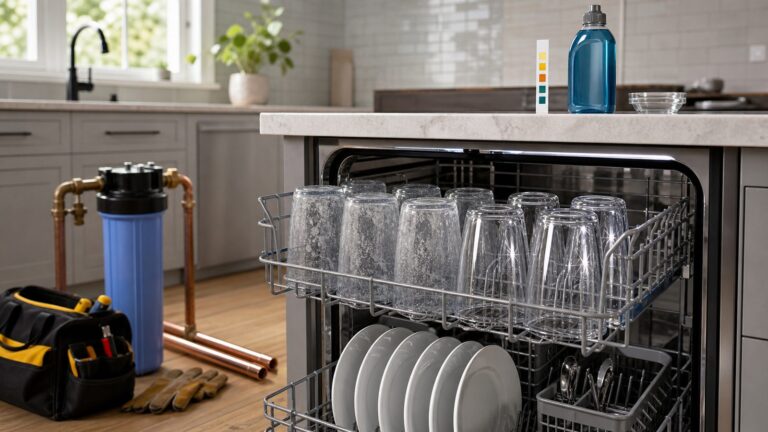
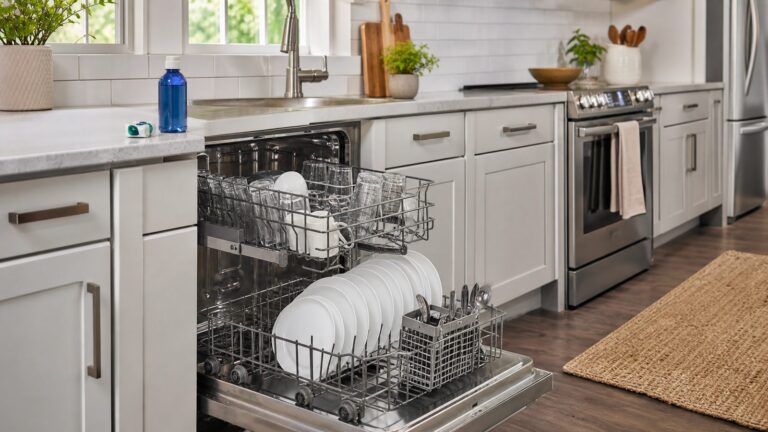
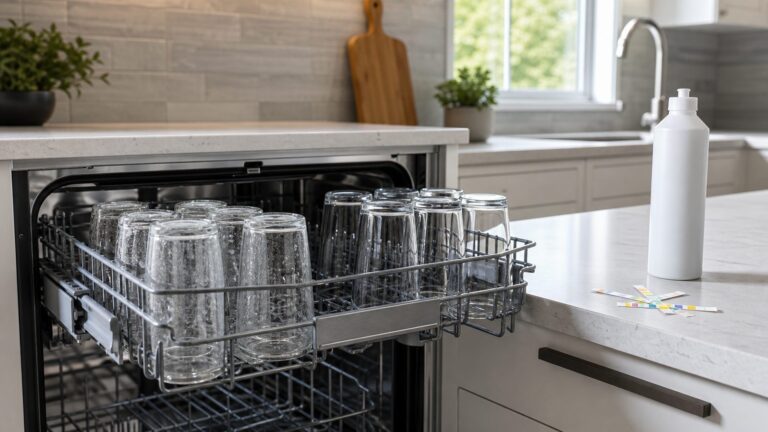
A laboratory study raises concerns about residue from some dishwasher detergents and rinse aids, but it does not prove that ordinary household dishwashers damage the human gut. The strongest evidence involved professional dishwashing conditions and laboratory models of the intestinal barrier. Practical residue-control steps are reasonable; claims that detergent causes clinical “leaky gut” or digestive disease are not supported by this research.
The short answer
A laboratory study found that some dishwasher detergents and rinse aids can damage intestinal cells and weaken laboratory models of the gut barrier. The strongest findings involved professional dishwashers and rinse-aid ingredients called alcohol ethoxylates.
As an Amazon Associate I earn from qualifying purchases.
That is a legitimate reason to reduce unnecessary detergent residue on food-contact surfaces. But the study does not prove that ordinary household dishwashers cause “leaky gut,” food allergies, inflammatory bowel disease, or other health conditions in people. It was an in-vitro study—not a human clinical trial or epidemiological study—and the researchers said that animal and human investigation is still needed.
The Tool Desk
Outbyte Driver Updater FREEScan for outdated or missing drivers - takes under a minuteDriver Scan →Outbyte PC Repair FREERepair Windows errors before they cause bigger problemsFix Now →What the study actually tested
The 2023 peer-reviewed study by Ogulur and colleagues examined commercial dishwasher detergents and rinse aids using several laboratory systems:
#1 Best Overall
- REMOVES GREASE ON CONTACT: Dawn Ultra packs a powerful punch of grease-fighting power for a deep, sparkling clean
- REFILL WITHOUT THE SPILL: Our new and improved jug features an easy-pour spout and comfortable handle to make refilling any Dawn dish soap bottle easier, faster, and less messy *vs. our previous jug.
- SAME CLEAN, BETTER VALUE: Save money* and save plastic when refilling with our dish soap refill jug (*when comparing $/oz within same sub-brand). You can fill multiple standard or EZ-Squeeze bottles with just one jug of Dawn.
- SAVES WILDLIFE: Dawn dish soap is the only brand trusted by rescue workers* to clean wildlife impacted by oil spills. (*International Bird Rescue uses Dawn Platinum)
- CLEANS BEYOND THE SINK: Use Dawn Platinum to pre-treat laundry stains, to clean greasy tools and car wheels, and to remove grease and grime from around the house.
- intestinal epithelial cell cultures;
- three-dimensional intestinal organoids; and
- a gut-on-a-chip model designed to reproduce some features of the intestinal barrier.
The researchers assessed cell toxicity, electrical resistance across the cell layer, movement of substances between cells, tight-junction staining, gene expression, and selected protein changes. These measurements are relevant because the intestinal lining normally acts as a selective barrier: it allows nutrients and other appropriate substances through while limiting unwanted passage between cells.
In the laboratory models, exposure to rinse aid produced dose-dependent toxicity and disruption of barrier function. The study associated the most damaging rinse-aid effects with alcohol ethoxylates, a class of surfactants used to help water drain from dishes and reduce spotting.
The experiments also showed changes in pathways related to:
- cell survival;
- epithelial-barrier function;
- cytokine signaling;
- metabolism; and
- inflammatory responses.
The primary study is available through PubMed. An evidence summary from the American Academy of Pediatrics describes the work as a preclinical, in-vitro study and likewise does not present it as proof of disease in people.
Why dishware residue matters—but does not prove harm to diners
The researchers also tested residue extracted from dishes washed in professional dishwashers. That residue retained cytotoxic and barrier-damaging activity in the laboratory models.
This result is important because it demonstrates a plausible route by which chemicals left on a dish could come into contact with food and, eventually, the digestive tract. However, it does not establish the dose a person would actually ingest. A laboratory extract is not automatically equivalent to the trace amount on an ordinary household plate after the residue is diluted by food, saliva, stomach contents, and intestinal fluids.
Rank #2

- 1. LESS SCRUBBING: Experience 50% less scrubbing with Dawn Ultra dish soap liquid compared to Dawn Non-Concentrated
- 2. WILDLIFE HELPER: Trusted by rescue workers, Dawn dish soap is used to clean wildlife impacted by oil spills
- 3. VERSATILE DISH SOAP: Dawn dishwashing liquid can be used beyond the kitchen sink, serving as a versatile liquid soap that can pre-treat laundry stains, clean greasy tools, car wheels, and fight grease and grime around the house
- 4. POWERFUL FORMULA: Dawn Ultra's powerful formula allows you to get through more dishes with less dishwashing liquid compared to Dawn Non-Concentrated
- 5. CLEANING: Dawn dish soap liquid ensures a thorough clean for your dishes, making it a perfect dish soap refill for your kitchen
The study also reported effects from household dishwasher detergents at the dilutions tested. That finding should not be converted into the broader claim that every home dishwasher leaves a harmful residue. Actual exposure depends on the formulation, detergent dose, rinse-aid setting, water volume, cycle design, dish loading, machine condition, and how much material remains on the dish.
The most accurate conclusion is narrower: some formulations and washing conditions can leave residues capable of damaging intestinal-barrier models, with the clearest direct evidence involving professional-dishwasher rinse-aid exposure. That is a preliminary laboratory warning, not a measured human-health risk estimate.
Professional and household dishwashers are not the same exposure
Professional dishwashers are commonly designed for speed and high throughput. Their operating conditions—including detergent concentration, rinse-aid delivery, temperature, cycle time, and rinse volume—may differ substantially from those of a household appliance.
That distinction is central to interpreting the research. The strongest residue findings came from dishware cleaned in professional machines. Although the study included household products, the tested laboratory dilutions do not tell us how much residue routinely remains on dishes in homes or whether that amount reaches the intestinal lining at a biologically active concentration.
There is currently no cited evidence establishing either:
What’s actually slowing this PC down?
Pick the symptom - the matching free tool is one click away.
- a safe or harmful chronic human dose for trace dishwasher residue; or
- that people who eat from normally washed household dishes develop a gut disorder as a result.
The study’s call for in-vivo research is itself an acknowledgment that the key exposure and health questions remain unresolved.
Rank #3

- 1. LESS SCRUBBING: 50% Less* Scrubbing (*vs. Dawn Non-Concentrated) with Dawn Ultra Dishwashing Liquid Dish Soap
- 2. VERSATILE DISH SOAP: Dawn dish soap liquid can be used beyond the kitchen sink. Use it as a dish soap or to fight grease and grime from tire rims and the outer shroud of a gas grill
- 3. POWERFUL FORMULA: Dawn Ultra's powerful formula helps you get through more dishes with less* dishwashing liquid (*vs. Dawn Non-Concentrated)
- 4. AMERICA'S CHOICE: #1 Dishwashing liquid brand* in North America (*Based on Sales).
- 5. EASY REFILL: This dish soap refill is easy to use, ensuring you always have enough to keep your dishes clean
What the research does not show
It would go beyond the evidence to say that dishwasher detergent is “poisoning” everyone’s gut or that clean dishes cause clinical “leaky gut.” In this context, barrier disruption refers to changes measured in experimental cell and tissue models. It is not the same as diagnosing a human disease.
The cited research does not prove that dishwasher products cause:
- intestinal permeability problems in people;
- food allergies;
- inflammatory bowel disease;
- irritable bowel syndrome;
- chronic abdominal symptoms; or
- any particular individual’s illness.
Mechanistic plausibility is useful for deciding what deserves further study, but it is not the same as demonstrated clinical causation.
How to reduce unnecessary residue at home
Consumers do not need to panic or stop using automatic dishwashers. The sensible response is to use the appliance as directed and investigate visible or detectable residue rather than assuming that every detergent is dangerous.
1. Use the manufacturer’s dose and settings
Follow the dishwasher and detergent instructions. Do not assume that adding more detergent produces cleaner dishes. Overdosing can increase the chance of film, odor, or residue and may interfere with rinsing.
2. Check the rinse-aid dispenser
Inspect the dispenser for leaks, overfilling, or a setting that is higher than necessary. If you are changing products, compare the formulation and confirm that it is intended for your specific dishwasher. A different dishwasher rinse aid is not proven to prevent gut injury; product selection is a residue-management decision, not a medical treatment.
3. Use an extra rinse when appropriate
If the appliance offers an additional rinse or a longer cycle, it may help when dishes have a visible film or detergent odor. Follow the machine’s instructions, since cycle names and options vary by model.
Quick wins for a faster PC:
Scan for outdated or missing drivers - takes under a minuteDriver Scan →Repair Windows errors before they cause bigger problemsFix Now →Rank #4

- NEW & IMPROVED FORMULA: New Dawn Platinum is now stronger* on tough grease, so you can spend less time washing dishes (*vs. previous formula)
- REMOVES TOUGH GREASE: Dawn Platinum removes 99% of Grease and Food Residue for a squeaky clean you can see and feel
- SCRUB LESS AND CLEAN FASTER*: Dawn Platinum dish soap attracts grease like a magnet so you can scrub less and clean faster* (*vs. previous formula)
- SAVES WILDLIFE: Dawn dish soap is the only brand trusted by rescue workers* to clean wildlife impacted by oil spills. (*International Bird Rescue uses Dawn Platinum)
- CLEANS BEYOND THE SINK: Use Dawn Platinum to pre-treat laundry stains, to clean greasy tools and car wheels, and to remove grease and grime from around the house.
4. Do not use the wrong kind of soap
Hand dish soap should not be used in an automatic dishwasher. It can create excessive foam and cause leaks or poor cleaning. If someone swallows dishwasher detergent, rinse-aid product, or another cleaning chemical, the appropriate response depends on the product and amount. In the United States, contact Poison Control through webPOISONCONTROL or by calling 1-800-222-1222.
5. Rewash dishes that clearly retain product
Rewash or thoroughly rinse dishes that feel slippery, look filmed, or taste or smell soapy. Persistent residue can indicate overdosing, a blocked spray arm, poor water drainage, an overloaded rack, a dirty filter, a malfunctioning dispenser, or a cycle that is not appropriate for the load.
6. Treat labels as a selection aid, not a health guarantee
Some readers may prefer a fragrance-free dishwasher detergent or a product listed under the EPA Safer Choice program. EPA Safer Choice evaluates ingredients against health and environmental criteria and maintains a searchable product list.
Those features can make ingredient comparison easier, but fragrance-free status is not proof of reduced intestinal risk, and Safer Choice certification is not clinical evidence that a product prevents gut injury. Check the current product listing and certification status rather than relying on a retailer’s headline or an outdated label.
Outdated Drivers Are Slowing You Down
One free scan finds every outdated or missing driver and matches the right update for your exact hardware.Free scan · exact hardware matchWindows Errors? Fix Them Before They Spread
Repair common Windows errors and clear accumulated junk for a smoother, more stable PC - no reinstall needed.Free scan · no reinstallWhat not to put in the rinse-aid dispenser
Do not treat vinegar, bleach, or improvised chemical mixtures as universal rinse-aid substitutes. Compatibility depends on the product, appliance, seals, plumbing, and manufacturer’s instructions. Mixing cleaning chemicals can create hazardous reactions, and an apparently simple substitution may damage the machine or leave a different residue.
Independent reader supportYour contribution helps us test, update, and keep practical guides available for everyone.Troubleshooting persistent film or detergent odor
If the problem continues, work through the appliance rather than simply switching products:
- Confirm that the detergent and rinse aid are intended for automatic dishwashers.
- Reduce dosing only within the manufacturer’s permitted range.
- Check that the rinse-aid cap and detergent compartment close correctly.
- Clean the filter and inspect spray arms for blockages.
- Avoid overloading dishes or blocking the spray pattern.
- Check that the machine drains fully and that the incoming water is suitable for the appliance.
- Run the manufacturer’s recommended cleaning or maintenance cycle.
- Consult the appliance instructions or a reliable dishwasher residue troubleshooting guide for model-specific steps.
If a dispenser is leaking, a spray arm is damaged, or the machine repeatedly leaves chemical residue despite correct operation, professional appliance service may be more useful than repeatedly changing detergent brands.
Best Value

- Our best dishwasher detergent for up to 100% Food Residue Removal
- Only Cascade Platinum Plus contains 2X* the Dawn grease fighting power and 2X* the scrubbing power to power through dried on food *Cleaning ingredients vs Cascade Complete ActionPacs
- Removes visible and invisible residues for virtually spotfree and shiny dishes
- 40% larger liquid top for even more* cleaning power that still fits in your dishwasher detergent dispenser *vs Cascade Platinum ActionPacs
- Running the dishwasher daily saves water* Save up to 20 gallons of water per dishwasher load *ENERGY STAR certified dishwashers use 4 gallons per cycle. Running the tap for 11 minutes handwashing uses up to 24 gallons of water.
When to seek medical or poison advice
Trace residue on a plate is not the same exposure as swallowing concentrated detergent or rinse aid. For an actual ingestion, eye exposure, or significant skin exposure, contact Poison Control in the United States at 1-800-222-1222 or use webPOISONCONTROL. Do not induce vomiting unless a medical professional specifically tells you to do so.
Seek medical care for persistent abdominal pain, repeated vomiting or diarrhea, difficulty swallowing, breathing problems, allergic symptoms, or other ongoing complaints. Do not assume that dishwasher residue caused those symptoms without an evaluation; the cited laboratory study cannot diagnose an individual.
Bottom line
The dishwasher-residue study is worth taking seriously as an early safety signal. It found that certain detergent and rinse-aid exposures—especially in professional dishwashing conditions—could damage intestinal-barrier models, and that residue from professionally washed dishware retained activity in those models.
But it does not show that normal household dishwasher use causes leaky gut or disease in people. Until human exposure and outcome studies are available, the proportionate response is to prevent visible or detectable residue: dose correctly, maintain the machine, check the rinse-aid dispenser, use an extra rinse when suitable, and rewash dishes that feel or taste soapy.
Frequently Asked Questions
Does dishwasher detergent cause leaky gut?
No. The study found toxicity and barrier disruption in cell, organoid, and gut-on-a-chip models, not diagnosed disease in human participants. It did not prove that household dishwasher use causes leaky gut, food allergies, or inflammatory bowel disease.
Free tools Windows power users keep installed
One-click scans. No signup required.
Are household dishwashers affected by this research?
The strongest direct evidence involved professional dishwashers and rinse-aid exposure. Household products also produced effects at tested laboratory dilutions, but those tests do not establish the actual dose remaining on household dishes or the health risk from normal home use.
How can I reduce dishwasher residue?
Use the recommended detergent amount, check that the rinse-aid dispenser is not leaking or overfilled, maintain the dishwasher, use an extra rinse when appropriate, and rewash dishes that feel slippery or smell or taste soapy. Do not substitute vinegar, bleach, or improvised chemical mixtures without appliance-specific guidance.
What should I do after swallowing dishwasher detergent or rinse aid?
For an actual ingestion, eye exposure, or substantial skin exposure in the United States, contact Poison Control through webPOISONCONTROL or call 1-800-222-1222. Persistent digestive or allergic symptoms should be assessed by a healthcare professional.
The Bottom Line
Bottom line: Laboratory evidence raises a credible question about dishwasher-detergent and rinse-aid residues, particularly from professional machines, but it does not prove that ordinary household dishwashers damage human gut health. Reduce avoidable residue and treat any actual chemical exposure as a poison-safety issue—not as proof of chronic disease.
Do these 3 things before closing this tab:
1Fix the driver behind crashes, sound loss and screen glitches2Repair Windows errors before they cause bigger problems3Scan for outdated or missing drivers - takes under a minuteQuick Recap
Product prices and availability are accurate as of the date/time indicated and are subject to change. Any price and availability information displayed on Amazon at the time of purchase will apply.