The Tool Desk
Outbyte PC Repair FREEClear out junk files and repair common Windows errorsFree Scan →Outbyte Driver Updater FREEFix the driver behind crashes, sound loss and screen glitchesFind Drivers →Choose a pool fence by starting with the barrier’s safety layout, openings, and gate—not its appearance. For a U.S. residential pool, the Consumer Product Safety Commission (CPSC) recommends a barrier that fully encloses the pool, at least 48 inches high (5 feet or higher is preferable), with openings and footholds controlled and a pedestrian gate that opens away from the pool and self-closes and self-latches. These are recommendations, not a universal building code: confirm the current rules for your property with your local building department before choosing a design.
Start with a complete barrier and a reliable gate
A fence is one layer of pool safety, not a substitute for adult supervision or other precautions. The Centers for Disease Control and Prevention (CDC) recommends four-sided fencing that fully encloses a backyard pool and separates it from the house. CPSC likewise says a barrier surrounding the pool is better than one that uses the house as its fourth side. The house-side arrangement can leave doors and other access points as part of the barrier’s function, so ask your local authority how those must be addressed.
CPSC’s Safety Barrier Guidelines for Residential Pools recommend a fence at least 4 feet high, with 5 feet or more preferable. Measure the top at least 48 inches above grade on the exterior side. Some jurisdictions may require 60 inches, so do not treat the CPSC dimensions as approval for a particular property.
Give the gate the same attention as the fence itself. CPSC recommends a locking device and says pedestrian gates should swing outward, away from the pool, and self-close and self-latch. CDC also recommends self-closing and self-latching gates. As CPSC puts it, “The weak link in the strongest and highest fence is a gate that fails to close and latch completely.” Consider how the gate will work in everyday use, then verify its latch location and operation against local requirements.
Do these 3 things before closing this tab:
1Scan for outdated or missing drivers - takes under a minute2Clear out junk files and repair common Windows errors3Fix the driver behind crashes, sound loss and screen glitches#1 Best Overall
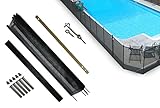
- Removable, mesh, pool safety fencing for use around swimming pools to help protect against accidental falls into the pool.
- This fence is at the recommend US CPSC height of 4 feet and come in individually boxed 12 foot sections.
- Each box contains pre-assembled 4' X 12' section of fence, required deck sleeves/caps, and brass safety latch.
- Installation requires a 1/2" minimum rotary hammer drill with a standard 5/8" long shaft masonry bit which is NOT included.
- Fence is installed into deck sleeves under tension. Each 12' section is assembled with 5 one inch poles with 1/2" stainless steel deck mounting pin at 36" spacing. Comes with template.
Check whether a design prevents climbing, slipping through, or crawling under
Appearance alone cannot establish that a fence is safe or code-compliant. Assess the whole barrier, including its surroundings: nearby furniture, grade changes, permanent structures, rails, ornament, and cutouts can affect how easily a child might climb over, pass through, or get under it.
- Limit footholds. Keep the barrier away from permanent structures and objects that could help a child climb. Solid masonry or stone barriers should not have indentations or protrusions that provide climbing holds.
- Check openings. CPSC’s summary recommends that barrier openings not pass a 4-inch-diameter sphere, but it gives additional, design-specific guidance for chain-link, lattice, and some fence configurations. Use the full guidance and local code for the design you are considering.
- Check clearance below the fence. CPSC recommends no more than 4 inches between the barrier and the ground, measured on the outside. For grass or gravel, it reports an industry recommendation of no more than 2 inches. Removable mesh fencing has a stricter recommendation: no more than 1 inch.
Horizontal and vertical members need particular care. CPSC’s booklet describes different spacing and placement recommendations depending on the distance between horizontal members; the right details depend on the actual configuration. Review the booklet’s illustrations and ask the building department or a qualified installer to confirm the proposed design against current local rules.
Rank #2

- Pool Safety Fence for Above-Ground Pools: This pool safety fence creates a protective barrier that helps deter unsupervised pool access by pets and family members
- Designed for Above-Ground Metal Frame Pools: This above ground pool fence kit includes 8 vinyl sections, each measuring 64.5-in W x 1.5-in D x 24-in H; end posts included; not compatible with soft-sided pools
- Secure Bracket Fit on Metal Uprights: Engineered specifically as a pool guard fence for above-ground pools with flat metal uprights and top rails; the mounting brackets ensure a secure fit
- Customizable Coverage: Build a pool fencing system using the modular kits; Kit A (8 sections with end posts) is the base kit; Kit B (3 sections with 3 connecting posts) and Kit C (2 sections with 2 connecting posts) are add-on kits and requires kit A
- Fits Round and Oval Above-Ground Pools: This pool fence for above ground pools works with round and oval pool shapes, serving safety to all homeowners and families
Compare pool fence designs by their practical trade-offs
CPSC discusses solid barriers, vertical-member fences, chain-link, lattice, and removable mesh. Each still needs to meet the relevant requirements for height, openings, climb resistance, clearance, and gate function. The official guidance does not rank fence materials for appearance, visibility, privacy, price, maintenance, corrosion resistance, lifespan, or installation labor, so compare those project-specific concerns with suppliers and installers rather than assuming one style is best.
| Design | Safety details to verify | Design question to consider |
|---|---|---|
| Solid wall or fence | Check height, gaps, and whether the surface has climb-enabling indentations or projections. CPSC recommends a complete enclosure. | Does the amount of visual screening suit the pool area and the rest of the yard? |
| Vertical-member fence | Check the spacing and placement of rails and vertical members, as well as any decorative openings, against the specific configuration in CPSC guidance and local code. | How much openness or screening do you want, and what effect will the rails and ornament have on sightlines? |
| Chain-link | CPSC’s guidance specifies a maximum mesh opening of 1¼ inches square, or 1¾ inches when slats reduce the openings. Confirm the complete design locally. | Will this style suit the intended appearance and visibility of the pool area? |
| Lattice | CPSC gives a maximum opening of 1¾ inches. Also check whether the pattern could act as a climbing aid. | Does the pattern provide the desired visual character without compromising the barrier design? |
| Removable mesh | CPSC recommends at least 48 inches in height, bottom clearance no greater than 1 inch, posts no more than 40 inches apart, and posts extending at least 3 inches below grade. It says the safest systems lock into the deck so removal requires extensive use of tools. | Confirm that the mounting method suits the deck and that the system’s removal and storage fit how the pool will be used. |
For horizontal and vertical members, CPSC’s booklet describes one arrangement when horizontal members are less than 45 inches apart: place the horizontals on the pool side, with 1¾-inch spacing guidance for that configuration. When the horizontal members are 45 inches or more apart, it describes a 4-inch maximum vertical spacing. These details are configuration-specific; consult the booklet’s illustrations and local authority rather than applying them as a universal rule.
PC Slower Than It Used to Be?
A free scan shows the junk files, broken settings and background clutter dragging Windows down - then fixes them in one click.Free scan · Windows 10 & 11Crashes, No Sound, or Screen Glitches?
Random freezes, missing sound and display glitches usually trace back to one bad driver. Find and replace yours safely.Free scan · under a minuteRank #3

- Easy-to-install, do-it-yourself gate kit for use with the Pool Fence DIY safety system; helps keep kids safe from accidental falls into your pool
- 2-foot walk-through opening and recommend height of 4 feet. 4' Tall X 36" Wide
- Aluminum, powder-coated square stock; sturdy double-truss uprights; industrial-strength mesh
- Ultra-reliable magnetic gate latch and self-closing gate hinges. Requires rotary hammer drill with 5/8 x 14-inch masonry bit (minimum; not included).
- Backed by a limited lifetime warranty; installation requires rotary hammer drill and long shaft masonry bit (not included); 7-day-a-week phone support
Get local approval before buying or installing
The applicable requirements depend on where the property is, the pool type, and the rules adopted by the local authority. CPSC explicitly says its guidelines are not a mandatory standard; jurisdictions may adopt different requirements, including different fence heights. The 2024 International Swimming Pool and Spa Code is model-code context, not proof of the law at an unidentified property.
- Contact the building department responsible for the property and ask which current code and permit requirements apply to your pool.
- Confirm required barrier height, layout, openings, setbacks, ground clearance, gate swing and hardware, and any rules for removable fencing.
- Show the proposed fence and gate details to the authority or installer before ordering. For removable mesh, confirm deck-substrate compatibility and follow the system manufacturer’s instructions as well as local approval requirements.
- After installation, check that the gate closes and latches reliably and that the barrier remains free of newly introduced footholds, gaps, or climbable objects.
The CDC’s Guidelines for Keeping Your Pool Safe and Healthy, updated May 29, 2025, also emphasize supervision and additional safety measures. A fence can reduce access, but it does not eliminate the need for those other precautions.
Quick Recap
Best Value

- POOL SAFETY KIT - Help to keep your outdoor above ground swimming pool safe with this 24" vinyl safety fence. Helps fight off the risk of accidental pool drownings with this pool barrier.
- A MUST ADD ON FOR ABOVE GROUND POOL - 24" high fence made of strong, UV-protected vinyl. This pool fence is sold in 2 piece, 3 piece and 8 piece sections. Please see the description below for how many sections you will need to fit your swimming pool.
- KEEP YOUR POOL SAFE - Add extra security to your pool with this fence kit. Helps keep unwanted intruders out while keeping pool toys in. This fence will keep out others from entering your pool when it is not in use.
- SWIMMING POOL ACCESSORIES - Extra strong mounting brackets easily attach to your swimming pool's uprights. This is also a removable pool fence that is simple to move when you need adjustments. Safely reapply the pool railing in no time. Swimming pool accessories you can trust. Use with your above ground pool ladder or above ground pool steps for optimal safety.
- ALL HARDWARE INCLUDED - Fencing, posts, required hardware and instructions are included with the pool safety fence. Start setting up your portable pool fence out of the box.
Rank #4

- Sturdy Gate Frame: The exquisitely crafted pool fence gate features 1" thick square aluminum poles and 3.9" long stainless steel legs, providing superior corrosion resistance and durability for long-term stability and safety.
- Premium Teslin Material: The pool safety gate frame is constructed with 340 gms Teslin PVC mesh fabric, utilizing triple-needle stitching to enhance durability, ensuring both the aesthetics and practicality.
- Innovative Stainless Steel Latch: The simple lock structure with a push-pull switch makes opening and closing the inground pool gate effortless. The latch is positioned 20cm above the gate to enhance safety and prevent accidental opening. Note: The pool gate can not automatically lock; please lock it manually.
- Quick and Easy Installation: Hooks are pre-installed on the poles, simplifying the installation process. One person can easily install the entire swimming pool gate, saving you time and effort while ensuring convenience and safety. Typically, one pool gate is sufficient for a pool. If multiple access are needed, you may purchase additional gates separately as needed.
- User-friendly Details: Equipped with an auxiliary installation drilling template and detailed installation instructions, we recommend using a 0.63" drill bit (not included) to ensure precise installation and perfect fitting of the pool safety gate.
Product prices and availability are accurate as of the date/time indicated and are subject to change. Any price and availability information displayed on Amazon at the time of purchase will apply.