The Tool Desk
Outbyte PC Repair FREEClear out junk files and repair common Windows errorsFree Scan →Outbyte Driver Updater FREEFix the driver behind crashes, sound loss and screen glitchesFind Drivers →Use clean, free-draining crushed drainage aggregate that meets the gradation specified by your retaining-wall manufacturer or engineer. For many modular block walls, a documented example is clean 1/2- to 3/4-inch crushed stone, but no single size or retail label is right for every wall.
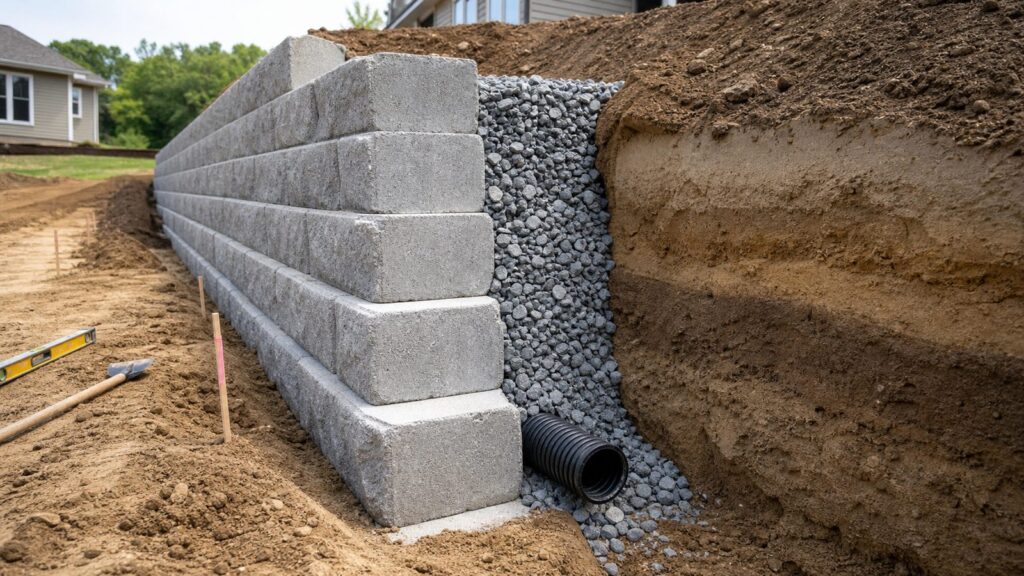
The stone creates a permeable path that helps prevent water pressure from building behind the wall; it is not a complete drainage system by itself. Follow the approved detail for drainage-zone width, filtration, pipe and outlet, and grade the site so concentrated runoff does not flow into or pool above the wall.
What Gravel to Use Behind a Retaining Wall
Ask for clean crushed drainage stone or wall rock that meets the wall system’s specified gradation and fine-content requirements. Open-graded aggregate with little fine material lets water move through the drainage zone. A Keystone modular-wall manual, for example, specifies clean crushed stone 1/2 to 3/4 inch in its unit-drainage zone. That is an example for that system, not a universal specification.
Do not choose by a regional product name alone. Labels such as “#57,” “drain rock,” or “wall rock” can refer to different materials. Ask the supplier for the actual gradation and whether the stone is clean and low in fines. A segmental-wall construction standard, for example, illustrates a measurable criterion of no more than 5% passing the No. 200 sieve; use the criterion required by your approved wall detail rather than assuming it applies to every wall.
Quick wins for a faster PC:
Clear out junk files and repair common Windows errorsFree Scan →Scan for outdated or missing drivers - takes under a minuteDriver Scan →#1 Best Overall

- Effective Filtration for Drainage Systems: This French drain fabric features a precision-knitted mesh structure designed to allow water to flow through while blocking soil sand silt and fine debris from entering perforated pipes; Helps reduce clogging and sediment buildup over time supporting consistent drainage performance
- Compatible with 4-Inch Pipes: This drain sock is specifically sized for 4-inch diameter pipes; The roll provides 100 feet in length offering sufficient material for residential drainage projects French drain installations or landscape grading tasks without the need for frequent repurchases
- Durable Construction: Crafted from white polyester knit fabric with a weight of 200 grams this filter sleeve is designed to resist tearing during installation; The material also offers resistance to rot mildew and biological degradation when buried in underground or outdoor conditions
- Elastic and Easy to Install: The knitted fabric has a flexible; stretchable design that slides over pipes much like a compression sock; It conforms to pipe surfaces without the need for special tools or adhesives and can be trimmed to the desired length with standard scissors for customized fitting
- Broad Application Scenarios: Suitable for use with various pipe materials including PVC concrete metal and corrugated drainage pipes; This filter fabric is applicable in French drains septic systems subsurface drainage garden landscaping and construction site water management projects
Drainage gravel helps reduce water buildup, but it cannot make an otherwise unsuitable wall safe. Wall performance also depends on wall type, foundation soils, compaction, embedment, slope, surcharge loads, groundwater, and reinforcement.
Drainage Gravel, Base Aggregate, and Backfill
The vertical drainage zone directly behind the wall is not necessarily the same material as the leveling base or the soil in a reinforced zone. Estimate and build each zone according to the manufacturer’s current manual and, where required, the engineered plan. Keep excavated soil, topsoil, roots, and organic debris out of the specified drainage aggregate.
Drainage-zone width varies by system. Allan Block residential instructions specify wall rock in the cores and at least 12 inches behind the block; a cited Keystone detail specifies a 24-inch unit-drainage-fill zone. These are system examples, not code requirements. Use the width and aggregate height shown in your approved detail. For reinforced, tall, loaded, sloped, or wet sites, do not select dimensions from a generic rule.
Rank #2

- Superior Filtration: Prevents Clogging.Drain Filter sock Equipped with a precision-woven mesh, our French drain filter sleeve ensures unobstructed water flow while effectively trapping soil, sediment, sand, silt, and small stones. By blocking debris from entering pipes, it prevents stubborn clogs, reduces internal buildup over time, and maintains consistent drainage performance—saving you time and money on costly pipe repairs
- Elastic & Easy to Install: Durable Polyester. French drain fabric is crafted from high-quality synthetic polyester, this drainage filter fabric boasts exceptional wear resistance and longevity, standing up to harsh underground conditions. Its elastic design allows for hassle-free installation: simply slide the sleeve over your 4-inch pipe and stretch it to the desired length. It fits snugly against pipe surfaces without tearing or slipping, ensuring reliable protection
- Suitable for 4-inch pipe: This package comes with one roll of 4" x 50' drain pipe filter sleeve, tailor-made for pipes with a 4-inch diameter. The 50-foot length provides abundant material to cover various drainage needs, making it a go-to solution for both small residential tasks and large-scale commercial or construction projects—no need for frequent repurchases
- Broad Compatibility: Designed specifically for 4-inch diameter piping systems, this filter sleeve is compatible with a wide range of pipe materials, including PVC, concrete, metal, and plastic. Whether you’re working on a new drainage setup or upgrading an existing one, it offers the flexibility to fit your project’s specific pipe type
- Versatile Applications: Perfect for residential, commercial, agricultural, and construction environments, this drain pipe filter sleeve delivers consistent performance across uses. Filter fabric for drainage is an essential addition to French drains, septic systems, subsurface drainage, garden drainage, and more—providing reliable filtration no matter the application or conditions
Materials to Avoid or Verify
| Material or label | What to check |
|---|---|
| Crusher run, road base, “minus” aggregate, stone dust | These may contain substantial fines and serve other construction roles. Do not use them in the vertical drainage zone unless the approved wall detail specifically calls for them. |
| Topsoil, excavated soil, roots, or organic debris | Keep these out of the drainage aggregate; the cited segmental-wall standard requires backfill free of organics and debris. |
| Pea gravel or other rounded aggregate | Do not assume it is interchangeable with the specified crushed stone. Some engineered details use pea gravel, so follow the system design rather than applying a blanket rule. |
| “#57,” “drain rock,” or other local product names | Verify actual gradation, fine content, and compatibility with the wall-system specification; the label alone does not establish suitability. |
Pipe, Filter, and Outlet
Where the approved detail calls for a perforated drain pipe, place it near the low point at the back or base of the drainage zone and provide a positive route to daylight or a storm-drain system where lawful and designed. Keystone’s cited detail uses a 4-inch perforated pipe, geotextile filter fabric, and an outlet; FHWA rockery guidance likewise identifies a minimum 4-inch PVC drain pipe to a suitable outlet. These details do not establish one universal pipe arrangement for all wall types.
Outdated Drivers Are Slowing You Down
One free scan finds every outdated or missing driver and matches the right update for your exact hardware.Free scan · exact hardware matchPC Slower Than It Used to Be?
A free scan shows the junk files, broken settings and background clutter dragging Windows down - then fixes them in one click.Free scan · Windows 10 & 11A gravel column without a suitable outlet is not a complete drain. Check the plans for outlet location, routing, filtration, and maintenance access. Do not discharge water where it could undermine the wall or cause other site problems.
Use geotextile where the approved detail calls for it, especially to separate retained soil from drainage aggregate or protect a drain from migrating fines. FHWA explains that filter fabric can prevent fine material from migrating into and clogging permeable drain material. Fabric does not replace suitable stone, grading, or an outlet, and its type and placement are project-specific.
Rank #3
- Effective Filtration for Drainage Systems: This French drain fabric features a precision-knitted mesh structure designed to allow water to flow through while blocking soil sand silt and fine debris from entering perforated pipes; Helps reduce clogging and sediment buildup over time supporting consistent drainage performance
- Compatible with 4-Inch Pipes: This drain sock is specifically sized for 4-inch diameter pipes; The roll provides 50 feet in length offering sufficient material for residential drainage projects French drain installations or landscape grading tasks without the need for frequent repurchases
- Durable Construction: Crafted from white polyester knit fabric with a weight of 200 grams this filter sleeve is designed to resist tearing during installation; The material also offers resistance to rot mildew and biological degradation when buried in underground or outdoor conditions
- Elastic and Easy to Install: The knitted fabric has a flexible; stretchable design that slides over pipes much like a compression sock; It conforms to pipe surfaces without the need for special tools or adhesives and can be trimmed to the desired length with standard scissors for customized fitting
- Broad Application Scenarios: Suitable for use with various pipe materials including PVC concrete metal and corrugated drainage pipes; This filter fabric is applicable in French drains septic systems subsurface drainage garden landscaping and construction site water management projects
A 4-inch perforated drain pipe with filter sock may be a practical product to consider where it matches the approved detail. Confirm compatibility, filtration, outlet routing, and local drainage requirements before purchasing.
How to Estimate the Gravel Quantity
Measure the dimensions of each aggregate placement in feet. Calculate the vertical drainage zone, base or leveling aggregate, and block-core fill separately, then add the volumes. These are geometric estimates, not design specifications.
| Aggregate placement | Calculate cubic feet | Convert to cubic yards |
|---|---|---|
| Vertical drainage zone | Wall length × drainage-zone width × aggregate height | Divide by 27 |
| Base or leveling aggregate | Wall length × base width × base thickness | Divide by 27 |
| Block cores | Number of blocks × manufacturer’s stated core-fill volume | Divide by 27 if the volume is in cubic feet |
For a 20-foot wall with a 4-foot aggregate height and a 24-inch (2-foot) drainage zone, the vertical zone is 20 × 2 × 4 = 160 cubic feet, or 160 ÷ 27 = about 5.9 cubic yards. At a 12-inch (1-foot) zone, the same wall’s vertical zone is about 3.0 cubic yards. These arithmetic examples exclude the leveling base, block cores, separate pipe bedding outside the measured zone, and any site-specific allowance.
Do not count stone around the pipe twice if the pipe sits within the measured drainage zone. Order by volume first. Convert to tons only after asking the supplier for the delivered bulk density of the exact aggregate, because density varies with quarry, gradation, moisture, and product.
Rank #4

- Superior Filtration:Prevents Clogging.Drain Filter sock Equipped with a precision-woven mesh, our French drain filter sleeve ensures unobstructed water flow while effectively trapping soil, sediment, sand, silt, and small stones. By blocking debris from entering pipes, it prevents stubborn clogs, reduces internal buildup over time, and maintains consistent drainage performance—saving you time and money on costly pipe repairs
- Suitable for 4-inch pipe: This package comes with one roll of 4" x 30' drain pipe filter sleeve, tailor-made for pipes with a 4-inch diameter. The 50-foot length provides abundant material to cover various drainage needs, making it a go-to solution for both small residential tasks and large-scale commercial or construction projects—no need for frequent repurchases
- Elastic & Easy to Install: Durable Polyester. French drain fabric is crafted from high-quality synthetic polyester, this drainage filter fabric boasts exceptional wear resistance and longevity, standing up to harsh underground conditions. Its elastic design allows for hassle-free installation: simply slide the sleeve over your 4-inch pipe and stretch it to the desired length. It fits snugly against pipe surfaces without tearing or slipping, ensuring reliable protection
- Broad Compatibility: Designed specifically for 4-inch diameter piping systems, this filter sleeve is compatible with a wide range of pipe materials, including PVC, concrete, metal, and plastic. Whether you’re working on a new drainage setup or upgrading an existing one, it offers the flexibility to fit your project’s specific pipe type
- Versatile Applications: Perfect for residential, commercial, agricultural, and construction environments, this drain pipe filter sleeve delivers consistent performance across uses. Filter fabric for drainage is an essential addition to French drains, septic systems, subsurface drainage, garden drainage, and more—providing reliable filtration no matter the application or conditions
Keep Runoff Away From the Wall
Drainage aggregate is not intended to receive concentrated roof, pavement, or uphill runoff. Route downspouts and surface water around the wall, and prevent pooling above or below it. The site grading and any separate drainage plan should suit the wall, surrounding soil, and outlet conditions.
When to Get a Qualified Engineer
Use a qualified engineer or the approved wall-system design where the wall is reinforced, affected by a slope, vehicle or building loads, groundwater or seepage, soft or disturbed soils, or where manufacturer instructions call for engineered design. A wall with difficult site conditions needs more than a generic gravel choice. Confirm local requirements rather than relying on a universal height or permit threshold.
FAQ
What is the best gravel for retaining wall drainage?
Use clean, free-draining crushed drainage aggregate that meets the wall manufacturer’s or engineer’s gradation and fine-content requirements. A Keystone modular-wall manual gives clean 1/2- to 3/4-inch crushed stone as one system-specific example.
Best Value

- Filters out sand and sediment
- No need for special gravel backfill, for residential, commercial, or agricultural
- Do not use where water pressure is needed
Is #57 stone always suitable behind a retaining wall?
No. “#57” is a product label, not proof that the material meets your wall system’s specification. Ask the supplier for the gradation and fine content and check them against the approved detail.
How wide should the drainage zone be?
Use the width in the approved plan or current manufacturer’s manual. Research examples differ: Allan Block residential instructions specify at least 12 inches behind the block, while a cited Keystone detail specifies 24 inches. Neither is a universal code requirement.
Do I need a drain pipe behind a retaining wall?
Follow the approved wall and site detail. Where it calls for a perforated pipe, the pipe must have a positive route to a suitable outlet; gravel alone does not provide an outlet for water.
How much gravel does a retaining wall need?
For the vertical drainage zone, multiply wall length by drainage-zone width by aggregate height, all in feet, then divide cubic feet by 27 to get cubic yards. Calculate the base and block-core fill separately, and use the actual dimensions in the approved detail.
Can I use pea gravel behind a retaining wall?
Do not substitute it for the specified drainage aggregate simply because it is sold as gravel. Some engineered details use pea gravel; follow the wall-system design for the project.
Quick Recap
Product prices and availability are accurate as of the date/time indicated and are subject to change. Any price and availability information displayed on Amazon at the time of purchase will apply.