Some links on this page are affiliate links: if you buy through them we may earn a commission, at no extra cost to you.
Cold-bend hardwood is real solid hardwood that has been thermo-mechanically compressed so it can bend while it is still moist. After it is clamped into the desired shape and dried, it becomes rigid and holds that curve under normal dry interior conditions.
That makes it useful for curved handrails, stair parts, bar fronts, reception desks, built-in furniture edges, curved casing, wall caps, ceiling accents, and restoration work where a solid wood curve looks better than a plastic substitute or a stack of thin laminations. It is not steam bending, not kerf bending, not bendable plywood, and not a shortcut for structural framing.
As an Amazon Associate I earn from qualifying purchases.
What’s actually slowing this PC down?
Pick the symptom - the matching free tool is one click away.
On our job sites, we treat cold-bend hardwood as specialty architectural millwork. That means the planning starts before anyone opens the sealed material: code geometry, templates, forms, clamps, fastening details, drying time, finish samples, and waste allowance all need to be figured out. Used in the right place, it can save labor and produce a clean, continuous curve. Used casually, it becomes an expensive way to split a beautiful board.
What Cold-Bend Hardwood Actually Is
Cold-bend hardwood starts as solid hardwood, commonly in North American species such as ash, red oak, white oak, walnut, elm, and maple. Manufacturers use heat, moisture, and compression to shorten the wood fibers along the length of the board. That compression is what gives the material its unusual bending range.
The key point is that the board bends while it is moist. It is normally shipped sealed to preserve that condition. Once the piece dries, it loses that working flexibility. After drying in a form, the wood becomes a rigid curved part. It does not keep acting like rubber, and it should not be expected to flex back and forth in service.
Popular on Amazon
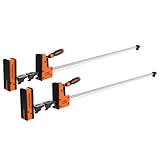
- RIGID STEEL BAR: This JORGENSEN 50-inch parallel clamp features a compact, industrial-grade steel bar that resists flexing under pressure, ideal for woodworking, furniture repairs, and cutting board assembly where even pressure matters
- POWERFUL CLAMPING FORCE: The upgraded steel screw thread delivers up to 2200 lbs of consistent clamping force, keeping workpieces secure and preventing warping during precise glue-ups, cabinet assembly, and other woodworking projects
- QUICK CLAMP-TO-SPREADER: The sliding jaw can be quickly reversed without tools, instantly converting the clamp into a spreader, making it versatile for clamping or separating tasks in DIY, carpentry, and home projects
- ERGONOMIC & SAFE OPERATION: An ergonomic soft-grip handle allows for controlled, high-torque tightening by hand, while a quick-release trigger enables safe repositioning without losing alignment, especially useful during glue-ups on drawers or frames
- SMART ACCESSORIES & DESIGN: The newly designed Soft Landing System prevents the sliding jaw from falling when carried vertically. This 2-pack bar clamp set also includes a 2-in-1 glue separator and clamp stand, elevating the bar off the surface to stay clean and stable. Replacement jaw pads are available for added protection and improved glue resistance
For a homeowner, the simplest way to think about it is this: cold-bend hardwood is a solid wood blank that arrives ready to be formed into a curve. The carpenter still needs a precise form, a clamping plan, and time for the piece to dry. The factory has done the compression work, not the final shaping work.
That distinction matters for schedule and cost. A 7-foot piece of cold-bend white oak may be much faster to shape into a curved handrail than laminating 10 or 12 thin strips around a form, but it still requires shop time. The work is closer to custom stair and millwork fabrication than standard trim installation.
How It Differs From Steam Bending, Laminating, and Kerf Bending
Curved wood details can be made several ways. Cold-bend hardwood is only one of them. The right choice depends on the radius, thickness, species, appearance requirements, durability, budget, and whether the part is decorative, graspable, or load-related.
| Method | How it works | Best uses | Main limits |
|---|---|---|---|
| Cold-bend hardwood | Compressed solid hardwood is bent cold while moist, then dried in a form. | Curved handrails, exposed millwork, furniture-grade built-ins, restoration pieces. | High material cost, limited suppliers, drying time, radius limits, waste risk. |
| Steam bending | Wood is heated with steam, bent quickly, then dried. | Chairs, boat parts, traditional curved components, some rails and furniture parts. | Needs steam equipment, fast handling, bending straps, species knowledge, springback control. |
| Bent lamination | Thin strips are glued around a form to make a thicker curved part. | Predictable curves, long rails, tight shapes, repeatable shop production. | Glue lines may show, more milling and clamping labor, longer assembly time. |
| Kerf bending | Saw cuts are made in the back of a board or panel so it can bend. | Paint-grade curves, concealed backs, simple decorative panels. | Weakens the piece, not ideal for exposed solid-wood edges or handrail profiles. |
| CNC-carved curve | A curved shape is machined from thicker stock or glued blocks. | Short ornamental parts, repeatable profiles, complex shapes. | High waste, grain may not follow the curve, can look less natural up close. |
| Flexible moulding | Synthetic moulding bends around curves and is painted or finished. | Painted casing, crown, base, and non-wood decorative trim. | Not solid wood, limited stain realism, not suitable for every architectural detail. |
The visual difference is often why cold-bend hardwood gets specified. With a bent solid board, the grain can flow through the curve more naturally than a carved part cut out of a larger blank. Compared with kerf bending, the face and edges stay solid. Compared with flexible moulding, it is real hardwood.
That does not make it automatically better. For a long commercial handrail with a consistent radius and a profile that must meet strict graspability rules, bent lamination may still be the most predictable option. For a paint-grade curved wall panel, kerf-bent substrate or flexible moulding may be more economical. For structural elements, the answer should come from an engineer and approved product data, not from a bending demonstration.
Recommended Free Tools
Where Cold-Bend Hardwood Makes Sense in Construction
The strongest use cases are visible, nonstructural architectural elements where the curve is part of the design. We look for places where solid wood matters, the bend is prominent, and the cost of fabrication can be justified by the finished appearance.
Curved stair handrails
Curved handrails are one of the most practical applications. A stair with a curved wall, flared starting step, landing turn, or radius balcony often needs a rail that follows the shape cleanly. Cold-bend hardwood can be formed first, dried, then milled or installed as part of a finished handrail assembly, depending on the supplier stock and shop process.
For stair work, the code geometry comes first. In a typical residential stair, the handrail height is commonly checked in the 34-inch to 38-inch range above the stair nosings, and the rail must be continuous where required, return properly, and be graspable. Local amendments and project type can change details, especially in commercial work. The curve is only one part of the assembly.
Reception desks, bars, and built-ins
Cold-bend hardwood works well on front edges, caps, and trim bands for desks, bars, banquettes, and built-in seating. These pieces are usually touched and seen up close, so a solid hardwood edge has value. A curved walnut bar nosing or white oak reception counter edge can justify the material premium because it sits at eye and hand level.
Quick wins for a faster PC:
Scan for outdated or missing drivers - takes under a minuteDriver Scan →Clear out junk files and repair common Windows errorsFree Scan →Fix the driver behind crashes, sound loss and screen glitchesFind Drivers →Curved casing, wall caps, and ceiling details
For arched openings, curved wall caps, barrel ceiling trim, and custom ceiling accents, cold-bend hardwood can provide a cleaner result than segmented pieces. It is most attractive when the detail is stain-grade and the curve is gentle enough to form without excessive risk.
Also popular on Amazon

- RIGID STEEL BAR: This JORGENSEN 36-inch parallel clamp features a compact, industrial-grade steel bar that resists flexing under pressure, ideal for woodworking, furniture repairs, and cutting board assembly where even pressure matters
- POWERFUL CLAMPING FORCE: The upgraded steel screw thread delivers up to 2200 lbs of consistent clamping force, keeping workpieces secure and preventing warping during precise glue-ups, cabinet assembly, and other woodworking projects
- QUICK CLAMP-TO-SPREADER: The sliding jaw can be quickly reversed without tools, instantly converting the clamp into a spreader, making it versatile for clamping or separating tasks in DIY, carpentry, and home projects
- ERGONOMIC & SAFE OPERATION: An ergonomic soft-grip handle allows for controlled, high-torque tightening by hand, while a quick-release trigger enables safe repositioning without losing alignment, especially useful during glue-ups on drawers or frames
- SMART ACCESSORIES & DESIGN: The newly designed Soft Landing System prevents the sliding jaw from falling when carried vertically. This 2-pack bar clamp set also includes a 2-in-1 glue separator and clamp stand, elevating the bar off the surface to stay clean and stable. Replacement jaw pads are available for added protection and improved glue resistance
Historic replication
Older buildings often contain curved solid wood details that are difficult to match with modern commodity trim. Cold-bend hardwood can help replicate curved casing, rails, and furniture-like built-ins where the owner wants the repair to read as wood, not filler, plastic, or a patchwork of short pieces.
Where It Does Not Belong
Cold-bend hardwood should not be treated as a replacement for engineered beams, studs, joists, guards, or other structural members unless a qualified engineer and the manufacturer provide the design values, fastening requirements, and approvals for that exact use. The fact that a board can bend does not make it a rated structural product.
It is also not a good fit for careless field bending. Letting the material sit unsealed until it dries, trying to bend around an improvised form, or forcing a radius tighter than recommended can ruin the blank. Because the material cost can run $180 to $355 per plank for common ready-to-ship examples, a failed bend is not a small mistake.
Outdated Drivers Are Slowing You Down
One free scan finds every outdated or missing driver and matches the right update for your exact hardware.Free scan · exact hardware matchPC Slower Than It Used to Be?
A free scan shows the junk files, broken settings and background clutter dragging Windows down - then fixes them in one click.Free scan · Windows 10 & 11We are cautious with exterior exposure unless the manufacturer, finish system, and project details support it. Moisture cycling, UV exposure, fastener corrosion, and finish maintenance all matter. Most of the best construction uses are interior or protected architectural elements where the dried shape remains stable.
Radius, Thickness, and Species: The Practical Limits
A useful rule of thumb from current supplier guidance is that cold-bend hardwood can often bend to an inside radius of about 4 to 6 times the plank thickness. That means a 1-inch-thick piece may be able to bend to an inside radius around 4 to 6 inches under the right conditions. A 1.25-inch piece may need something closer to 5 to 7.5 inches. A 1.5-inch piece may need about 6 to 9 inches.
Those numbers are planning ranges, not a guarantee. Species, grain, knots, runout, plank width, compression quality, moisture condition, and the shape of the form all affect the outcome. Wider or thicker material is harder to control. Compound curves are harder than simple curves. Tight bends need test pieces.
For design meetings, we usually ask four questions early:
Free tools Windows power users keep installed
One-click scans. No signup required.
- What is the inside radius of the curve in inches?
- What finished thickness and width does the part need?
- Will the piece be stained clear, painted, or covered by another finish?
- Does the part need to satisfy a code profile, load requirement, or inspection detail?
If the answer is “we are not sure yet,” the project is not ready for ordering. A supplier can help with stock and radius guidance, but the actual job geometry should come from field templates, shop drawings, or both.
What Cold-Bend Hardwood Costs in 2026
Cold-bend hardwood costs much more than ordinary hardwood lumber. Current ready-to-ship examples show planks in the $180 to $355 range. Examples include white oak around 43 to 44 inches long by 3 inches wide by 1.25 inches thick at about $180 to $182, white oak 56 inches by 6 inches by 1.25 inches at about $310, white oak 84 inches by 3 inches by 1.575 inches at about $320, and white oak 84 inches by 3.75 inches by 1.575 inches at about $355. Maple around 56 inches by 6 inches by 1.25 inches has been listed around $290, while ash or elm around 68 inches by 5 inches by 1.75 inches has been listed around $265.
When converted to board-foot math, many of those examples land roughly in the $50 to $120 per board foot range before waste, freight, forms, shop labor, finishing, and installation. By comparison, ordinary retail domestic hardwood price lists in 2026 often show common species around $3 to $22 per board foot depending on species, thickness, grade, and cut. Red oak may be around $3 to $10.50 per board foot, white oak around $6.50 to $19.50, rift or quartersawn white oak around $12.50 to $22.50, maple around $8 to $16, and walnut around $10.75 to $22.
Also popular on Amazon

- 1. The complete set includes 4pcs 6" bar clamps,2pcs 12" bar clamps and 2pcs 6" spring clamps, which can meet different needs.
- 2. 6" clamps are suitable for spreaders up to 11-9/64" and 12" clamps are suitable for spreaders up to 17-21/64", which can provide customers with more choices.
- 3. Strong nylon body and high-quality hardened steel bar have good impact resistance and can fully withstand the high frequency of use at the construction site.
- 4. Quick-change button design allows the F-Clamp to also function as a spreader. Just push the red button,remove the jaws,then reverse it and put it back in place to get the spreader you want.
- 5. With up to 150 lbs of squeeze capacity and metal ratchet construction,our pole clamps are perfect for woodworking and home repairs. Lightweight yet strong and durable,it can be used for a long time. Pad features a flexible material and a non-slip texture that enhances the overall clamping force. The quick release design makes your functions easier.
That difference is not just markup. The manufacturing process can yield only about 40 percent saleable finished product from the original lumber volume. The supplier is also carrying a specialized process, limited inventory, packaging, and moisture-controlled handling.
| Cost item | 2026 planning range | What it means on a project |
|---|---|---|
| Cold-bend hardwood plank | About $180-$355 per listed plank | Useful for short rails, samples, curved trim, caps, or built-in components. |
| Implied cold-bend board-foot cost | About $50-$120 per board foot | Before waste, freight, shop fabrication, finishing, and installation. |
| Ordinary domestic hardwood | About $3-$22 per board foot | Benchmark only; ordinary dry lumber will not bend the same way. |
| Basic installed wood stair handrail | About $40.15-$60.18 per linear foot | Applies to favorable basic conditions, not custom curved work. |
| Custom curved cold-bend rail or millwork | Often $100-$300+ per linear foot installed | Higher with tight radii, premium species, shop drawings, submittals, finish work, or difficult access. |
| Premium custom staircase context | About $25,000-$100,000+ | Cold-bend hardwood is usually one component within the larger stair budget. |
A small curved white oak wall cap might use one or two planks, a simple form, and a clear finish. A complex stair rail may require field templating, extra-long blanks for leverage, test bends, custom brackets, shop drawings, finish samples, multiple drying cycles, and a return visit after adjacent trades finish. Those are very different budgets.
How We Price It on Real Projects
We do not price cold-bend hardwood like commodity trim by the foot. We price it like custom millwork because the risk sits in planning and execution. The material is only one line item.
A realistic estimate usually includes the cold-bend blanks, freight, waste or test pieces, form material, shop labor, drying time, milling after forming, sanding, finish samples, final finishing, site protection, fasteners, blocking or bracket work, and installation. If the piece is part of a stair, balcony, guard, or commercial space, we also allow time for code review, shop drawings, submittals, and coordination with the inspector or design team.
For example, assume a curved stair wall needs 12 linear feet of stain-grade white oak rail. A basic straight wood handrail might be estimated around $40 to $60 per linear foot in favorable conditions, or roughly $480 to $720 before project-specific adders. A custom curved cold-bend hardwood rail at $100 to $300+ per linear foot may land closer to $1,200 to $3,600+, and that can move higher if the radius is tight, the profile is custom, the finish is premium, or the wall needs blocking.
The Tool Desk
Outbyte Driver Updater FREEScan for outdated or missing drivers - takes under a minuteDriver Scan →Outbyte PC Repair FREEClear out junk files and repair common Windows errorsFree Scan →That higher number is not just the rail. It is the cost of making the rail fit correctly, dry correctly, fasten correctly, pass inspection where applicable, and look like it belongs in a finished home or commercial interior.
The Job-Site Sequence That Prevents Expensive Mistakes
The most common failure is opening the sealed material before the form and clamps are ready. Cold-bend hardwood depends on moisture. Once it dries, it will not bend as intended.
Our preferred sequence is straightforward. First, confirm the design radius, finished dimensions, species, and code requirements. Second, order the material after checking current supplier stock, lead time, minimum radius guidance, storage instructions, and whether a custom order is needed. Third, build the bending form before opening the material. Fourth, stage clamps, cauls, straps if needed, and a clean work surface. Fifth, bend the piece, clamp it fully, and let it dry in the form. Sixth, verify the final curve, then trim, mill, sand, finish, and install.
Extra length helps. If the final part is 60 inches, a longer blank may give better leverage during bending and allow the ends to be trimmed after the curve is locked in. Short blanks can be harder to control, especially near the ends.
Drying time depends on thickness, species, humidity, airflow, and shop conditions. A thin trim part may stabilize faster than a thick handrail blank. For production or multi-piece commercial work, we document moisture conditioning, drying time, and final fit so the next piece can be made the same way.
Also popular on Amazon

- High-quality Materials: The jaws of our bar clamps is made of cast iron, sturdy and not easy to deform. The slide bar is constructed from 45# carbon structural steel, ensuring long-lasting and crack-proof performance
- 36-inch Large Jaw Opening: Our bar clamps for woodworking are ideal for various standard-sized woods. The 36-inch length provides users with more adjustment space during operation, resulting in precise positioning of the workpiece
- 600lbs Load Limit: These wood clamps for woodworking can easily handle various daily processing and assembly tasks, securely fixing to cut, join, and install wood, wood products (such as tables, chairs, cabinets), and steel materials
- Simple and Easy to Use: With a clear and detailed user manual, our F clamps allow for effortless operation throughout the process, making the processing efficient and time-saving
- Extended Rod: The extended rod design of our woodworking clamps can meet the operating range requirements of different thicknesses. You can use it in more scenarios, increasing the frequency of use.
Fastening, Finishing, and Code Details
For handrails and guards, the wood curve is only the visible part. The assembly still needs proper fastening, backing, bracket spacing, returns, continuity, graspability, height, and clearance. If the wall has no solid blocking, the rail may look good and still fail in service. We would rather open a wall or plan backing early than discover during installation that brackets only hit drywall.
For residential stair handrails, verify the required rail height, profile, wall clearance, returns, and continuity before shaping the wood. For commercial work, expect additional requirements and more formal review. Guardrails, balconies, public stairs, accessible routes, and assembly spaces can involve loads, dimensions, flame and smoke rules, and inspection expectations that go beyond the wood itself.
Finishing also deserves a test. Compression and moisture history can change how a board sands and accepts stain. For visible work, we make finish samples on offcuts from the same species and batch whenever possible. White oak, walnut, maple, ash, and elm all behave differently under stain, dye, oil, waterborne finish, and conversion varnish.
Fasteners should be selected for the substrate and finish environment. Interior trim may use concealed screws, adhesive, plugs, or mechanical brackets. Handrails need rated or code-appropriate fastening into framing or blocking. Exterior or damp locations need corrosion-resistant fasteners and a finish system that can be maintained.
Independent reader supportYour contribution helps us test, update, and keep practical guides available for everyone.DIY or Hire a Professional?
A careful homeowner or woodworker can experiment with cold-bend hardwood on small decorative parts. A short curved shelf lip, furniture edge, or non-code trim piece is a reasonable place to learn, as long as the material cost is acceptable and a failed bend will not hold up the project.
DIY becomes risky when the piece is expensive, long, tightly curved, stain-grade, or part of a stair, guard, balcony, or commercial interior. Those projects involve more than bending a board. They need accurate templates, code geometry, fastening plans, finish control, and often coordination with other trades.
A good dividing line is consequence. If a failed part means buying another $250 plank and spending a Saturday rebuilding a form, DIY may be acceptable. If a failed part delays a stair inspection, leaves a handrail noncompliant, or creates a visible defect in a $50,000 custom interior, hire a finish carpenter, stair builder, or architectural millwork shop.
Do these 3 things before closing this tab:
1Clear out junk files and repair common Windows errors2Fix the driver behind crashes, sound loss and screen glitches3Repair Windows errors before they cause bigger problemsFor contractors, the same rule applies. Do not promise cold-bend hardwood on a schedule until the supplier confirms current stock, minimum bend radius, storage instructions, and lead time. If the project needs a profile that must be milled before or after bending, confirm that process with the shop before pricing.
Permits and Safety Notes
Cold-bend hardwood itself usually does not trigger a permit. The assembly it belongs to might. A curved decorative wall cap in a living room is different from a stair handrail, guardrail, balcony rail, public counter, or commercial feature wall.
For stair and guard work, assume the inspector cares about the finished assembly, not the novelty of the material. The handrail still needs to be at the correct height, graspable, continuous where required, properly returned, adequately spaced from the wall, and fastened into solid support. Guardrails need to resist required loads and meet opening limitations. In commercial interiors, finish materials may also need to satisfy flame spread, smoke development, accessibility, and maintenance requirements.
Also popular on Amazon

- Parallel Clamping Faces: These bar clamps for woodworking provide even pressure and accurate alignment during gluing or assembly, keeping the workpiece firmly in place
- 1500 lbs Clamping Force: These bar clamps handle daily woodworking and assembly tasks, securely holding wood, furniture, cabinets, other wood products, and steel for cutting, joining, and installation work
- Strong Materials: These wood clamps for woodworking feature PA6 handles reinforced with 30% glass fiber for added strength under heavy tightening. The 45# carbon steel bar provides strong bend and wear resistance for smooth long-term use
- Workpiece-Friendly Pads: These F clamps use soft rubber clamping pads for better grip than standard hard pads, helping avoid dents or cracks on the workpiece surface
- 2-in-1 Design: These clamps for woodworking switch to spreading mode by reversing the jaws for internal support and correction. Clamping mode is ideal for panel gluing and assembly, allowing each tool to handle multiple tasks
Safety in the shop matters too. Bent material stores energy while it is clamped. Use a stout form, enough clamps, and controlled pressure. Keep hands out of pinch points. Do not stand in the line of a stressed board if a clamp slips. Treat the work like bending hardwood under load, not like flexing trim.
Outdated Drivers Are Slowing You Down
One free scan finds every outdated or missing driver and matches the right update for your exact hardware.Free scan · exact hardware matchWindows Errors? Fix Them Before They Spread
Repair common Windows errors and clear accumulated junk for a smoother, more stable PC - no reinstall needed.Free scan · no reinstallQuestions to Ask Before You Specify Cold-Bend Hardwood
Before committing to cold-bend hardwood, we want clear answers to a short list of practical questions.
- What species, thickness, width, and finished profile are required?
- What is the inside radius, and is it within the supplier’s recommended range?
- Is the piece decorative, graspable, load-related, or code-controlled?
- Will the part be stained, painted, oiled, or finished with a commercial coating?
- How many blanks are needed for final parts, test bends, waste, and offcuts?
- Where will the material be stored before bending, and who is responsible for keeping it sealed?
- Is the form already built, and are clamps, cauls, and drying space available?
- Does the wall, stair, counter, or framing have enough backing for final installation?
If those questions feel detailed, that is the point. Cold-bend hardwood is not hard to understand, but it is unforgiving when treated casually. Planning is what keeps it from becoming a costly experiment.
Bottom Line
Cold-bend hardwood is a valuable specialty material for curved, exposed, solid-wood details. It can produce elegant handrails, built-ins, caps, trim, and restoration pieces without the equipment required for steam bending or the glue-line look of some laminations. It works because compressed hardwood bends while moist and then dries into a permanent shape.
The tradeoff is cost and process control. In 2026, the material can imply roughly $50 to $120 per board foot, with individual planks often around $180 to $355 before waste, freight, shop labor, finishing, and installation. Custom installed curved work commonly belongs in the $100 to $300+ per linear foot planning range, not the basic straight handrail category.
For the right project, cold-bend hardwood is not a gimmick. It is a serious millwork option. Start with the required geometry, confirm the radius and species, build the form before opening the material, allow for testing and drying, and make the finished assembly meet the same code and durability standards as any other professional construction detail.
Frequently Asked Questions
What is cold-bend hardwood?
Cold-bend hardwood is solid hardwood that has been compressed with heat, moisture, and mechanical pressure so it can bend while moist. After it is clamped into shape and dried, it becomes rigid and holds the curve.
How is cold-bend hardwood different from steam-bent wood?
Steam bending requires heating wood in a steam box and bending it quickly while hot. Cold-bend hardwood arrives already compressed and can be bent cold while moist, but it still needs a form, clamps, moisture control, and drying time.
How much does cold-bend hardwood cost in 2026?
Ready-to-ship planks commonly run about $180 to $355, with implied material pricing around $50 to $120 per board foot before waste, freight, fabrication, finishing, and installation.
The Tool Desk
Outbyte PC Repair FREERepair Windows errors before they cause bigger problemsFix Now →Outbyte Driver Updater FREEFix the driver behind crashes, sound loss and screen glitchesFind Drivers →Can cold-bend hardwood be used for stair handrails?
Yes, it can be used for curved stair handrails, but the finished rail still has to meet code requirements for height, graspability, continuity, returns, clearance, and fastening. The curve alone does not make the assembly compliant.
What is the tightest radius cold-bend hardwood can bend?
A practical planning rule is an inside radius of about 4 to 6 times the plank thickness. For example, a 1.25-inch-thick plank may need roughly a 5- to 7.5-inch inside radius, depending on species, grain, width, and supplier guidance.
Is cold-bend hardwood a good DIY material?
It can be reasonable for small decorative projects, but stairs, guards, long stain-grade curves, commercial work, and tight-radius parts should be handled by a finish carpenter, stair builder, or millwork shop.
Quick Recap
Product prices and availability are accurate as of the date/time indicated and are subject to change. Any price and availability information displayed on Amazon at the time of purchase will apply.
Recommended Free Tools

