The Tool Desk
Outbyte Driver Updater FREEFix the driver behind crashes, sound loss and screen glitchesFind Drivers →Outbyte PC Repair FREERepair Windows errors before they cause bigger problemsFix Now →For a typical Western-style bevel-edge bench chisel, start with a 25° primary bevel and hone a narrow micro-bevel at about 26°–27°. That combination is a practical balance between easy cutting, edge sharpness, and durability.
Change the working angle to suit the job: use roughly 15°–20° for delicate paring, 30°–35° for chisels that are struck regularly or used in hard wood, and up to 35°–40° for heavy mortising. The best angle is not determined by tradition alone—your chisel’s task, steel, and tendency to roll or chip should decide it.
As an Amazon Associate I earn from qualifying purchases.
The quick answer
| Chisel or task | Good starting geometry | Reason |
|---|---|---|
| General-purpose bench chisel | 25° primary bevel; 26°–27° micro-bevel | Balanced cutting ease and edge strength |
| Dedicated paring chisel | 15°–20° working bevel | Lower resistance for controlled hand cuts |
| Bench chisel used for occasional chopping | 25° primary bevel; about 30° working edge | More support behind the edge |
| Firmer chisel or ordinary-use mortise chisel | 30°–35° working bevel | Better suited to mallet blows |
| Heavy mortising or brittle steel | 35°–40° working bevel | Maximum edge support, with more cutting resistance |
| Double-beveled carving tool | About 20° per side | Different geometry from a flat-backed bench chisel |
If you do not know which category your tool belongs to, use the default: 25° for a normal bench chisel. Do not automatically regrind a well-performing factory bevel just to hit an exact number.
Why 25° is the best default for a bench chisel
A lower bevel angle places less steel behind the cutting edge. The chisel therefore enters the wood more easily and is pleasant to use for paring and trimming. The trade-off is a less-supported edge that can roll, chip, or dull sooner when it is struck with a mallet or pushed through hard, knotty, or abrasive material.
#1 Best Overall

- Premium Blades: Drop forged CR-V steel with heat-treated edges ensures sharp precision and long-lasting durability, can be used to make finish or paring cuts on wood surfaces, as well as cut mortises
- Beveled Edge for Versatility: 25° Bevel edge for woodworking multi-purpose use, ideal for soft wood, hard wood, and laminated wood products
- Ergonomic PVC Handle: HURRICANE wood chisel set with Lightweight yet durable regular size impact PVC Handle, feels natural in your hand for everyday fixes, yet tough enough for mallet strikes—great for door locks or DIY use
- Safety & Portability: This four sizes (1/4"; 1/2"; 3/4"; and 1") chisel set with blade guards protects edges during storage
- Widely Function: this HURRICANE wood chisel set empowers beginners to tackle DIY projects while meeting the demands of hobbyists & Home use
A higher angle wedges more steel behind the edge. That makes the edge stronger, but it also increases resistance as the tool enters the wood. For general construction and woodworking tasks, 25° is a useful compromise. It is also a common factory angle for Western bevel-edge bench chisels; manufacturer examples include Lie-Nielsen’s bevel-edge chisels, while general sharpening guidance from Woodcraft describes 25° as a practical all-purpose bevel.
The angle is not a performance score. A 20° edge is not automatically sharper than a 35° edge, and a 35° edge is not automatically better. The angle controls the balance between penetration and support.
Primary bevel versus micro-bevel
Many sharpening problems come from treating the entire visible bevel as one angle. A chisel normally has two relevant surfaces:
Quick wins for a faster PC:
Repair Windows errors before they cause bigger problemsFix Now →Fix the driver behind crashes, sound loss and screen glitchesFind Drivers →- Primary bevel: the broad bevel established by grinding. On a general bench chisel, this is commonly 25°.
- Micro-bevel, or secondary bevel: a narrow polished strip right at the cutting edge, honed at a slightly steeper angle.
For the default setup, grind or preserve the primary bevel at 25°, then hone only a narrow micro-bevel at approximately 26°–27°. Raising the honing angle by 1°–2° removes very little metal, makes sharpening faster, and gives you a repeatable working edge.
Some sharpening systems and woodworking references use a larger difference—for example, a 25° primary bevel followed by a 28° secondary bevel. That can work, particularly when additional edge support is needed. The important point is that the secondary bevel should remain narrow. There is no benefit in repeatedly grinding the entire broad bevel every time the chisel becomes dull.
Choose the angle by the work
About 15°–20°: delicate paring
Use a low working bevel when the chisel will be pushed by hand for controlled shaving cuts, especially when trimming joinery or paring end grain. The lower angle reduces resistance and gives a paring chisel a very keen-feeling edge.
The weakness is durability. A 15°–20° edge contains relatively little supporting steel and should not normally be struck with a mallet. If a nominally low-angle paring edge chips or folds, either increase the working bevel or use a proper bench or mortise chisel for the striking work.
Rank #2
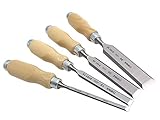
- Blades are made from highly alloyed Cr-Mn steel, hardened up to Rc 59.
- Meets DIN 5139 requirements.
- Handles are ergonomic with oval cross-section.
- Blade sizes: 6 mm (1/4"), 12 mm (1/2"), 20 mm (13/16") and 26 mm (1 1/32").
- Made in the Czech Republic.
25°: the normal bench-chisel setting
Use 25° when one chisel must handle a broad range of ordinary tasks: cleaning joints, chopping small waste areas, paring shoulders, and general fitting. A 25° primary bevel with a small 1°–2° micro-bevel is the most defensible one-number recommendation for a general-purpose chisel.
For a new chisel, start with its factory bevel if the edge performs properly. Regrinding it wastes time and steel, and a small difference in measured angle is rarely important in ordinary work.
About 30°: occasional chopping and harder wood
Around 30° is a useful working angle when a bench chisel sees occasional mallet use, encounters hard or knotty wood, or repeatedly loses its edge at 25°. A common arrangement is a 25° primary bevel with a narrow secondary bevel around 30°.
However, a 5° increase is not mandatory. Try a 1°–2° micro-bevel first. If the edge still rolls or chips, make the working bevel steeper. This changes only the small area at the edge and avoids grinding away the whole primary bevel.
About 30°–35°: mortising and regular striking
Dedicated mortise chisels and heavily struck firmer chisels need more support behind the edge than a paring tool. A working bevel in the 30°–35° range is a sensible starting point for ordinary mortising and repeated mallet blows.
Some specialist mortise chisels combine a relatively low primary bevel for penetration with a small, steeper secondary bevel—often around 35°—for reinforcement. This is why the large visible bevel does not always tell you the complete cutting geometry.
About 35°–40°: heavy use or fragile steel
Use a steeper working edge when the chisel is subjected to sustained heavy mortising, abusive conditions, very hard material, or repeated edge chipping. The stronger edge will not cut quite as freely, but it is less likely to fail under impact.
Rank #3

- EZARC premium set of wood chisel includes a variety of sizes, 1/4”(6mm), 3/8”(10mm), 1/2”(12mm), 5/8”(16mm), 13/16”(20mm), and 1”( 25mm), to cater to all your woodworking needs. Whether you're a seasoned woodworker or just starting out, this set is sure to impress.
- All chisels were made from fine-grained, nicely tempered chrome-vanadium steel with a hardness of HRC60 for long-lasting sharpness and ensuring a smooth finish.
- Beech wooden is a hard and dense wood species, making it highly resistant to wear and tear. This means that your chisel handle will last for years to come, even with frequent use. Finally, beech wood is a renewable resource, making it a more environmentally friendly option compared to synthetic materials.
- The carpentry chisel is precisely beveled ground at 25 degrees with an extremely sharp edge which can be used immediately after opening the package, easily cut mortises, shave rough surfaces, chop out corners and scrape off the glue with effortless.
- Professional chisel carefully packed in a wooden box, easy to store and transport. Ideal gift for beginners, hobbyists and professional wood artists.
Steeper is not always better. If a 35° or 40° edge is difficult to push, remove too much material, or prevents accurate paring, reserve that geometry for the chisel and task that actually require it.
What’s actually slowing this PC down?
Pick the symptom - the matching free tool is one click away.
Special cases that should not use the default blindly
Japanese chisels
Japanese chisels often use steeper bevels than Western paring chisels, commonly in the approximate 30°–35° range, although geometry varies by maker, construction, and intended use. Follow the maker’s guidance where available, then adjust based on the steel and the way the edge behaves.
Carving chisels and gouges
Do not transfer flat-backed bench-chisel advice directly to carving tools. Many carving chisels are beveled on both sides, commonly at about 20° per side. That is different from a cabinetmaking chisel with one bevel and a flat back. Gouges and other curved carving tools also require their own sharpening technique and edge geometry.
Brittle or highly wear-resistant steel
If a chisel chips at a low angle, increase the working bevel rather than assuming that the abrasive or sharpening technique is solely at fault. A useful diagnostic change is approximately 5° steeper, though a smaller increase may be enough.
Also consider the cut. A thin edge can fail because of twisting, levering, striking a knot, or taking too large a bite. A stronger bevel cannot make a chisel suitable for prying or sideways levering.
A practical sharpening procedure
- Identify the chisel’s job. Decide whether it is primarily for paring, general bench work, light chopping, or mortising.
- Inspect the existing bevel. If the factory angle is close to the appropriate range and the edge performs well, preserve it. Do not regrind unnecessarily.
- Prepare the back. Flatten and polish the area immediately behind the cutting edge. For ordinary precision work, you do not necessarily need to lap the entire back; a flat, polished area reaching across the edge is the critical part.
- Establish the primary bevel. Use about 25° for a general bench chisel, 15°–20° for a dedicated paring chisel, or the task-specific range above. Grind only when changing the geometry or repairing a damaged edge.
- Hone the primary bevel if needed. Progress from a coarse abrasive to finer abrasives until the edge is straight and the surface is refined.
- Add the micro-bevel. Raise the honing angle by approximately 1°–2° and polish a narrow strip at the edge. For extra support, a larger secondary angle such as 30° or 35° may be appropriate for the tool’s work.
- Remove the burr. Lay the back flat on a fine abrasive and make light passes until the wire edge disappears. Avoid rounding the back.
- Test the edge in the intended material. A sharp edge should cut cleanly rather than skid, crush fibers, or require excessive force.
- Adjust only if the evidence calls for it. If the edge rolls or chips, increase the working angle. If it cuts too aggressively or feels resistant during paring, the angle may be unnecessarily steep for that task.
For the sharpening workflow, a chisel honing guide can make 25°–35° angles and narrow micro-bevels more repeatable, particularly when sharpening a set of chisels. It is not essential—freehand sharpening is valid—but it reduces variation while you learn the correct blade movement and projection.
How to measure and reproduce the angle
Honing guides
A honing guide holds the blade at a repeatable angle. The blade projection from the guide determines the resulting bevel, so use the guide’s registration jig or projection chart rather than guessing from the guide body. This matters especially when switching between 20°, 25°, 30°, and 35°.
Veritas sharpening documentation, for example, maps common chisel applications across these ranges. A guide is most useful when establishing a new geometry, maintaining a consistent set, or creating a predictable micro-bevel.
Rank #4
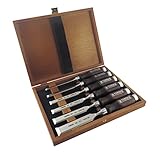
- 6 piece set comes on a wooden presentation box
- Blades are made from fine-grained, nicely tempered chrome-manganese steel and hardened to Rc 59
- Contains the following sizes: 6, 10, 12, 16, 20 and 26 mm
- Bevel ground at a 25 degree bevel.
- Handles are made from stained European Beech
Bevel gauges
A bevel gauge checks an existing bevel; it does not sharpen the chisel. A woodworking bevel gauge with slots in 5° increments can tell you whether an old edge is approximately 20°, 25°, 30°, 35°, or 40°. A digital bevel gauge can provide finer readings, but precise measurement is not usually necessary for routine maintenance.
Do these 3 things before closing this tab:
1Clear out junk files and repair common Windows errors2Scan for outdated or missing drivers - takes under a minute3Repair Windows errors before they cause bigger problemsUse an angle-checking gauge when diagnosing a problem or changing a tool’s geometry. For everyday sharpening, matching the existing bevel and producing a consistent micro-bevel are generally more valuable than chasing a perfect number.
For readers building the complete setup, a woodworking bevel gauge is the appropriate tool for checking an existing grind, while a honing guide is the appropriate tool for holding the blade during sharpening. They solve different problems.
Freehand sharpening versus guided sharpening
Freehand sharpening is perfectly workable. Most users do not need to measure every chisel, and a small rocking motion can naturally create a tiny convexity that supports the edge. The key is to keep the primary bevel reasonably consistent and avoid rounding the back.
A guide is preferable when:
- you are learning and cannot yet hold a stable angle;
- you are setting a new bevel accurately;
- you maintain several chisels to the same geometry;
- you need a repeatable 1°–2° micro-bevel; or
- you are troubleshooting edge failure and want to eliminate angle variation as a variable.
Neither method makes a poor angle suitable for the wrong task. A perfectly guided 20° bevel can still fail under heavy mortising, while a freehand 25° bench-chisel edge can perform very well.
PC Slower Than It Used to Be?
A free scan shows the junk files, broken settings and background clutter dragging Windows down - then fixes them in one click.Free scan · Windows 10 & 11Crashes, No Sound, or Screen Glitches?
Random freezes, missing sound and display glitches usually trace back to one bad driver. Find and replace yours safely.Free scan · under a minuteChoosing sharpening stones or other abrasives
The abrasive type is less important than using a consistent progression, keeping the back flat at the edge, and removing the burr. Waterstones, oilstones, diamond plates, and other systems can all produce a useful chisel edge when used correctly.
A coarse abrasive is useful for repairing damage or changing the primary bevel. A medium abrasive refines the bevel, and a fine abrasive polishes the micro-bevel and removes the remaining burr. A chisel sharpening stone set can be convenient for this coarse-to-fine workflow, but no single stone material is universally superior. Choose according to your maintenance preferences, flattening requirements, speed, and the steel being sharpened.
Independent reader supportYour contribution helps us test, update, and keep practical guides available for everyone.Troubleshooting by edge failure
| Symptom | Likely cause | Adjustment |
|---|---|---|
| Edge rolls over | Working angle is too low for the task, or the chisel was twisted or levered | Increase the micro-bevel angle by 1°–5° and avoid levering |
| Edge chips | Steel or edge is too brittle for the angle and impact | Use a steeper working bevel; take lighter cuts and inspect for knots |
| Chisel feels hard to push | Working bevel is unnecessarily steep or the edge is dull | Try a lower angle for paring work and refine the edge |
| Chisel cuts but leaves torn fibers | Edge is not fully refined, the burr remains, or the cut direction is wrong | Hone more finely, remove the burr from the back, and test with the grain |
| Sharpening takes too long | The entire bevel is being reground at every session | Maintain a narrow micro-bevel and grind only when its width becomes excessive |
Should you regrind a factory bevel?
Usually, no—not if the chisel cuts well and the bevel is reasonably close to the needs of the job. Factory angles are starting points, not errors that must be corrected. Preserve a sound 25° bevel on a bench chisel and add the working micro-bevel during honing.
Regrind when the existing geometry is clearly unsuitable, the edge is damaged, the bevel has become excessively wide from repeated sharpening, or the chisel is being reassigned to a different task. For example, converting a general bench chisel for frequent mortising may justify a stronger secondary bevel, while converting one for dedicated paring may justify a lower primary bevel.
Free tools Windows power users keep installed
One-click scans. No signup required.
Best Value

- 【 Professional Wood Chisel Set 】- Includes 6-50mm(1/4"-2") 8 sizes of wood chisels, 6mm, 10mm, 13mm, 19mm, 25mm, 32mm, 38mm, 50mm(¼", 3/8", ½", ¾", 1", 1-¼", 1-½", 2"), 1 honing guide and 1 alumina sharpening stone (120/200 grit), to meet various woodworking projects.
- 【Precision Pregrinding Chisel Heads】 - All woodworking chisel heads undergo precise 25 degree bevel pre grinding to ensure accuracy and sharpness, making it easy to cut mortises, scrape rough surfaces, cut corners, and scrape off glue.
- 【High Quality CR-V Blade】 - Our chisels for woodworking is made from chrome vanadium steel, hardened to Rockwell C60 for a long lasting sharp edge and durability. These wood chisels are durable and sharp enough for tough wood, fine carving and a variety of woodworking projects.
- 【Comfortable Wood Handle】 - The solid wood handle of our wood carving chisels are comfortable and beautiful to hold, sturdy and durable, and the end of the chisel handle is hooped with a metal ring, which is hammer-resistant and not easy to be deformed and broken, but it is still recommended to use a mallet or plastic hammer instead of an iron hammer.
- 【Sturdy Wooden Box】 - These 8 wood chisels are neatly organized in a wooden case that features double panels, padded hinges, and a protective EPE liner that ensures the woodworking chisels are safely stored and transported, Convenient for beginners and experts.
Buying context: one general chisel or several?
If you are starting from nothing, a general-purpose bevel-edge bench chisel around the 25° geometry is the most versatile first choice. It will not replace a dedicated low-angle paring chisel or a robust mortise chisel, but it covers the largest range of fitting and joinery work.
As the work becomes more specialized, separate tools are usually more practical than forcing one chisel to serve every role: a low-angle paring chisel for delicate hand work, a stronger bench or firmer chisel for striking, and a mortise chisel for repeated heavy blows.
Frequently Asked Questions
Is 25° or 30° better for a wood chisel?
25° is the better default primary bevel for a general bench chisel. Use a 30° working micro-bevel when the chisel sees occasional chopping, harder wood, or edge failure at 25°. For frequent mortising, use approximately 30°–35°.
What angle should a chisel be for sharpening?
For a normal Western bench chisel, maintain about a 25° primary bevel and hone a narrow micro-bevel about 1°–2° steeper. The correct working angle can range from roughly 15° for delicate paring to 40° for heavy mortising, depending on the tool and task.
Can I use a 20° bevel on a bench chisel?
You can, but a 20° edge is more fragile and is best reserved for a dedicated paring chisel used by hand. It should not normally be struck with a mallet.
Why does my chisel edge keep chipping?
The working bevel may be too low for the steel or the impact involved. Try increasing the working angle by approximately 5°, take lighter cuts, and avoid twisting or levering the chisel. A different chisel may also be needed for heavy mortising.
Do I need a honing guide to sharpen a chisel?
No. Freehand sharpening is valid if you can maintain a reasonably consistent bevel. A honing guide is useful for beginners, repeatability, consistent micro-bevels, and diagnosing edge problems.
The Bottom Line
For most bench chisels, use 25° as the primary bevel and hone a small micro-bevel 1°–2° higher. Go nearer 20° for hand-only paring, around 30° for occasional chopping, and 30°–40° for mortising and heavy impact. Let the edge’s actual behavior—rolling, chipping, or cutting resistance—tell you when to change the geometry.
Recommended Free Tools
Quick Recap
Product prices and availability are accurate as of the date/time indicated and are subject to change. Any price and availability information displayed on Amazon at the time of purchase will apply.




