The Tool Desk
Outbyte Driver Updater FREEFix the driver behind crashes, sound loss and screen glitchesFind Drivers →Outbyte PC Repair FREEClear out junk files and repair common Windows errorsFree Scan →Road construction signs warn you about changing conditions ahead, such as work activity, a lane restriction, a closure or a temporary route. Read the full sign—including its distance, arrow, route marker and destination—and follow the sequence of directions posted at the site. The explanations below describe standard U.S. sign conventions in the Federal Highway Administration’s 2023 Manual on Uniform Traffic Control Devices (MUTCD), 11th Edition, Part 6; the exact route and access rules depend on the project.
What do common road construction signs mean?
The sign legend identifies the kind of change or restriction ahead. Distance wording and arrows add information about where it begins or which way to go. These are general readings of the sign messages, not a guarantee of the precise layout or access rules at every work site.
As an Amazon Associate I earn from qualifying purchases.
| Sign | What it tells you | What to do |
|---|---|---|
| ROAD WORK (W20-1) | Work activity or a related traffic restriction is ahead. | Be ready for temporary traffic controls and changing road conditions. |
| DETOUR (W20-2) | A temporary reroute is ahead or indicated. | Follow the subsequent route signs and arrows rather than relying on this sign alone. |
| ROAD CLOSED (W20-3) | The route ahead is closed as indicated. | Do not proceed beyond the closure unless posted signs explicitly permit local access. |
| ONE LANE ROAD (W20-4) | Traffic is constrained to one lane in the indicated area. | Watch for opposing traffic and for a flagger or temporary signal where present. |
| RIGHT LANE CLOSED (W20-5) | The right lane is unavailable ahead. | Use the displayed distance to anticipate the restriction; merge or change lanes only when safe and permitted. |
The MUTCD also includes pedestrian and bicycle detour sign variants. A motor-vehicle detour therefore does not necessarily provide the route for a sidewalk or bike path.
Quick wins for a faster PC:
Scan for outdated or missing drivers - takes under a minuteDriver Scan →Clear out junk files and repair common Windows errorsFree Scan →Fix the driver behind crashes, sound loss and screen glitchesFind Drivers →How do you follow a road detour?
Treat a detour as a sequence of directions. An advance DETOUR sign warns that routing changes; route markers, arrows and destination signs guide you along the temporary path. Keep following those signs until they direct you back to the original route or identify the destination.
#1 Best Overall

- Complete Kit Included: Comes with one 36” x 36” fluorescent orange roll-up mesh safety sign, one 4-leg steel sign stand, and one pair of durable orange fiberglass cross ribs
- High-Visibility Mesh Material: Sign is constructed from premium 15 oz fluorescent orange tightly woven mesh for enhanced visibility in work zones and roadside applications
- Durable Corner Pocket Construction: Signs are equipped with reinforced corner pockets for secure cross rib support
- Stand & Sign Compatibility: Includes an universal bracket steel stand paired with sturdy corner pockets for secure sign attachment and dependable jobsite performance
- Compact & Portable Design: Lightweight waterproof steel stand folds down compactly for convenient transport, storage, and quick deployment
- Read the whole sign. Note the route designation, destination, arrow and any distance—not only the word DETOUR.
- Follow each subsequent direction. Use the posted arrows and route signs in order. Do not assume an early arrow or plaque is the only direction you need.
- Continue until the signs resolve the route. Follow them back to the original highway or onward to the signed destination.
A DETOUR plaque and an arrow do different jobs: the plaque identifies temporary detour routing, while an arrow can show direction along that route. The MUTCD says, “Each detour shall be adequately marked with standard temporary route signs and destination signs.”
What should you do when a lane is closed?
Use the sign’s lane designation and distance to understand which lane is affected and where the restriction begins. Change lanes only when it is safe and permitted by the signs and conditions. At a ONE LANE ROAD location, be alert for opposing traffic and any flagger or temporary signal. A lane restriction is not the same message as a ROAD CLOSED sign.
Rank #2
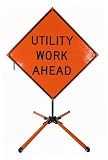
- Complete Sign & Stand Kit – Includes one 36” high-visibility roll-up safety sign and one 4-leg steel sign stand
- High-Visibility Sign Face – Bright fluorescent orange sign face enhances visibility on job sites; available in mesh, non-reflective, or reflective versions
- Portable & Easy to Store – Lightweight steel stand folds down compactly for quick transport and convenient storage
- Quick-Deploy Stand – Kick-release levers allow each leg to be lowered individually for fast setup on the job site
Why are construction signs orange?
In the MUTCD’s 11th Edition, additional temporary traffic-control guide signs use a black legend and border on an orange background. FHWA explains that orange is used broadly for temporary traffic patterns, while fluorescent pink is reserved for short-duration incident-management contexts. Its interpretation says detour signs are temporary and are removed when the activity requiring the detour ends: FHWA interpretation 4(386).
Do these 3 things before closing this tab:
1Scan for outdated or missing drivers - takes under a minute2Clear out junk files and repair common Windows errors3Fix the driver behind crashes, sound loss and screen glitchesWhat can change from one project to another?
The MUTCD sets national sign conventions, but the route, timing, permitted access and exact placement are specific to the location. Active closures and detours can change. For a particular trip, check the relevant state or local transportation agency’s current travel information and follow the signs actually posted at the site, including temporary arrows and instructions from authorized personnel.
Quick Recap
Best Value

- Complete Sign & Stand Kit – Includes one 36” high-visibility roll-up safety sign and one 3-leg tripod steel sign stand
- High-Visibility Sign Face – Bright fluorescent orange sign face enhances visibility on job sites; available in mesh, non-reflective, or reflective versions
- Portable & Easy to Store – Lightweight steel stand folds down compactly for quick transport and convenient storage
- Powder coated steel stand for Low to Medium Wind Conditions
Rank #4

- Complete Sign & Stand Kit – Includes one 36” high-visibility roll-up safety sign and one 4-leg steel sign stand
- High-Visibility Sign Face – Bright fluorescent orange sign face enhances visibility on job sites; available in mesh, non-reflective, or reflective versions
- Portable & Easy to Store – Lightweight steel stand folds down compactly for quick transport and convenient storage
- Quick-Deploy Stand – Kick-release levers allow each leg to be lowered individually for fast setup on the job site
Rank #3

- Complete Kit Included: Comes with one 36” x 36” fluorescent orange roll-up mesh safety sign, one 4-leg steel sign stand, and one pair of durable orange fiberglass cross ribs
- High-Visibility Mesh Material: Sign is constructed from premium 15 oz fluorescent orange tightly woven mesh for enhanced visibility in work zones and roadside applications
- Durable Corner Pocket Construction: Signs are equipped with reinforced corner pockets for secure cross rib support
- Stand & Sign Compatibility: Includes an universal bracket steel stand paired with sturdy corner pockets for secure sign attachment and dependable jobsite performance
- Compact & Portable Design: Lightweight waterproof steel stand folds down compactly for convenient transport, storage, and quick deployment
Product prices and availability are accurate as of the date/time indicated and are subject to change. Any price and availability information displayed on Amazon at the time of purchase will apply.




