An LNB is the small electronic unit mounted at the end of a satellite dish arm. It receives the extremely weak signal focused by the dish, amplifies it with minimal added noise, and converts its very high microwave frequency into a lower frequency that can travel through coaxial cable to a satellite receiver, modem, or tuner.
LNB usually means Low-Noise Block Downconverter. It is not the same thing as the dish: the dish reflects and focuses the signal, while the LNB performs the first active electronic processing.
As an Amazon Associate I earn from qualifying purchases.
Where is the LNB?
On a conventional satellite dish, the LNB is the cylindrical or rectangular weatherproof unit at the end of the feed arm, facing the reflector. It sits close to the dish’s focal point and normally has one or more coaxial cable connectors.
PC Slower Than It Used to Be?
A free scan shows the junk files, broken settings and background clutter dragging Windows down - then fixes them in one click.Free scan · Windows 10 & 11Crashes, No Sound, or Screen Glitches?
Random freezes, missing sound and display glitches usually trace back to one bad driver. Find and replace yours safely.Free scan · under a minuteMany consumer products combine the feedhorn and LNB electronics in one outdoor assembly. This is why people often call the entire front-end unit “the LNB,” even though the feedhorn and electronic converter perform different jobs.
#1 Best Overall

- High Performance: Features a low noise figure of 0.1 dB for superior signal reception.
- Wide Frequency Range: Capable of receiving signals from 10.7 GHz to 12.75 GHz, suitable for various FTA Universal satellite TV broadcasts.
- Durable Design: Robust construction ensures reliability and longevity in outdoor conditions, YIYIMIMO single LNB provide rubber waterproof cap as well.
- Easy Installation: Designed for straightforward setup with standard satellite dishes and compatible with satellite receivers.
- Versatile Compatibility: Works with HD 3D 4K and standard definition satellite signals, making it ideal for diverse viewing needs.
Satellite transmitter
        ↓
Dish reflector — focuses the microwave signal
        ↓
Feedhorn and LNB — captures, amplifies and downconverts it
        ↓
Coaxial cable
        ↓
Receiver, TV tuner, modem or SDR
Some flat-panel antennas integrate the receiving electronics into the antenna itself, so they may not have a separate, user-replaceable LNB.
Inverto’s technical explanation describes the feedhorn and LNB relationship in more detail.
What does an LNB do?
1. Receives the focused signal
The curved dish reflector gathers radio waves from the satellite and concentrates them at the focal point. The feedhorn captures that focused microwave energy.
The Tool Desk
Outbyte PC Repair FREEClear out junk files and repair common Windows errorsFree Scan →Outbyte Driver Updater FREEScan for outdated or missing drivers - takes under a minuteDriver Scan →2. Amplifies a very weak signal
Satellite signals can be extremely weak by the time they reach a home installation. The LNB is the first active electronic stage and amplifies the signal while trying to add as little noise as possible.
3. Downconverts the frequency
Satellite signals arrive at frequencies that are too high for ordinary coaxial cable and consumer receivers to handle directly. The LNB uses a local oscillator and mixer to shift the signal down to an intermediate-frequency range.
For a common universal Ku-band system, an LNB may convert approximately 10.7–12.75 GHz input signals to roughly 950–2,150 MHz. These are representative figures, not universal specifications for every LNB. See RF Essentials’ LNB frequency-converter overview and Televes’ technical description.
The lower-frequency output can then travel through coaxial cable to the receiver, which demodulates and decodes the service.
Rank #2
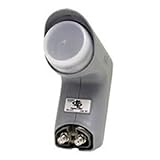
- Installation takes just minutes
- This item is designed to be used with a SECOND DISH, alongside a DISH 500 Antenna equipped with a DishPRO PLUS LNBF.
- Use this item on a SECOND DISH to capture signals from a THIRD Dish Network SATELLITE such as the 110,129, 61.5° or 148° satellite and feed those signals into the plus port on the DishPRO Plus LNBF
- A DISH Pro Dual LNBF looks at one orbital location.
- It has two output ports to directly connect to one or two receivers. It can also connect to DISH Pro DP44 switch, if needed.
What “low-noise,” “block,” and “downconverter” mean
- Low-noise: The LNB is designed to amplify the weak signal without significantly degrading it. Noise performance may be described by noise figure, noise temperature, or the system-level G/T figure.
- Block: It processes a range, or block, of frequencies rather than just one channel.
- Downconverter: It changes the high-frequency satellite signal to a lower intermediate frequency for transmission over coaxial cable.
A lower advertised noise figure can be beneficial, but it does not guarantee better reception. Dish diameter, alignment, focal-point position, LNB rotation, weather, cable loss, interference, receiver sensitivity, and the satellite’s signal strength can matter more than a small difference in the printed specification. Published figures may also be measured under different conditions.
How the receiver controls a conventional Ku-band LNB
The same coaxial cable commonly carries both the converted signal from the LNB to the receiver and DC power and control signals from the receiver to the LNB.
13/18-volt polarization control
In many conventional universal Ku-band systems, the receiver uses approximately 13 volts for one polarization and approximately 18 volts for the other. This is often described as vertical/horizontal selection, but the exact labels and implementation depend on the system.
22-kHz band selection
A receiver can add a 22-kHz tone to request the other Ku-band sub-band. Common universal LNBs use:
Free tools Windows power users keep installed
One-click scans. No signup required.
- Tone off for the lower band
- Tone on for the upper band
A universal Ku-band LNB commonly has 9.75 GHz and 10.6 GHz local oscillators for these two portions of the band. This switching method does not apply to every LNB.
DiSEqC
DiSEqC commands can select between multiple satellites, switches, or LNB inputs. DiSEqC is separate from the basic LNB function, and compatibility depends on the receiver, switch, LNB type, and overall wiring design.
Common LNB types
| Type | Typical use | Important qualification |
|---|---|---|
| Single | One independent tuner | One output does not necessarily mean one television; recording or multi-tuner equipment may need more. |
| Twin | Two independent tuners | Each output can normally select its own band and polarization. |
| Quad | Up to four direct independent connections | Its four outputs are independent and normally connect directly to tuners or receivers. |
| Quattro | Multiswitch distribution | Its four outputs are fixed band/polarization feeds: vertical low, vertical high, horizontal low, and horizontal high. |
| Universal Ku-band | Common Ku-band satellite television | “Universal” generally means low/high Ku-band switching, not compatibility with every satellite system. |
| Monoblock or Duo | Two closely spaced satellite positions | Designed for particular spacing, often around 3°, 4.3°, or 6°, depending on the model. |
| Unicable or dCSS | Multiple tuners over one coaxial cable | The receivers, LNB or multiswitch, and wiring must support the same standard and configuration. |
| Circular-polarization | Services using right- or left-hand circular polarization | Not interchangeable with a linear-polarization LNB merely because the frequency range looks similar. |
| PLL | Weak-signal, data, or SDR applications | A phase-locked-loop oscillator can provide useful frequency stability and phase-noise performance, but is not automatically best for every TV installation. |
Inverto’s product documentation explains the practical difference between quad and quattro LNBs.
Rank #3

- Universal Compatibility – Works with most standard satellite dishes and digital satellite receivers worldwide.
- Polarized Signal Reception – Supports horizontal and vertical polarization for improved channel separation and signal quality.
- High Gain Performance – 50db - 60db Maximizes signal strength, perfect for weak signal areas or distant satellites.
- Low Noise Technology – 0.3db Reduces signal interference for a cleaner, sharper HD picture and sound output.
- Weatherproof Design – Sealed casing protects against rain, snow, and extreme temperatures for year-round performance.
Ku-band, Ka-band, and C-band LNBs
An LNB must match the satellite system’s frequency band. Representative receive ranges include:
Recommended Free Tools
- C band: approximately 3.7–4.2 GHz in one receive-system example
- Ku band: approximately 10.7–12.75 GHz
- Ka band: approximately 17.7–21.2 GHz in one example
Actual allocations vary by service, region, and satellite plan. A universal Ku-band LNB is not a general-purpose replacement for a C-band, Ka-band, or proprietary satellite-internet unit. RevGo’s product information illustrates how different the required frequency ranges can be.
How to choose a replacement LNB
Do not choose solely by output count or the lowest advertised noise figure. Match the replacement to the complete installation.
- Identify the frequency band. Confirm whether the service uses C, Ku, Ka, or another specialized band.
- Check polarization. Determine whether the system uses horizontal/vertical linear polarization, left/right circular polarization, or a specialized arrangement.
- Match the receiver architecture. Check for conventional 13/18-volt and 22-kHz control, DiSEqC, Unicable, dCSS, a multiswitch, or operator-specific equipment.
- Choose the correct output architecture. Use a single, twin, or quad for the required number of independent direct connections; use a quattro with a compatible multiswitch.
- Match the local oscillator. The receiver’s LNB settings must correspond to the replacement’s local-oscillator frequency or frequencies.
- Check the physical mount. A 40-mm neck is common on consumer Ku-band dishes, but 23-mm, 60-mm, flange, long-neck, and short-neck designs also exist.
- Check feed geometry. The LNB must fit the dish’s feed arm and sit correctly at the focal point. A compatible electronic specification cannot compensate for poor positioning.
- Consider stability when appropriate. Standard television reception may not require a specialized PLL design, while weak-signal, narrowband, data, or SDR work can place greater importance on oscillator stability and phase noise.
Inverto’s catalogue separates Universal Ku, circular, Ka-band, monoblock, quad, quattro, and Unicable products. That separation is a useful reminder that “best LNB” is not a meaningful choice until the system requirements are known.
Safe replacement procedure
For a straightforward, accessible installation:
- Record the old LNB’s model, frequency range, local oscillator, connector count, and receiver settings.
- Confirm the satellite service and polarization type.
- Photograph every cable connection before removal.
- Switch off or disconnect receiver power before disturbing outdoor coaxial connections.
- Install an LNB with the matching band, polarization, mount, output architecture, and local oscillator.
- Reconnect the coaxial cables firmly and weatherproof outdoor connections.
- Confirm the receiver’s LNB type and local-oscillator settings.
- Check signal quality on a known working transponder.
- Only adjust LNB rotation or focal position if the dish design and installation require it.
- If reception remains absent, check the cable, connectors, receiver LNB-voltage output, and dish alignment before assuming the replacement is faulty.
Do not work on a roof, ladder, or outdoor electrical equipment during storms or unsafe conditions. For roof-mounted dishes or installations requiring repositioning, use a qualified installer. Inverto’s installation guidance includes connection and safety recommendations.
Do these 3 things before closing this tab:
1Scan for outdated or missing drivers - takes under a minute2Clear out junk files and repair common Windows errors3Fix the driver behind crashes, sound loss and screen glitchesLNB troubleshooting by symptom
No signal after replacing the LNB
Check for a wrong frequency band, polarization type, local-oscillator setting, quad/quattro mismatch, incompatible Unicable or dCSS configuration, damaged coax, a shorted connector, missing receiver power, dish movement, incorrect focal position, or incorrect LNB skew.
Some channels work but others do not
This often indicates a band, polarization, switching, or configuration problem rather than a completely failed LNB. Determine whether the missing channels are all on one polarization or one high/low band. Then check the receiver’s 13/18-volt and 22-kHz settings, the LNB configuration, and any multiswitch connections.
Rank #4

- Picks up satellites:101-110-119.
- Standard definition programming plus spanish language channels
- Connect up to 4 tuners.
- To be used with 18x20 satellite dish
Only one polarization is missing
Possible causes include a failed LNB polarization circuit, incorrect receiver voltage, a short or damaged cable, a bad connector, or a multiswitch problem.
Only high-band or low-band channels are missing
Check the 22-kHz tone, universal-LNB settings, local-oscillator frequencies, and multiswitch input wiring.
One receiver works but another does not
Test the suspect output with a known-good cable and receiver if possible. The fault may be a failed LNB output, damaged cable, receiver-specific power or control circuitry, a failed multiswitch port, or a quad/quattro wiring error.
Reception disappears in rain
Rain fade is a link-budget problem, especially at higher frequencies such as Ku and Ka band. It can expose a marginal dish size, poor alignment, water ingress, damaged cable, or aging equipment, but rain-related loss does not by itself prove that the LNB is defective.
Signal strength is high but signal quality is low
Possible causes include alignment on the wrong satellite, incorrect LNB skew, a wrong LNB type, local interference, a bad connector, excessive cable loss, or incorrect receiver settings. Receiver labels are not standardized, so “strength” and “quality” should be treated as manufacturer-specific indicators rather than identical measurements.
The LNB works directly but not through the distribution system
This points toward a multiswitch, splitter, power inserter, DiSEqC, or Unicable configuration problem. Ordinary terrestrial TV splitters are not automatically suitable for satellite intermediate-frequency signals or for passing the required DC and control signals.
What an LNB is not
LNB versus LNA
An LNA is a low-noise amplifier. An LNB normally includes an LNA, but also performs frequency conversion and often polarization or band switching. Calling an LNB only an amplifier leaves out its downconverter function.
Best Value
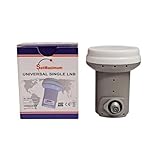
- Universal Compatibility – Works with most standard satellite dishes and digital satellite receivers worldwide.
- Polarized Signal Reception – Supports horizontal and vertical polarization for improved channel separation and signal quality.
- High Gain Performance – 50db - 60db Maximizes signal strength, perfect for weak signal areas or distant satellites.
- Low Noise Technology – 0.1db Reduces signal interference for a cleaner, sharper HD picture and sound output.
- Weatherproof Design – Sealed casing protects against rain, snow, and extreme temperatures for year-round performance.
LNB versus BUC
An LNB is primarily a receive component. A BUC, or block upconverter, is primarily a transmit component that converts a lower-frequency signal upward for satellite transmission.
LNB versus satellite receiver
The LNB is outdoors at the dish and delivers a converted intermediate-frequency signal. The receiver is indoors and tunes, demodulates, decodes, and outputs the service to the TV or network.
LNB versus satellite-internet terminal
Satellite-internet equipment may use integrated receive/transmit assemblies, electronically steered antennas, modems, and proprietary outdoor units. A generic universal Ku-band TV LNB should not be assumed to replace one.
Quick wins for a faster PC:
Repair Windows errors before they cause bigger problemsFix Now →Scan for outdated or missing drivers - takes under a minuteDriver Scan →Clear out junk files and repair common Windows errorsFree Scan →When replacing the LNB will not fix reception
A failed LNB is only one possible cause of poor reception. Replacement will not solve a blocked line of sight, incorrect satellite alignment, a loose dish mount, a damaged cable, water in a connector, insufficient dish size, receiver configuration errors, a failed multiswitch, local interference, or a service outage.
For construction or property-maintenance work, take particular care not to move the dish while repairing the mounting surface, roof, fascia, chimney, or feed arm. Even a small alignment change can reduce signal quality while leaving apparent signal strength unchanged.
Key takeaway
The LNB is the dish’s active receiving and frequency-conversion unit. The reflector focuses the satellite signal; the LNB captures it, adds low-noise gain, selects the required band and polarization, and converts it to a lower frequency for the receiver. When replacing one, compatibility with the band, polarization, local oscillator, mounting geometry, output architecture, and receiver controls matters more than a headline noise figure or the number of connectors.
Quick Recap
Product prices and availability are accurate as of the date/time indicated and are subject to change. Any price and availability information displayed on Amazon at the time of purchase will apply.
What’s actually slowing this PC down?
Pick the symptom - the matching free tool is one click away.




