Some links on this page are affiliate links: if you buy through them we may earn a commission, at no extra cost to you.
To keep weeds from growing in your driveway, do not stop at spraying the green growth. Kill or remove the weeds, clean out the crack or joint, remove the dirt and roots, then repair the opening so seeds do not have a damp place to settle again. On asphalt and concrete, that usually means crack sealing. On pavers, it means clean, full joints with properly installed sand. On gravel, it means enough stone depth, a stable fabric separator, firm edging, and grading that sheds water.
On our job sites, we see the same pattern again and again: weeds usually are not punching through sound asphalt or concrete. They are growing where the driveway already gave them an opportunity: an open crack, a paver joint full of soil, a gravel edge contaminated by lawn dirt, or a low spot that holds water and sediment. If you only burn, pull, or spray the weeds, the driveway still has the same open nursery waiting for the next round of seeds.
As an Amazon Associate I earn from qualifying purchases.
The right fix depends on the surface. A 1/8-inch concrete control joint needs different treatment than a 1/2-inch asphalt crack, and both are different from a gravel driveway that has thinned down to bare soil at the tire paths. This guide breaks the work down by driveway type, with realistic 2026 costs, safety cautions, and the point where a homeowner should stop patching and call a pro.
Why Weeds Keep Coming Back in Driveways
Weeds need four things: a place to lodge, a little soil or organic matter, moisture, and sunlight. Driveways accidentally provide all four when cracks, joints, edges, and gravel voids collect leaves, dust, sand, grass clippings, and windblown seeds.
Popular on Amazon
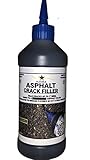
- DIY - Fast & Easy To Apply - No Special Tools Needed
- Formulated To Remain FLEXIBLE in HOT and COLD Weather
- Fill Cracks up to ONE INCH WIDE
- Seals Cracks To Prevent Further Damage
- MADE IN THE U.S.A.
Intact asphalt and concrete are not friendly growing surfaces. A solid slab or pavement mat has no root zone. The trouble starts when movement, water, freeze-thaw cycles, settlement, tree roots, or poor base preparation create openings. Once a crack opens, water carries fine soil into it. Leaves and clippings decay. Seeds land in the joint. Roots follow the moisture downward. Over time, the roots widen the opening and trap more debris, which makes the next weed crop easier.
Edges are just as vulnerable. When a lawn or planting bed sits higher than the driveway edge, soil washes onto the pavement. If the edge is unsupported, asphalt can crumble, pavers can spread, and gravel can migrate into the grass. That creates a ragged, damp strip where weeds thrive.
Drainage is the hidden driver. A driveway that holds standing water after rain will grow weeds faster than one that dries quickly. Low spots collect sediment. Open cracks stay wet. Gravel fines settle into the voids. Paver joints stay damp long enough for seeds to germinate. Before spending money on herbicides or sealers, look at where the water goes during a storm. If water is sitting for more than a few hours, weed control will be a recurring job until the drainage is corrected.
The Best Long-Term Method: Remove, Clean, Repair, Prevent
The most reliable process is the same whether the driveway is asphalt, concrete, pavers, or gravel. The materials change, but the sequence does not.
- Kill or loosen existing growth. Treat actively growing weeds with a labeled post-emergent herbicide, pull them by hand, use boiling water on small annual weeds, or use a flame weeder where fire risk is low and local rules allow it.
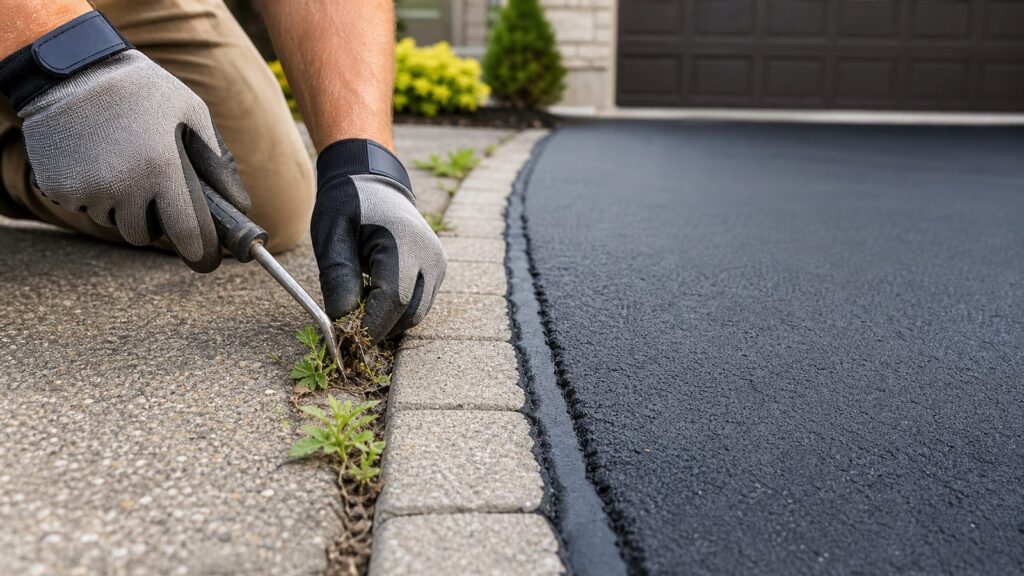
- Remove roots and debris. Dead weeds still leave roots and organic matter behind. Use a crack weeder, screwdriver, stiff brush, shop vacuum, blower, or pressure washer to clean the opening.
- Let the area dry. Crack fillers, sealants, and polymeric sand fail when installed into damp, dirty joints unless the product specifically allows it.
- Repair the opening. Fill asphalt cracks, seal concrete joints with flexible sealant, refill paver joints, or rebuild thin gravel areas.
- Prevent new seed germination. Use a pre-emergent where appropriate, keep edges clean, maintain slope, and remove leaves and soil before they settle into joints.
That order matters. Sealing over living weeds or loose dirt traps failure inside the repair. Spraying weeds after crack filler or polymeric sand installation can stain the surface or weaken the joint depending on the product. Clean first, repair second, prevent third.
Driveway Weed Control by Surface Type
The mistake many homeowners make is treating every driveway the same. The durable fix for an asphalt driveway is not the durable fix for pavers or gravel. Use the surface type as your starting point.
Outdated Drivers Are Slowing You Down
One free scan finds every outdated or missing driver and matches the right update for your exact hardware.Free scan · exact hardware matchPC Slower Than It Used to Be?
A free scan shows the junk files, broken settings and background clutter dragging Windows down - then fixes them in one click.Free scan · Windows 10 & 11Asphalt Driveways
Asphalt is flexible, but it still cracks as it ages. Sun exposure dries the binder. Water enters small cracks. Freeze-thaw movement widens them. Vehicle loads press down on softened or poorly supported areas. Weeds show up after soil and organic matter collect in those openings.
For narrow cracks under about 1/4 inch, a DIY asphalt crack filler may be enough if the pavement is otherwise sound. Clean the crack thoroughly, remove every root you can reach, blow or vacuum out loose material, and apply filler according to the label. Small bottles or tubes of crack filler often cost about $5 to $10 and may cover roughly 24 linear feet of narrow cracks, depending on width and depth.
For wider cracks, recurring cracks, alligator cracking, or crumbling edges, the driveway may need professional crack repair or partial patching. Current 2026 pricing commonly runs about $1 to $3 per linear foot for asphalt crack filling, with minimum service charges often around $100 to $250. Whole-driveway crack repair minimums can land around $100 to $400 before sealcoating or larger patches.
Sealcoating helps protect asphalt, but it is not a structural crack repair. On our asphalt work, cracks get cleaned and filled before sealer goes down. Sealcoat should not be used to bridge open cracks, sunken areas, or edge failures. Professional asphalt driveway sealing is often quoted around $1.25 to $1.50 per square foot when labor and materials are included, although simpler sealcoating-only scopes may be advertised around $0.20 to $0.50 per square foot. The difference is scope: cleaning, edging, crack filling, oil spot treatment, number of coats, and minimum trip charges all change the final number.
If you hire the work out, ask whether vegetation removal, crack routing, crack cleaning, hot-applied or cold-pour sealant, and pre-seal pressure washing are included. Pressure washing before sealing can add about $100 to $500 depending on driveway size, staining, access, and equipment.
Concrete Driveways
Concrete weeds usually appear in control joints, expansion joints, slab separations, and cracks. Concrete itself is rigid, so the joint material has to handle movement. A rigid patch compound placed into a moving joint often cracks loose during temperature swings or freeze-thaw cycles.
Also popular on Amazon

- IDEAL BLACKTOP — Sikaflex black self-leveling caulk is the perfect choice for filling cracks and gaps in asphalt driveways, pavements, walkways, and similar surfaces
- TOUGH AND DURABLE — Formulated to resist weathering and aging, this asphalt sealer features a permanent elasticity that also helps prevent tearing and cracking
- TOUGH AND DURABLE — Formulated to resist weathering and aging, this asphalt sealer features a permanent elasticity that also helps prevent tearing and cracking
- FAST-ACTING — Once your asphalt sealant is applied, required skin time is typically less than 60 minutes, so long as temperature and humidity is moderate
- READY TO USE — Sealant comes ready for use in handy cartridges that fit most standard caulk guns. No mixing is required. Condition cartridge to between 65 °F and 75 °F prior to use for best results
For control joints and expansion joints, clean the joint to sound material. Remove weeds, roots, rotten wood, old loose sealant, and packed dirt. For deeper joints, install backer rod so the sealant has the correct shape and does not waste material at the bottom of the joint. Then use a flexible concrete joint sealant rated for exterior pavement.
As a practical rule, sealant performs better when the joint is clean, dry, and proportioned correctly. Many exterior sealants are designed to bond to the sides of the joint, not the bottom. Backer rod helps create that profile. If you simply pump caulk into a deep, dirty crack, the top may skin over while the lower material stays weak or disconnected.
Professional concrete driveway crack filling is commonly priced around $0.50 to $3 per linear foot in 2026, with minimum fees often around $100 to $250. Small DIY repairs can be inexpensive, but settlement, slab heaving, structural cracking, resurfacing, mudjacking, or slab replacement can move the project from hundreds into thousands of dollars.
Watch the crack pattern. A single clean shrinkage crack is one thing. A slab corner that has dropped 1 inch, a crack with vertical displacement, or several cracks radiating from a low spot is a base or movement issue. Weed control will not last until the slab movement is addressed.
Paver Driveways
Paver driveways are jointed systems by design. The joints allow the surface to flex, but they also create places where seeds can settle if the joints lose sand or fill with soil. Weed prevention depends on clean, full joints and stable edges.
Polymeric sand can reduce weed growth when installed correctly. It is not magic, and it will not fix a poorly draining or moving paver system by itself. Failures are common when the joints are damp, dusty, underfilled, poorly compacted, contaminated with old soil, overwatered, or not cleaned from the paver faces before activation.
What’s actually slowing this PC down?
Pick the symptom - the matching free tool is one click away.
For an existing paver driveway, the usual process is to remove old contaminated joint material to the depth required by the sand manufacturer, pressure wash or clean the joints, allow the surface to dry, install sand, compact it into the joints, sweep the surface clean, and water exactly as the bag directs. Overwatering can wash binders out. Under-watering can leave the joint weak. Leaving a dusty film on the paver surface can create a haze that is difficult to remove.
Big-box polymeric sand commonly costs around $30 for a 35-pound bag, while specialty 50-pound products often run about $40 to $60 per bag. Coverage varies heavily with paver size, joint width, joint depth, and waste. A driveway with wide, deep joints can use far more sand than a tight walkway.
Edge restraint matters. If the pavers are spreading at the edges, fresh sand will not stay tight for long. Restore or add hard edging along paver borders to reduce soil migration from lawns and planting beds and to keep the paver field locked together.
Gravel Driveways
Gravel driveways are the most weed-prone because they are open systems. Stone voids can collect soil. Thin gravel exposes the subgrade. Tire tracks push fines downward. Edges blend into the lawn. Once soil and sunlight reach the top few inches, weeds have what they need.
Quick wins for a faster PC:
Fix the driver behind crashes, sound loss and screen glitchesFind Drivers →Repair Windows errors before they cause bigger problemsFix Now →The long-term fix is not just spraying. A durable gravel driveway needs a compacted subgrade, proper stone depth, woven geotextile separation where appropriate, a crowned or sloped profile, and periodic regrading or top-dressing. The geotextile separates the aggregate from the soil below so the stone does not disappear into the subgrade. The crown or slope sheds water so sediment does not sit in the tire paths.
For an existing gravel drive, start by removing weeds and organic buildup. Regrade low areas, restore the crown, and add stone where the driveway has thinned. A common target is enough aggregate depth that tires are riding on stone, not churning the soil underneath. Many residential gravel sections need several inches of compacted aggregate to stay stable, and heavily used drives may need a layered base and surface stone rather than a single thin top-dress.
Also popular on Amazon

- LONG-LASTING SEALANT - Fortified with plasticizers for added flexibility, Jetcoat Premium Elasto Asphalt Crack Filler is designed to enhance and repair asphalt pavement surfaces. This asphalt driveway filler is polymer-modified and emulsion-based for ultimate sealing power.
- GREAT FOR MULTIPLE SURFACES - Use this extra strength driveway filler on all types of asphalt pavements and blacktop surfaces. Quickly fill in cracks, holes, gaps, and breaks with this dynamic and powerful sealant in parking lots, airports, athletic courts, driveways, traffic safety islands, playgrounds, and walkways.
- READY TO USE - This sealant comes ready to fill and seal any blacktop surface. Simply stir the sealer to a uniform consistency and continue to stir throughout the application process. Dries black.
- EASY APPLICATION - Shake well and use the included spout to pour product into the crack slightly above surface level. The material may settle, requiring a second application. Always allow 24 hours between applications. To prevent cracking or tracking, avoid heavy or uneven application.
- LONG-LASTING REPAIR - Our polymer-modified asphalt emulsion-based crack sealant has resilient characteristics that allow for self-healing quality and lasting results. It has excellent low temperature durability, zero issues with high temperature tracking, and dries fast.
In 2026, basic gravel driveway installation is commonly cited around $1 to $3 per square foot, with professional installation often around $2 to $4 per square foot. Gravel itself often runs about $30 to $100 per ton before delivery and placement variables. Costs change with excavation, geotextile, stone type, depth, drainage work, delivery distance, grading, compaction, and local labor.
Weed Killers, Vinegar, Boiling Water, and Flame Weeding
There is a place for weed killers, but they should support the driveway repair plan, not replace it. Choose the method based on the weed, the surface, nearby plants, runoff risk, and your tolerance for repeat work.
The Tool Desk
Outbyte PC Repair FREEClear out junk files and repair common Windows errorsFree Scan →Outbyte Driver Updater FREEFix the driver behind crashes, sound loss and screen glitchesFind Drivers →Post-Emergent Herbicides
Post-emergent herbicides are for weeds you can already see. Glyphosate is a non-selective post-emergent herbicide registered in the United States since 1974. It controls many grasses and broadleaf weeds when applied to actively growing plants, but it does not provide long-term residual prevention by itself unless paired with a label-approved residual product.
Non-selective means it can injure or kill desirable plants too. Do not spray on windy days. Do not spray to runoff. Avoid application before rain or irrigation. Follow the label for protective gear, mixing, timing, reentry, and disposal. The label is not a suggestion; it governs legal and safe use.
For driveway cracks, a careful spot application is usually better than broadcast spraying. Treat the foliage, wait for the product to work according to the label, then remove the dead plant material and clean the crack before sealing.
Pre-Emergent Products
Pre-emergent products help prevent seeds from germinating. They do not kill established weeds. They are most useful after the driveway is cleaned and repaired, especially along gravel edges, paver joints, and recurring crack zones where seeds keep landing.
Do these 3 things before closing this tab:
1Clear out junk files and repair common Windows errors2Fix the driver behind crashes, sound loss and screen glitches3Repair Windows errors before they cause bigger problemsTiming matters. Early spring is a common window before warm-season annual weeds germinate, with follow-up timing depending on the product, climate, and label. If you apply a pre-emergent after weeds are already established, you still need a post-emergent or physical removal for the existing growth.
Vinegar and Boiling Water
Household vinegar, horticultural vinegar, and boiling water can burn down young annual weeds on hardscapes. They are most effective on small, tender plants. Established perennial weeds with deep roots often regrow because the root system survives.
Vinegar is non-selective and can damage nearby grass and landscape plants. Stronger vinegar products can irritate skin and eyes. Boiling water is simple, but it carries burn risk and is awkward on long driveways. Both methods are usually short-lived, so the real cost is the repeat labor over the growing season.
Salt-Based DIY Recipes
We do not recommend salt as a routine driveway weed control method. Salt can move with runoff, damage nearby lawns and planting beds, persist in soil, contribute to corrosion, and create problems near wells, storm drains, concrete reinforcement, and sensitive drainage areas. It may look cheap on day one, but it is not a clean construction or landscape maintenance practice.
Recommended Free Tools
Flame Weeding
Flame weeding can work on small young weeds in cracks and gravel, but it is non-selective and often requires repeat passes. The goal is to heat the plant tissue, not burn the plant to ash. Fire risk is the limiting factor. Avoid flame weeding in dry, windy conditions, near mulch, near structures, during drought restrictions, or where local rules prohibit it. Keep water or an extinguisher nearby and do not use flame around fuel spills, dry leaves, or stored materials.
Also popular on Amazon

- ASPHALT-MATCHING FINISH: Colored and textured to blend seamlessly with asphalt for a uniform, professional look.
- DURABLE & FLEXIBLE SEAL: Ideal for cracks and joints in driveways, parking lots, and walkways—remains flexible to resist cracking.
- PREVENTS WATER DAMAGE: Forms a strong, water-resistant seal to block moisture, frost, and erosion.
- ADHERES TO DAMP SURFACES: Can be applied in wet or humid conditions, ensuring reliable repairs in less-than-ideal weather.
- EASY TO APPLY: 10.1 fl oz cartridge fits standard caulking guns for fast, clean application. Made in the USA.
2026 Cost Guide for Driveway Weed Prevention
The cost range is wide because the work can be as small as cleaning a few cracks or as large as rebuilding a failed gravel drive. Use the table below as a planning guide, then price your actual driveway by square footage, linear feet of cracks, and repair scope.
| Project | Typical 2026 Cost | Best Use |
|---|---|---|
| DIY boiling water or vinegar spot treatment | Low material cost; repeat labor is the real cost | Small young annual weeds in cracks or joints |
| Ready-to-use herbicide spot treatment | Varies by brand, active ingredient, and number of applications | Actively growing weeds before physical cleaning and repair |
| Pressure washer rental | About $45-$100 per day nationally; one 2000-2700 PSI rental example is about $63 for 4 hours or $90 per day | Cleaning paver joints, concrete joints, and dirty cracks before repair |
| DIY asphalt or concrete crack filler | About $5-$10 per bottle for roughly 24 linear feet of narrow cracks | Small, clean, non-structural cracks |
| Professional concrete crack filling | About $0.50-$3 per linear foot; minimums often $100-$250 | Longer cracks, multiple joints, or better prep and tooling |
| Professional asphalt crack filling | About $1-$3 per linear foot; whole-driveway minimums often $100-$400 | Open asphalt cracks before sealcoating |
| Asphalt sealcoating | Often $1.25-$1.50 per square foot with labor and materials; simpler scopes may be quoted around $0.20-$0.50 per square foot | Protecting sound asphalt after cracks are filled |
| Hired pressure washing before sealing | About $100-$500 | Dirty, stained, or larger driveways before sealing or coating |
| Polymeric sand | About $30 per 35-lb bag; specialty 50-lb bags often $40-$60 | Clean, dry, properly prepared paver joints |
| Gravel driveway refresh or rebuild | Basic installs often $1-$3 per square foot; professional installs commonly $2-$4 per square foot; gravel often $30-$100 per ton | Thin, rutted, weedy gravel drives needing stone, grading, fabric, or drainage work |
For a small driveway with 60 linear feet of narrow cracks, DIY crack filler may be under $50 in materials plus cleaning tools. For a larger asphalt driveway that needs cleaning, crack filling, and sealcoating, the quote can easily run several hundred dollars or more depending on size. For a gravel driveway that needs excavation, geotextile, imported stone, grading, and compaction, the project is closer to driveway construction than weed control.
Seasonal Maintenance Schedule
Driveway weed prevention works best as a seasonal maintenance routine. Waiting until weeds are mature and rooted deep into cracks makes every step harder.
Free tools Windows power users keep installed
One-click scans. No signup required.
Early Spring
Sweep or blow off leaves, winter grit, and soil. Clean joints and edges before weeds get established. Apply a pre-emergent where the product label fits your surface and runoff conditions. Inspect asphalt and concrete cracks after winter movement. Mark cracks that need repair once temperatures and product instructions allow.
Late Spring
Spot treat visible weeds while they are actively growing. Pull or scrape young weeds before roots thicken. Check gravel tire paths for low spots and sediment buildup. For paver driveways, look for joints that have lost sand or areas where ants, water flow, or vehicle turning have opened voids.
Summer
Keep edges cut clean. Remove grass clippings and blown-in mulch before they settle into joints. Avoid unnecessary irrigation overspray onto the driveway. If using flame weeding, be especially conservative in dry or windy weather.
Fall
Clean leaves and organic debris before winter. In freeze-thaw climates, fall is often a good time to seal cracks so water does not enter and expand during winter. For asphalt, crack sealing should happen before sealcoating if both are planned. For gravel, restore crown and fill ruts before wet winter conditions make the drive soft.
When to DIY and When to Hire a Pro
DIY is reasonable when the weeds are limited, the cracks are narrow, the driveway is structurally sound, and the work is mostly cleaning, spot treatment, and small crack filling. A homeowner can often handle a weekend project with a stiff broom, crack tool, blower or shop vacuum, labeled weed control product, gloves, eye protection, and the right filler or sand.
Hire a pro when the driveway has structural symptoms. That includes asphalt alligator cracking, potholes, large settled areas, crumbling edges, concrete slabs with vertical displacement, recurring wide cracks, pavers that have settled or spread, or gravel drives with persistent rutting and standing water. Those conditions point to base, drainage, or edge restraint problems. Cosmetic weed control will not hold.
For asphalt, ask whether the contractor is filling cracks before sealcoating and whether the quote uses hot-applied or cold-pour material. Ask what crack widths are included and what is excluded. For concrete, ask whether moving joints will receive backer rod and flexible sealant. For pavers, ask how deep the old joint material will be removed and whether compaction is included. For gravel, ask about excavation depth, geotextile type, stone size, compaction, crown, drainage, and edging.
A useful quote should tell you what problem is being solved. “Spray weeds and seal driveway” is not the same as “remove vegetation, clean cracks, fill 180 linear feet of cracks, pressure wash, and apply two coats of sealer.” Scope is where cheap bids become expensive later.
Also popular on Amazon

- High Elasticity & Crack Resistance - Wadities liquid Asphalt crack filler offers a high elasticity formula, making it ideal for filling a wide range of cracks. The cured asphalt concrete sealer delivers long-lasting, reliable repairs for driveways, sidewalks, and patios, withstanding frequent traffic and concrete expansion and contraction to ensure a durable seal
- Excellent Adhesion & Weather Resistance - Asphalt driveway crack filler maintains adhesion even with building movement and temperature changes, making it ideal for high-stress areas such as driveways, sidewalks, and patios. Withstands a wide range of weather conditions, including exposure to UV rays and extreme temperatures, reducing the need for frequent repairs or replacement
- Waterproof & Leakage Protection - Driveway waterproof asphalt sealer provides reliable waterproof protection and once cured, quickly form a strong waterproof barrier that prevents water infiltration. Cement crack filler is Create a seamless waterproof membrane on flat roofs, metal roofs, low slope roofs, foundations, gutters, concrete surfaces, planter boxes, and more, tackling projects from roof leak fixes to basement waterproof
- Fast Curing & Easy Application - Ensure the crack is dry and clean, then open the lid, attach the nozzle and inject the asphalt concrete hole filler directly into the crack and smooth it out with a tool. Our Concrete crack waterproof sealant features a self-leveling, quick-drying formula that significantly reduces curing time and ensure that the surface is smooth and flat. Surface drying time is 4 to 6 hours. 24-48 hours to fully cured
- Multi-Surface Universality - This versatile concrete joint filler is highly versatile and can be applied to a variety of surfaces including concrete, asphalt, brick, tile, metal, and wood. Ideal for a wide range of scenes including driveway, patio, sidewalk, basement, garage, construction site, Parking lot, Cracks in the corners, Garden, provides a comprehensive solution for your asphalt concrete repair needs, ensuring a durable finish
Safety, Runoff, and Permit Notes
Driveway weed control touches more than the driveway. Anything sprayed, washed, burned, or rinsed can affect lawns, planting beds, storm drains, wells, and neighboring property.
Follow herbicide labels exactly. Apply uniformly and do not spray to runoff. Avoid treatment before rain. Keep products away from storm drains unless the label specifically allows the use pattern. Wear the protective gear required by the product, and store chemicals where children and pets cannot access them.
Pressure washing can send sediment, oils, sealant residue, and weed debris toward the street. Block or collect heavy debris before it enters drains. Use degreasers only where appropriate for the surface and local runoff rules. A pressure washer in the 2000-2700 PSI range can clean many hardscape surfaces, but it can also scar soft mortar, dislodge paver joint material, or force water into cracks if used carelessly.
Permits usually are not required for simple weed removal, crack sealing, or maintenance. They may be required if you widen a driveway, change the apron, alter drainage, add impervious surface, replace a driveway, connect to a public right-of-way, or work in a stormwater-regulated area. Some municipalities count driveway expansion as impervious cover, which can affect site plans, drainage review, or zoning limits. Before changing the footprint, check local rules and utility marking requirements.
What’s actually slowing this PC down?
Pick the symptom - the matching free tool is one click away.
The Bottom Line
The best way to keep weeds out of a driveway is to remove the growing material and eliminate the conditions that let weeds establish. For asphalt, clean and fill cracks before sealcoating. For concrete, clean joints and use flexible sealant with backer rod where needed. For pavers, rebuild clean, compacted joints with the right sand and stable edging. For gravel, maintain stone depth, fabric separation, crown, drainage, and edges.
Weed killer can be useful, but it is only one step. The long-term answer is maintenance that treats the driveway like a built system: surface, base, water, edges, and joints all working together. When those pieces are right, weeds have fewer places to root, and the driveway stays cleaner with far less seasonal fighting.
Frequently Asked Questions
What is the best way to stop weeds from growing in driveway cracks?
Kill or pull the weeds, remove roots and dirt from the crack, let it dry, then seal the crack with the correct asphalt or concrete product. Herbicide alone leaves debris and open space behind, so weeds often return.
Can weeds actually grow through asphalt or concrete?
Usually no. Weeds typically grow in cracks, joints, edges, and damaged areas where soil, sand, leaves, and seeds collect. If weeds appear in the middle of pavement, the surface already has an opening or weak spot.
Recommended Free Tools
Is vinegar or salt safe to use on driveway weeds?
Vinegar can burn down small young weeds but often does not kill established roots. Salt is risky because it can move with runoff, damage soil and plants, contribute to corrosion, and create problems near storm drains, wells, lawns, and concrete reinforcement.
How do I keep weeds out of a gravel driveway long term?
Maintain enough gravel depth, use a durable woven geotextile separator where appropriate, keep the driveway crowned or sloped for drainage, regrade ruts, top-dress thin areas, and install firm edging to reduce soil migration from lawns and beds.
Does polymeric sand stop weeds between pavers?
Polymeric sand can greatly reduce weed growth when joints are clean, dry, deep enough, compacted, swept clean, and watered exactly per product directions. It fails when installed over dirt, damp joints, loose old sand, or unstable pavers.
Should I seal driveway cracks before or after killing weeds?
Kill or remove the weeds first, then clean out roots, soil, and loose material. Seal only after the crack or joint is clean and dry. Sealing over weeds or dirt usually shortens the life of the repair.
The Tool Desk
Outbyte Driver Updater FREEScan for outdated or missing drivers - takes under a minuteDriver Scan →Outbyte PC Repair FREEClear out junk files and repair common Windows errorsFree Scan →Quick Recap
Product prices and availability are accurate as of the date/time indicated and are subject to change. Any price and availability information displayed on Amazon at the time of purchase will apply.

