Some links on this page are affiliate links: if you buy through them we may earn a commission, at no extra cost to you.
The best ice maker for a garage is not always the biggest one or the one with the highest daily production number. In a real garage, performance depends on heat, water quality, drainage, ventilation, electrical protection, and how often you actually need ice. A small countertop unit may be perfect for weekend coolers. A plumbed undercounter unit may be right for a finished garage bar. A commercial machine only makes sense when you have the demand, utilities, and maintenance plan to support it.
On our job sites, we see the same pattern with garage appliances: the appliance is usually the easy purchase, and the rough-in is what determines whether the setup works long term. A garage ice maker needs a practical location, a safe power source, a reliable water supply, and a drain strategy that will not leave water on the floor. If the garage is finished, conditioned, or connected to a mudroom, gym, pool area, or outdoor kitchen, the planning matters even more.
As an Amazon Associate I earn from qualifying purchases.
Recommended Free Tools
For most homeowners in 2026, the right choices fall into three tiers. Portable countertop ice makers usually make about 26 to 50 pounds of ice per day and need manual filling. Residential undercounter ice makers commonly produce about 25 to 80 pounds per day and need plumbing. Commercial undercounter machines can make 80 to 220 pounds per day or more, but they cost more, use more utilities, and need more maintenance space.
Quick Answer: The Best Garage Ice Maker by Use Case
If you only need ice for a cooler a few weekends a month, buy a portable countertop bullet-ice maker in the $90 to $300 range. It does not need a water line or drain, and you can store it when the garage gets too hot or cold. Expect real-world output to be lower than the label if the garage is 85 to 100 degrees.
Popular on Amazon

- HIGH CAPACITY & FAST ICE MAKING – Designed for heavy-duty usage, this commercial ice maker produces up to 100 lbs of ice per 24 hours, crafting 45 clear ice cubes per cycle in just 10-20 minutes. It features a large built-in storage bin holding 33 lbs of ice, ensuring you never run out during peak hours. The automatic overflow prevention system guarantees safe operation, making it perfect for large families, parties, or commercial settings.
- ETL CERTIFIED FOR COMMERCIAL & HOME USE – Safety and quality are paramount. Unlike standard units, the EUHOMY ice maker is ETL certified for both household and commercial applications. Its versatile design allows it to be used in indoor/outdoor kitchens, restaurants, bars, hotels, or grocery stores. Whether you are hosting a backyard BBQ or running a coffee shop, this machine delivers reliable performance.
- INTUITIVE LCD CONTROL PANEL – Take full control with the smart LCD display. It allows you to monitor the ambient temperature and adjust the ice-making time to customize the thickness of your ice cubes—thin for smoothies or thick for drinks. The panel also features a one-touch Automatic Cleaning function, simplifying maintenance and ensuring your ice is always fresh and hygienic.
- EFFICIENT COOLING & QUIET OPERATION – Equipped with a powerful yet quiet compressor, this under-counter ice machine creates ice efficiently without disrupting your environment. The advanced energy-saving technology helps reduce electricity consumption, lowering your operating costs over time. The stainless steel construction not only looks professional but also provides durability and effective heat dissipation.
- INSTALLATION & MAINTENANCE TIPS – This unit utilizes Gravity Drainage (requires a floor drain or gravity outlet; strictly no pump included). Please ensure the drain hose is positioned lower than the machine specifically for optimal drainage. IMPORTANT: Before first use, keep the machine upright for at least 24 hours to let the refrigerant settle. We recommend running the self-cleaning cycle twice before consuming the first batch of ice.
If you want soft chewable ice for drinks, a countertop nugget machine such as a GE Profile Opal-style unit is the premium plug-in option. Current nugget countertop models commonly make about 34 to 38 pounds per day. The GE Profile Opal 2.0, for example, is listed at up to 38 pounds per day and is roughly 13.43 inches wide, 17.5 inches deep, and 16.5 inches high. Budget about $350 to $650 for this class.
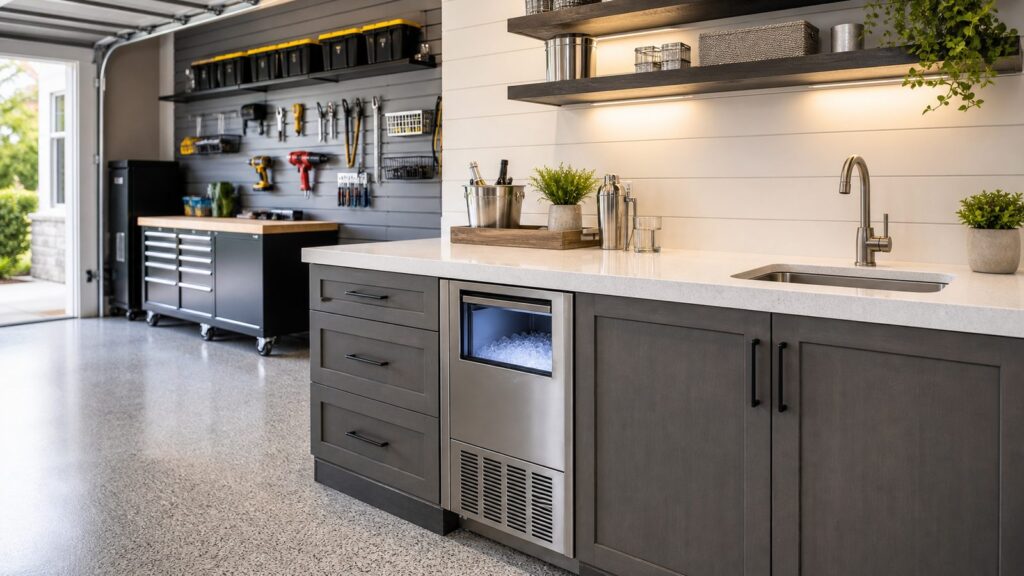
If you are building a garage bar, pool-house connection, finished garage, or entertaining wall, a 15-inch residential undercounter ice maker is usually the better long-term answer. These commonly cost $1,000 to $4,000, with many stainless name-brand units around $2,000 to $3,000. They need a cold-water line, shutoff valve, drain plan, ventilation clearance, and GFCI-protected power.
If you are filling large coolers, supporting sports teams, hosting frequently, or using the garage as a jobsite staging area, consider a light-commercial or commercial undercounter machine. Smaller commercial machines often run about $1,500 to $2,500, while larger machines can reach $5,000 to $10,000. They are more capable in high-demand use, but they are not casual plug-in appliances.
Garage Ice Maker Comparison
The table below separates the common choices by output, installation needs, and garage suitability. Daily production numbers are manufacturer-style ratings, usually based on moderate room temperature and cooler incoming water. In a hot garage, actual output can drop noticeably.
| Type | Typical Output | Bin Size | Water and Drain | Install Complexity | Best For |
|---|---|---|---|---|---|
| Countertop bullet ice maker | 26-50 lb/day | Small removable basket, often 1.5-3 lb | Manual fill, no drain | Plug-in only | Occasional coolers, drinks, renters, temporary use |
| Countertop nugget ice maker | 34-38 lb/day common | Small basket, often a few pounds | Manual fill or side tank, no permanent drain | Plug-in only | Garage drink station, chewable ice, light entertaining |
| Residential undercounter ice maker | 25-80 lb/day | Commonly 20-35 lb | Cold-water line and drain required on most models | Moderate | Finished garage bar, daily family use, pool access |
| Outdoor-rated undercounter ice maker | 25-80 lb/day | Commonly 20-35 lb | Cold-water line and drain required | Moderate to high | Hot garages, outdoor kitchens, patio bars, less-conditioned spaces |
| Commercial undercounter ice maker | 80-220+ lb/day | Often 20-90+ lb depending on model | Water line, filtration, drain, often larger clearances | High | Large families, frequent hosting, teams, jobsite support |
What Makes a Garage Different From a Kitchen
A kitchen is usually conditioned, level, close to plumbing, and wired for appliance loads. A garage may be hot in July, near freezing in January, dusty, sloped toward the door, and shared with tools, chargers, freezers, storage racks, and vehicles. That environment changes the ice maker decision.
Ambient temperature is the first issue. Many countertop ice makers are designed for indoor room temperatures, not a 95-degree garage with warm incoming water. The machine may still run, but it will make ice slower, the ice may melt faster in the basket, and the compressor may cycle harder. If the garage routinely gets hot, an outdoor-rated undercounter model or a commercial-grade unit is usually a better fit than a bargain countertop unit.
What’s actually slowing this PC down?
Pick the symptom - the matching free tool is one click away.
Water quality is the second issue. Hard water leaves mineral scale on evaporator plates, pumps, tubing, valves, and sensors. Scale slows production, clouds the ice, affects taste, and increases service calls. For a plumbed garage machine, we treat filtration as part of the installation, not an upgrade to think about later. At minimum, plan for an accessible inline filter. In hard-water areas, ask about scale control and nickel-safe cleaner compatibility.
Drainage is the third issue, and it is often the deciding factor. Undercounter ice makers create meltwater. Some models use gravity drains, which need a properly sloped route to a lower drain. Others use drain pumps, which cost more but can move water to a higher or farther drain location. If there is no nearby floor drain, utility sink, standpipe, or sanitary drain, choose a pump model from the start instead of trying to force a gravity-drain machine into the wrong location.
Best Portable Ice Makers for Garages
Countertop Bullet Ice Makers
Countertop bullet machines are the simplest garage ice makers. You fill the reservoir, plug the unit into a grounded receptacle, and empty the basket as ice forms. Common units produce about 26 to 50 pounds per day under rated conditions. A Newair-style countertop bullet ice maker, for example, is in the 28-pound-per-day range.
These are best for homeowners who need ice occasionally and do not want to run plumbing. They work well for drinks, lunch coolers, backyard parties, and overflow ice when the refrigerator cannot keep up. The tradeoff is storage. Most portable machines do not keep ice frozen indefinitely. The basket is not a freezer; unused ice slowly melts back into the reservoir and gets remade.
For a garage, look for a unit with a removable basket, easy drain plug, visible water level, self-cleaning cycle, and enough counter depth. Leave several inches of open space around the vents. Do not bury the unit under cabinets or beside a hot refrigerator compressor.
Countertop Nugget Ice Makers
Nugget ice is popular because it is soft, chewable, and good in water, tea, cocktails, and sports bottles. Premium countertop nugget machines commonly make about 34 to 38 pounds per day. The GE Profile Opal 2.0 class is a good example of the category, with an output rating up to 38 pounds per day and a compact footprint around 13.43 inches wide by 17.5 inches deep by 16.5 inches high.
The downside is maintenance. Nugget machines use a more involved internal system than simple bullet-ice machines. Scale, biofilm, and warm garage conditions can create problems faster. If you choose nugget ice for a garage, follow the cleaning schedule, use filtered water, and do not leave standing water in the machine for long stretches between uses.
Best Built-In Ice Makers for Garage Bars
A residential built-in ice maker is the right step when the garage is becoming a real usable space: a finished garage, home gym, pool entry, workshop lounge, or wet bar. These units typically fit a 15-inch or 18-inch cabinet opening and produce about 25 to 80 pounds per day depending on the model.
The Tool Desk
Outbyte Driver Updater FREEScan for outdated or missing drivers - takes under a minuteDriver Scan →Outbyte PC Repair FREEClear out junk files and repair common Windows errorsFree Scan →Also popular on Amazon

- High-Output & Large Storage: This commercial ice maker produces up to 100 lbs of crystal-clear ice daily, with the first batch ready in just 10-18 mins. Features an expanded 18-33 lbs storage bin (it is not a freezer), ensuring a steady supply of 200+ cold drinks for home parties, bars, or light commercial use
- Easy 3-Step Setup & Under-Counter Installation: This undercounter ice maker machine offers quick plug-and-play operation: just connect the faucet (1/2-inch Male Threaded), attach the drain hose (requires a floor drain), and plug in the power. Sized at 15.1x15.7x29 inches with front venting, it fits seamlessly as a freestanding or built-in unit under standard cabinets
- Self-Cleaning Support & Easy Controls: One-touch self-cleaning helps rinse the internal water system and reduce routine maintenance effort. Adjustable ice thickness, LED lighting (automatically activates a blue light when opened), and simple controls make this self-cleaning ice maker commercial easier to use in homes, cafes, offices, and small business drink areas
- Built to Last & Safe: Commercial ice machine is built with heavy-duty, rust-proof stainless steel for ultimate durability. Features food-grade safe interior components to keep every cube pure and tasteless. Designed for reliable, 24/7 peak performance, it delivers consistent performance and lasting peace of mind
- Faster Cooling & Lower Bills: Driven by an advanced R290 compressor, this ice maker 100lbs boosts energy efficiency by up to 30%, saving you up to $260/year on utility bills. This ice machine commercial delivers rapid refrigeration while lowering long-term operating costs, making it the perfect smart choice
Expect the appliance to cost about $1,000 to $4,000 in 2026. Many stainless 15-inch units from familiar appliance brands land around $2,000 to $3,000. Panel-ready fronts, clear-ice systems, outdoor ratings, ADA-height designs, and factory drain pumps usually push the price higher.
Clear-ice machines are attractive for bars because they make harder, clearer cubes that melt more slowly than soft bullet ice. They are not always the best choice if your only goal is filling coolers quickly. Nugget machines are better for chewable drink ice. Cube or crescent machines are usually more general-purpose.
For garage cabinetry, verify the manufacturer’s clearance requirements before building the opening. A 15-inch appliance does not always belong in a tight 15-inch framed pocket without side, rear, toe-kick, or grille clearance. Ice makers reject heat, and heat has to go somewhere. Poor ventilation shortens appliance life and reduces ice output.
When Commercial Ice Makers Make Sense
Commercial ice makers are not automatically better for a normal household garage. They are louder, more expensive, and more demanding. But for the right use case, they solve a real problem.
Windows Errors? Fix Them Before They Spread
Repair common Windows errors and clear accumulated junk for a smoother, more stable PC - no reinstall needed.Free scan · no reinstallCrashes, No Sound, or Screen Glitches?
Random freezes, missing sound and display glitches usually trace back to one bad driver. Find and replace yours safely.Free scan · under a minuteConsider commercial equipment if you routinely need more than 50 to 80 pounds of ice in a day, fill multiple coolers, host large groups, support youth sports, or use the garage for construction, landscaping, catering, or field crews. Commercial undercounter units commonly produce 80 to 220 pounds per day or more. Smaller commercial machines often cost about $1,500 to $2,500. Larger systems can cost $5,000 to $10,000, especially when capacity, storage, filtration, or brand requirements increase.
Commercial listings at big-box retailers can range from roughly $250 to more than $5,000, but price alone is a poor filter. Confirm production rating, bin capacity, voltage, drain type, condenser type, warranty terms, service access, and whether the unit is appropriate for residential garage conditions. Some commercial machines expect more clearance, better air movement, and more frequent cleaning than homeowners anticipate.
Garage Ice Maker Cost in 2026
For a realistic budget, separate the appliance cost from the installation cost. A plug-in countertop unit may require no construction work at all. A built-in or commercial ice maker can become a small plumbing and electrical project.
| Item | Typical 2026 Cost | Notes |
|---|---|---|
| Basic countertop bullet ice maker | $90-$300 | No water line or drain; best for occasional use |
| Premium countertop nugget ice maker | $350-$650 | Popular for drinks; more cleaning required |
| Residential undercounter ice maker | $1,000-$4,000 | Many stainless 15-inch models run $2,000-$3,000 |
| Commercial undercounter machine | $1,500-$2,500 small units; $5,000-$10,000 larger units | Higher output, higher utility and maintenance demands |
| Basic install labor and materials | $494-$599 national estimate | Homewyse May 2026 estimate before major upgrades |
| Simple DIY tubing and fittings | $50-$150 | Only for suitable existing conditions and code-compliant work |
| Simple hired plumbing/appliance labor | $150-$400 often cited | Costs rise with new water, drain, or electrical routes |
| Filtration, leak protection, drain pump, shutoff upgrades | Varies by layout | Often worth including in finished garages |
The biggest cost drivers are distance to a cold-water line, access to a drain, wall finish, floor slope, panel capacity, and whether you need a new dedicated receptacle or circuit. Locating the ice maker near a utility sink, laundry wall, wet bar, garage refrigerator rough-in, or existing plumbing chase can save meaningful money.
Water, Drainage, and Leak Protection
A plumbed garage ice maker should have a dedicated cold-water supply, an accessible shutoff valve, and a properly rated supply line. We prefer braided stainless supply lines where the appliance connection allows it, with the shutoff located where a homeowner can reach it without pulling apart cabinets.
Drainage needs to be decided before the cabinet layout is final. Gravity-drain models need continuous fall to an approved drain. If the drain is too high, too far away, or poorly sloped, the result can be standing water in the bin, slow melting, backups, or floor leaks. Pump models add cost and another mechanical part, but they are often the right answer in garages where the nearest drain is a utility sink, laundry standpipe, or wall drain above the ice maker outlet.
Finished garages deserve extra protection. Use a pan where appropriate, a water alarm, an accessible shutoff, and periodic inspection. If the appliance is placed next to finished drywall, built-in cabinets, base trim, or stored valuables, a slow leak can become expensive before anyone notices it.
Follow the manufacturer’s instructions for air gaps, high loops, pump discharge routing, and drain connection. Local plumbing codes and inspector expectations vary, especially when tying into sanitary drainage.
Quick wins for a faster PC:
Fix the driver behind crashes, sound loss and screen glitchesFind Drivers →Clear out junk files and repair common Windows errorsFree Scan →Electrical and GFCI Safety in a Garage
Garage receptacles generally require GFCI protection under modern electrical rules. For an ice maker, that means planning the outlet location and circuit instead of relying on an extension cord. Extension cords are a common garage mistake, especially when the unit is squeezed beside a freezer, workbench, or storage rack.
Also popular on Amazon

- High Ice Production: Produces up to 120 lbs of ice per day, delivering 6000+ ice cubes daily—enough for 580+ drinks. This ice maker machine with a 33 lbs maximum ice storage capacity,The ice-full indicator light will automatically turn on when the ice storage reaches 19 lbs. Ideal for parties, watching games and commercial peak hours—say goodbye to the anxiety of running out of ice
- Fast Ice Making & Large Storage: Get your first batch of ice in just 10 minutes. The large-capacity bin reduces the need for frequent emptying, ensuring ice is always ready when you need it
- 48-Hour Timer for Easy Planning: Schedule ice production up to 48 hours in advance with the intuitive LED panel. Ideal for events and busy hours, so you can enjoy the moment without worrying about ice supply
- Quiet & Hassle-Free Operation: Runs at under 50 dB, keeping your space quiet. Features smart alerts and one-touch self-cleaning with a detachable water tank for effortless maintenance and hygienic ice
- Adjustable Ice for Every Drink: Choose ice thickness to suit your needs—thin ice in 9 mins for coffee and tea, or thick ice in 14 mins for cocktails and whiskey. Designed for versatility and better drink experience
A dedicated GFCI-protected receptacle or circuit is often cleaner than sharing power with freezers, battery chargers, compressors, and shop tools. Nuisance trips are more than an inconvenience when an appliance contains water and melting ice. An electrician can evaluate panel capacity, conduit route, receptacle height, AFCI/GFCI requirements, and whether the garage finish requires surface-mounted conduit or wall repair.
For built-in units, verify voltage, amperage, plug type, and access requirements before the cabinet is built. The receptacle should be reachable enough for service without creating a cord pinch or blocking ventilation.
Hot Garages, Cold Garages, and Seasonal Use
Heat slows ice production. If your garage regularly climbs above 90 degrees, do not expect a countertop machine to perform like it does on a kitchen counter. Incoming water temperature matters too. Warmer water takes longer to freeze, and the machine has to reject more heat into air that is already hot.
Free tools Windows power users keep installed
One-click scans. No signup required.
For hot garages, look first at outdoor-rated undercounter units, commercial-grade machines, or a location closer to conditioned space. Improve ventilation around the appliance. Avoid placing the machine near a west-facing garage door, water heater, furnace, freezer compressor, or direct sun through glass.
Cold garages create a different problem. If the garage can freeze, a plumbed ice maker needs winterization or freeze protection. Water lines, filters, valves, pumps, and reservoirs can crack. In seasonal homes or detached garages, plan shutoff and drain-down access. A portable unit is often safer if the garage is unconditioned and only used in warm months.
Independent reader supportYour contribution helps us test, update, and keep practical guides available for everyone.Cleaning and Maintenance
Ice is food. The machine needs cleaning, descaling, and sanitizing on a schedule. Descaling removes mineral buildup. Sanitizing addresses biological growth. They are related tasks, but they are not the same.
In a garage, dust, heat, and intermittent use make maintenance more important. For countertop units, drain and dry the machine when it will sit unused. For plumbed machines, follow the manufacturer’s cleaning interval and use the specified cleaner. Many machines require nickel-safe descaler. Replacing filters on schedule matters, especially with hard water.
As a practical rule, inspect the unit monthly during heavy use. Clean portable machines every few weeks if they are used often. For built-in and commercial machines, follow the manual, but expect more frequent attention in hot or hard-water conditions. Minor ice-maker repairs are often in the $75 to $150 range for simple issues, while small refrigerator-style ice-maker replacement can run around $260 to $450. Built-in and commercial service can cost more because parts, access, and diagnostics are more involved.
When to DIY vs. When to Hire a Pro
DIY Makes Sense When
DIY is reasonable for a countertop ice maker that plugs into an existing grounded GFCI-protected receptacle. It can also make sense for cleaning, filter replacement, and basic setup if the manual is clear and no permanent utility work is required.
A capable homeowner may also handle simple supply tubing in some jurisdictions when there is an existing approved connection, accessible shutoff, and no wall opening. Even then, the risk is water damage. Use proper fittings, avoid saddle valves where prohibited or discouraged, and test for leaks under pressure.
Hire a Pro When
Hire a professional when the appliance needs a new water line, drain connection, drain pump routing, electrical circuit, GFCI receptacle, cabinet modification, wall repair, or permit. Also hire help if the garage is finished and a leak would damage flooring, drywall, cabinets, or stored property.
Do these 3 things before closing this tab:
1Scan for outdated or missing drivers - takes under a minute2Repair Windows errors before they cause bigger problems3Fix the driver behind crashes, sound loss and screen glitchesA contractor can coordinate the full layout: appliance opening, countertop height, cabinet ventilation, floor slope, water shutoff, filter access, drain route, receptacle placement, and service clearance. That coordination is where many garage appliance projects succeed or fail.
Common Mistakes to Avoid
The first mistake is buying a countertop ice maker for a hot garage and expecting the rated daily output. Those numbers are usually based on controlled conditions, not a hot garage with warm water.
Also popular on Amazon

- Never Run Out of Ice: Our commercial ice maker delivers reliable performance: it cranks out 110lbs of ice daily (36 clear cubes per batch)—no shortage even during peak hours. It holds 33lbs of ice, lets you adjust cube thickness for drinks (cocktails, coffee, etc.), and offers two installation options (Under Counter or Freestanding) to fit your space. Perfect for homes, bars, restaurants, and hotels.
- Quick & Quiet Ice Production: Powered by a high-performance compressor, this commercial ice maker efficiently makes ice cubes in 7–14 minutes (thickness-adjustable) — no long waits for cold drinks. It runs with minimal noise for a comfortable space, plus ETL-certified energy savings to cut costs, making it ideal for long-term commercial use
- Smart Control Panel: Our commercial ice machine is equipped with an intelligent LCD panel, putting all controls at your fingertips. Monitor environmental temperature, adjust ice cube size, and initiate automatic cleaning: all from this easy-to-use interface
- Automatic Self-Cleaning: This commercial ice makers features one-touch self-cleaning and a removable water filter—just control cleaning via the smart panel, no hassle. (We recommend regular cleaning based on usage)
- Premium Insulation Design:Our ice maker has a premium stainless steel build for long durability, plus a food-grade interior that prioritizes hygiene. Its corrosion-resistant surface, elevated moisture-repellent base and easy-wipe finish ensure reliable performance and quick cleaning—no tedious scrubbing. It’s a low-maintenance, long-lasting choice for any space
The second mistake is ignoring the drain. A gravity-drain machine cannot drain uphill. If the drain elevation is wrong, buy a pump model or change the location.
The third mistake is skipping filtration. Hard water causes scale, cloudy ice, slower production, and service issues. Put the filter where it can be changed without moving the appliance.
Free tools Windows power users keep installed
One-click scans. No signup required.
The fourth mistake is enclosing the appliance too tightly. Ice makers create heat. Follow the clearance requirements and keep the grille clear.
The fifth mistake is using an extension cord. A garage ice maker should have a properly located grounded receptacle with required GFCI protection.
Our Bottom-Line Recommendation
For occasional garage use, buy a countertop bullet ice maker and keep the setup simple. For better drink ice, choose a premium countertop nugget machine, but commit to cleaning it. For a finished garage bar or daily household use, install a plumbed 15-inch undercounter unit with filtration, leak protection, and a correct drain. For high-volume coolers, teams, or jobsite support, step up to a light-commercial machine and plan the utilities like a real construction project.
Bettesworth Construction can help homeowners plan garage ice maker installations as part of a finished garage, mudroom, pool-access area, garage bar, workshop, or utility upgrade. The best time to solve water, power, drainage, ventilation, and cabinetry is before the appliance arrives, not after it is sitting in the middle of the garage waiting for a place to go.
Recommended Free Tools
Frequently Asked Questions
Can you put an ice maker in a garage?
Yes, but choose the unit around the garage conditions. Countertop machines work for occasional use, while hot garages, finished bars, and frequent entertaining usually call for an outdoor-rated, built-in, or commercial-grade machine with proper water, drain, ventilation, and GFCI-protected power.
Does a garage ice maker need a water line?
Portable countertop ice makers usually do not need a water line because you fill them manually. Built-in and commercial ice makers normally need a cold-water supply, shutoff valve, and often a filter.
Does an undercounter ice maker need a drain?
Most undercounter ice makers need a drain for meltwater. Some use gravity drains, which require a lower nearby drain with proper slope. Others use drain pumps, which are better when the drain is higher or farther away.
How much does it cost to install a garage ice maker in 2026?
Homewyse lists a May 2026 national installation estimate of about $494 to $599 per icemaker before major plumbing or electrical upgrades. The appliance itself can range from about $90 for a basic countertop unit to $1,000 to $4,000 for residential built-ins and $1,500 to $10,000 for commercial machines.
Windows Errors? Fix Them Before They Spread
Repair common Windows errors and clear accumulated junk for a smoother, more stable PC - no reinstall needed.Free scan · no reinstallCrashes, No Sound, or Screen Glitches?
Random freezes, missing sound and display glitches usually trace back to one bad driver. Find and replace yours safely.Free scan · under a minuteDo garage ice makers need GFCI outlets?
Garage receptacles generally require GFCI protection under modern electrical rules. For a plumbed or built-in ice maker, a properly located grounded GFCI-protected receptacle or dedicated circuit is usually the cleanest approach.
How often should a garage ice maker be cleaned?
Follow the manufacturer’s schedule, but expect more frequent cleaning in hot, dusty, or hard-water garages. Portable machines used often may need cleaning every few weeks. Built-in and commercial machines need regular descaling, sanitizing, and filter changes.
Quick Recap
Product prices and availability are accurate as of the date/time indicated and are subject to change. Any price and availability information displayed on Amazon at the time of purchase will apply.

