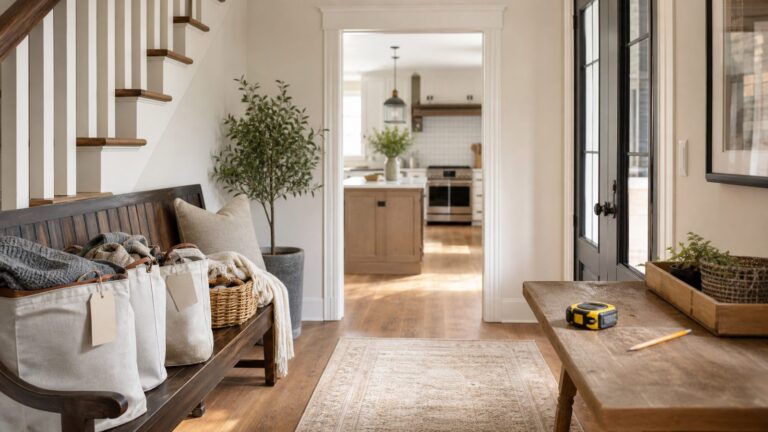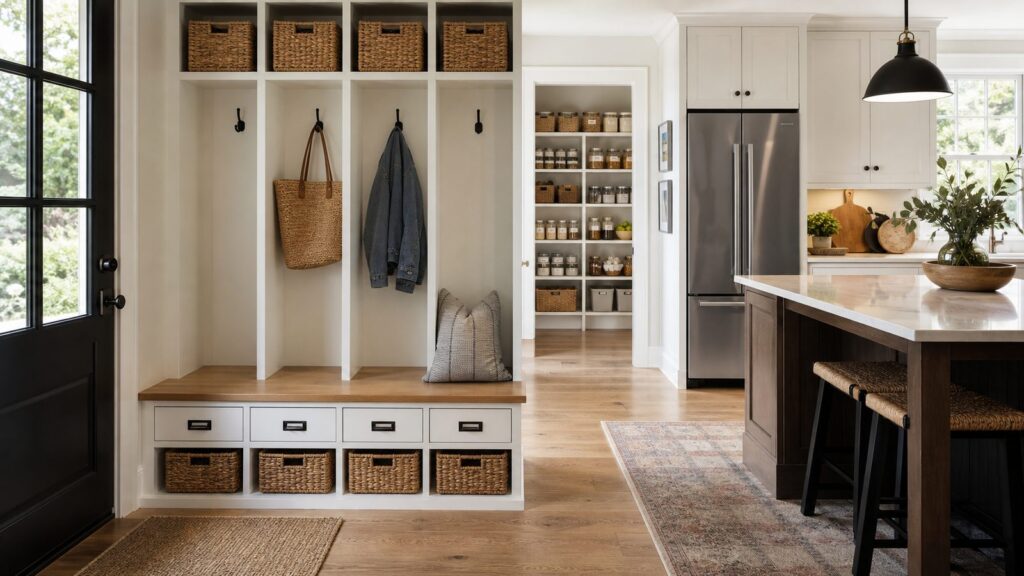
A home is easier to declutter when you work on one small, finishable area at a time—not when you empty several rooms at once. Decide what stays, where outgoing items will go, and where kept belongings belong; then clean the cleared space and return only what fits. Repeat the process in the next zone, while keeping pathways and household safety in view.
Storage containers can help, but they are optional. Sort and measure first, then choose a container only if it fits the items and the available space. Decluttering is an ongoing process, as Penn State Extension notes in its child-care guidance, “Clean, Uncluttered Space.”
A Small-Zone Decluttering Sequence
Choose a drawer, shelf, counter, or one section of a closet. Set up a place for outgoing belongings before you begin, and check local rules for donations, recycling, trash, and hazardous products. Work through the area without expanding into other rooms.
- Choose one contained zone. Pick an area you can finish without taking over other rooms. If decisions become tiring, pause and return later.
- Set up destinations. Depending on the item and local acceptance rules, destinations might include keep, give, donate, sell, recycle, or discard. Do not assume every charity or recycling service accepts every item.
- Decide what stays. Consider whether an item is used, in usable condition, fits your needs, and has a practical place in the home. Involve other household members before deciding about belongings they own.
- Handle sentimental items at your own pace. If it helps, take a photograph as a record before letting an item go. Penn State Extension’s “Decluttering with Less Hassle” suggests photos as one option; there is no need to force a quick decision.
- Remove outgoing items from the work area. Follow local guidance for donation, reuse, recycling, and disposal. For paint, pesticides, and other potentially hazardous household products, follow the label and ask county solid-waste officials about local handling, as University of Minnesota Extension advises.
- Clean, then put back what stays. Return items to a defined place. Measure the space before buying storage; optional lidded containers or labels may help identify what belongs there.
- Repeat in another small zone. Use a brief reset to return items to their assigned places, but choose an interval that works for your household rather than treating a particular schedule as a rule.
Penn State Extension’s guidance recommends planning destinations, starting with a closet or drawer, asking for help, and taking breaks. The process can feel relieving to some people and stressful to others, so adapt the pace to your household.
What’s actually slowing this PC down?
Pick the symptom - the matching free tool is one click away.
#1 Best Overall

- Designed for Maximum Hanging Capacity: This closet system is ideal if you need more hanging space. With 5 reinforced hanging rods, it keeps shirts, pants, dresses, and coats organized, visible, and wrinkle-free—perfect for clothing-heavy wardrobes.
- Fits Most Closet Sizes from 5'8" to 7'6": Timate P3 heavy duty clothes rack adjusts to fit a wide range of closet sizes. The expandable frame is designed to adapt seamlessly to small closets, apartments, and walk-in spaces without the need for custom installation.
- Maximizes Vertical Space in Small Areas: Timate P3 works well in small spaces by using vertical storage. Engineered to make full use of wall height, it increases storage capacity without crowding your floor—ideal for compact living environments.
- Stable and Secure for Everyday Use: Timate P3 Sturdy enough for heavy clothing like coats and jackets. Built with reinforced materials and equipped with anti-tip hardware, it delivers long-term stability you can rely on daily.
- Easy to Assemble even for first-time users: Thoughtfully designed components and step-by-step instructions ensure a smooth setup process without requiring professional tools.
Choose a Home for Each Item
Before putting something back, consider its use, condition, storage location, and any safety or disposal needs. These questions can help distinguish items that belong in the home from those that need a different destination.
| Question | How it helps |
|---|---|
| Is it used, and does it fit the household’s needs? | Helps decide whether keeping it supports daily life. |
| Is it safe and in usable condition? | Helps identify items that need repair, special handling, or disposal. |
| Does it have a defined place? | Reduces the chance that it will return to an unrelated drawer or surface. |
| Can it be donated, sold, given away, recycled, or discarded? | Points to an outgoing route; check local acceptance and disposal rules. |
| Does it need to be easy to reach, secured from children, or kept off the floor? | Helps balance storage with access, safety, and cleaning needs. |
| Will a container actually fit the item and the measured space? | Helps prevent buying storage that does not solve the space problem. |
Room-by-Room Decluttering and Safety Guide
Kitchen
Start with one drawer, shelf, or counter zone. Keep frequently used cooking items accessible and preserve clear work surfaces. As you sort, secure knives, matches, glassware, and cleaning products away from children. Clean spills promptly and avoid leaving food or water out overnight, in line with the ENERGY STAR-hosted “Room by Room Checklist for a Healthy Home.”
Once you know what remains, group items by a useful task or location. Optional labels or containers can help, but measure the cabinet or shelf first and do not buy them as a substitute for sorting.
Bedrooms and Closets
Work through one shelf, drawer, or section of hanging clothes at a time. Decide what stays based on use, fit, condition, and available space. Put kept items back where they can be found and returned easily.
Do these 3 things before closing this tab:
1Repair Windows errors before they cause bigger problems2Scan for outdated or missing drivers - takes under a minute3Clear out junk files and repair common Windows errorsKeep blind cords out of children’s reach and maintain working smoke detection, as the ENERGY STAR-hosted checklist advises. If the home predates 1978 and painted surfaces are a concern, do not disturb suspect old paint during organizing; seek appropriate professional guidance.
Living, Dining, and Family Rooms
Choose one surface, cabinet, or shelf rather than emptying the whole room. Keep cords out of floor pathways, and make sure routes through the room stay clear. Secure heavy televisions and bookcases against tipping, and keep blind cords away from children, following the ENERGY STAR-hosted checklist.
If the home predates 1978, that checklist recommends checking painted surfaces for lead. Decluttering is not a reason to disturb suspect paint; refer concerns to appropriate professionals.
Entry
Use one small zone for the belongings that regularly arrive at the door, such as shoes or bags, and give each kept item a reachable place. Keep the route into and through the home clear. The ENERGY STAR-hosted checklist recommends an entry mat and shoe-removal practice where lead dust is a concern, and repairing weather seals if needed.
The Tool Desk
Outbyte PC Repair FREERepair Windows errors before they cause bigger problemsFix Now →Outbyte Driver Updater FREEFix the driver behind crashes, sound loss and screen glitchesFind Drivers →Bathroom
Start with one vanity drawer, shelf, or medicine cabinet section. Put medicines and cleaning products somewhere secure from children. Keep the area manageable without blocking access to fixtures. The ENERGY STAR-hosted checklist also recommends ventilation after bathing, cleaning up water, and considering slip-resistant mats. Grab bars may be a useful accessibility consideration for older adults or people with mobility or balance concerns.
Rank #2

- [LARGER & HIGHER]: We upgraded the 5 tier shelves length from 14 to 23.6 inches for placing more belongings, and the total height of this version is upgraded to 5.9 feet. The 4 expandable hanger rods provide more space and choices to hang clothes
- [EXTENDABLE & ADJUSTABLE]: Each hanger rod can be extend from 23.6 to 40 inches. The garment rack will suit your reserved size flexibly, therefore, it is simple to custom the assembly method. Meanwhile, the height of the shelves and the installation position of the hanger rods can be adjusted according to your needs
- [MULTIFUNCTIONAL]: The garment rack used for hanging dresses, suits, coats, T-shirts, pants, and so on. Assemble the first shelf little higher from the ground if you need to store items under the shelf. Take advantage of the top shelf can help you add the extra storage space
- [STURDY, STABLE & DURABLE]: Made with carbon steel material to make the garment rack sturdy and durable. The leveling feet and anti-tip device can make it more stable and prevent falling down
- [QUICK ASSEMBLE]: Detailed installation guide is included in the package. This product need to mount onto the wall. A rubber hammer is recommended to use when you assemble the wire shelves onto the plastic clip sleeves, it makes the shelf fit snugly to the poles(The rubber hammer is not included.)
Laundry Room
Work on one shelf or storage area and keep detergents secured away from children. Leave the dryer and its service access usable. Regularly remove lint and make sure the dryer vents outside rather than into an attic, as the ENERGY STAR-hosted checklist advises.
Attic
Sort one accessible area at a time and keep eave and roof vents unblocked. Clearing clutter may reduce places where rodents and insects can nest, but it is not pest treatment or proof that a home is pest-free.
Do not disturb suspect insulation as part of a casual organizing project. The ENERGY STAR-hosted checklist advises consulting an asbestos professional about exposed insulation that may contain asbestos. If you are considering storage changes, have concerns about the structure, or cannot work safely in the space, consult an appropriate professional.
Quick wins for a faster PC:
Fix the driver behind crashes, sound loss and screen glitchesFind Drivers →Clear out junk files and repair common Windows errorsFree Scan →Basement or Crawlspace
Work in a contained area and keep routes and access to household equipment clear. Secure cleaning products and pesticides away from children. The ENERGY STAR-hosted checklist identifies pest harborage, radon, and lead among potential home concerns; clearing belongings does not test for or remediate these hazards. Consult relevant professionals for testing or remediation where needed.
Garage
Clear one shelf or floor area at a time, keeping pathways and access to stored items in mind. Keep gasoline, pesticides, and cleaners away from children, and clean spills promptly. Never operate a car, mower, or other combustion equipment in a closed garage, as the ENERGY STAR-hosted checklist warns.
Follow product labels and local guidance for household chemicals and disposal. Do not assume a regular donation, recycling, or trash route accepts hazardous products.
Kids’ Rooms and Home Offices
In a child’s room, choose one small category or storage area and involve the child where appropriate. Penn State Extension’s Better Kid Care guidance, “Clean, Uncluttered Space,” recommends cleaning before organizing and suggests labeled, lidded containers in child-care settings. At home, treat containers and labels as optional tools, not universal requirements.
For an office, sort one stack, drawer, or shelf at a time. Decide what records need to be kept and what can be securely discarded according to your circumstances. Shredding may be appropriate for sensitive papers, but follow applicable recordkeeping requirements before disposing of important documents.
Independent reader supportYour contribution helps us test, update, and keep practical guides available for everyone.Storage: Measure First, Buy Only If Needed
Storage can make a defined home easier to maintain, but buying more containers before sorting can simply preserve excess belongings. Finish the zone, clean it, and measure the available space before choosing a product. Lidded plastic containers and labels are options mentioned in Penn State’s child-care guidance, though that advice is written for child-care spaces rather than as a universal household rule.
Rank #3

- CLOSET ORGANIZER SYSTEM: All in one wire closet shelves kit that creates up to 96 in. of hanging space and 144 in. of shelf space; Kit includes hang track, standards, shelf brackets, closet rods, closet rod support and SuperSlide shelves
- FITS CLOSETS 4 – 6 FEET WIDE: Multiple closet design configurations for spaces 4 – 6 feet wide with 12 in. deep shelves; Some shelf, hang track and/or rod cutting may be required to fit your space
- ADJUSTABLE SHELVES: The ShelfTrack system offers design configuration and adjustable shelves that can be easily moved up or down depending on your needs, or for changes over time; Ideal for kids closets, entryway closets or hall closets
- SUPERSLIDE HANG ROD: Includes SuperSlide hang rod system with support hardware that allows for continuous slide of hangers
- DURABLE WIRE SHELVES: Vinyl coated steel shelving resists rusting and chipping; All shelving SCS Certified for minimum of 90% recycled content; HARDWARE INCLUDED: Installation hardware included with easy-to-follow instructions
For large, attached, overhead, or structural storage changes, decluttering guidance is not a substitute for checking the building conditions. If you are unsure whether a proposed installation is suitable, consult a qualified professional or your local building department.
When to Ask for Help
Ask household members to help with shared belongings and decisions. If sorting becomes tiring or overwhelming, take a break or ask someone you trust to work alongside you. Penn State Extension’s “Decluttering with Less Hassle” recommends asking for help and taking breaks as practical options.
Outdated Drivers Are Slowing You Down
One free scan finds every outdated or missing driver and matches the right update for your exact hardware.Free scan · exact hardware matchWindows Errors? Fix Them Before They Spread
Repair common Windows errors and clear accumulated junk for a smoother, more stable PC - no reinstall needed.Free scan · no reinstallFor concerns about hazardous household products, follow the label and contact county solid-waste officials, as University of Minnesota Extension advises. For suspected lead or asbestos, or questions about testing or remediation, consult appropriate professionals rather than disturbing the material during organizing.
A Manageable Plan for the Next Decluttering Session
- Choose one drawer, shelf, closet section, or small counter area.
- Set out a few destination options for kept and outgoing items, checking local rules where relevant.
- Sort only that area, involving other owners in decisions and taking a break if needed.
- Remove outgoing items from the work area and arrange their next destination.
- Clean the cleared space and return only belongings that have a place there.
- Measure before considering storage, then choose another small zone when you are ready.
Do not move a pile into another room and count it as finished. Complete the area by deciding where its outgoing items go and putting the kept belongings back in a defined place.
Frequently Asked Questions
What is the best way to start decluttering when the whole home feels overwhelming?
Choose one small, contained area, such as a drawer or shelf, and finish that zone before moving on. Penn State Extension recommends starting with a closet or drawer, planning destinations for items, and taking breaks if needed.
What should I do with items I am letting go?
Depending on the item and local rules, possible destinations include giving, donating, selling, recycling, or discarding it. Check whether a destination accepts the item before making a trip or leaving it for collection.
Should I buy storage containers before decluttering?
Usually, decide what stays and measure the space first. Containers and labels are optional tools; a container should fit both the belongings and the available storage area.
How can I handle sentimental belongings?
Take your time rather than forcing a fast decision. Penn State Extension suggests that a photograph can be one way to preserve a memory of an item you decide not to keep.
How should I dispose of paint or pesticides?
Follow the product label and ask county solid-waste officials about local collection and handling. University of Minnesota Extension advises using those local resources for potentially hazardous household products.
Does clearing clutter get rid of pests or make a home safe?
No. Clearing clutter may reduce places where pests can nest, but it is not pest treatment and does not establish that a home is pest-free. Decluttering also does not test for or remediate hazards such as radon, lead, or asbestos; consult appropriate professionals where needed.
Free tools Windows power users keep installed
One-click scans. No signup required.
Quick Recap
Product prices and availability are accurate as of the date/time indicated and are subject to change. Any price and availability information displayed on Amazon at the time of purchase will apply.