Solvent recycling can collapse expanded polystyrene (EPS) foam and leave a denser polystyrene-rich material that may be cast into a mass, film, coating, or shape. It does not make new expanded foam, chemically erase the plastic, or guarantee a safe finished product.
For a household, jobsite, or ordinary workshop, the better option is usually clean-material reuse, a local EPS drop-off, or a professional recycler. Acetone-based dissolution is a flammable-solvent operation that requires engineered ventilation, ignition control, compatible PPE and equipment, and a legitimate waste plan.
As an Amazon Associate I earn from qualifying purchases.
What solvent recycling does to EPS foam
Expanded polystyrene (EPS) is mostly air: its closed-cell structure is roughly 98% air by volume. A solvent such as acetone can dissolve the polystyrene framework, allowing that air-filled volume to collapse. The foam has disappeared visually, but the plastic has not been destroyed. Polystyrene remains in the solvent-rich mixture.
That distinction matters. Solvent dissolution is different from mechanical recycling, which processes the plastic without dissolving it, and from chemical depolymerization, which breaks polymer chains into smaller chemical building blocks. In dissolution recycling, a suitable solvent generally preserves the polymer chains. Contaminants may be separated in a controlled process, and the solvent may be removed or recovered, leaving a denser polystyrene-rich material.
#1 Best Overall

- Recycling & Garbage Bin: This spacious blue bin makes waste disposal and recycling easy. With a generous capacity, it’s designed to help you collect and sort rubbish efficiently.
- Blue Waste Bin: Measuring 22.25" L x 17.25" W x 14.25" H, this recycling trash can offers a 17-gallon capacity and weighs only 3.92 lbs. It has a low profile and fits discreetly in any space.
- Home Recycling Tote: Built with tall side walls, carry handles, and injection-molded construction with a cross-stacking design, this bin ensures durability, ease of use, and easy storage.
- Versatile Bin: Ideal for home, office, garage, or outdoor use, this versatile recycling container features an easy-to-identify Mobius loop symbol and address bar for simple sorting and organization.
- Create a Gracious Home: At Gracious Living, we’re committed to making innovative and high-quality products to help people live more organized and gracious lives in homes they love.
The realistic result is usually a dense, irregular mass, film, coating, or cast shape—not new expanded foam. The finished article will not automatically have the original foam’s cellular structure, insulation value, impact performance, fire performance, food-contact approval, or dimensional consistency.
Important safety boundary: Dissolving EPS with solvents is not a suitable casual kitchen, garage, or classroom activity. Acetone produces highly flammable vapors, and solvent-rich polystyrene waste still needs proper handling. Demonstrations belong in a professional laboratory or a maker space with a suitable chemical fume hood or professionally engineered local exhaust, ignition control, chemical PPE, and an approved waste plan.
First identify the foam: “Styrofoam” is not a precise material name
People commonly call many white or colored foamed plastics “Styrofoam.” For this subject, the material of interest is usually expanded polystyrene, or EPS: the lightweight bead-based foam used in some protective packaging and molded products. Construction sites may also encounter extruded polystyrene (XPS) insulation, high-impact polystyrene, copolymers, laminated boards, coated products, and foams made from entirely different plastics.
Do not assume that all of these materials dissolve, cast, or perform the same way. Commercial insulation products can contain facings, adhesives, fire-retardant additives, pigments, coatings, or other polymers. A foam board with an unknown composition is not a suitable experimental feedstock.
Use only known, clean material in a controlled process
Research or industrial processing should begin with clean, uncoated EPS whose identity is known. Keep out foam containing:
- food residue, grease, soil, or biological contamination;
- paper labels, tape, adhesive, or embedded fasteners;
- paint, foil, fabric, coatings, or laminated facings;
- unknown pigments, flame retardants, or other additives; and
- pieces mixed with polyethylene, polypropylene, polyurethane, rubber, or other plastics.
Contamination can remain in the cast product, change the way the polymer dissolves, interfere with solvent recovery, and produce unpredictable fumes or waste. In a construction setting, segregating clean EPS packaging from insulation offcuts and mixed jobsite debris is essential.
Why the foam collapses so dramatically
EPS looks substantial because it occupies a large volume, not because it contains a large amount of polymer. When solvent enters the foam, it dissolves the polystyrene walls and strands surrounding the air cells. The cells collapse and the trapped air escapes. A large bag of foam can therefore turn into a much smaller quantity of viscous polymer solution or gel-like residue.
This is a volume-reduction effect, not evidence that the plastic has vanished or become environmentally harmless. The polymer is still present, and the solvent may now contain dissolved additives, dirt, adhesive, or other contaminants. The apparent reduction in waste volume also concentrates the material into a flammable, chemically contaminated stream.
Rank #2

- SUPER STRONG – Extra sturdy, high-quality stacking recycle bins – 75 LB CAPACITY – Made in America
- EASY TO USE – Open front allows deposit of recyclables even while stacked. Comfortable carrying handles make taking out the recycling a breeze. Durable plastic containers wipe clean and air dry.
- LARGE CAPACITY – 12.5 Gallon Recycle Bin - Outside (15-1/4-Inch x 19-7/8-Inch x 12-1/2-Inch), Inside (13-5/8-Inch x 17-1/2-Inch x 12-1/4-Inch)
- PERFECT FOR HOME – Ideal for kitchens, garages, offices and more. Sort all your recyclables with ease.
- PERFECT FOR BUSINESS – Handles heavy loads of recyclables including metal, paper, plastic and glass. Recycle like a pro!
Acetone: effective for demonstrations, but not benign
Acetone is widely discussed because it is commercially accessible and rapidly collapses many EPS products. A suitable acetone solvent may be relevant to a controlled laboratory or maker-space investigation, but it should not be treated as a harmless craft liquid or a universal answer for foam recycling.
NIOSH classifies acetone as a Class IB flammable liquid. Its boiling point is about 133°F, its vapor pressure is about 180 mmHg, and its flash point is 0°F. Its lower and upper explosive limits in air are approximately 2.5% and 12.8%. In practical terms, acetone can produce an ignitable vapor atmosphere at ordinary working temperatures; waiting for it to “feel warm” before treating it as a fire risk is not a safe approach.
NIOSH identifies inhalation, ingestion, and skin or eye contact as exposure routes. Possible effects include irritation of the eyes, nose, and throat, headache, dizziness, central-nervous-system depression, and dermatitis. The NIOSH recommended exposure limit is 250 parts per million as an eight-hour time-weighted average, and the listed immediately dangerous to life or health value is 2,500 ppm.
What’s actually slowing this PC down?
Pick the symptom - the matching free tool is one click away.
Keep acetone and acetone-rich polymer away from flames, sparks, smoking, hot surfaces, heat-producing tools, and electrical equipment that is not rated for the environment. A household window, box fan, or open garage door is not an engineered control for a flammable vapor atmosphere.
Why heating is especially dangerous
Heating can accelerate evaporation, but it also increases vapor generation and can create an ignition hazard. Do not use a household oven, hot plate, heat gun, torch, open flame, or improvised heating setup to dry a solvent-cast polystyrene article. Do not place solvent mixtures in a sealed container where vapor expansion could create pressure. A professional process uses equipment, ventilation, temperature control, and solvent-recovery measures designed for flammable liquids.
d-Limonene and other solvents
d-Limonene is a citrus-derived solvent that has been studied for dissolving and densifying EPS. Its natural origin and generally lower volatility than acetone can make it attractive for research comparisons. They do not make it risk-free. d-Limonene can irritate skin and may cause sensitization in some people. It also evaporates more slowly, which can complicate drying and solvent recovery, and it still creates a solvent-and-polymer waste stream.
If a qualified facility is comparing solvents, a d-limonene solvent should be evaluated by its safety data sheet, compatibility information, exposure controls, waste requirements, and actual process performance—not by the word “citrus” on the label.
The research literature includes aromatic, ketone, ester, ether, and terpene solvents that can dissolve or swell polystyrene. A 2024 solvent-screening study reported rapid laboratory dissolution for candidates including cyclohexene, 2-pentanone, ethylbenzene, and methyl ethyl ketone under particular test conditions. Those results help researchers understand solvent selection; they are not a DIY shopping list. Some alternatives have serious toxicity, carcinogenicity, flammability, odor, regulatory, or disposal concerns.
Do not present benzene, chlorinated solvents, toluene, xylene, tetrahydrofuran, or similar laboratory and industrial solvents as casual substitutes for acetone. A solvent’s ability to dissolve polystyrene does not make it appropriate for a home, jobsite, school, or unventilated workshop.
What controls dissolution rate
There is no single universal “EPS dissolves in solvent” rate. Research has found that dissolution depends strongly on the solvent’s properties and viscosity, mixing, temperature, particle size, and reactor design. A smaller piece may expose more surface area, but changing particle size or agitation does not remove the need for ventilation, ignition control, compatible equipment, and waste management.
Rank #3

- Household or office recycling bin
- 9 gallon recycle bin
- Built from heavy-duty polypropylene
- Stackable for easy storage and shipping
- Displays universal recycling symbol
Results can also change with polymer molecular weight, additives, contamination, concentration, and the ratio of foam to solvent. Two pieces that look identical may produce different viscosities or different cast surfaces if they came from different products. A clear-looking mixture is not proof that contaminants have been removed.
The Tool Desk
Outbyte PC Repair FREERepair Windows errors before they cause bigger problemsFix Now →Outbyte Driver Updater FREEFix the driver behind crashes, sound loss and screen glitchesFind Drivers →What “casting” means after dissolution
Solvent casting means spreading or pouring a polymer solution or dispersion and allowing the solvent to leave. For polystyrene, the solvent is a temporary processing aid; it is not part of the desired finished polymer article. As solvent leaves, the polymer chains come closer together and form a dense solid or film.
That process is fundamentally different from recreating EPS’s original bead-and-cell structure. A cast object may shrink substantially as solvent evaporates. It may also develop:
- surface skinning, where the outside dries before the interior;
- bubbles, voids, or channels from trapped air or escaping vapor;
- warping caused by uneven shrinkage;
- cracks caused by internal stress or overly rapid drying;
- a solvent-rich interior or other residual-solvent gradient; and
- an irregular texture caused by contamination, additives, or incomplete dissolution.
Research on solvent-cast polystyrene-containing films shows that evaporation rate and post-evaporation treatment can change morphology and final structure. A 2024 study involving acetone-dissolved EPS reported that cast specimens reproduced a target geometry better than printed specimens under the study conditions, while rapid evaporation contributed to void formation in printed specimens. That result does not establish a universal recipe or guarantee a particular finish; it illustrates why casting geometry, drying conditions, and process control matter.
Expected result by process choice
| Process | Likely result | What it does not prove |
|---|---|---|
| Solvent dissolution | Collapsed foam and a polystyrene-rich solution, gel, or viscous residue | That the polymer has decomposed or become harmless |
| Solvent casting | A dense mass, film, coating, or irregular molded shape after solvent removal | That the article is equivalent to factory-made EPS |
| Rapid evaporation | Shorter apparent drying time, but greater risk of skinning, voids, warping, and residual solvent | That all solvent has safely left the interior |
| Controlled industrial dissolution | Potential contaminant separation, solvent recovery, and characterized recycled polystyrene | That a small household process has the same environmental or quality outcome |
A controlled-process outline—not a household recipe
A legitimate laboratory or industrial investigation would normally address the following sequence. It should be performed only under the facility’s chemical-safety procedures and the solvent manufacturer’s safety data sheet.
Free tools Windows power users keep installed
One-click scans. No signup required.
- Identify and segregate the feedstock. Confirm that the material is EPS or another intentionally selected polystyrene grade. Reject unknown, coated, dirty, mixed, or contaminated foam.
- Plan the controls before opening solvent. Establish a suitable chemical fume hood or engineered local exhaust, ignition-source control, compatible equipment, emergency procedures, spill supplies, labeling, and a waste route.
- Prepare the material and equipment under those controls. Particle size, mixing, temperature, concentration, and reactor geometry affect dissolution. These variables should be selected and documented by the responsible facility—not improvised on a workbench.
- Separate contamination where the process allows. Insoluble material may be removable in a controlled operation, but dissolved additives or other polymers will not necessarily be removed by simple straining.
- Cast only into a compatible form or onto a compatible surface. The process must allow for shrinkage, vapor release, and uneven drying. A mold that works for water-based material may not be compatible with acetone or another organic solvent.
- Remove or recover solvent under controlled conditions. Dryness cannot be judged reliably from a hard surface or lack of odor. Industrial systems may capture and recover solvent; informal evaporation releases vapors and leaves uncertain residue.
- Characterize the result before using it. Check dimensions, mass change, voids, cracking, residual solvent, contamination, and mechanical behavior. Without testing, the result should be considered an experimental polymer article, not a certified product.
This workflow may reduce volume and produce a reshaped material, but it is not closed-loop recycling in the usual sense unless the recovered polymer, recovered solvent, emissions, contaminants, energy use, and final application are all controlled and evaluated.
PPE and facility requirements
Engineering controls come first. PPE does not make an unsuitable room safe. A proper setup requires a chemical fume hood or professionally engineered local exhaust designed for the solvent, no ignition sources, compatible containers and tools, closed and accurate labeling, and a documented spill and waste response.
Wear eye protection appropriate to splash risk. Chemical splash goggles can protect the eyes from liquid splashes, but they do not ventilate a room or control solvent vapor. Ordinary safety glasses should not automatically be treated as equivalent to splash goggles.
Glove selection must come from the solvent’s SDS and glove-compatibility or breakthrough data. NIOSH’s acetone guidance identifies barrier materials such as butyl and PE/EVAL for protective clothing applications. Ordinary disposable nitrile gloves should not be described as universally adequate for prolonged acetone exposure; compatibility depends on the exact glove, thickness, contact time, and task. A professional facility evaluating butyl chemical-resistant gloves should still verify the manufacturer’s data rather than relying on the material name alone.
Quick wins for a faster PC:
Clear out junk files and repair common Windows errorsFree Scan →Fix the driver behind crashes, sound loss and screen glitchesFind Drivers →Repair Windows errors before they cause bigger problemsFix Now →A dust mask does not control organic-solvent vapor. Respiratory protection, where permitted and necessary, requires a properly managed workplace respiratory-protection program, appropriate cartridges, fit testing, training, and change-out procedures. It is not a substitute for a fume hood or local exhaust.
Rank #4

- OUR TOP-SELLER: The 4-pack is perfect for households that need to separate their recycling and take to them to a recycling center.
- INGENIOUS DESIGN: handle folded forward, they stack; handle folded back, they nest!
- SUPER EASY TO CLEAN: Smooth surface makes it easy to wash out.
- VERSATILE: popular in homes, schools, condos/apartments and yes, it's great for organizing a chest freezer!
- FEEL GOOD ABOUT YOUR PURCHASE. Made in America by the nonprofit organization Recycling Rules! All sales benefit our education initiatives across the U.S.
Storage, spills, and waste
Unused solvent, solvent-rich polystyrene, contaminated absorbents, and cleanup materials should be treated conservatively as a hazardous solvent waste stream. Do not pour them down a drain, onto soil, into a storm sewer, or into ordinary recycling. Do not assume that leaving the container open until the solvent evaporates is an acceptable disposal method: it releases flammable vapors and does not eliminate the polymer or contamination.
EPA advises against pouring household hazardous waste down drains, on the ground, or into storm sewers. It recommends checking local or state collection options, keeping hazardous products in their original labeled containers when possible, not mixing leftovers, and following local disposal instructions. Rules vary by location, so no general article can promise that a particular disposal method is legal where you live.
Follow the receiving facility’s instructions before transferring anything. If it specifically requires a secondary vessel, use a solvent-resistant glass container or approved flammable-liquid storage container only after verifying material compatibility, closure requirements, labeling, and pressure considerations. An ordinary household jar is not automatically a safe solvent-waste container. Never mix acetone waste with other chemicals simply to reduce the number of containers.
Do these 3 things before closing this tab:
1Clear out junk files and repair common Windows errors2Fix the driver behind crashes, sound loss and screen glitches3Repair Windows errors before they cause bigger problemsWhat the finished cast material can—and cannot—be used for
Informal solvent-cast polystyrene has unknown composition, residual-solvent content, porosity, strength, fire behavior, and long-term dimensional stability. It should not be assumed suitable for:
- food contact, food preparation, or beverage containers;
- children’s products or objects likely to be mouthed;
- aquariums, animal enclosures, or applications where leaching matters;
- medical uses or prolonged skin contact;
- electrical insulation or fire-protection assemblies;
- load-bearing, structural, or code-regulated construction work; or
- replacement insulation, especially where thermal performance and fire classification are specified.
Even a visually smooth cast piece is not equivalent to virgin EPS or a tested construction product. It has not automatically been tested for compressive strength, thermal resistance, flame spread, smoke development, emissions, water absorption, adhesion, or aging. Do not place it in a wall, roof, cavity, or other building assembly unless it is a certified product approved for that exact use.
Safer options for construction and packaging waste
1. Find an EPS drop-off or established recycler
Very few localities accept Styrofoam or EPS in curbside recycling. Check your municipality, transfer station, or regional solid-waste authority for an EPS drop-off or commercial collection program. Keep the material clean and dry, and confirm whether the facility accepts packaging foam, insulation, food-service foam, or only particular grades.
2. Reuse clean pieces without dissolving them
Clean packaging EPS may be reusable for protective packing, temporary cushioning, mockups, or noncritical display work where its fire and contamination limits are understood. Keep it away from heat, flames, solvents, food, and applications where small pieces could become a hazard. Construction crews should keep reuse separate from regulated building materials and should not install miscellaneous packaging foam as insulation.
Crashes, No Sound, or Screen Glitches?
Random freezes, missing sound and display glitches usually trace back to one bad driver. Find and replace yours safely.Free scan · under a minuteWindows Errors? Fix Them Before They Spread
Repair common Windows errors and clear accumulated junk for a smoother, more stable PC - no reinstall needed.Free scan · no reinstall3. Use a professional densification or recycling service
Industrial EPS processors can use mechanical densification, controlled dissolution, solvent recovery, contaminant separation, emissions controls, and product testing. Their economics and environmental performance cannot be inferred from a tabletop demonstration, but they have the equipment needed to manage the hazards and produce a characterized output.
4. Ask whether the material can be returned through the supplier
For large construction or packaging streams, the manufacturer, distributor, insulation supplier, or waste contractor may have a take-back or consolidated recycling route. Document the material type and contamination status before arranging collection; mixed or dirty foam may be rejected.
Best Value
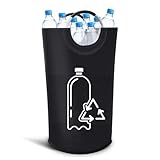
- Large 82L Capacity & Value Pack :This recycling bag offers a spacious 82L (38cm x 72cm) volume, giving you more room for bottles, cans, plastic, and glass than most standard bins. An affordable, high-capacity solution for serious recycling.
- Water-Resistant Fabric : Made from durable Oxford cloth with a waterproof PE coating. It resists moisture, tears, and stains, ensuring long-lasting use even when handling heavy loads of recyclables.Suitable for kitchens, garages, patios, or utility rooms, keeping your space tidy and organized.
- Sturdy Handles & Stands Upright : Reinforced with soft-grip aluminum handles for comfortable carrying when full. The reinforced base keeps the bag standing securely on its own, making filling and transport hassle-free.
- Folds Flat for Compact Storage : When empty, this bin easily collapses and can be tucked away in a closet, under a sink, or in a cabinet. Its space-saving design maximizes utility without consuming permanent space.
- Service Guarantee:We always ensure 100% customer's satisfaction, if you have any questions, please feel free to send me a message, we will surely help you solve the problem within 24 hours.
Bottom line for a jobsite or workshop
Solvent treatment can make EPS collapse and can potentially produce a denser, reshaped polystyrene article. It does not turn foam into new Styrofoam, does not chemically make the plastic disappear, and does not guarantee a safe or useful finished product. Acetone is particularly hazardous because it is highly flammable and volatile; d-limonene is not harmless merely because it is citrus-derived.
For most households, contractors, and small workshops, the responsible choice is to keep clean EPS separate and use a local collection program, mechanical reuse, or a professional recycler. If solvent dissolution is necessary for legitimate research, use a qualified facility with engineered ventilation, ignition control, solvent-compatible PPE and equipment, documented solvent recovery, and approved hazardous-waste handling.
Recommended Free Tools
Evidence note: The technical discussion incorporates the supplied research on EPS structure and dissolution, solvent-casting behavior, the 2024 polystyrene solvent-screening and casting studies, NIOSH acetone exposure and PPE guidance, OSHA flammable-liquid principles, and EPA household-hazardous-waste and EPS-recycling guidance.
Frequently Asked Questions
Does acetone destroy Styrofoam?
No. Acetone dissolves the polystyrene structure and collapses the air-filled foam, but it does not normally destroy the polymer chains. The plastic remains in the solvent-rich mixture and may later form a dense mass, film, or cast shape.
Can solvent casting turn waste foam back into new Styrofoam?
Usually no. Solvent casting can create a dense polystyrene article, but it does not normally restore EPS’s original bead-and-cell structure, insulation value, impact performance, fire classification, or dimensional consistency.
Is d-limonene a safe alternative to acetone for EPS?
No. d-Limonene is citrus-derived and may be less volatile than acetone, but it can still irritate skin, cause sensitization, and create a contaminated solvent-and-polymer waste stream. Its natural origin is not a safety certification.
Recommended Free Tools
Can solvent-rich polystyrene be poured down the drain or put in recycling?
No. Unused solvent, solvent-rich polystyrene, and contaminated cleanup materials should not go down a drain, onto soil, into a storm sewer, or into ordinary recycling. Contact your local or state household-hazardous-waste program and follow its packaging and collection instructions.
What can a solvent-cast polystyrene piece safely be used for?
Not without testing and certification. Informal cast polystyrene has unknown residual solvent, contamination, strength, fire behavior, and long-term stability. Do not assume it is suitable for food contact, children’s products, aquariums, medical uses, insulation, or structural construction.
The Bottom Line
The honest answer: solvents can densify and reshape EPS, but they do not recreate expanded foam or make the plastic disappear. Because acetone vapors are highly flammable and the residue remains a hazardous solvent-rich waste stream, solvent casting belongs in a properly equipped laboratory or professional maker space—not a casual household or construction-site experiment. For ordinary waste, choose clean-material reuse, an established EPS drop-off, or a professional recycler.
Quick Recap
Product prices and availability are accurate as of the date/time indicated and are subject to change. Any price and availability information displayed on Amazon at the time of purchase will apply.
Do these 3 things before closing this tab:
1Clear out junk files and repair common Windows errors2Fix the driver behind crashes, sound loss and screen glitches3Repair Windows errors before they cause bigger problems
