Pressure-treated wood usually costs the least to install, but it does not automatically cost the least over the life of a deck. In a current 20-year estimate for a 320-square-foot deck, cedar totaled $14,950, composite $19,950 and pressure-treated wood $29,300 after sealing and a mid-life pressure-treated surface replacement were included. An archived U.S. Environmental Protection Agency model reaches a different ranking, with composite having the lowest modeled annualized cost, pressure-treated wood below cedar. Those are scenarios, not guarantees: local labor, climate, board grade, maintenance habits, deck size and replacement timing can reverse the result.
What the comparison is really measuring
A meaningful long-term comparison adds every cost attributable to the visible decking surface over the period you expect to own the deck:
As an Amazon Associate I earn from qualifying purchases.
- Initial decking material, installation labor and waste.
- Cleaning, stain or sealer, application labor and the value of your time.
- Board repairs and any partial or complete surface replacement.
- Disposal, delivery and access costs when replacement occurs.
- The expected service life of the boards in your climate.
The framing, footings, stairs, railings, ledger work and permits are often the same regardless of whether the walking surface is pressure-treated pine, cedar or composite. A pressure-treated frame is common under all three choices. Compare that structural work once, then compare the incremental cost of each surface; otherwise you can make a material appear cheaper or dearer by assigning the same frame cost to it repeatedly.
The Tool Desk
Outbyte Driver Updater FREEScan for outdated or missing drivers - takes under a minuteDriver Scan →Outbyte PC Repair FREEClear out junk files and repair common Windows errorsFree Scan →For a simple, undiscounted ownership estimate, use:
#1 Best Overall

- 【Superior Durability & Longevity】Unlike traditional wood that rots, warps, or splinters over time, our WPC decking is engineered to withstand the elements. It is 100% rot-proof, decay-resistant. The composite structure ensures it maintains its structural integrity for years, even under heavy foot traffic or extreme weather conditions, saving you money on long-term replacements.
- 【Zero Maintenance】Say goodbye to the annual chore of sanding, staining, or sealing your deck. Our boards feature a hard outer shell that resists stains and fading. To clean, all you need is soap and water. This "fit-and-forget" nature gives you more time to enjoy your outdoor space rather than working on it.
- 【Eco-Friendly & Safe Design】Made from a blend of recycled wood fibers and high-density polyethylene (HDPE), our decking is an environmentally responsible choice. Furthermore, the surface is engineered with a wood grain texture that provides a high slip-resistance, making it safer for children and pets compared to lumber wood.
- 【Beautiful Aesthetic Without the Flaws】Enjoy the luxurious look of natural hardwood without the imperfections. Using advanced cap stock technology, our decking offers rich, consistent color tones that resist UV rays and moisture. It won't crack or split like traditional lumber, ensuring your patio looks picture-perfect all season long.
- 【Advanced Safety: Flame-Retardant Protection】Safety meets peace of mind. Our decking is manufactured with added flame retardants, achieving an excellent non-combustible rating. This critical feature minimizes fire risks, making it a responsible choice for your home, especially in outdoor entertainment areas where grills or fire pits are present.
20-year surface cost = initial surface cost + maintenance materials and labor + replacement surface cost + replacement labor and disposal.
This is a planning model, not a promise of resale value. If you want a more formal financial comparison, run the same cash flows with your own inflation and discount assumptions. Do not mix a current local quote with a historical national benchmark and call the result a single market price.
The current 320-square-foot, 20-year example
Tallyard’s 2026 estimate uses a 320-square-foot deck and includes sealing plus the replacement assumption used for pressure-treated boards. Its totals are:
Free tools Windows power users keep installed
One-click scans. No signup required.
| Surface | Initial material range in the example | Expected surface life in the example | Sealing interval | 20-year total in the example | Arithmetic cost per square foot |
|---|---|---|---|---|---|
| Pressure-treated wood | $3–$6 per square foot | 10–15 years | Every 1–2 years | $29,300 | $91.56 |
| Cedar | $4–$8 per square foot | 15–25 years | Every 2–3 years | $14,950 | $46.72 |
| Composite | $5–$14 per square foot | 25–50 years | None in the estimate | $19,950 | $62.34 |
The per-square-foot figures are simply each stated total divided by 320; they are not separate quotations. The surprising result is that cedar is lowest in this particular scenario and pressure-treated wood is highest. That outcome depends on the stated service-life, sealing and replacement assumptions. It should not be read as a national price ranking.
The estimate supports two dependable observations: pressure-treated wood normally has the lowest starting price, and recurring wood maintenance can outweigh that saving when it is repeated for many years. Composite starts higher but avoids the routine staining or sealing counted for the wood options.
What the archived EPA model shows
The U.S. EPA’s archived calculator modeled a 600-square-foot deck with historical inputs. It is useful as a benchmark, not as a 2026 quote for your project.
Rank #2

- 【Superior Durability & Longevity】Unlike traditional wood that rots, warps, or splinters over time, our WPC decking is engineered to withstand the elements. It is 100% rot-proof, decay-resistant. The composite structure ensures it maintains its structural integrity for years, even under heavy foot traffic or extreme weather conditions, saving you money on long-term replacements.
- 【Zero Maintenance】Say goodbye to the annual chore of sanding, staining, or sealing your deck. Our boards feature a hard outer shell that resists stains and fading. To clean, all you need is soap and water. This "fit-and-forget" nature gives you more time to enjoy your outdoor space rather than working on it.
- 【Eco-Friendly & Safe Design】Made from a blend of recycled wood fibers and high-density polyethylene (HDPE), our decking is an environmentally responsible choice. Furthermore, the surface is engineered with a wood grain texture that provides a high slip-resistance, making it safer for children and pets compared to lumber wood.
- 【Beautiful Aesthetic Without the Flaws】Enjoy the luxurious look of natural hardwood without the imperfections. Using advanced cap stock technology, our decking offers rich, consistent color tones that resist UV rays and moisture. It won't crack or split like traditional lumber, ensuring your patio looks picture-perfect all season long.
- 【Advanced Safety: Flame-Retardant Protection】Safety meets peace of mind. Our decking is manufactured with added flame retardants, achieving an excellent non-combustible rating. This critical feature minimizes fire risks, making it a responsible choice for your home, especially in outdoor entertainment areas where grills or fire pits are present.
| Surface | Modeled initial cost for 600 square feet | Modeled annual maintenance | Lifespan assumption |
|---|---|---|---|
| Recycled wood/plastic composite | $3,972–$6,270 | $0 | 25–50 years |
| Cedar/redwood | $4,596–$6,894 | $374.40–$624 | 10–20 years |
| Pressure-treated southern yellow pine | $3,036–$5,022 | $374.40–$624 | 10–20 years |
Under that archived model’s assumptions, composite has the lowest modeled annualized cost, pressure-treated pine ranks below cedar, and both wood options carry the same stated annual maintenance range. The model’s age, regional inputs and lifespan assumptions explain why its ranking differs from the current 320-square-foot example. Use it to understand how maintenance and longevity can change the answer, not to price a 2026 build.
PC Slower Than It Used to Be?
A free scan shows the junk files, broken settings and background clutter dragging Windows down - then fixes them in one click.Free scan · Windows 10 & 11Crashes, No Sound, or Screen Glitches?
Random freezes, missing sound and display glitches usually trace back to one bad driver. Find and replace yours safely.Free scan · under a minuteInitial installed cost: why pressure-treated wood usually wins
Material price
Pressure-treated boards are generally the entry-level option. In the current example, the material range is $3–$6 per square foot, compared with $4–$8 for cedar and $5–$14 for composite. Grade, thickness, profile, color, fastener system, waste and availability can move a quote outside those ranges.
Labor and deck geometry
Installation labor is driven by the same details that affect any deck: height, stairs, curves, picture framing, borders, inaccessible sites and the number of cuts. Composite systems may require hidden clips or manufacturer-specific spacing; cedar may require more careful selection and handling; pressure-treated boards can still demand sorting, drilling and end treatment. Ask each installer to show material, labor, waste, fasteners, delivery, demolition and tax as separate lines.
Costs that the surface choice may not change
Footings, posts, beams, joists, ledger flashing, railings, stairs, permits and site preparation can dominate a project budget. If the frame must be rebuilt, replacing only the boards will not solve a structural problem. Confirm whether the quote assumes a new pressure-treated substructure, reuse of an existing frame, or repairs before comparing surface prices.
Maintenance: the recurring cost many budgets miss
Pressure-treated wood
The current estimate assumes sealing every one to two years. That means repeated purchases of deck stain and sealer, surface preparation, application labor and time spent moving furniture and protecting adjacent areas. Skipping a cycle may reduce short-term spending but can change appearance and the timing of board replacement; a local contractor should identify the maintenance standard assumed in the warranty or quote.
Cedar
The estimate assumes sealing every two to three years. Cedar’s lower density and natural appearance can be part of its appeal, but the long-term cost depends on whether you maintain that appearance, allow it to weather, or replace boards that split, stain or decay. Regional cedar pricing varies substantially, so obtain a local material quote rather than applying a national average.
Rank #3
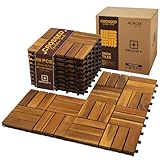
- Premium Acacia Wood 0.9 Thick: Solid acacia hardwood treated with a protective linseed oil finish that penetrates and guards the wood grain against moisture and wear; each tile measures a full 12 x 12 x 0.9 inches for a premium, substantial feel
- Safe Grip on Any Wet Surface with Grooved Slats and PPC Base: Deep-groove pattern keeps feet secure around pools, balconies, patios, and wet areas; supports up to 490 lbs
- Superior Drainage with Elevated Raised Base: Lifts tiles off the ground to channel water away underneath; promotes airflow and keeps surfaces dry — ideal for poolside, bathrooms, RV floors, and balconies
- Snaps Together in Minutes with No Tools Required: Precision interlocking clips lock all four sides by hand; tiles cut easily with a hand saw to fit edges and corners
- Built Tough for All-Weather Outdoor Use: Handles heat, UV exposure, and heavy use in all seasons; sweep or rinse with a hose to keep tiles looking their best
Composite
The cited models count no sealing for composite. That does not mean literally maintenance-free. Composite still needs routine cleaning, prompt removal of spills and leaves, adequate ventilation and installation that follows the specific board manufacturer’s spacing and fastening instructions. Cleaning supplies and occasional labor remain possible costs even when stain and sealer are not.
Your time versus paid labor
Two owners can have different lifecycle costs for the same boards. If you do preparation and sealing yourself, the cash cost may be lower but the time commitment is real. If a contractor performs the work, request a written per-visit price and frequency. Use the same labor assumption for all three surfaces; otherwise the comparison rewards the option you happened to model with unpaid labor.
Service life, repairs and replacement timing
The current estimate lists surface-life ranges of 10–15 years for pressure-treated wood, 15–25 years for cedar and 25–50 years for composite. The archived EPA model uses 10–20 years for cedar/redwood and pressure-treated pine and 25–50 years for composite. These are planning ranges, not guarantees for every board.
Replacement rarely happens as a single, clean event. High-traffic paths, stair treads, board ends near splash zones and areas under planters may fail first. Include the possibility of partial board replacement, color matching, fastener removal and labor to protect the frame. The 320-square-foot pressure-treated total explicitly includes a mid-life surface replacement; omitting that line is why a low initial price can look artificially cheap over 20 years.
When a surface reaches the end of its life, inspect joists, beams, ledger connections and flashing before ordering boards. Water damage or code changes may require structural work, and that cost is separate from the material comparison.
Appearance, feel and climate exposure
Appearance and feel
Wood offers natural grain and can be stained to alter its color; composite provides manufactured color and texture with more consistent board dimensions. Visit installed decks or obtain samples in direct sun and shade. Compare slipperiness when wet, surface texture, edge profiles, color variation, heat under your local summer conditions and how easily a damaged board can be replaced. A material that costs less but is disliked may be replaced early, defeating the financial model.
Rank #4

- Authentic Wood Aesthetic - Expertly crafted texture that flawlessly mimics the richness and elegance of real wood, offering a breathtakingly natural and timeless look that transforms your outdoor space into a luxurious retreat.
- Effortless Installation - Enjoy hassle-free setup with our flexible installation options, complete with a FREE tool kit including stainless steel spiked clips, screws, and edge clips.
- Unmatched Durability - Engineered to withstand the toughest conditions, our boards offer supreme resistance to stains, fading, water, scratches, and wear, ensuring they remain as stunning as the day they were installed, no matter the weather.
- Low-Maintenance Luxury - Revolutionize your outdoor living with composite boards that demand almost no upkeep. Forget the endless sanding, staining, and sealing of traditional wood—our boards stay pristine and beautiful year after year with minimal effort.
- Eco-Friendly & Pest-Resistant - Designed with sustainability in mind, our boards are not only durable but also resistant to rodents and insects, offering a planet-friendly and worry-free solution for your outdoor oasis.
Moisture, sun and temperature
Rain, snow, freeze-thaw cycles, intense ultraviolet exposure, standing water and poor airflow all affect maintenance and service life. Decks close to grade, beside pools or under dense tree cover usually need a different cleaning routine from an elevated, open deck. Tell the installer about sprinklers, roof runoff, coastal exposure and shade. Those facts can justify a different sealing interval or board-life assumption than the published ranges.
What’s actually slowing this PC down?
Pick the symptom - the matching free tool is one click away.
How to calculate your own 20-year cost
- Measure the surface. Record square footage, stairs, picture framing, borders and any areas that need a different board profile. Keep stairs and railings in separate line items.
- Choose the ownership horizon. Run at least a 10-year and a 20-year version if you might move. A material that wins at 20 years may not win during a short ownership period.
- Separate the frame. Price footings, posts, beams, joists, ledger work, stairs and railings once. Then calculate the incremental surface cost for each option.
- Collect comparable local quotes. Ask for the same deck geometry, board width, fastener method, waste allowance, delivery, demolition and tax. Require labor and materials to be itemized.
- Set maintenance assumptions. Write down who will clean or seal, how often, the product cost and the labor rate. Use one consistent labor value when comparing materials.
- Model replacement. Choose a conservative, middle and optimistic board-life case from the published ranges. Add partial repairs, disposal and installation labor, not just new board prices.
- Check climate and drainage. Adjust the maintenance and life assumptions for shade, runoff, wet ground, snow, coastal air and local contractor experience.
- Run sensitivity cases. Change labor rates, sealing frequency and replacement year. If a small change reverses the winner, report the choice as assumption-sensitive rather than claiming one material is universally cheapest.
| Worksheet line | Pressure-treated | Cedar | Composite |
|---|---|---|---|
| Surface material and waste | Enter local quote | Enter local quote | Enter local quote |
| Initial surface installation | Enter local labor | Enter local labor | Enter local labor |
| Cleaning over ownership period | Frequency × cost | Frequency × cost | Frequency × cost |
| Stain or sealer and application | Frequency × cost | Frequency × cost | Use zero only if your model excludes it |
| Repairs and replacement | Year, area and labor | Year, area and labor | Year, area and labor |
| Total surface cost | Add lines above | Add lines above | Add lines above |
Is composite worth the higher upfront cost?
Composite is worth considering when you value predictable upkeep, expect to own the deck through a wood replacement cycle, or would otherwise pay for frequent sealing. Its higher initial range—$5–$14 per square foot in the current example—buys a modeled 25–50-year surface life and eliminates routine sealing in the cited estimates. The premium is harder to justify for a short ownership period, a very small deck, or an owner who enjoys and performs wood maintenance at little cash cost.
Check the specific product before signing: color availability, heat and texture, expansion gaps, joist spacing, fastening system, stair-nosing details, cleaning restrictions and shipping can change the installed total. A composite quote that excludes required clips, fascia, picture framing or upgraded substructure is not comparable with an all-in wood quote.
A 2018 manufacturer report presented composite decking as more durable, longer lasting and easier to maintain than the wood products it compared. Treat that as a manufacturer position, not independent proof that every composite product will outlast every wood deck; product formulation, installation and exposure still matter.
Is cedar cheaper than pressure-treated wood in the long run?
It can be, but the answer is highly assumption-sensitive. In the current 320-square-foot, 20-year estimate, cedar is the lowest-cost option because its 15–25-year life and two-to-three-year sealing interval combine favorably with the assumptions used. In the archived EPA model, cedar/redwood carries the same annual maintenance range as pressure-treated pine and ranks above pressure-treated on annualized cost. Regional cedar prices, the finish you expect, labor rates and whether you replace individual boards or the whole surface can move the result either way.
Do these 3 things before closing this tab:
1Clear out junk files and repair common Windows errors2Scan for outdated or missing drivers - takes under a minute3Repair Windows errors before they cause bigger problemsAsk for two cedar scenarios: one that lets the wood weather naturally and one that maintains a chosen color with regular sealing. Those are different appearance and maintenance contracts, so they should not be blended into one number.
Common comparison mistakes
- Comparing material prices only. Correct it by adding labor, waste, fasteners, maintenance and replacement.
- Using different deck sizes. Normalize every option to the same square footage and geometry.
- Charging the full frame to one material. Separate the pressure-treated substructure from the visible boards.
- Assuming no sealing means no composite maintenance. Include cleaning and manufacturer-required installation details.
- Treating an archived model as a current quote. Label the EPA figures historical and obtain local 2026 pricing.
- Ignoring owner labor. Record your hours or use a contractor rate consistently for every option.
- Using the longest life in every case. Run conservative and middle-life cases, especially in wet or shaded locations.
- Forgetting disposal and access. Replacement on a raised or hard-to-reach deck can cost more than the boards.
- Choosing by color alone. Inspect samples for wet traction, texture, heat, repairability and the appearance you will accept after several seasons.
A practical decision framework
| Your priority | Material that may fit | What to verify before deciding |
|---|---|---|
| Lowest initial cash outlay | Pressure-treated wood | Sealing budget, labor frequency and likely replacement year |
| Natural wood appearance with a potentially longer first surface life | Cedar | Local cedar grade and price, finish standard and maintenance commitment |
| Long ownership and less routine sealing | Composite | Installed price, cleaning requirements, heat and texture, clips and shipping |
| Uncertain ownership period | Compare all three at 10 and 20 years | Resale plans, transferable warranties and replacement assumptions |
Before accepting a bid, have the contractor state the board product and grade, square footage, waste percentage, framing scope, fastener system, maintenance instructions, expected replacement interval and every exclusion. Put the same information into all three versions of your worksheet. That is the only reliable way to tell whether a higher upfront price is buying lower ownership cost or merely a more expensive installation.
Quick Recap
Product prices and availability are accurate as of the date/time indicated and are subject to change. Any price and availability information displayed on Amazon at the time of purchase will apply.

