For most homes, a correctly sized window air conditioner is the more efficient practical choice. It normally has a shorter, better-sealed path for rejecting heat outdoors. A portable air conditioner remains the sensible option when a window unit cannot be mounted, building rules prohibit it, or you need to move and store the equipment. There is no defensible universal percentage difference: the U.S. Department of Energy (DOE) tests portable and room (window) air conditioners under separate procedures, so their ratings are not a simple apples-to-apples conversion.
What “efficiency” means in this comparison
Efficiency can mean several different things. You may be asking which unit uses fewer watts while running, which removes more heat for each unit of electricity, which costs less on your bill, or which keeps a room comfortable with fewer operating hours. Those answers can diverge if one unit is badly sized, poorly sealed, installed in a hotter location, or operated under different conditions.
As an Amazon Associate I earn from qualifying purchases.
The fairest comparison starts with two current models that are intended for the same cooling load. Read each model’s stated rating, identify the metric behind that rating, and then consider installation and operating conditions. A rating is a controlled result, not a promise that every installation will consume the same amount of electricity.
PC Slower Than It Used to Be?
A free scan shows the junk files, broken settings and background clutter dragging Windows down - then fixes them in one click.Free scan · Windows 10 & 11Outdated Drivers Are Slowing You Down
One free scan finds every outdated or missing driver and matches the right update for your exact hardware.Free scan · exact hardware matchPortable and window air conditioners are different regulatory categories
DOE definition of a portable air conditioner
DOE quotes the Code of Federal Regulations defining a portable air conditioner as “a portable encased assembly, other than a ‘packaged terminal air conditioner,’ ‘room air conditioner,’ or ‘dehumidifier,’ that delivers cooled, conditioned air to an enclosed space, and is powered by single-phase electric current.” The equipment is a self-contained appliance intended to remain inside the room while delivering conditioned air there.
#1 Best Overall
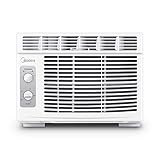
- PERFECT FOR SMALLER ROOMS - Midea's Affordable Window AC unit is perfect to help your room be as comfortable as possible. It can cool 150 sq. ft. with 7 temperature settings, 2 cooling/2 fan-only speeds, and 2-way air direction to give you the perfect amount of cooling every time.
- ENERGY EFFICIENT- Midea's 5,000 BTU window air conditioner has a Combined Energy Efficiency Rate (CEER) of 11.0 which helps reduce the energy costs to save you money throughout the year.
- QUIET & EASY TO USE - This window AC unit is quieter than a household refrigerator. It also features easy-to-use mechanical controls to quickly set the time, temperature, and mode and has a removable & reusable air filter.
- EASY INSTALLATION - Easily install in your home or apartment's existing window frame. Suitable for windows 23''-36'' wide and minimum 13'' high. All mounting accessories are included. A screwdriver is required (but not included) for installation. For some window frames, pilot holes are recommended before installing screws. Please see included instruction manual for further detail.
- WARRANTY: 1 Year Parts & Labor Warranty comes with each Midea product to ensure the quality of our brand to our customers. Our team is happy to help if any questions or issues arise and make sure to register your product on our website for even faster support in the future.
DOE definition of a room air conditioner
DOE defines a room air conditioner as “a consumer product, other than a ‘packaged terminal air conditioner,’ which is powered by a single phase electric current and which is an encased assembly designed as a unit for mounting in a window or through the wall for the purpose of providing delivery of conditioned air to an enclosed space.” A conventional window AC falls within this room-air-conditioner category.
Why the category distinction matters
Portable air conditioners are tested under 10 CFR 430, Subpart B, Appendix CC. Residential room air conditioners are tested under Appendix F. Because the test procedures differ, a portable model’s published number should not be treated as though it were measured on exactly the same basis as a window model’s number.
DOE’s portable-air-conditioner information lists standards established in a final rule published January 10, 2020, with compliance required beginning January 10, 2025, and a test-procedure final rule published May 15, 2023. DOE also reported a proposed determination dated May 16, 2025, to withdraw a prior determination that portable air conditioners qualify as covered products. That proposal is regulatory context, not evidence that existing requirements have already changed; check the current DOE rule status when making a procurement decision.
Quick wins for a faster PC:
Fix the driver behind crashes, sound loss and screen glitchesFind Drivers →Repair Windows errors before they cause bigger problemsFix Now →Which type is usually more efficient?
In a typical installation, choose a window air conditioner when a suitable window or through-wall opening is available. The unit places its heat-rejection side outside and its cooling side inside, so the basic heat-transfer path is direct. A portable unit must remain indoors and send heat through an exhaust arrangement at a window or another approved opening. The enclosure, hose, seals, and room pressure can make that arrangement more sensitive to installation quality.
This is a practical rule of thumb, not a measured universal ratio. The reviewed official material does not establish that every window model beats every portable model, nor does it provide a controlled current-model percentage saving. A highly efficient portable model in a well-sealed installation can be a better real-world choice than an undersized, poorly fitted, or damaged window unit.
How to read the efficiency information on each model
Start with the stated metric
Look at the product label, specification sheet, or owner’s manual and record the exact metric and test basis. DOE and the Federal Energy Management Program (FEMP) discuss Combined Energy Efficiency Ratio (CEER) in room-air-conditioner purchasing guidance. Portable-air-conditioner material also describes a DOE procedure using CEER, but that does not make a portable CEER value directly interchangeable with a room-AC CEER value because the categories use separate procedures.
Do not rank a portable and a window unit solely by whichever number looks larger. First confirm that you are comparing the same kind of metric, under the same stated capacity convention, and within the appropriate product category.
Record capacity as well as efficiency
A unit that cannot meet the room’s heat load may run continuously and still leave the room uncomfortable. A unit with substantially more capacity than needed can cycle in ways that do not provide the comfort or humidity control you expect. Use the manufacturer’s room-size and installation guidance as a starting point, then account for sun exposure, ceiling height, occupants, appliances, insulation, and air leakage.
Use a simple operating-cost calculation
For a rough household estimate, multiply electricity consumed in kilowatt-hours by your utility’s price per kilowatt-hour:
operating cost = energy used (kWh) × electricity price ($/kWh)
The nameplate wattage alone is not a yearly cost forecast. Actual consumption depends on compressor cycling, fan settings, thermostat setpoint, outdoor temperature, humidity, operating hours, and whether the room gains heat from adjacent spaces. For a meaningful estimate, use the model’s published consumption information and your own expected schedule rather than applying a generic window-versus-portable percentage.
Free tools Windows power users keep installed
One-click scans. No signup required.
Installation is often the deciding efficiency factor
Window-unit requirements
A window AC needs a window or through-wall location that can safely support the appliance and accept its dimensions. Before buying, verify the manufacturer’s minimum and maximum opening width, opening height, sill depth, side-clearance requirements, electrical requirements, and any limit on installation angle. Confirm that the sash, frame, and surrounding wall can support the installation without unsafe gaps.
- Measure the opening at several points; older windows are not always square.
- Check whether the unit must be supported by brackets or another approved support method.
- Seal the side panels and perimeter according to the manufacturer’s instructions.
- Keep outdoor intake and discharge areas clear of obstructions.
- Confirm that the circuit and receptacle meet the unit’s electrical requirements; do not use an extension cord unless the manufacturer explicitly permits it.
A window unit that sits crooked, has open side gaps, or discharges into a confined recess can lose practical performance and create safety or water-management problems. Building rules, landlord requirements, historic-district restrictions, and emergency-egress requirements may also rule out a window installation even when the dimensions appear to fit.
Rank #2

- BEST FOR SMALL ROOMS: Cools up to 150 sq ft efficiently with 5,000 BTU cooling power. Ideal for bedrooms, home offices, dorm rooms, workshops, and studio apartments. Compact 16.4" W x 13.4" D x 12.6" H design fits tight spaces.
- QUIET OPERATION - Quieter than many older window AC units, with 2 cooling modes (low 52 dBA for nighttime, high 56 dBA for rapid cooling) and 2 fan speeds for personalized comfort. Simple mechanical controls mean no annoying digital beeps.
- SIMPLE, RELIABLE MECHANICAL CONTROLS: Easy-to-use dials for temperature and fan speed—no Wi-Fi, apps or complex setup required. 10 temperature settings let you dial in your perfect comfort level. Auto restart after power outages.
- LOW MAINTENANCE & ENERGY SMART: No manual draining under normal conditions. Washable, reusable filter for easy care. Low 440W power draw helps reduce energy costs compared to older, inefficient units.
- EASY DIY INSTALLATION: Fixed chassis installs easily and fits double-hung windows 27.125"–36" wide and 13.375" high minimum. EZ Mount kit with foam insulation included. Backed by 1-year GE limited warranty for peace of mind.
Portable-unit requirements
A portable AC normally needs a nearby electrical outlet and an exhaust route to the outdoors. Follow the supplied window adapter and sealing instructions, and keep the exhaust path as short and straight as the manufacturer allows. Do not vent the hot exhaust into an attic, crawlspace, wall cavity, garage, or another enclosed area unless the installation instructions specifically approve that arrangement.
- Check the exhaust-hose length and outlet location before placing the appliance.
- Seal the adapter around the window so outdoor air cannot freely enter.
- Keep the hose and grille free of kinks, crushing, dust, and furniture.
- Leave the specified clearance around air inlets and outlets.
- Use the condensate-drain method described in the manual, especially during high-humidity operation.
Portability does not eliminate installation losses. Moving the unit from room to room can leave a different window seal, hose path, or room configuration each time. Recheck the seal after every move.
Why a portable unit can use more electricity in practice
Heat rejected through an indoor hose
The exhaust hose is exposed to the conditioned room. Some of the heat it carries can radiate back into that room, particularly when the hose is long, damaged, or routed beside the user. Keep it away from bedding and seating, avoid unnecessary length, and follow the manufacturer’s clearance instructions.
Air-pressure effects and leakage
When a portable design exhausts room air outdoors, replacement air can enter through cracks around doors, windows, and building penetrations. That incoming air may be hot and humid, increasing the cooling load. The size of this effect depends on the unit’s design and the building’s airtightness; it is not a fixed penalty that can be expressed as one percentage for all homes.
Window-adapter sealing
The adapter is a critical part of the installation. An open corner or loose fabric panel can allow outdoor air around the exhaust opening, making the compressor work longer. Inspect seals in daylight, secure them without blocking required airflow, and replace damaged sealing material with a method approved for the appliance.
Room-to-room moves
Portable ACs are useful when you cool only an occupied room, but frequent moves introduce setup time and the possibility of a poor seal. If you move the appliance, treat the new installation as a fresh setup: check clearances, hose routing, drainage, and window sealing before judging its efficiency.
Recommended Free Tools
When a portable air conditioner is the better choice
No safe or permitted window location
Choose portable equipment when the building has no suitable window, the window cannot support the required dimensions, a landlord or condominium rule prohibits a window unit, or a required emergency exit must remain unobstructed. In these cases, a portable AC can provide useful cooling even if its installation is less efficient in theory than a properly mounted window unit.
Short-term occupancy or seasonal storage
Renters, temporary workspaces, and seasonal rooms may value an appliance that can be disconnected and stored. Measure the storage location and the route through doors and stairs; a unit that is technically portable but difficult to move may not deliver the practical benefit you expect.
Cooling one room at a time
If you occupy a bedroom or home office for only part of the day, cooling that room instead of an entire dwelling can reduce total household energy use. The result depends on closing doors, limiting heat transfer from adjacent spaces, and selecting a capacity appropriate to that room.
When a window air conditioner is the better choice
A compatible opening is available
A window unit is usually the stronger efficiency choice when the opening is structurally suitable, permitted, and capable of being sealed. Its outdoor heat-rejection components remain outside, and the installation can stay in place for the cooling season.
The Tool Desk
Outbyte Driver Updater FREEFix the driver behind crashes, sound loss and screen glitchesFind Drivers →Outbyte PC Repair FREERepair Windows errors before they cause bigger problemsFix Now →You expect long daily run times
The more hours the compressor operates, the more important the installation and category-appropriate efficiency rating become. For a room that needs cooling through most hot afternoons and nights, prioritize a correctly sized window model with a strong rating within the room-AC category.
You want a fixed, repeatable setup
A properly supported and sealed window unit does not require a new hose and adapter arrangement each time you use it. That consistency can make its real-world performance easier to maintain, provided filters, coils, drainage paths, and seals are kept clean and unobstructed.
A decision framework for comparing two specific models
- Define the room. Record floor area, ceiling height, sun exposure, insulation quality, major heat-producing equipment, occupants, and the hours the room will be used.
- Confirm installation eligibility. For a window model, verify opening dimensions, structural support, electrical access, and building permissions. For a portable model, verify an approved exhaust route, window-adapter fit, outlet location, and hose clearances.
- Match capacity to the load. Compare models intended for the same cooling need. Do not use a larger capacity as a substitute for fixing air leakage or poor insulation.
- Write down each rating exactly. Include the metric name, capacity basis, category, and any conditions stated by the manufacturer.
- Estimate your schedule. Use expected hours per day and seasonal days, then combine the model’s consumption information with your local electricity rate.
- Evaluate the installed configuration. Account for hose exposure, window gaps, room pressure, direct sun on the equipment, and whether the unit can remain correctly installed.
- Price the complete project. Include approved brackets or supports, sealing materials, drainage provisions, and any electrician or carpenter required for a safe installation.
- Choose the option that remains compliant and maintainable. A theoretically efficient unit is a poor choice if it cannot be safely installed, sealed, drained, or serviced in your space.
Comparison at a glance
| Decision factor | Window air conditioner | Portable air conditioner |
|---|---|---|
| Official category | Residential room air conditioner | Portable air conditioner |
| DOE test procedure cited | 10 CFR 430, Subpart B, Appendix F | 10 CFR 430, Subpart B, Appendix CC |
| Typical placement | Mounted in a window or through a wall, with the heat-rejection side outdoors | Self-contained assembly inside the room, with conditioned air delivered indoors and an exhaust arrangement to outdoors |
| Installation dependency | Requires a suitable, permitted, supported opening and careful perimeter sealing | Requires an approved exhaust route, window adapter or equivalent opening, clearances, and careful sealing |
| Mobility | Limited once installed; generally seasonal equipment | Designed to be moved and stored, although each new setup must be checked |
| Rating comparison | Use the model’s room-AC rating and metric | Use the model’s portable-AC rating and metric; do not convert it directly to a room-AC number |
| Best fit | A permitted window or wall location and regular, sustained cooling | No practical window installation, rental restrictions, or a need to move the appliance |
What the DOE statistics do—and do not—tell you
DOE reported in 2023 that a typical new room air conditioner uses 39% less energy than its 1990 counterpart. The same announcement estimated approximately $1.5 billion per year in consumer electricity-bill savings and 106 million metric tons of reduced carbon dioxide emissions over 30 years. These are historical benefits associated with room-air-conditioner standards; they are not a window-versus-portable test result and should not be presented as a percentage advantage for one type over the other.
Rank #3

- Effortless Cooling: Achieve optimal comfort with customizable temperature settings and two fan speeds; Effortless Temperature Control helps to maintain your preset temperatures for consistent comfort
- Easy Maintenance: Keep your air conditioner running efficiently with the easy-to-clean washable filter, designed to capture dust from the air for long-lasting performance
- Undisturbed Comfort: Experience a peaceful home environment with a quiet performance at 52 dBA – ideal for bedrooms or small spaces up to 150 sq. ft.
- Effortless Convenience: Benefit from the Auto Restart feature, which automatically restores the unit's previous settings once power is restored to the window air conditioner
- Hassle-Free Operation: The extra-long three-prong power cord eliminates the need for extension cords, while the adjustable side panels easily extend to best fit your window, ensuring a secure installation with optimal efficiency and airflow
The figures also do not predict the bill for a particular home. Your result depends on the specific model, room load, weather, thermostat setting, operating schedule, electricity price, and installation quality.
Common mistakes and how to correct them
Comparing unlike rating numbers
Symptom: A portable model appears to have a lower or higher number than a window model, so you declare a winner immediately.
Correction: Identify the rating metric and the DOE category-specific test procedure first. Compare only after confirming that the models serve the same cooling need.
Buying by room area alone
Symptom: The appliance runs continuously, or the room becomes clammy despite a seemingly adequate capacity.
Correction: Reassess sunlight, ceiling height, occupants, appliances, insulation, door openings, and air leakage. Follow the manufacturer’s sizing guidance rather than relying on a single square-foot number.
Do these 3 things before closing this tab:
1Clear out junk files and repair common Windows errors2Scan for outdated or missing drivers - takes under a minute3Repair Windows errors before they cause bigger problemsIgnoring the opening and support
Symptom: The window unit vibrates, leaks, leaves gaps, or blocks a required exit.
Correction: Stop and verify the opening, support method, level, clearances, and building requirements. Use only installation hardware and methods approved for that model.
Treating a portable hose as an afterthought
Symptom: The room cools slowly, the hose is hot, or the compressor runs almost continuously.
Correction: Shorten and straighten the hose within the manufacturer’s limits, restore required clearances, inspect the adapter seal, and keep hot exhaust away from the room’s occupied area.
What’s actually slowing this PC down?
Pick the symptom - the matching free tool is one click away.
Using a generic electricity estimate
Symptom: The predicted bill does not resemble the utility statement.
Correction: Recalculate from actual operating hours, the local electricity rate, model-specific consumption information, and the weather and thermostat conditions during the billing period.
Maintenance that protects real-world efficiency
- Clean or replace filters at the interval specified by the manufacturer; a loaded filter restricts airflow.
- Keep indoor and outdoor grilles, coils, and discharge paths free of dust and obstructions.
- Inspect window panels, perimeter seals, and portable adapters at the beginning of the cooling season and after any move.
- Check condensate handling and drainage before humid weather; follow the manual for tank emptying or continuous-drain use.
- Do not cover required ventilation openings during storage or operation.
- Disconnect and store equipment according to the manufacturer’s instructions when the season ends, protecting hoses, seals, and electrical components from damage.
Bottom line for a construction or renovation project
Plan for a window air conditioner when the project can provide a safe, code-compliant, structurally supported, and well-sealed opening. Plan for a portable air conditioner when the project cannot provide that opening or when the occupant needs movable cooling. In either case, select a capacity suited to the room, read the rating within its own DOE category, and evaluate the complete installed system rather than a headline number.
For a specific household, the responsible comparison is between current models matched for capacity and operating conditions. The official sources reviewed do not establish a universal efficiency percentage or a current controlled model ranking, so any claim that one type always saves a stated amount should be treated skeptically.
Quick Recap
Product prices and availability are accurate as of the date/time indicated and are subject to change. Any price and availability information displayed on Amazon at the time of purchase will apply.

