Free tools Windows power users keep installed
One-click scans. No signup required.
The safe way to pressure-wash a car, patio or exterior wall is to let two things control every setting: the pressure washer’s owner’s manual and the surface manufacturer’s care instructions. There is no single “safe” PSI, nozzle or distance for all paint, glass, concrete, pavers, wood, siding, stucco or brick. Start with the least aggressive combination the instructions allow, test an inconspicuous spot, keep the wand moving and stop at the first sign of damage.
A pressure washer is a power tool, not an ordinary hose. A concentrated stream can inject fluid through skin, throw debris, damage finishes and create electrical or carbon-monoxide hazards. The procedure below separates universal precautions from surface-specific decisions so you can clean without treating an unverified setting as a guarantee.
As an Amazon Associate I earn from qualifying purchases.
Before you start: make the machine and work area safe
Read the exact manual and check recalls
Find the model and serial number on the washer, then read the sections covering nozzles, detergents, grounding, water supply, startup, shutdown and pressure release. The manual takes priority over generic charts or advice. For example, a Westinghouse pressure-washer manual says not to aim its red high-pressure nozzle at glass and to use detergents recommended for that washer; that is model-specific guidance, not a universal rule for every machine (Westinghouse owner’s manual).
Check the U.S. Consumer Product Safety Commission’s current recall database before each new or second-hand machine. A recall notice dated August 28, 2025 covers certain RYOBI RY142300, RY142300VNM and RY142711VNM pressure washers in specified serial ranges. CPSC reports 135 overheating reports, including 41 explosions and 32 injuries or fractures, for that recalled product group. If your model and serial number match the notice, stop using it and arrange the free repair instead of attempting a workaround (CPSC recall notice, August 28, 2025). Those figures apply only to the recalled group, not to pressure washers generally.
#1 Best Overall
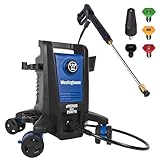
- Delivers 2500 max PSI and 1.76 max GPM (at lowest pressure), and 2000 rated PSI and 1.2 rated GPM of water flow; Pro-style steel extendable 17.5” wand with quick-connect nozzles (0°, 15°, 25°, turbo and soap applicator)
- Super compact and lightweight at 16.5” tall and 19 pounds for convenient storage and portability; Four quick-lock wheels with 360° steering design and low center of gravity engineered for anti-tipping design
- Easy-coil nylon braided 25' hose; 20 ounce onboard soap tank to add detergents/chemicals for heavy duty cleaning power on decks, driveways, garage floors, stairs, fencing, patio furniture and vehicles
- Pump automatically stops when trigger is not engaged to conserve energy and promote pump and motor life
- Backed by a 3-Year limited service, labor and parts coverage with nationwide customer service and support network
Inspect the washer and the site
- Examine the hose, trigger gun, wand, couplers, nozzle and water inlet for cuts, bulges, cracks, loose fittings or missing seals. Replace damaged parts before pressurizing.
- Confirm that the water source, extension equipment (if the manual permits it) and power supply meet the machine’s requirements. Never bypass a ground pin, safety switch or ground-fault protection.
- Remove toys, stones, loose trim, planters and other objects that could become projectiles. Identify drains and areas where detergent or dirty runoff must not enter.
- Keep children, pets and bystanders outside the spray and rebound area. Tell anyone nearby not to approach while the trigger is locked or the engine is running.
- Choose stable, level footing with enough room to step back without tripping over a hose. Do not use the spray to move heavy objects or to “test” the stream at your feet.
Wear protection and control exposure
Wear safety goggles or a face shield, gloves that preserve trigger control, sturdy non-slip footwear and clothing that covers exposed skin. Add hearing protection for noisy equipment and torso protection when the job can throw substantial debris. Guidance summarized by the Washington State Department of Labor and Industries calls out eye, hand, foot, ear and torso protection (NIOSH/ Washington State “Tip Sheet: Handling the Pressure,” 2020).
A high-pressure injection injury can look like a small puncture while fluid and contamination spread beneath the skin. The CDC warns that delayed treatment can lead to infection, disability or amputation. If a jet strikes a person—even when the wound appears minor—turn off the machine, seek urgent medical care and tell clinicians that it was a high-pressure injection injury (CDC, “Pressure Washer Safety,” reviewed August 26, 2026).
Separate electrical and exhaust hazards
With an electric washer, keep plugs, connectors and extension connections out of standing water and away from runoff. Follow the manual’s grounding and GFCI instructions, and stop if protective equipment trips repeatedly; do not reset it while the area is wet or while investigating a fault.
Do these 3 things before closing this tab:
1Clear out junk files and repair common Windows errors2Scan for outdated or missing drivers - takes under a minute3Repair Windows errors before they cause bigger problemsWith a gasoline washer, work outdoors in open air. Keep the exhaust at least 20 feet from doors, windows and vents, and aim it away from the building and other air intakes. Never run the engine in a garage, shed, crawlspace, vehicle, or any partly enclosed area: carbon monoxide can accumulate without a warning smell. The CDC’s safety guidance gives the 20-foot separation; the washer manual may impose additional limits.
Rank #2

- HIGH PRESSURE WASHER: LWQ power washer with deep cleaning high pressure up to 2.5 GPM of water flow. It's saving water and energy, it also ensures high cleaning efficiency and the ability to clean objects with complex shapes and structures, which makes it ideal for cleaning various surfaces in your home, such as driveways, patio furniture, and cars.
- MULTI-PURPOSE USE: Equipped with 4 quick-connect metal spray nozzles (water-pressure strength:0°>15°> 25°> 40°) and a foam cannon, the LWQ pressure washer is easy to clean objects with complex shapes and structures. The detergent bottle can be filled with chemicals such as bleach, the cleaner will not pass through the pump.
- CONVENIENT TO USE: LWQ Pressure Washer designs of 2 rollers for easy movement and operation, while the bottom of the body adds an anti-tipping design for overall stability when not in motion. Simple assembly + dual-roller design + anti-tipping base + faucet/bucket water collection system - making it more convenient to use anywhere.
- EASY TO STORAGE: With power cord hook and nozzle holders, it is easy to access or to store in a garage/pantry after use. In addition, its compact design for easy to store in a garage or pantry when not in use. The LWQ pressure washer is perfect for cleaning concrete, pavement, driveways, patios, decks, sidewalks, RVs, cars, boats, homes, fencing, and more.
- USER-FRIENDLY & SAFETY: The LWQ pressure washer using high-pressure water flow to clean up the dirt, for saving water and energy and ensuring high cleaning efficiency. Tip: Before turning on the pressure washer, exhaust the air in the high pressure hose as well as the inlet hose, this will ensure that the machine can spray high pressure water stream properly.
How pressure, nozzles and distance affect damage
Pressure at the pump is not the same as force delivered to a particular finish. Nozzle angle, orifice size, water flow, distance, the time the jet stays in one place and the condition of the surface all change the result. A narrow fan concentrates energy; a broad fan spreads it. A zero-degree stream is the most concentrated option and can scar or strip a surface almost immediately. Consumer Reports specifically warns that a zero-degree nozzle can cause severe damage quickly and describes broad fan nozzles for general outdoor cleaning (Consumer Reports, “Pressure Washer Safety Alert”).
Do not select a nozzle by color alone: color conventions vary, and the manual for your washer controls which tips are approved. Begin with the least aggressive nozzle and the greatest practical distance allowed by both sets of instructions. Keep the wand moving in smooth, overlapping passes. Bringing the tip closer increases impact rapidly, so adjust only one variable at a time and retest.
A conservative pressure-washing workflow
- Plan the job. Identify the material, fragile components, openings, runoff path and the area where you can stand securely. Obtain the surface maker’s cleaning instructions if they are available.
- Read and inspect. Follow the machine manual, verify the model against recall notices, check every hose and connection, and confirm the water and power arrangements.
- Set a clean perimeter. Move people, pets and loose objects away. Protect or close openings that the surface instructions identify as vulnerable, without blocking required ventilation for the machine.
- Put on PPE. Use eye protection, gloves and non-slip footwear at minimum, adding hearing and torso protection when the manual or conditions call for them.
- Connect with the machine off. Attach the water supply, wand and the least aggressive approved nozzle. Open the water supply and purge air according to the manual before starting the motor.
- Make a test patch. Choose a hidden or low-visibility area made of the same material and finish. Use the proposed nozzle, distance, movement and detergent (if any), then let the spot dry enough to reveal lifting, whitening, etching, fuzzing, streaking or color change.
- Clean in controlled passes. Work in manageable sections, keep the wand moving and maintain the tested distance. Never aim at a person, animal, electrical fitting, ventilation opening or fragile edge.
- Use soap only when compatible. Select a detergent the washer manual allows and the surface maker permits. Follow the product label for dilution, dwell time and rinsing; do not assume that a vehicle soap, masonry cleaner or household chemical is interchangeable.
- Watch the surface and machine. Stop for coating lift, exposed aggregate, damaged joints, water entering an opening, unusual vibration, leaks, burning smell or an electrical protection trip. Turn the machine off before investigating.
- Shut down as directed. Follow the manual’s order for stopping the engine or motor, closing the water supply, squeezing the trigger to release trapped pressure and storing the hose and wand. Do not disconnect a pressurized fitting.
How to pressure-wash a car without damaging it
Why a vehicle needs a light touch
Automotive paint, clear coat, plastic trim, rubber seals, badges, cameras, parking sensors and glass have different tolerances. No authoritative vehicle-finish specification establishes one PSI, nozzle or standoff distance that is safe for every car. Treat the vehicle-care instructions and your washer manual as the controlling specifications rather than copying a setting from another vehicle.
Car-safe setup and sequence
- Park on stable ground away from traffic and close doors, windows, the hood and the liftgate. Remove loose dirt by a gentle preliminary rinse only if the vehicle-care instructions allow it.
- Fit the broadest, least aggressive approved spray pattern. Keep the stream off concentrated jets and do not use a zero-degree tip on painted or glass surfaces.
- Test a hidden section of paint, trim and glass separately. Look for clouding, lifted edges, loosened emblems, water behind lamps or damage to a wrap or coating before proceeding.
- Work from a controlled distance with the wand moving continuously. Keep the jet away from door and window seals, chips in the paint, convertible-top fabric, sensors, cameras, charging ports, wheel-bearing seals and other openings.
- If using soap, use only a washer-compatible product that the vehicle-care instructions permit. Apply and rinse exactly as its label directs; do not let detergent dry on the body.
- Rinse without forcing water into grilles, vents or weather seals. Inspect the test areas and vulnerable parts again before moving to the next panel.
Stop immediately if paint changes gloss or color, a film lifts, trim flexes, a seal moves, a sensor cover clouds, or water appears inside a lamp or cabin. Switch to the vehicle maker’s approved hand-cleaning method rather than increasing pressure to remove a stubborn spot.
Rank #3

- Powerful cleaning: Electric power washer with1700 max psi* and 1. 2 gpm**
- Added benefit: soap applicator bottle for cleaning with soap
- Compact design for easy storage: onboard nozzle, hose, cord, and wand storage keep accessories organized. Easy to assemble and operate.
- Long lasting performance: 20 ft. kink-resistant hose eliminates hassle and provides long-lasting performance, ideal as car pressure washer and portable power washer
- Extended reach: Lightweight and highly portable pressure washer comes with 35 ft. power cord for range from your outlet
How to clean a patio safely
Match the method to the patio material
“Patio” describes several unlike surfaces. Concrete, clay or concrete pavers, natural stone, wood decking, painted or sealed slabs and polymeric jointing can react differently to the same stream. A setting that removes grime from sound concrete can erode a soft stone, strip a coating, furrow wood or wash jointing out of pavers. Get the material manufacturer’s instructions and test a hidden section before treating the visible area.
| Patio surface | Primary risk to check | Decision before full cleaning |
|---|---|---|
| Concrete slab | Etching, exposed aggregate, marks from uneven passes | Confirm the slab’s finish and sealer instructions; test for a uniform appearance. |
| Pavers | Displaced jointing sand, chipped edges and uneven color | Check jointing and re-sanding requirements; keep the spray from dwelling on joints. |
| Wood decking | Raised grain, gouges and splintering | Use the deck maker’s method; never transfer a concrete setting to wood. |
| Painted or sealed surface | Coating lift, whitening or loss of gloss | Verify that pressure washing is allowed and test the coating while dry and wet. |
| Natural or manufactured stone | Surface erosion, staining and damage to weak veins or joints | Follow the stone supplier’s cleaner and pressure limits, if provided. |
Patio procedure
Use a broad fan approved by the washer and begin well away from the surface, moving closer only if the test patch remains intact. Keep passes parallel and overlapping rather than tracing lines into the material. Consumer Reports’ warning about the zero-degree nozzle is especially relevant to soft edges, joints and coated areas; avoid it unless the exact manual and surface instructions explicitly authorize it for that task.
A pressure-washer surface-cleaner attachment can make a large hard surface more uniform, but it is not automatically safe. Confirm that the attachment’s pressure, flow, wheels and spray bars are compatible with the exact washer and patio material. Keep runoff from carrying sediment, detergent or loose jointing into storm drains or neighboring property, and follow local disposal requirements.
How to wash exterior walls without causing hidden damage
Identify the wall and its weak points
Siding, stucco, brick, mortar, painted masonry, fiber-cement panels and rendered finishes are not interchangeable. A universal pressure value or nozzle recommendation is not established for this group. Read the cladding or coating maker’s instructions and test a concealed section, including a joint or edge that represents the weakest part of the wall.
Rank #4

- PREMIUM RESIDENTIAL PERFORMANCE: Easy-to-start with a DeWalt 208cc engine, perfect for cleaning decks, patios, siding, and prepping exteriors for painting. Simple assembly makes it ideal for residential use.
- POWER AND DURABILITY: OEM Technologies axial cam pump delivers 3300 PSI at 2.4 GPM. Welded steel frame with powder-coated finish adds durability. Thermal relief valve prevents overheating for long-lasting performance.
- LIGHTWEIGHT AND PORTABLE: Compact design is easy to transport. Premium 10-inch pneumatic tires allow for smooth maneuvering across uneven terrain. Dimensions: L:41” x W:21” x H:24”.
- INCLUDES QUALITY ACCESSORIES: Comes with a 25-ft abrasion-resistant hose, 5 quick-connect nozzles (0°, 15°, 25°, 40°, soap), ergonomic spray gun, and 16-inch steel wand for versatile cleaning tasks.
- IMPORTANT NOTES: 49-state compliant. Maintain max fuel level 1/2 inch below filler neck to prevent spillage. Factory-tested pressure washers may contain minimal residual fuel or odors.
Keep the spray away from window and door seals, weep holes, vents, electrical fixtures, soffits, roof edges and cracks. A wall can look clean while water has entered behind cladding or into insulation. Stop if paint blisters, mortar powders, stucco chips, siding flexes, insulation becomes visible or water appears indoors.
Reach height from stable ground
Do not climb a ladder while operating a running pressure washer. Hose reaction and recoil can pull you off balance, and a wet ladder becomes more hazardous. The NIOSH-described guidance recommends a telescoping wand to avoid ladders or elevated platforms (“Tip Sheet: Handling the Pressure”). Use only equipment rated for the washer, keep both feet on stable ground and stop when the wand can no longer be controlled.
Wall-cleaning sequence
- Close and protect openings as the building and washer manuals direct, while preserving required appliance or engine ventilation.
- Test the least aggressive approved spray on a concealed patch and allow it to dry. Check for color change, streaks, loose coating and moisture on the interior side.
- Clean small vertical sections, keeping the wand moving and the spray directed so water sheds downward rather than behind laps or joints.
- Use only a detergent approved for both the washer and wall finish. Keep dwell time within the label and rinse before the product dries.
- Inspect the wall and interior rooms after each section. Stop and investigate any leak, bubbling finish or unexpected movement.
Choosing electric or gasoline power for the job
| Consideration | Electric washer | Gasoline washer |
|---|---|---|
| Power source | Needs a suitable outlet, grounding and GFCI protection as specified by the manual; connections must stay dry. | Needs fuel, outdoor operation and clear exhaust; follow engine-fuel and ventilation instructions. |
| Exhaust | No engine exhaust at the worksite. | Carbon-monoxide risk; keep exhaust at least 20 feet from doors, windows and vents and never operate indoors. |
| Noise and neighborhood impact | Often easier to use where electrical access is safe; actual noise depends on the model. | Engine noise and vibration vary by model and may affect neighbors or enclosed courtyards. |
| Compatibility | Use only the nozzle, hose, detergent and accessories listed for the model. | Use only the nozzle, hose, detergent and accessories listed for the model. |
| Best decision criterion | Whether the available circuit, GFCI arrangement and cord placement can remain dry and within the manual’s limits. | Whether an open-air location can keep exhaust away from people and building openings. |
Neither power source is automatically safer for a particular finish. Compare the exact machine’s allowed pressure and flow, accessory compatibility, water supply and the way you can position it without losing stable footing.
Quick wins for a faster PC:
Clear out junk files and repair common Windows errorsFree Scan →Fix the driver behind crashes, sound loss and screen glitchesFind Drivers →Repair Windows errors before they cause bigger problemsFix Now →When to stop and what to do next
- Injury: Release the trigger, shut down the washer and obtain urgent medical care for any suspected injection wound, even if the skin opening looks small.
- Electrical trip or shock: Stay clear of wet connections, disconnect power only as the manual permits, and have the setup inspected before reuse. Do not defeat GFCI or grounding protection.
- Gasoline fumes, headache or nausea: Move everyone into fresh air and call emergency services if carbon-monoxide exposure is suspected. Do not re-enter an enclosed area to retrieve the machine.
- Surface damage: Stop the pass, document the affected area, rinse only if the surface instructions say that is safe, and contact the finish or material maker for recovery advice. More pressure usually worsens the defect.
- Water intrusion: Stop washing, dry accessible areas and inspect the interior, insulation, outlets and fixtures. Arrange a building professional’s assessment when moisture has entered behind a wall or into electrical components.
- Abnormal machine behavior: Turn it off, release pressure according to the manual and tag it out until a qualified person checks leaks, vibration, overheating or a failed safety device.
Shutdown, cleanup and storage
Complete the manual’s shutdown and pressure-release sequence before changing nozzles, disconnecting hoses or transporting the washer. Drain or protect the pump as the manual specifies for the temperature and storage period. Rinse compatible accessories, remove debris from the intake screen and store the wand, hose and electrical parts where they cannot be crushed, frozen or left in standing water. Record any surface damage, leak or protective-device trip so it is addressed before the next job.
Quick Recap
Product prices and availability are accurate as of the date/time indicated and are subject to change. Any price and availability information displayed on Amazon at the time of purchase will apply.

