The Tool Desk
Outbyte PC Repair FREERepair Windows errors before they cause bigger problemsFix Now →Outbyte Driver Updater FREEFix the driver behind crashes, sound loss and screen glitchesFind Drivers →Some links on this page are affiliate links: if you buy through them we may earn a commission, at no extra cost to you.
Most homeowners searching for an outdoor patio air conditioner are really looking for one thing: a way to make the patio usable when summer heat pushes everyone back inside. The best answer is rarely a standard indoor-style AC unit. Open patios cannot be sealed, dehumidified, or pressurized the way an interior room can. On an outdoor slab, deck, pergola, or covered porch, comfort comes from controlling shade, radiant heat, airflow, and sometimes water-based cooling.
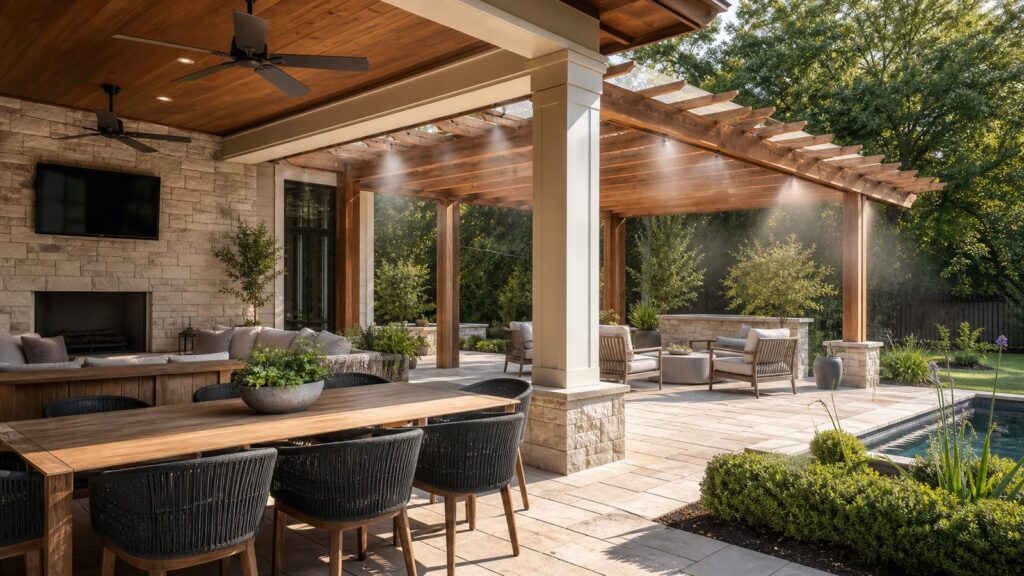
On our job sites, we treat patio cooling as part of the outdoor structure, not as an appliance picked at the end. A covered patio with a ceiling fan, light pavers, and well-placed misting nozzles can feel dramatically better than the same patio with a portable unit sitting in the corner. A shaded open patio in Arizona may do well with a high-CFM evaporative cooler. A humid patio in Florida may need fans, roof cover, screening choices, and heat reduction more than mist.
As an Amazon Associate I earn from qualifying purchases.
The practical choices in 2026 are portable evaporative coolers, misting fans, fixed patio misting systems, outdoor-rated ceiling or wall fans, and portable spot AC units for semi-enclosed areas. Each has a place. The right one depends on your climate, patio layout, budget, water tolerance, and how permanent you want the installation to be.
Start With the Patio, Not the Machine
Before buying equipment, look at the heat load your patio is already carrying. Direct western sun, dark pavers, dark composite decking, low airflow, and heat radiating from exterior walls can make a patio feel 10 to 20 degrees hotter than the air temperature. No portable cooler can fully overcome poor shade and hot surfaces.
Popular on Amazon

- 【All Day Cooling Without Constant Refills】Tired of small portable fan with mist models running dry after a short time outdoors? This misting fan portable features a large 15L water tank that delivers hours of continuous cooling mist for patios, camping trips, tailgates, and backyard BBQs. The ultra fine spray helps reduce heat discomfort faster while avoiding frequent refilling, so you can stay comfortable during long summer activities
- 【40000mAh Battery Powered Outdoor Misting Fan】Need cooling where there's no power outlet nearby? This camping fan rechargeable is equipped with a powerful 40000mAh battery that delivers strong airflow for extended periods — perfect for camping, fishing, RV trips, outdoor work, or power outages. Built-in USB output ports also let you charge your phone and other devices directly from the fan, so you don't need to carry extra power banks
- 【Custom Airflow & Mist for Different Heat Conditions】Hot afternoons need stronger airflow while quiet evenings need softer cooling. This cooling fan includes 5 adjustable fan speeds and 4 mist modes, allowing you to control airflow and water spray based on your environment and comfort level. Whether used as a portable fan inside a tent or as misters for outside patio gatherings, the flexible settings help save battery and water while maintaining effective cooling
- 【Remote Control Convenience with Built In Timer】No one wants to get up repeatedly to adjust settings during rest or outdoor gatherings. The included remote control allows you to manage this fan with mist from a distance, changing speed, lighting, and timer settings effortlessly. The timer function helps avoid unnecessary battery drain overnight and creates a more comfortable sleeping environment for camping or patio evenings
- 【Fan with LED Light & Hanging Design】Outdoor cooling is most efficient when one device solves multiple summer discomforts. This mist fan features 90° oscillation for ultra-wide 270° automated coverage, delivering refreshing mist without constant adjustments. Equipped with bright LED light for nighttime visibility during camping, BBQs, fishing or outages. Convenient hanging hook mounts easily in gazebos or garages—saving space while maximizing airflow
For most projects, we start with four construction questions. Is there roof cover or a pergola? Which direction does the harsh afternoon sun come from? Where does the breeze naturally move? Are the seating, dining, grill, and bar areas grouped together or spread across the yard?
A patio does not need to cool the entire backyard. It needs comfort zones. That may be a 10-by-12-foot dining area, a 12-by-16-foot lounge area, or a narrow bar zone beside an outdoor kitchen. Designing for a 120 to 250 square foot comfort zone usually produces better results than trying to cool a 900 square foot patio with one device.
Recommended Free Tools
Shade is the first layer. Roof covers, pergolas with adjustable shade, exterior roller shades, trees, and lighter hardscape materials all reduce radiant heat. On remodels, we often recommend light concrete coatings, porcelain pavers with lower heat absorption, or shade structures before expensive cooling equipment. Once the patio is shaded, fans, misters, and evaporative coolers can do their job with less runtime and less water.
Outdoor Patio Cooling Options Compared
Here is the cleanest way to think about outdoor patio air conditioners: some move air, some cool by evaporation, some add mist, and a few use compressor-based refrigeration in limited conditions. The table below gives a practical comparison for 2026 budgets and performance.
| Cooling option | Best use | Typical 2026 cost | Strengths | Watch-outs |
|---|---|---|---|---|
| Outdoor ceiling or wall fans | Covered patios, porches, pergolas, screened rooms | Often a few hundred dollars per fan plus electrical work | Low water use, reliable, improves sweat evaporation, works in humid climates | Does not lower actual air temperature; needs outdoor rating and proper mounting |
| Portable misting fan | Small seating zones, events, flexible patios | $100-$250 for small portable models; $400-$700 for stronger patio models; $3,000+ for premium overhead integrated misting fans | Quick setup, movable, noticeable relief in dry heat | Can wet furniture and floors; wind drift; noise; water refills or hose management |
| Portable evaporative cooler | Hot, dry patios, garages, workshops, open covered areas | $100-$400 small units; $400-$900 stronger patio units; $1,000-$3,900+ commercial-style high-CFM units | High airflow, lower electricity use than compressor AC, good in dry climates | Performance drops in humidity; requires water, cleaning, and airflow path |
| Fixed patio misting system | Covered patios, pergolas, pool decks, outdoor dining areas | $50-$300 low-pressure DIY kits; $300-$800 mid-pressure kits; $1,000-$1,600 high-pressure pump kits; installed projects commonly $1,968-$3,584 | Cleanest built-in look, can cool larger comfort zones, high-pressure systems feel drier | Needs planning for nozzles, drainage, hard water, backflow, pump location, and electrical safety |
| Portable spot AC | Semi-enclosed patios, temporary work areas, tented spaces with exhaust path | Varies widely by size and duty rating | True refrigeration where air can be directed to people | Inefficient in open air; hot exhaust must go somewhere; condensation and electrical protection matter |
Climate Decides More Than Brand
The biggest mistake homeowners make is buying the same patio cooling product their friend bought in another state. Outdoor cooling is climate-specific. Evaporative cooling and misting work by using water evaporation to absorb heat. When the air is dry, evaporation happens quickly and the cooling effect can be strong. When the air is already humid, evaporation slows down and the patio can feel damp instead of cool.
A useful rule is to look beyond the forecast temperature and think about wet-bulb temperature. Evaporative coolers perform best in dry climates and are generally most comfortable where summer design wet-bulb temperatures are below about 70 degrees Fahrenheit. They may still provide limited benefit up to roughly 74 degrees, but the margin gets smaller.
That is why evaporative coolers and misting systems make the most sense in places like Arizona, Nevada, New Mexico, Utah, Colorado, the Mountain West, inland California, and drier parts of Texas. In the Southeast, Gulf Coast, humid Midwest, and many coastal areas, we put more emphasis on shade, ceiling fans, wall fans, roof design, airflow paths, and radiant-heat reduction. Misting can still work selectively, but it has to be placed carefully and used when conditions are favorable.
Hot and Dry Climates
In hot, dry regions, high-pressure misting and evaporative cooling can be excellent patio tools. Industry temperature-drop claims often land around 20 to 30 degrees under favorable dry conditions. In the real world, we treat those as best-case numbers, not guarantees. Wind, shade, nozzle height, water pressure, humidity, and surface heat all change the result.
For a covered patio in a dry climate, a perimeter high-pressure misting line paired with ceiling fans is often the strongest permanent setup. For an open patio, a portable evaporative cooler with strong airflow can work well if it is placed upwind so cooled air moves through the seating area.
Mixed or Seasonal Humidity Climates
In places with dry mornings but humid afternoons, or spring comfort but harsh late-summer humidity, choose flexible equipment. A portable evaporative cooler or misting fan may be worth owning if you can use it during dry heat and store it when conditions are muggy. A fixed system can still make sense, but we would design zones and shutoffs so the homeowner is not forced to run every nozzle every time.
Do these 3 things before closing this tab:
1Clear out junk files and repair common Windows errors2Fix the driver behind crashes, sound loss and screen glitches3Repair Windows errors before they cause bigger problemsHumid Climates
In humid regions, outdoor fans are usually the first mechanical layer. Moving air across skin improves comfort even when the air temperature does not drop. Covered patios should be designed with fan blocking, correct fan height, and weather-rated fixtures from the beginning. For many homes, a pair of properly placed outdoor ceiling fans will outperform a small misting kit that leaves cushions damp.
Portable Evaporative Coolers: Best for Dry, Open-Air Cooling
Portable evaporative coolers, often called swamp coolers, pull warm air through wet media pads and push cooler air out through a fan. They are not the same as refrigerated AC. They need fresh air movement and dry conditions. Used correctly, they can be effective for patios, garages, workshops, and covered outdoor areas.
In 2026, small consumer evaporative coolers typically run about $100 to $400. Stronger patio and garage units usually fall around $400 to $900. Commercial-style high-CFM models can run from $1,000 to $3,900 or more. Published airflow ratings commonly range from about 1,400 CFM to more than 5,300 CFM, with coverage claims from roughly 250 to 1,600 square feet. On a real patio, those coverage numbers depend heavily on shade, wind, openness, and where people are sitting.
For a 12-by-16-foot covered patio, we usually care less about the maximum square footage claim and more about airflow direction. The cooler should sit where it can pull fresh air and push cooled air through the seating zone, not blast one chair while the rest of the patio stays still. If the patio is exposed to strong crosswind, position the unit so prevailing wind helps carry the cooled air instead of fighting it.
Look for a durable pump, thick evaporative media, hose hookup if you do not want to refill the tank, smooth casters, corrosion-resistant hardware, and simple access for cleaning. Units used near pools or coastal air should have better corrosion resistance. Pads need service, tanks need cleaning, and hard water can leave scale. If a cooler is going to sit in a finished outdoor living area, also check noise level and cord routing before buying.
Misting Fans: Flexible Relief With Some Tradeoffs
Misting fans combine airflow with fine water droplets. They can be useful for a dining patio, pool deck, sports viewing area, or temporary event space where a fixed system is not justified. The lower-cost models are convenient, but they are not magic. If the droplets are too large, if humidity is high, or if the fan is too close to furniture, people feel wet instead of cooled.
Portable misting fans cost about $100 to $250 for smaller consumer models, $400 to $700 for stronger patio models, and $3,000 or more for premium overhead integrated misting fans. Price usually follows fan diameter, pump pressure, battery versus corded operation, onboard tank size, stainless components, noise control, and outdoor rating.
For a casual homeowner setup, a portable fan with a hose connection can be enough for a 100 to 200 square foot sitting area. Place it where the air crosses the patio, not where it blows mist directly into food, cushions, electronics, or an open door. Around grills, keep mist away from burners, hot surfaces, outlets, and food-prep counters. On finished stone or tile, test for slickness before using it during a party.
The best use case is temporary comfort. If you want a polished outdoor room that looks built-in, a fan on wheels and a hose across the patio will eventually feel like a compromise. For frequent use, a fixed high-pressure misting system is usually cleaner and easier to operate.
Also popular on Amazon

- 𝐈𝐧𝐭𝐞𝐧𝐬𝐞 𝐂𝐨𝐨𝐥𝐢𝐧𝐠 𝐌𝐢𝐬𝐭, 𝐑𝐞𝐝𝐞𝐟𝐢𝐧𝐢𝐧𝐠 𝐎𝐮𝐭𝐝𝐨𝐨𝐫 𝐂𝐨𝐦𝐟𝐨𝐫𝐭: TurboCool Mist Technology takes outdoor cooling to a whole new level. 86.9μm ultra-fine mist, powerful 33 ft/s airflow and to far-reaching 23.2 feet. It quickly drops temp up to 12℉. This is a redefined tower fan for outdoor cooling.
- 𝐔𝐧𝐥𝐞𝐚𝐬𝐡 𝐏𝐨?𝐞𝐫𝐟𝐮𝐥 𝐂𝐨𝐨𝐥𝐢𝐧𝐠: DREO's outdoor tower fan sets a new standard with extreme performance. Featuring up to 33 ft/s airflow speed, 42 ft air reach, and 2022 CFM powerful airflow, it instantly sweeps away heat across patios, backyards, or garages.
- 𝐀𝐥𝐥-𝐖𝐞𝐚𝐭𝐡𝐞𝐫, 𝐀𝐧𝐲𝐰𝐡𝐞𝐫𝐞 𝐂𝐨𝐨𝐥𝐢𝐧𝐠: Engineered with IPX4-rated water resistance and UV-protection, this misting fan stands strong against sun exposure and light rain. Use it seamlessly from living rooms to patios while its 9.8 ft (3m) power cord gives you flexible placement to cool wherever you need it.
- 𝟏𝟐 𝐒𝐩𝐞𝐞𝐝𝐬, 𝟒 𝐌𝐨𝐝𝐞𝐬 & 𝐓𝐚𝐫𝐠𝐞𝐭𝐞𝐝 𝐎𝐬𝐜𝐢𝐥𝐥𝐚𝐭𝐢𝐨𝐧: Customize your comfort with 12 precise speed levels and 4 smart modes. This oscillating fan's MotionSync helps you control oscillation from 30° to 150° with a simple remote control gesture, allowing you to lock airflow exactly where you want it. Power-off memory automatically restores your last settings for uninterrupted convenience.
- 𝟐𝟎𝐝𝐁 𝐔𝐥𝐭𝐫𝐚 𝐐𝐮𝐢𝐞𝐭𝐧𝐞𝐬𝐬: Powered by a DC motor and optimized airflow system, this cooling fan operates as low as 20dB on its lowest setting—quiet enough for restful sleep or peaceful relaxation. Set the 12h timer to automatically turn off after you fall asleep, keeping you cool without overexpending.
Fixed Patio Misting Systems: The Best Built-In Option in the Right Climate
A fixed patio misting system uses tubing, nozzles, a water supply, and often a pump to create a cooling mist around the patio perimeter. Low-pressure systems connect to standard hose pressure. Mid-pressure systems add better nozzles and moderate pump pressure. High-pressure systems atomize water into finer droplets, which usually means better cooling and less surface wetting when conditions are right.
Low-pressure DIY kits cost about $50 to $300. They are fine for temporary or budget use in a small shaded area, but they are more likely to drip, clog, and leave surfaces wet. Mid-pressure kits often land around $300 to $800, with some stainless kit examples around $475. High-pressure residential pump kits commonly cost about $1,000 to $1,600 for 40 to 100 feet of coverage. Professionally installed misting systems commonly run about $1,968 to $3,584, with an average near $2,744. High-end custom systems can exceed $5,000.
Installed cost depends on linear footage, number of zones, nozzle count, pump pressure, filtration, tubing material, concealment, electrical availability, backflow requirements, and labor rates. Quality materials commonly run about $5 to $20 per linear foot, and professional labor is often $50 to $100 per hour.
What’s actually slowing this PC down?
Pick the symptom - the matching free tool is one click away.
Water use is modest compared with irrigation, but it is not zero. A high-pressure misting nozzle commonly uses about 1.25 gallons per hour. A 10 to 15 nozzle residential system may use roughly 10 to 25 gallons per hour depending on nozzle size and runtime. In drought-prone areas or districts with high water rates, that should be part of the decision.
Nozzle Placement Matters
We generally avoid putting nozzles directly over the middle of the dining table or lounge seating. Better placement is usually around the perimeter of a covered patio or pergola, aimed so the mist evaporates before it settles. Keep nozzles away from doors, televisions, speakers, outlets, grills, ceiling fixtures, and stained wood surfaces. In an outdoor kitchen, the goal is to cool the people, not spray the cooktop.
Typical spacing varies by system pressure, nozzle size, wind, and patio shape, but many residential layouts use nozzles every 2 to 4 feet around the active cooling zone. A 40-foot perimeter may need 10 to 15 nozzles. Larger patios should often be zoned so the homeowner can run the lounge area without misting the grill or walkway.
Water Quality and Maintenance
Hard water is a common reason misting systems disappoint. Scale clogs nozzles, leaves residue on surfaces, and shortens component life. For professional installations, we like to test water quality before specifying premium nozzles. Filtration or scale control may be worth the cost, especially in the Southwest and other hard-water regions.
Free tools Windows power users keep installed
One-click scans. No signup required.
Plan access to the pump, filters, shutoffs, drains, and winterization points. A beautiful hidden system becomes frustrating if a technician has to remove finished trim to service it. In freeze-prone areas, the system needs a way to drain or be winterized before temperatures drop.
Can You Use a Real Portable AC Outside?
A true portable AC uses a compressor and refrigerant, which means it can produce cold air regardless of humidity. The problem is that it also produces hot exhaust air and condensation. In an open patio, the cold air quickly mixes with outdoor air while the unit dumps heat nearby. That makes it inefficient for normal open-air patios.
Portable spot AC can make sense in semi-enclosed areas, temporary work zones, enclosed tents, screened rooms with a defined airflow path, or a protected outdoor bar where the cold air is aimed directly at people and the hot exhaust is ducted away. It also needs a safe electrical setup, weather protection, and condensate management.
For a typical pergola or uncovered slab, we usually do not recommend compressor AC as the primary answer. You will spend more on electricity and still fight the basic physics of open air. If a patio can be enclosed enough for AC to work, it may be time to discuss a sunroom, screened porch, or conditioned addition rather than a loose outdoor unit.
Quick wins for a faster PC:
Fix the driver behind crashes, sound loss and screen glitchesFind Drivers →Clear out junk files and repair common Windows errorsFree Scan →Electrical, Plumbing, and Safety Details Homeowners Should Not Skip
Outdoor cooling equipment brings together water, electricity, moving fan blades, and finished patio materials. That combination deserves real planning. Any receptacle serving outdoor cooling equipment should be weather-appropriate and GFCI protected as required by modern residential electrical practice. Covers, boxes, and in-use protection should match the exposure, especially where cords remain plugged in while the equipment runs.
Do not run extension cords through walking paths, under rugs, across wet slabs, or near pool edges. If the best cooler location requires a cord stretched across the patio, the patio probably needs a dedicated outdoor receptacle. For ceiling fans, use outdoor-rated fan boxes and fixtures matched to damp or wet locations depending on exposure.
On the plumbing side, misting systems may require backflow prevention so water from the patio line cannot contaminate the potable water supply. Requirements vary by jurisdiction, and some areas are stricter than others. A professional installer should know the local plumbing authority requirements and install the correct backflow device, shutoff, and drain points.
Drainage also matters. Low-pressure misting kits and poorly aimed fans can leave wet concrete, tile, or stone. Smooth porcelain pavers, sealed concrete, and some natural stone can become slick. Around wood, composite decking, or painted surfaces, repeated wetting can shorten service life or create staining. Near pools and coastal air, stainless or UV-rated components are worth considering because heat, sun, salt, and chlorine age cheap tubing and fittings quickly.
When to DIY vs. When to Hire a Pro
DIY makes sense for temporary, low-risk cooling. A portable evaporative cooler, portable misting fan, or basic hose-connected misting kit can be a reasonable weekend purchase if you understand the limitations. Expect 30 minutes to 3 hours for basic setup, depending on whether you are assembling a fan, routing a hose, clipping tubing to a pergola, or testing nozzle placement.
A DIY low-pressure kit is best for a small shaded patio where occasional wetting is acceptable and the tubing can be mounted without drilling into critical waterproofing, electrical runs, or finished trim. Keep the layout accessible and reversible. Use UV-rated tubing and better fittings if the system will stay up all season.
Hire a pro when the system is permanent, high-pressure, concealed, tied into plumbing, mounted to a finished patio cover, or located near outdoor kitchens, TVs, lighting, pools, or expensive stonework. A professional installation is also the better route when you need a new electrical circuit, GFCI/weatherproof upgrades, backflow prevention, water filtration, multiple zones, or clean integration into a pergola or soffit.
For remodels, it is much cheaper to plan cooling before the patio cover is finished. Running water lines, electrical, blocking for fans, and hidden conduit during construction is cleaner than retrofitting after the ceiling, stone, or trim is complete. On a new covered patio, we like to decide fan locations, switch locations, mist pump location, water shutoff access, and service panels before framing is closed.
PC Slower Than It Used to Be?
A free scan shows the junk files, broken settings and background clutter dragging Windows down - then fixes them in one click.Free scan · Windows 10 & 11Crashes, No Sound, or Screen Glitches?
Random freezes, missing sound and display glitches usually trace back to one bad driver. Find and replace yours safely.Free scan · under a minuteAlso popular on Amazon

- 【Cordless Fan for Indoor & Outdoor】One Fan, Two Ways to Cool – Use it as a cordless fan at home, in the garage, or outdoors. Turn the misting function off for indoor airflow, or switch it on outside when you want an extra layer of cooling.
- 【Mist on the Go】This 12-inch water fan has a built-in water pump – no faucet needed. Capable of drawing water directly from any container, it offers outdoor enthusiasts a convenient and efficient cooling solution. Ideal outdoor fan for patios, BBQ, camping, gardens, poolside, RV travel, porch and more.
- 【Rechargeable Battery & 7-Speed】Go cordless—enjoy unrestricted coolness. Battery fan can work continuously for 7-50 hours after 7h fully charged with fast-charging adapter. Perfect for long hours of outdoor work or vacation. The mister fan has 7 different speed settings, from breeze to strong wind, to meet your different needs.
- 【Oscillating Fan with Remote】Manage the patio spray fan with ease using the included remote (within a range of 5m). The spray fan can auto oscillate 45°/90° horizontally, ensuring a wide cooling range, more suitable for multi-person scenes.
- 【Quiet but Powerful & Timer】Our pedestal fan is driven by a powerful brushless motor, let you forget the noise and stay breezy all night. Our fan for bedroom also features a 1/2/4/8H timer, auto shut-off for worry-free sleep. LED screen keeps you informed on battery and speed.
Best Cooling Setups by Patio Type
Covered Patio or Porch
The most dependable setup is shade plus outdoor-rated ceiling fans. In dry climates, add high-pressure perimeter misting outside the main seating line. For a 12-by-20-foot covered patio, two ceiling fans often move air more evenly than one oversized fan. Add misting zones only where water will not drift onto doors, outlets, TVs, grills, or cushions.
Pergola
A pergola needs shade density before cooling equipment can shine. Open rafters alone may not reduce enough sun. Consider shade slats, retractable canopies, or climbing shade where appropriate. Misting lines can mount along beams, but use UV-rated tubing or metal lines and plan for clean service access.
Uncovered Patio Slab
Start with shade: umbrella, sail shade, freestanding structure, or trees. Then add a portable evaporative cooler or misting fan if the climate is dry enough. Without shade, much of the cooling benefit is lost to radiant heat from the slab and surrounding walls.
Screened Patio
Be careful with water-based cooling in screened areas. Screens reduce some airflow and can hold humidity. Fans usually come first. Evaporative coolers may help in dry climates if there is enough air exchange. Misting inside a screened porch is usually a specialty decision, not a default.
Recommended Free Tools
Outdoor Kitchen
Keep mist away from grills, burners, outlets, refrigerators, ice makers, and food prep. Use fans to move heat away from the cook, and consider a separate cooling zone for seating. The person grilling needs airflow, but the equipment needs dry, safe clearances.
How to Choose the Best Outdoor Patio Air Conditioner for Your Home
Use this decision path before buying:
1. Check your humidity. If your summers are hot and dry, evaporative coolers and misting systems are strong candidates. If your summers are humid, prioritize shade and fans.
2. Define the comfort zone. Measure the area where people actually sit. A 10-by-12-foot dining zone needs a different solution than a 20-by-30-foot pool deck.
3. Fix shade first. A patio cover, pergola shade, exterior screen, or lighter surface may reduce heat more effectively than upgrading from a small cooler to a larger one.
Quick wins for a faster PC:
Repair Windows errors before they cause bigger problemsFix Now →Fix the driver behind crashes, sound loss and screen glitchesFind Drivers →4. Decide how much water is acceptable. If wet cushions, slick tile, or water spots are unacceptable, avoid low-pressure mist kits and look at fans, high-pressure misting, or dry airflow strategies.
5. Plan utilities. Identify water supply, electrical outlets, GFCI protection, weatherproof covers, drainage, shutoffs, and service access before installing anything permanent.
6. Match the system to the finish level. A hose-fed portable misting fan is fine for weekend use. A finished outdoor living room usually deserves concealed lines, zoned controls, quality nozzles, and professional electrical and plumbing details.
For many homes, the best answer is a layered system: shade structure first, outdoor fans second, then evaporative or mist cooling only where the climate and patio materials support it. That approach costs more thoughtfully, performs better, and avoids the common disappointment of buying a product that was never suited to the patio.
What’s actually slowing this PC down?
Pick the symptom - the matching free tool is one click away.
Bottom Line
The best outdoor patio air conditioner is the one that fits your climate and your structure. In dry heat, a high-pressure misting system or strong evaporative cooler can make a patio noticeably more comfortable. In humid regions, fans, shade, roof cover, and radiant-heat control usually give better results than adding more water to the air.
Budget about $100 to $700 for portable misting fans, $100 to $900 for most homeowner-grade evaporative coolers, and roughly $2,000 to $3,600 for many professionally installed residential misting systems. Spend first on shade, airflow, safe electrical work, durable materials, and serviceable installation. That is how a patio cooling system becomes part of the home instead of another summer appliance sitting in the way.
Frequently Asked Questions
Do outdoor patio air conditioners really work?
Yes, but not like indoor AC. Open patios are hard to refrigerate, so most effective systems use shade, airflow, evaporative cooling, or misting. True portable AC only works well in semi-enclosed areas with a clear exhaust path.
What is the best way to cool an outdoor patio in summer?
Start with shade and airflow. A covered patio with outdoor-rated ceiling fans is the most reliable base. In dry climates, add a high-pressure misting system or portable evaporative cooler for stronger cooling.
Is an evaporative cooler better than a misting fan for a patio?
An evaporative cooler is usually better for larger dry-climate comfort zones where you can direct high-CFM airflow. A misting fan is better for flexible, temporary cooling in a smaller area. Both perform poorly when humidity is high.
How much does a patio misting system cost in 2026?
Basic DIY low-pressure kits cost about $50-$300. Mid-pressure kits are commonly $300-$800. High-pressure residential pump kits run about $1,000-$1,600, while professionally installed systems commonly land around $1,968-$3,584.
Do patio misters work in humid climates?
They can help in limited situations, but performance drops sharply as humidity rises. In humid climates, shade, fans, roof cover, lighter surfaces, and better airflow usually provide more dependable comfort.
How much water does an outdoor misting system use?
A high-pressure nozzle commonly uses about 1.25 gallons per hour. A typical 10-15 nozzle residential system may use roughly 10-25 gallons per hour, depending on nozzle size, pressure, and runtime.
Quick Recap
Product prices and availability are accurate as of the date/time indicated and are subject to change. Any price and availability information displayed on Amazon at the time of purchase will apply.

