Do these 3 things before closing this tab:
1Scan for outdated or missing drivers - takes under a minute2Repair Windows errors before they cause bigger problems3Fix the driver behind crashes, sound loss and screen glitchesSome links on this page are affiliate links: if you buy through them we may earn a commission, at no extra cost to you.
If your deck gets six, eight, or ten hours of direct sun, the best deck stain is usually not the one with the prettiest color chip. It is the stain system with enough pigment to block ultraviolet light, enough flexibility to handle heat cycling, and enough compatibility with the wood and old coating to stay bonded.
For most full-sun decks, our practical recommendation is this: choose a high-quality semi-solid stain when you want the best balance of UV protection and visible wood texture. Choose a solid-color stain when maximum sun protection and color uniformity matter more than seeing the grain. Choose a penetrating semi-transparent oil or hybrid stain only when grain visibility and easier future maintenance are higher priorities than maximum fade resistance. Avoid clear sealers on full-sun walking surfaces unless you are comfortable with frequent upkeep.
As an Amazon Associate I earn from qualifying purchases.
On our job sites, the longest-lasting deck stain work is rarely about one magic brand. It comes down to choosing the right opacity, preparing the boards correctly, checking moisture with a meter, applying in the right weather window, and recoating before the finish fails. A $70 gallon of stain over damp, dirty, sun-baked boards can fail faster than a cheaper product installed correctly.
Why Full Sun Is So Hard on Deck Stain
Direct sun attacks a deck in several ways at once. UV light breaks down lignin, the natural binder in wood fibers, which is why exposed wood turns gray and brittle. Heat expands boards during the day, then they contract at night. Rain, sprinklers, humidity, and morning dew push moisture into checks and end grain. Foot traffic grinds dust and grit into the coating. On horizontal boards, all of that happens on the surface that takes the most abuse.
Popular on Amazon

- NO LAPS, RUNS OR STREAKS: Goof Proof formula with no back brushing required; ideal for exterior wood projects
- OUTSTANDING DURABILITY: No cracking, chipping, flaking or peeling with excellent moisture resistance and UV protection; great for outdoor decks, fences, wood siding and more
- CAN WITHSTAND RAIN WITHIN MINUTES OF APPLICATION: Can also be applied in direct sunlight
- HIGH AND LOW TEMPERATURE APPLICATION: Requires no wet-line application, the product will blend itself and can be applied in any temperature range for proper application
- EASY TO APPLY AND MAINTAIN: Low odor formula may be applied using sprayer, roller or brush onto the wood's surface; no sanding or stripping required for reapplication
That is why the walking surface of a deck usually fails before railings, fascia, and vertical posts. A railing might look good for five years while the floor needs attention in two or three. It is also why product warranties need to be read carefully. Long warranty periods on stain labels often depend on correct preparation, proper coat thickness, drainage, exposure, and surface type. A south-facing deck in Texas, Arizona, Colorado, Georgia, or coastal North Carolina has a very different life than a shaded deck in a mild climate.
Full-sun decks usually fail from one or more of these issues: too little pigment, poor prep, trapped moisture, incompatible old coatings, overly dark color, missed recoat timing, or applying stain while boards are too hot. The best product choice solves only part of the problem.
Free tools Windows power users keep installed
One-click scans. No signup required.
The Best Stain Type for Full Sun
The simplest rule is also the most reliable: more pigment blocks more UV. Pigment is what shades the wood fibers. Clear and transparent products let the most UV through. Semi-transparent stains offer some protection while showing grain. Semi-solid stains add more color and UV resistance while still leaving some wood character. Solid stains provide the strongest UV shielding but behave more like a coating, so prep and moisture control become more critical.
| Stain Type | Best Use in Full Sun | UV Protection | Wood Grain Visibility | Typical Maintenance |
|---|---|---|---|---|
| Clear sealer | Generally avoid on full-sun deck floors | Low | High | Often annual or very frequent |
| Transparent stain | Only when natural appearance matters most | Low to moderate | High | Often 1-2 years in harsh sun |
| Semi-transparent penetrating stain | Good for owners who want grain and easier recoats | Moderate | Moderate to high | Commonly 1-3 years on full-sun floors |
| Semi-solid stain | Best all-around choice for many full-sun decks | High | Some texture, less grain | Often 2-4 years, depending on exposure and prep |
| Solid-color stain | Maximum UV shielding and color uniformity | Highest | Low | Can last longer, but recoat before peeling |
Semi-Solid Stain: The Best Balance
For many sun-exposed decks, semi-solid stain is the sweet spot. It has enough pigment to protect the wood better than a semi-transparent finish, but it does not always create the same heavy film appearance as a solid stain. On older pressure-treated pine, cedar, or weathered deck boards with uneven color, semi-solid stain can also hide blotchiness without making the deck look painted.
We like semi-solid systems when the homeowner wants a natural deck feel but is realistic about sun exposure. They work especially well on decks that are structurally sound but cosmetically tired, where transparent stain would highlight every gray patch, water mark, and board replacement.
Solid Stain: Maximum UV Protection
Solid stain gives the most UV protection because it carries the most pigment. Water-based acrylic solid stains are widely available, offer strong color retention, and can be a good fit for full-sun decks when the surface is properly cleaned, sanded where needed, and dry. Products in this category include budget-accessible solid-color stain-and-sealer options sold through major home centers.
The tradeoff is that solid stain behaves more like a coating. If old stain is peeling, if moisture is trapped below the boards, or if the deck is stained before it dries, solid stain can peel. Once a solid coating fails broadly, restoration may require stripping, sanding, or both. That is why we push annual inspection. Recoating a sound solid stain is manageable. Removing a failed one is labor-heavy.
Semi-Transparent Penetrating Stain: Easier Future Maintenance
Penetrating semi-transparent stains are useful when the owner wants visible grain and a maintenance path that may involve cleaning and recoating rather than stripping. Many oil-based and hybrid stains fall into this category. They can be forgiving on older wood because they soak into the fibers instead of building a thick surface film.
Also popular on Amazon

- READY-TO-USE DECK STAIN & SEALER: Olympic WaterGuard acorn brown semi-transparent wood stain and sealant combines color and waterproofing in one water-based, ready-mix coat.
- WATERPROOFING DECK & FENCE PROTECTION: Forms a water-repellent barrier that protects decks, fences and siding from rain and moisture; dries in about 24 hours.
- SUNBLOCK UV DEFENSE: Advanced UV protection guards exterior wood against fading and graying, keeping color rich season after season.
- EXCLUSIVE SCUFF GUARD TECHNOLOGY: Resistant coating stands up to foot traffic and wear - protects up to 3 years on decks and 4 years on fences and siding.
- EASY SOAP & WATER CLEANUP: The acorn brown water-based formula cleans up with soap and water and covers 250–350 sq. ft. per gallon on decks, fences, railings and furniture.
The tradeoff is UV life. In full sun, especially on horizontal deck boards, semi-transparent finishes usually need more frequent refresh cycles. In harsh exposure, annual inspection is non-negotiable and maintenance every 1-3 years is a realistic expectation.
Product Categories We Commonly Consider
No stain is best for every deck. Wood species, age, previous coating, state VOC rules, sun exposure, and homeowner expectations all matter. That said, these are the categories we look at when specifying a full-sun deck stain.
Outdated Drivers Are Slowing You Down
One free scan finds every outdated or missing driver and matches the right update for your exact hardware.Free scan · exact hardware matchWindows Errors? Fix Them Before They Spread
Repair common Windows errors and clear accumulated junk for a smoother, more stable PC - no reinstall needed.Free scan · no reinstall| Category | Examples | Why It Works | Watch For |
|---|---|---|---|
| Water-based semi-transparent UV-focused stain | Defy Extreme-style products | Good UV package, lower odor, easier cleanup | Prep and application temperature still matter |
| Pigment-rich semi-solid stain | Armstrong-Clark or TWP semi-solid where available | Strong full-sun protection while keeping some wood texture | VOC availability varies by state and formula |
| Broad-retail semi-solid or solid stain | Cabot semi-solid and solid products | Accessible in many markets with multiple opacity choices | Confirm compatibility with existing coating |
| Budget-accessible solid acrylic stain | Behr Premium Solid Color Waterproofing Stain & Sealer-style products | High pigment, easy retail access, strong color coverage | Failed prep can lead to peeling on deck floors |
Before buying, check whether the product is legal and available in your state or air district. Some oil-based deck stains have VOC shipping or use restrictions in California, Northeast and OTC states, Colorado, parts of Arizona, and other stricter jurisdictions. A stain that performs well in one state may not be sold in the same formula in another.
Color Matters More Than Homeowners Think
Color affects appearance, heat, and maintenance. Dark browns, charcoals, and deep reds absorb more heat. On a full-sun deck, that can make boards uncomfortable for bare feet and pets during summer afternoons. Very light colors run cooler, but they can show dirt, pollen, tannin bleed, mildew staining, and grill-area traffic more easily.
For most full-sun decks, medium tones are the practical compromise: cedar, redwood, warm brown, medium walnut, weathered gray, or muted taupe-gray. These colors give enough visual depth without turning the deck into a heat sink. If the deck surrounds a pool, gets strong southern exposure, or serves as a barefoot outdoor living area, we usually steer away from very dark solid colors.
Do not choose from a brochure alone. Put sample patches on actual deck boards after cleaning and drying. Weathered pressure-treated lumber can shift color dramatically. Older boards may absorb more stain than new replacement boards. A color that looks calm on a store chip can read orange, red, or nearly black across 300 square feet in direct sun.
Prep Determines How Long the Stain Lasts
Deck stain failure is often blamed on the can, but the real failure started before the can was opened. On our projects, prep is where we spend the most judgment. A full-sun deck needs clean, sound, dry wood with no loose old coating and no mill glaze blocking penetration.
Inspect Before You Stain
Cosmetic refinishing should not hide structural problems. Before staining, check for soft boards, popped fasteners, loose rail posts, cracked stair stringers, poor ledger flashing, rot at joist ends, and movement in guardrails. A deck can look better after staining and still be unsafe.
Also popular on Amazon

- WATERPROOFING STAIN – Bring out the beauty of your outdoor wood with Thompson’s WaterSeal Semi-Transparent Waterproofing Wood Stain. Along with adding lightly tinted color, it’s a deck sealer that prevents water damage to help you maintain your outdoor living spaces.
- SEMI-TRANSPARENT WOOD STAIN – This outdoor wood stain provides a semi-transparent finish. It will hide the wood grain, but still allow the wood texture to show. It provides complete protection while adding lightly tinted color.
- FADE RESISTANT FINISH – The advanced polymers in this outdoor wood and deck stain deliver fade-resistant color so it stays looking great year-round. The coating resists UV damage, so you can apply with confidence.
- EASY TO USE – Whether you’re refinishing an existing fence or putting the finishing touches on a new deck, this waterproofing wood stain is easy to apply. It can be applied to damp or dry wood. Clean the surface thoroughly prior to use for best results.
- EXCEEDS INDUSTRY STANDARDS – Thompson’s Waterproofing Exterior Wood Stain exceeds Industry Standard ASTM D-4446 for waterproofing wood.
Most maintenance staining does not require a building permit. Structural repairs, ledger replacement, stair reconstruction, guardrail changes, or deck expansion may trigger local permit and code requirements. Many US jurisdictions use versions of the International Residential Code, but enforcement is local. If the project goes beyond surface maintenance, call the building department before work starts.
Clean, Strip, Brighten, Sand
A normal maintenance recoat may only need cleaning, light sanding, and spot prep. A deck with peeling solid stain, mismatched coatings, heavy mildew, or unknown old oil may need stripping or sanding before new stain goes down. If a stripper is used, wood brightener or neutralizer is commonly part of the system, depending on the product instructions.
Pressure washing can help, but it can also damage wood. We typically use controlled pressure, the right tip, and enough distance to clean without carving the grain. After washing, raised fibers should be sanded once the deck dries. For deck boards, 60-80 grit is often a practical range. Sanding too fine can polish the surface and reduce stain penetration, especially for penetrating stains.
Use a moisture meter
Do not stain because the deck looks dry. Use a moisture meter. Many coatings want wood around 12%-15% moisture or below, but the correct limit is the one printed by the stain manufacturer. New pressure-treated lumber may need time to dry before staining unless the chosen product specifically allows application to damp or new wood.
Calendar rules are unreliable. One batch of pressure-treated decking may be ready much sooner than another. A shaded deck in a humid climate can hold moisture long after the surface feels dry. A $30-$60 moisture meter is cheap compared with stripping a failed finish.
Application Rules for Decks That Bake in Sun
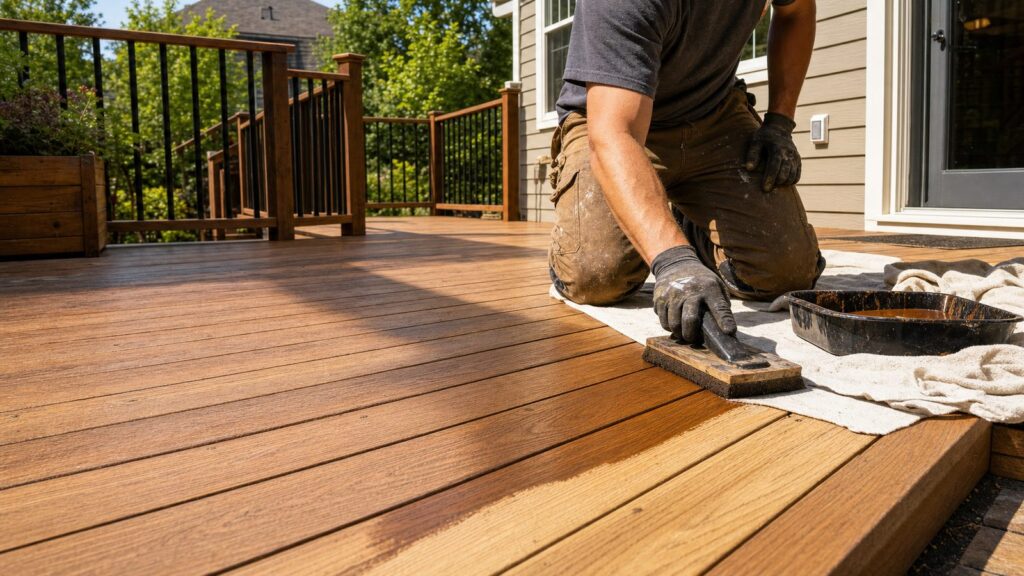
Full sun changes how stain behaves during application. Hot boards can flash-dry the product before it penetrates or levels. That leads to lap marks, shiny patches, poor adhesion, and uneven color. If the boards are too hot to touch comfortably, they are usually too hot to stain well.
The Tool Desk
Outbyte PC Repair FREERepair Windows errors before they cause bigger problemsFix Now →Outbyte Driver Updater FREEScan for outdated or missing drivers - takes under a minuteDriver Scan →Schedule the work around shade. Start early, follow the shade line, and avoid peak afternoon sun. Respect the product’s temperature and humidity range. Watch the forecast for rain, dew, and overnight temperature drops. Maintain a wet edge, work board-length sections where possible, and avoid stopping in the middle of a board field.
For penetrating stains, brush or pad the stain into the grain and remove excess if the label requires it. Puddled oil stain can become sticky and attract dirt. For solid acrylic stain, think like a coating installer: surface prep, recommended spread rate, dry film thickness, and recoat window all matter.
Coverage and Cost in 2026
Deck stain coverage varies widely. Many products cover roughly 150-400 square feet per gallon depending on opacity, coat count, wood age, porosity, and whether railings, stairs, fascia, benches, and undersides are included. Rough, thirsty, weathered boards use more stain than smooth, previously coated boards.
Also popular on Amazon

- SEMI TRANSPARENT EXTERIOR WOOD STAIN: Our outdoor wood stain and sealer allows the natural wood grain to show through, highlighting the beauty of your decks, fences and sidings and preserving its natural look.
- ULTIMATE UV PROTECTION DECK SEALER: Shields wood from damaging UV rays, preventing fading & graying. Lasts longer than deck paint for wood decks, siding or fences & is better for the planet because it's water based with less than 50 g/l VOC content.
- WOOD DECK STAIN AND SEALER IN ONE: This outdoor wood protector serves a dual purpose as both a stain and sealer. It adds color to your wood and seals it, designed to penetrate deep into wood pores for maximum protection and longevity.
- BEAUTIFUL WOOD STAIN COLORS: Our semi-transparent wood deck stain comes in stunning colors that dry to a flat and natural-looking finish. Enhance the beauty of your exterior wood with our natural, cedar, light walnut, gray, and dark walnut colors.
- EFFECTIVE ON DAMP WOOD FOR FASTER APPLICATION: Our wood stain sealer works on damp wood, cutting down wait times between cleaning and staining. Once your wood deck is visibly dry, it's ready for staining, speeding up your project.
For professional deck staining in 2026, a practical planning range is about $2-$6 per square foot for a straightforward clean-and-stain job. A light maintenance recoat may run closer to $0.50-$2.50 per square foot. Heavy stripping, sanding, and restoration can climb to about $2.50-$8.20 or more per square foot.
Recommended Free Tools
| Project Scope | Typical 2026 Cost | What It Usually Includes |
|---|---|---|
| DIY materials only | $35-$85 per gallon; specialty products often $65-$85 per gallon | Stain, cleaner, pads, brushes, masking, small tools |
| Light maintenance recoat | $0.50-$2.50 per sq ft | Cleaning, minor prep, one maintenance coat where compatible |
| Standard professional clean and stain | $2-$6 per sq ft | Cleaning, masking, normal prep, stain application |
| Heavy restoration | $2.50-$8.20+ per sq ft | Stripping, sanding, brightening, repairs, more labor |
| Typical 300 sq ft deck | $750-$1,800 professionally | Varies heavily with rails, stairs, prep, and coating type |
Retail product pricing changes by region and availability, but recent price signals put many common deck stains in the $35-$85 per gallon range. Some solid-color stains start around $49 per gallon. Semi-solid and specialty penetrating products often land around $66-$84 per gallon, with 5-gallon pails commonly around $250-$350 or more.
Labor is usually the larger part of a professional job because cleaning, masking, sanding, stripping, drying time, rail work, and return trips take real hours. Railings can double the detail work. Stairs slow production. A 300 square foot rectangular platform is not the same job as a 300 square foot deck with wraparound rails, lattice, built-in benches, and two stair runs.
Independent reader supportYour contribution helps us test, update, and keep practical guides available for everyone.When to DIY and When to Hire a Pro
DIY can make sense when the deck is small, low to the ground, structurally sound, and previously coated with a compatible stain that is not peeling. A homeowner with a free weekend, basic tools, and patience can clean, dry, sand raised grain, mask siding, and apply a maintenance coat. For a 200-300 square foot deck, DIY material costs may stay in the few-hundred-dollar range if no major stripping is needed.
Hire a pro when the old coating is peeling, the prior stain type is unknown, the deck has extensive railings or stairs, boards need repair, the deck is elevated, or the home may have lead-paint concerns nearby. Older homes require extra care with pressure washing and runoff containment where lead-based paint may be present on adjacent painted surfaces. Contractors should control wash water, chips, and debris rather than blasting contaminants into soil, patios, or neighboring property.
A pro is also worth considering when you want a solid stain over a questionable existing surface. Solid coatings are less forgiving of trapped moisture and loose old finish. The cost of proper prep is easier to accept than the cost of redoing a peeling deck a year later.
Maintenance Schedule for a Full-Sun Deck
Inspect a full-sun deck every year, preferably in spring. Look for fading, water absorption, gray exposed fibers, checking, cupping, loose fasteners, mildew, and early peeling. Splash water on several boards. If water soaks in quickly instead of beading or shedding, the finish may be wearing thin.
Transparent and semi-transparent stains on harsh full-sun decks often need maintenance every 1-3 years. Semi-solid and solid stains can last longer, but they should be recoated before cracking and peeling begin. Waiting for broad failure turns a maintenance job into a restoration job.
Also popular on Amazon
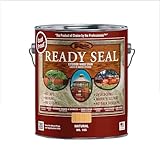
- NO LAPS, RUNS OR STREAKS: Goof Proof formula with no back brushing required; ideal for exterior wood projects
- OUTSTANDING DURABILITY: No cracking, chipping, flaking or peeling with excellent moisture resistance and UV protection; great for outdoor decks, fences, wood siding and more
- CAN WITHSTAND RAIN WITHIN MINUTES OF APPLICATION: Can also be applied in direct sunlight
- HIGH AND LOW TEMPERATURE APPLICATION: Requires no wet-line application, the product will blend itself and can be applied in any temperature range for proper application
- EASY TO APPLY AND MAINTAIN: Low odor formula may be applied using sprayer, roller or brush onto the wood's surface; no sanding or stripping required for reapplication
Keep the deck clean between recoats. Remove leaves from gaps, keep planters on risers, move rugs periodically, and avoid trapping moisture under mats. Check sprinklers so they are not soaking one side of the deck every morning. Good drainage and airflow extend stain life as much as brand choice.
What’s actually slowing this PC down?
Pick the symptom - the matching free tool is one click away.
Our Practical Recommendation
If a homeowner asks us for the best deck stain for full sun, we start with the finish system, not the brand. For maximum UV protection, use a solid-color stain. For the best balance of UV resistance, wood texture, and appearance, use a semi-solid stain. For visible grain and easier future maintenance, use a penetrating semi-transparent stain and accept a shorter maintenance cycle. Avoid clear sealers on full-sun deck floors unless frequent maintenance is part of the plan.
Then we confirm the basics: what coating is on the deck now, whether the wood is dry enough, whether local VOC rules affect product choice, how hot the surface gets, what color will be comfortable, and whether the deck needs repairs before cosmetics. That process produces a better result than chasing a top-ten list.
The right stain, installed over clean and dry wood at the right time of day, can protect a deck from UV, moisture, and traffic for years. The wrong opacity or poor prep can fail in one season. In full sun, pigment, preparation, and maintenance timing are the whole game.
Frequently Asked Questions
What type of deck stain lasts longest in full sun?
Solid-color stain usually provides the most UV protection because it contains the most pigment. Semi-solid stain is often the best balance because it blocks substantial UV while still leaving some wood texture visible.
Quick wins for a faster PC:
Scan for outdated or missing drivers - takes under a minuteDriver Scan →Clear out junk files and repair common Windows errorsFree Scan →Fix the driver behind crashes, sound loss and screen glitchesFind Drivers →Is oil-based or water-based deck stain better for full sun?
Neither is automatically better. Water-based acrylic solid stains can provide strong UV resistance and color retention. Penetrating oil stains can be easier to maintain, but they often need more frequent refresh cycles and may have VOC restrictions in some states.
How often should I stain a deck that gets full sun?
Inspect it every year. Transparent and semi-transparent stains in harsh sun often need maintenance every 1-3 years. Semi-solid and solid stains may last longer, but they should be recoated before cracking or peeling starts.
What stain color is best for a hot sunny deck?
Medium tones are usually the most practical. Cedar, redwood, warm brown, medium walnut, weathered gray, and muted taupe-gray offer good color depth without getting as hot as very dark browns, charcoals, or black-toned stains.
How much does professional deck staining cost in 2026?
A straightforward professional clean-and-stain job commonly runs about $2-$6 per square foot. A 300 square foot deck often lands around $750-$1,800, depending on railings, stairs, prep work, coating type, and local labor rates.
Should new pressure-treated wood be stained right away?
Usually not unless the stain is approved for new or damp wood. New pressure-treated lumber should be checked with a moisture meter and stained only when it meets the manufacturer’s moisture requirement, commonly around 12%-15% for many coatings.
Quick Recap
Product prices and availability are accurate as of the date/time indicated and are subject to change. Any price and availability information displayed on Amazon at the time of purchase will apply.

