Recommended Free Tools
Some links on this page are affiliate links: if you buy through them we may earn a commission, at no extra cost to you.
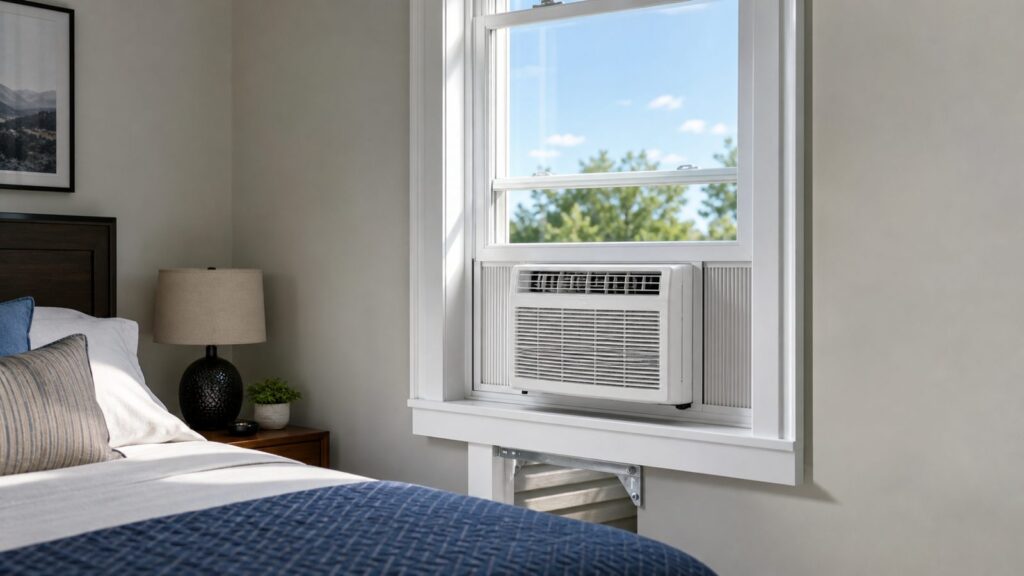
A Whirlpool window air conditioner can be a smart, affordable way to cool one room, a garage office, an upstairs bedroom, or a sunroom without replacing the whole HVAC system. The best choice is not simply the biggest unit on the shelf. It is the unit that fits the room, runs on the available electrical circuit, drains correctly, sits safely in the window, and seals tightly enough to do its job.
For most homeowners, the short answer is this: use about 20 BTU per square foot as the starting point, then adjust for sun, insulation, ceiling height, kitchens, open floor plans, and how many people use the room. Whirlpool models commonly cover about 150 square feet with 5,000 BTU, 250 square feet with 6,000 BTU, 450 square feet with 10,000 BTU, 550 square feet with 12,000 BTU, 650 square feet with 14,000 BTU inverter models, and around 700 square feet with 15,000 BTU models.
As an Amazon Associate I earn from qualifying purchases.
In 2026 retail pricing, Whirlpool window AC units commonly run from about $200 for smaller basic models to about $630 for large 15,000 BTU units. A 12,000 BTU standard model is often around $430, a 12,000 BTU inverter model around $460, and a 12,000 BTU 230V heat/cool model around $550. Local pricing changes, but those numbers are realistic planning figures.
On our job sites, we see the same pattern every summer: the product matters, but the installation usually decides whether the room actually feels comfortable. A midrange unit that is properly sized, well supported, and sealed around the sash will outperform a premium unit sitting in a loose, leaky opening.
Popular on Amazon

- Powerful Cooling Capacity: The Whirlpool 15,000 BTU window air conditioner is powerful enough to cool rooms up to 700 square feet with 3.5 pints per hour of dehumidification; Perfect for cooling your apartment, bedroom, living room or any environment
- Functionality: Electronic control panel with digital display and 3 cooling speeds, eco mode, sleep mode, and programmable 24 hour on/off timer with 8-way directional air louvers; Remote control included for easy control
- Easy to Install: This window unit ac comes with a quick and effective window mounting kit that allows for easy installation in windows with a minimum window height of 19"
- Replaceable Filter: Clean Alert indicates when air filters should be replaced or removed and washed for convenient maintenance
- Auto Restart: After a power failure, the window ac unit automatically restarts when power is restored
Best Whirlpool Window AC Choices by Room Size
Start with the room, not the box. Measure the length and width of the room, multiply them for square footage, then compare that number to the cooling capacity. If the room connects openly to a hallway, kitchen, loft, or stairwell, include that connected area unless there is a door you plan to keep closed.
| Room Size | Good Whirlpool Capacity | Typical Use | 2026 Price Expectation |
|---|---|---|---|
| Up to 150 sq. ft. | 5,000 BTU | Small bedroom, office, nursery | About $200 and up |
| Up to 250 sq. ft. | 6,000 BTU | Bedroom, compact guest room | Often low-to-mid $200s |
| Up to 450 sq. ft. | 10,000 BTU | Large bedroom, den, small living room | About $360 |
| Up to 550 sq. ft. | 12,000 BTU | Living room, large primary bedroom | About $430 standard, $460 inverter |
| Up to 650 sq. ft. | 14,000 BTU inverter | Large open room, upstairs bonus room | Varies by retailer |
| Up to 700 sq. ft. | 15,000 BTU | Large living space, open family room | About $630 |
Those numbers are useful, but they are not a substitute for judgment. A shaded 12-by-14 bedroom with good attic insulation may cool well with a smaller unit. A west-facing upstairs room with older windows and poor attic ventilation may need the next size up. A kitchen needs extra capacity because cooking adds heat. A room with three or four regular occupants also needs more capacity than an empty guest room.
Free tools Windows power users keep installed
One-click scans. No signup required.
Oversizing is a real problem. A unit that is too large can cool the air quickly, shut off, and leave the room damp. That short cycling is uncomfortable in humid climates and can make the room feel clammy even when the thermostat reads a low number. Undersizing creates the opposite problem: the unit runs continuously and never catches up on hot afternoons.
Our Practical Whirlpool Picks
Best for Small Bedrooms: Whirlpool 5,000 to 6,000 BTU Window AC
For a small bedroom, nursery, or home office under 250 square feet, a 5,000 or 6,000 BTU Whirlpool window air conditioner is usually the right category. These smaller units are easier to lift, easier to install, and more likely to run on a typical 115V household outlet without stressing the circuit.
This size range makes sense when the room has a door, standard 8-foot ceilings, average insulation, and no major heat source. Expect basic models to cost roughly $200 to the mid-$200s depending on features. If the room is used mostly at night, a smaller unit can be a better comfort choice than a larger unit because it runs longer cycles and removes moisture more consistently.
Best for Large Bedrooms and Dens: Whirlpool 10,000 BTU Window AC
A 10,000 BTU Whirlpool model is a strong fit for rooms around 400 to 450 square feet. That might be a large bedroom, a small finished basement room, a den, or a detached office if the envelope is reasonably tight.
Windows Errors? Fix Them Before They Spread
Repair common Windows errors and clear accumulated junk for a smoother, more stable PC - no reinstall needed.Free scan · no reinstallCrashes, No Sound, or Screen Glitches?
Random freezes, missing sound and display glitches usually trace back to one bad driver. Find and replace yours safely.Free scan · under a minuteIn 2026, Whirlpool 10,000 BTU retail examples appear around $360. At this size, installation weight becomes more meaningful. We prefer a support bracket even when a homeowner thinks the sash can carry it. A bracket reduces load on the window frame, helps control tilt, and makes the installation more stable during storms and repeated vibration.
Best All-Around Choice: Whirlpool 12,000 BTU Window AC
The 12,000 BTU class is the practical middle of the Whirlpool lineup for many homeowners. It commonly covers up to about 550 square feet, which works for a living room, large bedroom, home studio, or an upstairs room that central air does not reach well.
A standard 12,000 BTU Whirlpool window AC has been seen around $430 in 2026 retail listings. This category is where we slow down and check the electrical side carefully. Some 12,000 BTU units are 115V, while heat/cool models or heavier-duty versions may require 230V. You cannot plug a 230V unit into a regular 115V outlet with an adapter and call it done. The receptacle, breaker, wiring, and nameplate requirements all have to match.
Best for Bedrooms and Offices: Whirlpool 12,000 BTU Inverter Window AC
If the budget allows, the Whirlpool 12,000 BTU inverter model is the one we would look at first for a bedroom, home office, media room, or any space where steady temperature and lower noise matter. Inverter units can vary compressor speed instead of cycling hard on and off. ENERGY STAR notes that many certified room air conditioners now use variable-speed technology because it improves comfort, lowers noise, and reduces energy use compared with older fixed-speed designs.
With 2026 retail examples around $460, the inverter upgrade may only be about $30 more than a comparable standard 12,000 BTU unit. That is not always the case, but when the spread is small, the inverter model is often the better long-term buy for daily summer use.
Best for Supplemental Heat: Whirlpool 12,000 BTU 230V Heat/Cool Window AC
Whirlpool also offers 12,000 BTU 230V window units with supplemental heat, with 2026 retail examples around $550. These are not a replacement for a full heating system in a cold climate, but they can be useful in a sunroom, garage workspace, shoulder-season room, or addition where extending ductwork is not practical.
The key word is 230V. Before buying, confirm the outlet type, breaker size, wire capacity, and manufacturer requirements. If the room does not already have the correct circuit, this becomes licensed electrical work, not a simple appliance install.
Best for Large Rooms: Whirlpool 14,000 to 15,000 BTU Window AC
For rooms in the 650 to 700 square foot range, look at Whirlpool 14,000 BTU inverter units or 15,000 BTU models. A 15,000 BTU Whirlpool unit has been seen around $630 in 2026 retail searches.
The Tool Desk
Outbyte PC Repair FREERepair Windows errors before they cause bigger problemsFix Now →Outbyte Driver Updater FREEScan for outdated or missing drivers - takes under a minuteDriver Scan →At this size, the window and wall condition matter as much as the cooling rating. These units are heavy enough that we want a support bracket, solid sill material, a clear drainage path, and a realistic plan for lifting the unit into place. For upper-story windows, multifamily buildings, masonry openings, or old wood frames, hiring a pro is usually the better call.
How to Size a Whirlpool Window Air Conditioner Correctly
The standard rule of thumb is about 20 BTU per square foot. That gets you in the right neighborhood. After that, make adjustments based on the actual room.
Add capacity when the room has strong afternoon sun, large west- or south-facing windows, poor insulation, high ceilings, heavy electronics, cooking heat, or more than two regular occupants. Consider stepping down slightly when the room is heavily shaded, well insulated, and separated from other spaces by a door.
Open floor plans are where many homeowners get into trouble. A 12,000 BTU unit rated for 550 square feet may not cool a 550-square-foot living room if that room opens directly into a kitchen, hallway, and stairwell. The unit sees the connected air volume, not the furniture layout. In those situations, a window AC may still help the comfort zone near the unit, but it may not condition the whole space evenly.
Do these 3 things before closing this tab:
1Fix the driver behind crashes, sound loss and screen glitches2Repair Windows errors before they cause bigger problems3Scan for outdated or missing drivers - takes under a minuteHumidity also changes the answer. In humid parts of the country, correct sizing matters because the unit needs enough runtime to pull moisture out of the air. A slightly oversized fixed-speed unit can make the room feel cold and damp. An inverter model can be more forgiving because it can run at lower output for longer periods.
Whirlpool Window AC Costs in 2026
For planning, national window air conditioner product costs run roughly $150 to $1,000 depending on capacity, efficiency, inverter technology, smart controls, heating capability, and brand. Window units are still much less expensive than central air replacement and usually less expensive than a ductless mini-split. That is why they remain popular for room-by-room cooling.
For Whirlpool specifically, current 2026 retail examples put smaller units around $200, 10,000 BTU models around $360, 12,000 BTU standard units around $430, 12,000 BTU inverter units around $460, 12,000 BTU 230V heat/cool units around $550, and 15,000 BTU units around $630. Prices vary by local store, season, promotion, and availability.
Installation costs are separate. A basic DIY install can cost almost nothing beyond accessories if the window is sound and the outlet is correct. Angi’s 2026 average for window AC installation is about $315, with a broad range from roughly $150 for a simple setup to $1,200 for a more involved professional installation.
| Item | Typical 2026 Cost | When It Applies |
|---|---|---|
| Whirlpool small/basic window AC | About $200+ | Small rooms up to 150-250 sq. ft. |
| Whirlpool 10,000 BTU unit | About $360 | Rooms up to about 450 sq. ft. |
| Whirlpool 12,000 BTU standard unit | About $430 | Rooms up to about 550 sq. ft. |
| Whirlpool 12,000 BTU inverter unit | About $460 | Daily-use rooms where comfort and noise matter |
| Whirlpool 12,000 BTU 230V heat/cool unit | About $550 | Rooms needing cooling plus supplemental heat |
| Whirlpool 15,000 BTU unit | About $630 | Large rooms around 700 sq. ft. |
| Support bracket | $30-$100 | Recommended for heavier units and upper floors |
| Foam, weatherstripping, sealant | $10-$40+ $8-$20 sealant | Needed to reduce air leaks and pest gaps |
| Professional installation | About $150-$1,200 | Varies by access, bracket, window condition, and electrical needs |
Do not forget operating cost. Runtime, local electricity rate, insulation, shade, thermostat setting, and unit efficiency all matter. A 12,000 BTU unit at 750 hours per year is a common comparison basis, but hot climates, poor insulation, and leaky installations can push real usage much higher.
Efficiency: Look at CEER, Not Just BTU
BTU tells you cooling capacity. CEER, or combined energy efficiency ratio, tells you more about how efficiently the unit uses electricity during operation and standby. When comparing Whirlpool models of similar capacity, CEER is one of the first numbers worth checking.
The Department of Energy amended room air conditioner efficiency standards for units manufactured in or imported into the United States starting May 26, 2026. For non-reverse-cycle units with louvered sides, federal CEER minimums include 13.1 for units under 6,000 BTU/h, 13.7 for 6,000 to 7,900 BTU/h, and 16.0 for 8,000 to 13,900 BTU/h. That matters because a clearance unit may have been manufactured under an older standard while new-production inventory may meet newer requirements.
ENERGY STAR certified room air conditioners are worth considering for rooms that run daily. The savings are not only on the electric bill. Variable-speed models often maintain a steadier room temperature, reduce compressor cycling, and make less noise. In bedrooms and offices, that comfort difference is noticeable.
Electrical Requirements: 115V vs 230V
Before buying any Whirlpool window AC over the small-room range, check the nameplate requirements and the outlet in the room. Many window units run on standard 115V household outlets. Some larger models, heat/cool units, and higher-capacity units require 230V.
Also popular on Amazon

- Powerful Cooling: The 5,000 BTU window air conditioner is powerful enough to cool rooms up to 150 square feet with 1.1 pints per hour of dehumidification
- Easy Installation: Comes with a quick and effective window mounting kit that allows for easy installation in windows with minimum window height of 14.5"
- Fan Speeds: Mechanical rotary controls with 2 fan speeds, low and high, along with 8-way directional air louvers to give multiple options for comfort
- Replaceable Filter: Clean Alert indicates when air filters should be replaced or removed and washed for convenient maintenance
- Auto Restart: After a power failure, the unit automatically restarts when power is restored
A regular 115V outlet cannot safely power a 230V unit. This is not a cosmetic plug difference. The circuit voltage, breaker, conductor size, receptacle type, and appliance requirements have to match. If they do not, call a licensed electrician.
Older homes need extra caution. A bedroom circuit may already serve lights, outlets, a hallway, and another room. Add a 10,000 or 12,000 BTU AC, and nuisance tripping can become a daily problem. Worse, overloaded or outdated wiring can become a safety issue. If you plan to run multiple window units on the same floor, have the electrical load checked before summer heat arrives.
Independent reader supportYour contribution helps us test, update, and keep practical guides available for everyone.Installation Details That Decide Performance
Good installation starts before the box is opened. We inspect the window the same way we would inspect any building opening: frame condition, sill slope, sash operation, lock engagement, storm-window clearance, exterior drainage path, and whether fasteners can bite into sound material.
Quick wins for a faster PC:
Repair Windows errors before they cause bigger problemsFix Now →Fix the driver behind crashes, sound loss and screen glitchesFind Drivers →Clear out junk files and repair common Windows errorsFree Scan →The unit should tilt slightly toward the exterior when the manufacturer calls for it, so condensate drains outdoors. It should not dump water onto a neighbor’s window, a walkway, a roof surface that stains easily, or a wall assembly where repeated wetting can cause damage. If the exterior drainage path is questionable, solve that before installing the unit.
Support brackets are cheap insurance. For any heavy unit, especially 10,000 BTU and above, we recommend a bracket even when the manual does not make one mandatory. A bracket reduces stress on the sash and sill, improves stability, and lowers fall risk. In cities and multifamily buildings, support requirements can be stricter. NYC guidance is a useful cautionary example: common window AC units do not require a work permit there, but they must be securely installed, and brackets or interior angles must be structurally fastened and sized for the unit weight.
Air sealing is the step most DIY installs underdo. Side accordion panels alone are not a true air seal. Use foam, weatherstripping, and exterior-appropriate sealant where needed. Seal the top rail, side gaps, sash contact points, and any odd openings around storm windows or trim. A tight installation keeps hot air, humidity, insects, dust, and noise out of the room.
Permits, Codes, and Building Rules
In many jurisdictions, a typical residential window air conditioner is considered a plug-in appliance and does not require a mechanical permit. That changes when the work includes a new electrical circuit, a 230V receptacle, through-wall installation, structural alteration, commercial equipment, historic-district restrictions, or multifamily building rules.
Renters should check the lease. Condo owners should check HOA or building management rules. Some buildings restrict where window units can be installed, require brackets, prohibit drilling into exterior masonry, or require licensed installation above a certain floor.
Do not assume that because a unit fits in the window, it is allowed there. For upper-story installations, the liability of a poorly secured unit is serious. If a bracket has to fasten into brick, concrete, deteriorated wood, metal framing, or an unusual window assembly, hire someone who knows how to anchor into that material correctly.
When to DIY vs When to Hire a Pro
A homeowner can usually DIY a small Whirlpool window AC when the unit is light enough to handle safely, the window frame is solid, the outlet matches the unit, the installation is on the first floor, and the manufacturer instructions can be followed without modifying the building. Plan on 60 to 120 minutes for a careful first-time installation, plus another 30 minutes for air sealing.
Hire a pro when the unit is heavy, the window is above the first floor, the frame or sill is soft, the opening is masonry, the unit needs a 230V outlet, a new dedicated circuit is required, the installation is in a multifamily building, or the work involves converting a window unit to a through-wall setup. A through-wall installation is not the same as a window installation. Wall sleeves, flashing, drainage, insulation, structure, and exterior finish all have to be handled correctly.
What’s actually slowing this PC down?
Pick the symptom - the matching free tool is one click away.
From a construction standpoint, the risk is rarely the AC cabinet itself. The risk is damaging the window, trapping water, overloading a circuit, creating air leaks, or leaving a heavy object poorly supported above people and property.
When a Window AC Is the Wrong Tool
A Whirlpool window unit is a good room-by-room solution, but it is not always the right fix. If you are trying to cool multiple connected rooms, a large open floor plan, a finished attic, or an addition with comfort problems year-round, compare the window AC against a ductless mini-split or HVAC redesign.
A ductless mini-split costs more upfront, but it is usually quieter, more efficient, better sealed, and more permanent. Central HVAC replacement is a larger project, but it may be the right answer if the existing system is at the end of its life, the ductwork is failing, or the whole house is uncomfortable. National AC replacement costs are far above window-unit pricing, but so is the scope of the solution.
Window units make the most sense when the need is specific: one hot bedroom, one office, one rental room, one seasonal space, or backup cooling during peak heat. They make less sense when every room needs help.
Crashes, No Sound, or Screen Glitches?
Random freezes, missing sound and display glitches usually trace back to one bad driver. Find and replace yours safely.Free scan · under a minuteWindows Errors? Fix Them Before They Spread
Repair common Windows errors and clear accumulated junk for a smoother, more stable PC - no reinstall needed.Free scan · no reinstallSeasonal Maintenance and Storage
Clean the filter every two to four weeks during heavy use. A clogged filter reduces airflow, hurts efficiency, and can make the coil freeze. Keep the outdoor side clear of leaves, lint, and debris. Check that condensate drains properly after storms or long humid stretches.
At the end of the season, remove and store the unit if the manufacturer recommends it and the installation allows it. Store it upright in a dry place. If the unit stays in the window through winter, seal around it carefully. A poorly sealed winter window AC can undo a lot of the energy savings you gained during summer.
Inspect the window every season. Look for softened wood, loose screws, cracked sealant, rust, water stains, or movement in the bracket. These small checks take 10 minutes and can prevent expensive repairs.
Bottom Line
The best Whirlpool window air conditioner for most daily-use rooms is the correctly sized unit with the best CEER you can justify, installed with a proper support bracket and tight air sealing. For small bedrooms, 5,000 to 6,000 BTU is usually enough. For larger bedrooms and dens, 10,000 BTU is a practical step up. For living rooms around 550 square feet, a 12,000 BTU model is the common workhorse. If the room is used every day, the 12,000 BTU inverter model is often worth the modest price premium.
Before buying, confirm the room size, outlet voltage, window condition, drainage path, and whether building rules apply. That contractor-level checklist is what separates a good purchase from a frustrating summer.
Frequently Asked Questions
What size Whirlpool window air conditioner do I need?
Use about 20 BTU per square foot as a starting point. Common matches are 5,000 BTU for about 150 square feet, 6,000 BTU for 250 square feet, 10,000 BTU for 450 square feet, 12,000 BTU for 550 square feet, and 15,000 BTU for about 700 square feet. Adjust for sun, insulation, kitchens, ceiling height, and open rooms.
Is a Whirlpool inverter window AC worth it?
For bedrooms, offices, and daily-use rooms, yes in many cases. Inverter units can vary compressor speed, which usually means steadier temperatures, less cycling, lower noise, and better efficiency. If the price difference is modest, the inverter model is often the better long-term choice.
Do I need a permit to install a window air conditioner?
A typical plug-in residential window AC often does not require a mechanical permit, but rules change when you add a circuit, install a 230V outlet, alter a wall, work in a multifamily building, or deal with historic or HOA restrictions. Check local rules before installing.
What’s actually slowing this PC down?
Pick the symptom - the matching free tool is one click away.
Can I plug a 230V Whirlpool window AC into a regular outlet?
No. A 230V unit needs the correct voltage, receptacle, breaker, and wiring. Do not use an adapter to force it into a standard 115V outlet. If the room does not already have the correct outlet, hire a licensed electrician.
Does a window AC need a support bracket?
For heavier units, especially 10,000 BTU and above, a support bracket is strongly recommended. It reduces stress on the sash and sill, improves stability, and helps control fall risk. Some buildings require brackets by rule.
When should I choose a mini-split instead of a window AC?
Choose a ductless mini-split when you need quiet, efficient, year-round comfort in a room used every day, or when you are trying to condition multiple connected spaces. A window AC is better for lower-cost, room-by-room cooling.
Quick Recap
Product prices and availability are accurate as of the date/time indicated and are subject to change. Any price and availability information displayed on Amazon at the time of purchase will apply.
The Tool Desk
Outbyte Driver Updater FREEScan for outdated or missing drivers - takes under a minuteDriver Scan →Outbyte PC Repair FREERepair Windows errors before they cause bigger problemsFix Now →
