Quick wins for a faster PC:
Repair Windows errors before they cause bigger problemsFix Now →Scan for outdated or missing drivers - takes under a minuteDriver Scan →Some links on this page are affiliate links: if you buy through them we may earn a commission, at no extra cost to you.
The best air conditioner for a basement window is the one that fits the opening, cools the actual room load, drains safely, and does not create a code or safety problem. For most U.S. homes in 2026, that usually means a 5,000 to 10,000 BTU window unit for a small to mid-size basement room, an inverter model for finished living space, a casement/slider unit for narrow vertical windows, or a dual-hose portable AC when a window-mounted unit would block emergency escape.
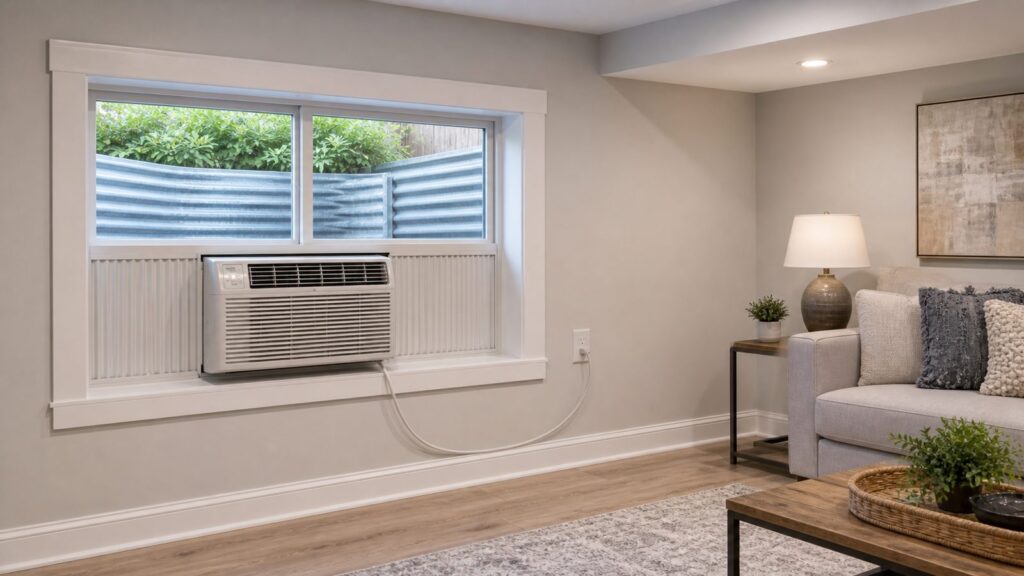
On our basement remodeling and repair jobs, we do not start by asking which AC has the best online rating. We start with the window. Basement windows are low, tight, often partly below grade, and sometimes part of the home’s required emergency escape and rescue opening. A unit that works fine in a second-floor bedroom can be a poor fit in a window well if it traps hot exhaust, blocks egress, drains against the foundation, or overloads an older circuit.
If you want a quick rule: choose the smallest high-efficiency unit that can hold the room at a comfortable temperature on a hot afternoon while removing enough moisture to keep the basement from feeling clammy. Then confirm the installation is legal, supported, weather-sealed, and electrically sound.
As an Amazon Associate I earn from qualifying purchases.
Start With the Basement Window, Not the Air Conditioner
Before comparing brands or features, measure the opening and inspect how the window works. Write down the clear opening width, clear opening height, sill depth, distance from the exterior face of the window to the window well wall, and the distance to the nearest grounded receptacle. Also identify the window type: double-hung, slider, casement, hopper, awning, glass block with vent, or a replacement basement egress window.
Most standard window air conditioners are designed for double-hung windows. They sit on the sill, project outside, and use side panels to close the gap. Many basement windows are not double-hung. A slider or casement window often needs a vertical casement/slider AC. A hopper or awning window may not accept a window unit safely at all without modification. Glass block windows with small vents are generally not suitable for mounting a conventional AC.
Measure the window in inches, not by rough guess. Many small 5,000 to 6,000 BTU window units need roughly 21 to 23 inches of width and 13 to 15 inches of height, while larger 8,000 to 12,000 BTU units often need wider openings and stronger support. Casement/slider models may need around 15 inches of width but 20 inches or more of height. Always use the manufacturer’s stated minimum and maximum opening dimensions because brackets, sash stops, and filler panels vary.
What’s actually slowing this PC down?
Pick the symptom - the matching free tool is one click away.
Popular on Amazon
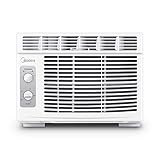
- PERFECT FOR SMALLER ROOMS - Midea's Affordable Window AC unit is perfect to help your room be as comfortable as possible. It can cool 150 sq. ft. with 7 temperature settings, 2 cooling/2 fan-only speeds, and 2-way air direction to give you the perfect amount of cooling every time.
- ENERGY EFFICIENT- Midea's 5,000 BTU window air conditioner has a Combined Energy Efficiency Rate (CEER) of 11.0 which helps reduce the energy costs to save you money throughout the year.
- QUIET & EASY TO USE - This window AC unit is quieter than a household refrigerator. It also features easy-to-use mechanical controls to quickly set the time, temperature, and mode and has a removable & reusable air filter.
- EASY INSTALLATION - Easily install in your home or apartment's existing window frame. Suitable for windows 23''-36'' wide and minimum 13'' high. All mounting accessories are included. A screwdriver is required (but not included) for installation. For some window frames, pilot holes are recommended before installing screws. Please see included instruction manual for further detail.
- WARRANTY: 1 Year Parts & Labor Warranty comes with each Midea product to ensure the quality of our brand to our customers. Our team is happy to help if any questions or issues arise and make sure to register your product on our website for even faster support in the future.
Basement window wells add another constraint. The outside half of the AC must reject heat. If the condenser is jammed into a shallow well with only a few inches of clearance, the unit can recirculate hot air and lose capacity. We look for clear airflow around the rear and sides of the unit, a well that drains, and a cover that does not trap hot exhaust. A window well full of leaves, mud, or standing water is not ready for an AC installation.
Do Not Block a Required Basement Egress Window
This is the detail many product guides skip. If the basement window is required for emergency escape and rescue, installing an air conditioner in that opening can create a serious code and life-safety issue. Finished basements, basement bedrooms, and habitable spaces often rely on specific egress openings. Under commonly used residential code requirements, an emergency escape and rescue opening must provide a minimum net clear opening of 5.7 square feet, except grade-floor openings may be allowed at 5.0 square feet. It also must typically have at least 20 inches of clear width, at least 24 inches of clear height, and a sill height no more than 44 inches above the floor.
A window AC can reduce that clear opening to zero while it is installed. Even if the sash still opens partially, the unit, brackets, filler panels, cords, and window well may prevent a person from escaping or a firefighter from entering. If that window is the only compliant egress opening for a basement bedroom or finished living area, do not treat the AC as a harmless seasonal accessory.
Basement egress checklist before installing a window AC
- Is this window in a basement bedroom or finished habitable basement space?
- Is it the only window large enough for emergency escape and rescue?
- Does the clear opening still meet local code dimensions with the AC installed?
- Can the window be opened fully without tools, keys, or removing fasteners?
- Is the window well large enough and equipped with a ladder or steps where required?
- Would an occupant be able to get out quickly in smoke, darkness, or panic?
If the answer is uncertain, assume you need a safer cooling plan. That may mean using a different window, adding a through-wall sleeve, installing a ductless mini-split, or upgrading the basement window layout. This is where a contractor’s site visit is worth more than another hour of product research.
The Tool Desk
Outbyte PC Repair FREEClear out junk files and repair common Windows errorsFree Scan →Outbyte Driver Updater FREEScan for outdated or missing drivers - takes under a minuteDriver Scan →Match the AC Type to the Basement Window
The right AC category depends heavily on window geometry. A basement with a normal double-hung window has many options. A basement with a narrow slider, hopper, or egress casement window has fewer.
| Basement window type | Best AC option | Typical fit concern | Contractor note |
|---|---|---|---|
| Double-hung | Standard window AC, inverter window AC, or U-shaped model | Minimum width, sill strength, and exterior clearance | Usually the simplest install if egress is not blocked. |
| Horizontal slider | Casement/slider AC or dual-hose portable AC | Vertical filler panel and secure side support | Do not force a standard unit sideways or unsupported. |
| Casement | Casement AC or ductless mini-split | Narrow width and tall opening requirements | Check crank hardware and sash removal requirements. |
| Hopper or awning | Portable dual-hose AC, through-wall unit, or mini-split | Sash swing interferes with mounting | Often a poor candidate for window AC installation. |
| Glass block vent | Mini-split, through-wall unit, or window replacement | Vent area is too small for most AC units | Modification may affect security, water control, and appearance. |
| Egress window | Use only if another compliant egress route remains | Blocked emergency escape opening | Verify local code before installing anything removable or fixed. |
For finished basements, we usually prefer inverter window units where the window allows. Inverter compressors modulate output instead of cycling hard on and off. In real use, that usually means quieter operation, steadier temperatures, and better efficiency than a basic fixed-speed unit. For a TV room, guest room, office, or basement bedroom, noise matters. A cheap unit that rattles at 2 a.m. will feel like a bad purchase even if it cools adequately.
U-shaped and clear-view units can be useful where a double-hung window has enough height and depth. They allow the sash to close farther into the unit’s center channel, which can reduce noise and preserve more window function. In a basement, the limiting factor is often the window well and sill detail. These units still need proper outdoor airflow and must be installed exactly to the manufacturer’s bracket instructions.
Casement and slider ACs solve a different problem. They are taller and narrower, making them better for vertical openings. They usually cost more than basic window units, with many current retail examples in the low-$300s to $700 range depending on capacity and brand. They are worth considering when the window type matches, but they are not a workaround for egress safety.
Choose the Right BTU Size for a Basement
BTU sizing is where homeowners often overspend. Bigger is not automatically better. An oversized unit can short-cycle, meaning it cools the air quickly and shuts off before it removes enough moisture. In a basement, that can leave the room cold and clammy.
Use square footage as the starting point. Typical room AC sizing looks like this: about 5,000 BTU for 100 to 150 square feet, 6,000 BTU for 150 to 250 square feet, 8,000 BTU for 300 to 350 square feet, 10,000 BTU for 400 to 450 square feet, and 12,000 BTU for 450 to 550 square feet. Then adjust for real conditions.
| Basement area | Starting AC size | Best use case | Watch-outs |
|---|---|---|---|
| 100-150 sq. ft. | 5,000 BTU | Small office, hobby room, storage room used occasionally | May struggle if the room has poor air sealing or high humidity. |
| 150-250 sq. ft. | 6,000 BTU | Small bedroom or finished basement room | Check noise rating if used for sleeping. |
| 300-350 sq. ft. | 8,000 BTU | Medium rec room or open finished area | Inverter models are often worth the added cost. |
| 400-450 sq. ft. | 10,000 BTU | Larger finished basement zone | Confirm circuit capacity and outlet location. |
| 450-550 sq. ft. | 12,000 BTU | Large open area with decent airflow | May need multiple units or a mini-split for comfort across rooms. |
Basements are different from above-grade rooms. They often have less direct sun but more moisture, foundation contact, air leakage at the rim joist, and heat from appliances. A basement laundry area with a dryer, freezer, or mechanical equipment may need more capacity than square footage suggests. A well-insulated finished basement with limited heat gain may need less.
Also consider layout. A single window AC cools the room where it is installed. It will not reliably cool three closed-off basement rooms through doorways. For separated spaces, you may need transfer grilles, fans, multiple small units, or a different HVAC solution. We would rather see two correctly sized zones than one oversized unit blasting cold air into a corner.
Best Basement Window AC Categories for 2026
Instead of chasing one universal model, choose from the category that matches your basement. Product availability changes, but these categories are the ones we recommend most often on real projects.
Small 5,000 to 6,000 BTU budget window units
Best for small unfinished or lightly finished basement rooms around 100 to 250 square feet. These are the simplest and cheapest units, often starting around $150 to $250, with some entry 5,000 BTU models around $169. They are compact, easier to lift, and less likely to require a dedicated circuit than larger units.
The tradeoff is noise, efficiency, and moisture control. Many budget units use fixed-speed compressors and basic mechanical or electronic controls. They can work well for a workshop or storage area, but we do not usually recommend the cheapest model for a guest room or home office where comfort and sound matter.
8,000 to 10,000 BTU inverter window units
This is the sweet spot for many finished basement spaces from roughly 300 to 450 square feet. In 2026, 8,000 to 12,000 BTU smart or inverter models commonly list around $279 to $549 at major retailers. They cost more up front, but the quieter operation and steadier temperature control are noticeable.
PC Slower Than It Used to Be?
A free scan shows the junk files, broken settings and background clutter dragging Windows down - then fixes them in one click.Free scan · Windows 10 & 11Outdated Drivers Are Slowing You Down
One free scan finds every outdated or missing driver and matches the right update for your exact hardware.Free scan · exact hardware matchFor a finished basement family room, home gym, or office, look for an ENERGY STAR certified model, washable filter, clear condensate instructions, and a noise rating that fits the room use. Smart controls are useful if the basement is used on a schedule, but they should not be the main reason to buy the unit.
U-shaped or clear-view window units
These can be a strong choice for double-hung basement windows that have enough height and exterior clearance. The design can reduce noise transmission and let the sash close more securely than a traditional box-style unit. They are especially appealing in finished basements where the window is visible and used for light.
Do not assume every basement double-hung window can take one. Check the sill, trim depth, bracket requirements, storm window frame, and window well clearance. A U-shaped unit still needs a stable support path and room to reject heat outdoors.
Also popular on Amazon

- BEST FOR SMALL ROOMS: Cools up to 150 sq ft efficiently with 5,000 BTU cooling power. Ideal for bedrooms, home offices, dorm rooms, workshops, and studio apartments. Compact 16.4" W x 13.4" D x 12.6" H design fits tight spaces.
- QUIET OPERATION - Quieter than many older window AC units, with 2 cooling modes (low 52 dBA for nighttime, high 56 dBA for rapid cooling) and 2 fan speeds for personalized comfort. Simple mechanical controls mean no annoying digital beeps.
- SIMPLE, RELIABLE MECHANICAL CONTROLS: Easy-to-use dials for temperature and fan speed—no Wi-Fi, apps or complex setup required. 10 temperature settings let you dial in your perfect comfort level. Auto restart after power outages.
- LOW MAINTENANCE & ENERGY SMART: No manual draining under normal conditions. Washable, reusable filter for easy care. Low 440W power draw helps reduce energy costs compared to older, inefficient units.
- EASY DIY INSTALLATION: Fixed chassis installs easily and fits double-hung windows 27.125"–36" wide and 13.375" high minimum. EZ Mount kit with foam insulation included. Backed by 1-year GE limited warranty for peace of mind.
Casement and slider window air conditioners
These are built for narrow vertical openings and are often the right answer for older basement sliders or casement replacement windows. They commonly cost more than basic window units, often landing from the low-$300s to $700 depending on size and features.
Recommended Free Tools
They need careful sealing because the opening above the unit is tall. Use rigid filler panels, manufacturer-approved kits, or properly detailed inserts. Foam stuffed loosely around the unit may stop some drafts for a week, but it usually looks poor, leaks air, invites pests, and degrades in sunlight.
Heat/cool window units
A heat/cool window unit can help during shoulder seasons if the basement gets chilly in spring or fall. These units are usually larger, heavier, and more demanding electrically than cooling-only models. They are not a substitute for a code-compliant permanent heat source where one is required for finished living space.
Before installing a 10,000 BTU or larger heat/cool model, have the circuit checked, especially in older homes. The combination of compressor load and resistance heat can be more than a casual plug-in decision.
Dual-hose portable AC units
A dual-hose portable AC is useful when a window-mounted unit is unsafe, impractical, or would block egress. It sits on the floor and vents through a panel in the window. Choose dual-hose over single-hose when possible. Single-hose units can depressurize the room and pull warm, humid outdoor air through foundation leaks, rim joists, or stairwell gaps.
Do these 3 things before closing this tab:
1Clear out junk files and repair common Windows errors2Fix the driver behind crashes, sound loss and screen glitches3Repair Windows errors before they cause bigger problemsThe drawbacks are floor space, noise, condensate handling, and lower real-world efficiency. Still, a dual-hose portable unit can be the safer temporary choice for a basement bedroom if the only large window must remain usable for escape.
Efficiency Standards and What to Look For on the Label
Room air conditioner efficiency is commonly expressed as CEER, or Combined Energy Efficiency Ratio. Higher is better. ENERGY STAR listings are a practical filter because they let buyers compare certified room AC models by capacity, efficiency, and features.
DOE’s amended room air conditioner efficiency standards apply to units manufactured in or imported into the United States starting May 26, 2026. For common non-reverse-cycle units with louvered sides, required CEER values include 13.1 for units under 6,000 BTU/h, 13.7 for 6,000 to 7,900 BTU/h, and 16.0 for 8,000 to 19,900 BTU/h classes. That does not mean every old unit disappears immediately from shelves, but it does mean efficiency should be part of your 2026 buying decision.
For basements, efficiency is not only about the electric bill. A better unit that runs longer at lower output can improve comfort because it keeps air moving and removes moisture more steadily. Look for inverter operation, an ENERGY STAR label, a washable filter, an accessible drain design, and a thermostat that can hold a stable setpoint without constant cycling.
Running cost varies widely. A window AC may cost roughly $12 to $120 per month to operate depending on local electric rates, BTU size, runtime, thermostat setting, insulation, air leakage, humidity, and efficiency. A small unit used evenings in a tight basement is at the low end. A 12,000 BTU unit fighting a leaky, damp basement all day in August can move toward the high end.
Basement Drainage, Condensation, and Window Wells
Basement AC installation is partly an HVAC job and partly a water-management job. Condensate has to go somewhere. Some modern window units intentionally retain water in the base pan and use the condenser fan to improve efficiency. Others drain more freely. Follow the manual. Do not drill drain holes unless the manufacturer allows it.
From a construction standpoint, the key issue is where water lands. You do not want condensate draining against wood trim, into a window frame, onto an unprotected sill, or toward a foundation crack. The unit should be pitched exactly as specified by the manufacturer, usually slightly outward, and the exterior side should have a clear drip path.
Window wells need attention. A clogged well drain can turn a summer thunderstorm into a basement leak. Before installing an AC, clean debris from the well, confirm the drain is open if one exists, check the well cover, and inspect the window frame for rot, gaps, or failed sealant. If the well is already taking on water, the AC will not fix that problem. Address grading, downspouts, window well drainage, or foundation waterproofing first.
Free tools Windows power users keep installed
One-click scans. No signup required.
Basements also need humidity control beyond temperature. If the space regularly sits above 55 to 60 percent relative humidity, a window AC may help but may not be enough. A dedicated dehumidifier, rim joist air sealing, duct sealing, or foundation moisture repair may be the correct fix. Cooling a damp basement without controlling moisture can make the room feel colder but still smell musty.
Electrical Safety: Outlets, Cords, GFCI, and Circuit Load
Window air conditioners should plug directly into a properly grounded receptacle. Do not use extension cords, lightweight power strips, or improvised adapters. Summer AC use is a common source of overloaded cords and overheated connections.
Check the unit nameplate for voltage and amperage. Many smaller window units run on a standard 120-volt, 15-amp circuit, but larger units, heat/cool units, and some 12,000 BTU models may need more capacity. If the lights dim when the compressor starts, the breaker trips, the receptacle is loose, or the outlet is ungrounded, stop and bring in an electrician.
Basements may also have GFCI or AFCI requirements depending on the circuit, location, and local code adoption. Requirements vary by jurisdiction and by the age of the installation. A licensed electrician can confirm whether the receptacle is appropriate, whether the circuit has spare capacity, and whether a dedicated circuit is needed.
On older homes, we are cautious with 10,000 BTU and larger window units. The issue is not just the breaker size. It is the condition of the wiring, shared loads on the same circuit, receptacle grip, grounding, and whether the homeowner plans to run a dehumidifier, freezer, treadmill, or power tools on the same branch circuit.
Independent reader supportYour contribution helps us test, update, and keep practical guides available for everyone.What a Basement Window AC Costs in 2026
For planning purposes, a window AC project can be as low as a few hundred dollars or it can turn into a larger basement improvement if the window, electrical, or drainage conditions are poor. In 2026, window AC units commonly cost about $150 to $800 nationally depending on capacity, brand, inverter technology, noise rating, smart controls, heat mode, and specialty form factor.
| Project item | Typical 2026 cost | What affects price |
|---|---|---|
| Basic 5,000-6,000 BTU window AC | $150-$250 | Controls, noise level, efficiency, brand |
| 8,000-12,000 BTU smart or inverter unit | $279-$549 | Inverter compressor, CEER, smart features, sound rating |
| Specialty casement/slider unit | Low-$300s-$700 | Narrow format, capacity, installation kit, availability |
| Professional standard setup labor | About $130-$255 | Unit weight, access, bracket, sealing, window condition |
| Installed window AC total | About $139-$519 typical range; many homeowners around $312 | Basic unit plus standard installation conditions |
| Unit plus labor broader range | $300-$1,100 | Larger units, difficult windows, support brackets, sealing work |
| Window replacement or modification | $300-$2,100 per window; average around $850 | Size, egress requirements, material, masonry, finish repair |
Basement-specific cost drivers include window type, opening size, support bracket requirements, window well clearance, whether the opening is required egress, air sealing difficulty, drainage path, trim or masonry modifications, and receptacle location. If the outlet is across the room, the right answer is not an extension cord. It may be a new receptacle or a different cooling approach.
Also popular on Amazon

- Effortless Cooling: Achieve optimal comfort with customizable temperature settings and two fan speeds; Effortless Temperature Control helps to maintain your preset temperatures for consistent comfort
- Easy Maintenance: Keep your air conditioner running efficiently with the easy-to-clean washable filter, designed to capture dust from the air for long-lasting performance
- Undisturbed Comfort: Experience a peaceful home environment with a quiet performance at 52 dBA – ideal for bedrooms or small spaces up to 150 sq. ft.
- Effortless Convenience: Benefit from the Auto Restart feature, which automatically restores the unit's previous settings once power is restored to the window air conditioner
- Hassle-Free Operation: The extra-long three-prong power cord eliminates the need for extension cords, while the adjustable side panels easily extend to best fit your window, ensuring a secure installation with optimal efficiency and airflow
If a window unit is not code-safe or practical, the budget changes. A portable AC may avoid mounting but still needs venting and condensate management. A through-wall unit requires cutting and weatherproofing the building envelope. A ductless mini-split or central AC upgrade can move the project from hundreds into the thousands, but it may be the better long-term answer for finished space used every day.
When to DIY and When to Hire a Pro
A straightforward DIY installation can make sense when the unit is small, the window is a standard double-hung style, the opening is not required for egress, the sill is solid, the exterior has clear airflow, and there is a grounded receptacle nearby. A careful homeowner can usually install a small unit in one to two hours with the manufacturer’s bracket, weatherstripping, screws, level, tape measure, and a helper for lifting.
Hire a pro when the unit is heavy, the window is old or damaged, the sill is soft, the exterior drops into a deep window well, the opening is an egress window, or the installation needs custom filler panels. Also hire an electrician if the circuit is questionable, the receptacle is ungrounded, the breaker trips, or the unit requires a dedicated circuit.
Call a contractor instead of forcing the installation when the window does not match the AC type. We see the most trouble when someone tries to adapt a standard unit into a slider, hopper, or casement opening with scrap lumber and foam. That can create a poor seal, weak support, water entry, pest gaps, and a blocked escape route. A properly built insert, replacement window, through-wall sleeve, or mini-split may cost more up front but avoids repeat repairs.
Installation Details That Separate a Good Job From a Temporary Patch
A basement AC installation should be stable, sealed, serviceable, and reversible where possible. The unit should bear on the correct support points, not just hang from the sash. Side panels or filler panels should resist weather and pests. The sash should be secured so it cannot lift unexpectedly. Any bracket should fasten into solid material and comply with the AC manufacturer’s instructions.
Air sealing matters. Small gaps around a basement window AC can pull in humid outdoor air, insects, and dust. Use manufacturer-provided seals, closed-cell foam where appropriate, and rigid panels for large openings. Avoid stuffing loose insulation or towels around the unit. They absorb moisture and look like a temporary fix because they are one.
Security also matters. A basement window is accessible from grade. After the AC is installed, the sash and filler panels should not be easy to remove from outside. Many kits include sash locks or brackets, but field conditions vary. In some cases, a removable interior security bar or better window hardware is appropriate, provided it does not interfere with required egress.
Plan for maintenance. The filter should be removable without dismantling the installation. The unit should be accessible for seasonal removal if you do not leave it in year-round. If the basement window is exposed to snow or freeze-thaw conditions, off-season removal and proper storage can extend the life of the unit and reduce air leakage.
When a Window Unit Is the Wrong Answer
A window AC is not the right tool for every basement. If the only suitable window is required egress, look elsewhere. If the window well is too tight for airflow, the unit may run inefficiently and dump heat into a confined space. If the basement has chronic water intrusion, fix water first. If the space is divided into several rooms, a single window unit may not distribute air well.
For a finished basement used as daily living space, compare the lifecycle cost of a window unit against a ductless mini-split. A mini-split costs more to install, but it keeps the window clear, improves comfort, runs quietly, and can provide heating depending on the model. For a basement office, bedroom suite, or family room, that may be the cleaner long-term investment.
A through-wall unit can also be appropriate when a permanent opening makes sense and the wall assembly can be detailed correctly. That means proper structural support, flashing, air sealing, insulation, and exterior finish work. Cutting a hole through a foundation wall or framed wall is not the same as slipping a unit into a window for July and August.
Our Practical Buying Checklist
Use this checklist before buying. It will prevent most expensive mismatches.
- Measure clear window width and height to the nearest 1/8 inch.
- Confirm the window type matches the AC category.
- Verify the window is not the only required emergency escape and rescue opening.
- Check sill condition, frame condition, and exterior window well clearance.
- Size the unit by square footage, then adjust for humidity, insulation, appliances, and layout.
- Favor inverter and ENERGY STAR certified models for finished rooms.
- Confirm voltage, amperage, plug type, and receptacle grounding.
- Plan condensate drainage before the first hot day.
- Use manufacturer-approved brackets and installation parts.
- Budget for professional help if the window, electrical, or drainage conditions are not straightforward.
For most homeowners, the best basement window air conditioner is not a luxury model. It is a correctly sized, efficient unit installed in the right opening with clean drainage, safe power, and enough exterior airflow. Spend the measuring time before you spend the money. In basement work, that is usually what separates a comfortable summer from a noisy, leaky, unsafe installation you end up redoing.
Recommended Free Tools
Frequently Asked Questions
Can you put an air conditioner in a basement window?
Yes, if the window type, opening size, sill strength, exterior clearance, drainage, and electrical supply match the unit. Do not install one in a required egress window unless another compliant emergency escape opening remains available.
What size window AC do I need for a basement?
Start with square footage: about 5,000 BTU for 100-150 sq. ft., 6,000 BTU for 150-250 sq. ft., 8,000 BTU for 300-350 sq. ft., 10,000 BTU for 400-450 sq. ft., and 12,000 BTU for 450-550 sq. ft. Adjust for humidity, insulation, appliances, occupancy, and layout.
Is it legal to put a window AC in a basement egress window?
It can be a problem if the AC blocks or reduces the required emergency escape and rescue opening. Common residential code criteria include minimum clear opening area, width, height, and sill height. Check local code before installing an AC in any basement bedroom or required egress opening.
What is the best AC for a small basement window?
For a small double-hung window, a compact 5,000-6,000 BTU unit may be enough for 100-250 sq. ft. For a narrow slider or casement window, look at a casement/slider AC or a dual-hose portable unit instead of forcing a standard window AC into the opening.
Free tools Windows power users keep installed
One-click scans. No signup required.
How much does it cost to install a basement window air conditioner in 2026?
A window AC unit commonly costs about $150-$800. Standard professional setup often runs about $130-$255 for labor, with many installed projects around $312. Difficult basement conditions, specialty units, window modification, drainage work, or electrical upgrades can raise the total.
Should I use a portable AC or window AC in a basement?
Use a window AC when the window is compatible, safe, and not required for egress. Use a dual-hose portable AC when window mounting is unsafe or impractical. Avoid single-hose portable units when possible because they can pull humid outdoor air into the basement.
Quick Recap
Product prices and availability are accurate as of the date/time indicated and are subject to change. Any price and availability information displayed on Amazon at the time of purchase will apply.

