Some links on this page are affiliate links: if you buy through them we may earn a commission, at no extra cost to you.
The best sealant for metal roof screws is not a magic tube of caulk. On an exposed-fastener metal roof, the primary water seal should be the screw and its EPDM sealing washer. Sealant is the backup, not the main event.
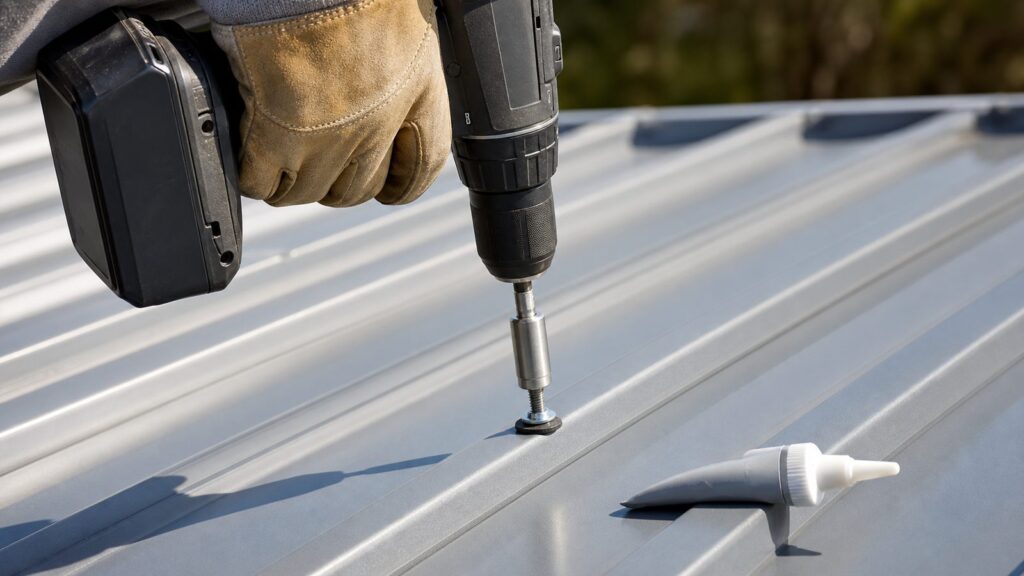
For most leaking metal roof screws in 2026, the durable repair is this: remove and inspect the suspect screw, replace it with a manufacturer-compatible metal roofing screw with a fresh EPDM washer, use the correct length and diameter for the panel and substrate, seat the washer properly, and then use a high-quality neutral-cure silicone, polyurethane, or metal-roof-specific Hybrid sealant only where the washer edge, old hole, flashing joint, or penetration detail still needs supplemental protection.
On our job sites, we do not start by smearing sealant over every screw head. That often hides the real problem for one season and makes the next repair messier. We look for backed-out screws, overdriven washers, split washers, wallowed-out holes, rust, wrong fastener length, failed laps, loose trim, and panel movement. Once the cause is clear, the right sealant choice becomes much easier.
As an Amazon Associate I earn from qualifying purchases.
The Short Answer: Use the Right Screw First, Then the Right Sealant
If you have exposed screws on a metal roof, the top choice is a long-life metal roofing screw with a fresh EPDM sealing washer. The washer compresses between the screw head and the panel, creating the water seal. If that washer is cracked, flattened, missing, or miscompressed, no exposed bead of caulk is as reliable as replacing the fastener correctly.
For supplemental sealing, use one of these roof-rated products, matched to your panel coating and job conditions:
Popular on Amazon

- 【#10 x 1-1/2” Roofing Screw】 JEGONFRI roofing screws are designed to fix thin-gauge metal plates under 2.4 mm to wooden structures. Composed of high-strength alloy steel to provide strong toughness. An additional magnetic-absorbing driver bit available.
- 【Convenient to Use】 The self-drilling point can reduce metal shaving. Galvanized ASD coarse thread with moderate corrosion resistance is applied to wood. Mainly used for most iron panel, steel plate, aluminum panel, wood, plastic sheet, composite board, etc.
- 【EPDM Washer】 The 1/2"(13.8 mm) rubber washers expand under pressure to form a durable weather-tight seal. And the suitable diameter tightly covers screw hole.
- 【Brown Hex Head】 The process of baking varnish provides superior corrosion resistance and exterior protection for 5/16" hex head with high-torque drive when installed. Chocolate brown matches popular roofing colors.
- 【Warm Tips ! 】 Since the coarse thread and small head of screw, it is not suitable for thick metal plate exceeding 2.4mm and the connection between the metal plates! Ensure holding angle to prevent sliding when use. 250 pieces per retail package, a cost-effective choice for job.
- Neutral-cure silicone: Good UV resistance, flexible, and usually safer around painted metal than acetoxy bathroom silicone. It works well for exposed small repairs when compatible with the roof finish.
- Polyurethane roof or flashing sealant: Tough, paintable in many cases, and strong for metal-to-metal or flashing repairs. It can be harder to remove later and must be applied within the product’s temperature and moisture limits.
- Hybrid sealant: Often sold as metal-roof or exterior construction sealant. These products combine flexibility, adhesion, and weather resistance and are commonly a good choice for screw-area repairs, trim, and penetrations.
- Butyl tape or non-curing butyl sealant: Excellent inside compressed laps, closure details, trim, vents, and concealed joints during installation or disassembly. It is usually not the best exposed cap over an already driven screw head.
Avoid generic bathroom silicone, asphalt roof cement, tar, and hard-setting caulks on painted metal roofing. They can crack, stain panels, lose adhesion, trap water, or make future service harder. A roof-rated sealant should say it is compatible with metal, exterior weather exposure, UV, and the specific surface condition you are sealing.
Why Metal Roof Screws Leak
Most leaks around exposed fasteners come from a small set of causes. The visible screw may be the source, but water can also travel from a ridge cap, pipe boot, sidewall flashing, end lap, or closure strip and show up along a screw line inside the building. Diagnosis matters.
Backed-out screws
Metal panels expand and contract with temperature. Wind vibration and thermal cycling can gradually loosen screws, especially when the original fastener missed solid framing or was driven into deteriorated wood. A backed-out screw lifts the washer off the panel. Once the washer is no longer compressed, wind-driven rain can enter around the shank.
Overdriven washers
Overdriving is one of the most common installation mistakes. The EPDM washer should compress enough to seal, but it should not be smashed until it bulges far beyond the metal washer or splits at the edge. When the washer is crushed, it ages faster and can form a leak path around the screw head.
Underdriven screws
An underdriven screw leaves the washer loose. It may look installed from the ground, but the washer is not sealed to the panel. This often happens when installers use the wrong clutch setting, a dull nut setter, or drive screws at a slight angle.
What’s actually slowing this PC down?
Pick the symptom - the matching free tool is one click away.
Wallowed-out holes
If a screw has moved for years, the hole in the panel, purlin, or deck may be enlarged. Reinstalling the same diameter screw into a stripped hole rarely lasts. The repair may need a larger-diameter replacement screw, a longer screw into sound substrate, or a manufacturer-approved relocation or patch detail.
Corrosion and incompatible metals
Fasteners must match the roof metal and coating. Galvanized, zinc-aluminum, aluminum, and stainless fasteners are not interchangeable in every assembly. In coastal, industrial, or agricultural settings, salt air and chemical exposure can make cheap fasteners fail early. Corrosion around screw heads can stain panels, weaken the fastener, and break the washer seal.
Old washers
EPDM washers last a long time when specified and installed correctly, but they are still exposed rubber components. Sun, heat, freeze-thaw cycles, and movement eventually take a toll. On older exposed-fastener roofs, widespread washer checking or flattening is often a sign that spot caulking is the wrong plan.
Best Sealant Types for Metal Roof Screws
The best sealant depends on whether you are sealing an exposed screw, a joint under compression, a flashing transition, or a penetration. We separate those uses because each material behaves differently.
Also popular on Amazon

- Thread Diameter: #10; Length: 3/4"; Head Height: 0.19" (4.9mm); Flange Diameter: 0.41" (10.5mm); Washer Size: 0.54" (13.8mm); Package: 50 PCS Metal Roofing Screws with a Hex Bit Socket.
- Material: Both the screw and the metal washer are made of carbon steel with zinc-plated surface, which is corrosion-resistant and anti-rust, not easy to damage. The black washer is made of EPDM, which is wear and oxidation resistant.
- Feature: The EPDM rubber washer can prevent leaks, loosening and damage the contact surface, which is bonded to the metal washer forming a tight sealing when you tighten the self-drilling screw.
- Easy to Use: The self-drilling screws can be directly screwed into the metal or wood without pre-drilling, not easy to deform and slide when use, high strength, long service life. All you need to install them with a power drive tool.
- Wide Application: The hex head metal roofing screws are typically used in metal-to-metal and metal-to-wood applications, most commonly on thin metals such as iron panel, steel plate, aluminum panel, also used in wood, plastic sheet, composite board, etc.
| Material | Best use | Where we avoid it | Typical DIY material cost |
|---|---|---|---|
| EPDM washer roofing screw | Primary seal for exposed-fastener panels | Wrong metal, wrong length, stripped holes, or mismatched coating | About $15 to $30 per 250-count box for common screws; premium tested fasteners may run about $0.39 to $0.41 each |
| Neutral-cure silicone | Supplemental exposed sealing around screw heads, small gaps, and compatible painted metal details | Dirty, chalky, oily, wet, or incompatible surfaces; generic bathroom silicone | About $10 to $25 per tube |
| Polyurethane roof sealant | Durable flashing, trim, and localized roof repairs where adhesion and toughness matter | Joints needing easy future removal; surfaces outside cure limits | About $10 to $25 per tube |
| Hybrid metal-roof sealant | General metal roof repair, screw-area touchups, penetrations, and trim where product data supports the use | Uncleaned oxidation, loose fasteners, or untested coating compatibility | About $10 to $25 per tube |
| Butyl tape or non-curing butyl | Concealed compressed laps, closures, vents, trim, and new installation details | Exposed blobs over screw heads or areas where dirt and UV exposure will attack the repair | Varies by roll size; commonly bought by roll or cartridge |
| Asphalt roof cement or tar | Emergency temporary work only, if no better option exists | Painted metal roof screw repairs, clean exposed work, warrantable repairs | Low material cost, high long-term cleanup cost |
For a screw that is simply leaking because the washer failed, sealant alone is the weaker repair. Replace the screw. For a screw in a slightly irregular panel surface, or a repaired hole where the new washer seals but you want extra protection, a neat dome of compatible sealant can help shed water. The bead should be tooled tight to clean metal. It should not bridge loosely over dirt, rust, old failed caulk, or a moving screw.
How We Repair a Leaking Metal Roof Screw
A good repair starts before the caulk gun comes out. The roof surface, fastener pattern, framing, and leak path all need a quick inspection.
1. Confirm the leak source
We check above the interior stain first, not just directly over it. Water can run along panel ribs, insulation, purlins, underlayment, or trim before it appears inside. Common false leads include ridge caps, skylights, plumbing boots, sidewall flashing, end laps, and closure strips. If the roof is older, there may be several leak paths at once.
2. Remove the suspect screw
We do not reuse a failed screw as the final repair. Removing it tells you what happened. Look at the washer, shank, threads, coating, and hole. A screw that comes out rusty, bent, too short, or with a destroyed washer has already given you the diagnosis.
Do these 3 things before closing this tab:
1Repair Windows errors before they cause bigger problems2Scan for outdated or missing drivers - takes under a minute3Clear out junk files and repair common Windows errors3. Match or upgrade the replacement fastener
Use a screw intended for metal roofing, with an EPDM sealing washer and coating compatible with the roof. Match the diameter, length, head style, and drill point to the panel and substrate unless the hole is enlarged. If the hole is wallowed out, a larger-diameter repair screw is often the correct next step. Document what you remove: screw length, diameter, washer size, coating, and roof panel type. That prevents a mid-job mismatch when you are replacing dozens or hundreds of fasteners.
4. Drive it straight with controlled torque
The screw should be perpendicular to the panel, not angled. Use a screw gun or drill with torque control. The washer should flatten evenly under the metal cap, but not squeeze out dramatically. Underdriven means no seal. Overdriven means a damaged washer and often a distorted panel hole.
5. Seal only where needed
If the new fastener seats cleanly and the panel surface is sound, the washer may be enough. If there is pitting, a slightly irregular surface, a repaired hole, or a vulnerable transition, apply a small amount of roof-rated neutral-cure silicone, polyurethane, or hybrid sealant. Tool it into a low dome that sheds water. Do not leave a tall blob with unbonded edges.
6. Test a small area first
On older painted metal, adhesion can be poor because of chalking, oxidation, old coatings, oil, or residue. Before coating dozens of fasteners, we like to clean and seal a small test area, allow the product to cure according to the label, and check adhesion. A failed test patch is much cheaper than a roof full of peeling sealant.
When a Full Re-Screw Beats Spot Caulking
Spot repairs make sense when only a few screws are loose, missing, or damaged. But if you find widespread washer failure, repeated leaks along several screw lines, or fasteners backing out across the roof, a systematic re-screw is usually cleaner and more durable than chasing leaks with sealant.
On exposed-fastener roofs, the fasteners penetrate the weather surface. That design is common and serviceable, but it requires periodic inspection. Standing seam roofs are different: the clips and fasteners are usually concealed, so the roof has fewer exposed washer-maintenance points. That does not mean standing seam roofs never leak, but the maintenance profile is different.
Also popular on Amazon

- 1/4" Hex Head - 1/2" EPDM Washer - Shank Diameter 0.18" - Width 0.5" - Height 0.297 - Length 1-1/2"
- Self-Piercing screws are designed to push through pre-drilled sheet metal panels
- Stainless Steel screws are ultimate in corrosion resistance in high humidity areas - no corrosion
- Our screws are backed by a Manufacturer Warranty against defects
- These screws are great sheet metal roofing screws to use on any metal roofing or siding project
A roof-wide re-screw can include replacing old screws with correctly matched fasteners, upsizing stripped holes, correcting missed framing where practical, replacing failed pipe boots, resealing vulnerable trim, and addressing rust before it spreads. If panels are still structurally sound, this can be a cost-effective way to extend the roof’s service life.
The wrong time to re-screw is when the panels are badly corroded, the substrate is rotten, the fastener pattern is fundamentally wrong, or the roof has major flashing failures. In that case, screws and sealant are treating symptoms. The better conversation is panel replacement, trim reconstruction, or a larger roof repair scope.
The Tool Desk
Outbyte PC Repair FREEClear out junk files and repair common Windows errorsFree Scan →Outbyte Driver Updater FREEScan for outdated or missing drivers - takes under a minuteDriver Scan →Cost to Seal or Replace Metal Roof Screws in 2026
For many homes and small commercial buildings, national metal roof repair averages in 2026 fall around $300 to $1,500 total, or about $5 to $15 per square foot for many repair jobs. Leak repair commonly runs $200 to $1,000. Seam resealing commonly runs $250 to $1,100. Screw replacement commonly runs $150 to $1,000 for smaller jobs, with wider contractor-reported ranges reaching about $4,000 for large, steep, high, or deteriorated roofs.
DIY material costs are modest. A tube of metal roof sealant commonly costs about $10 to $25. Boxes of common roofing screws with rubber or EPDM washers often estimate around $15 to $30 per 250-count box, while premium tested fasteners from specialty suppliers can run roughly $0.39 to $0.41 each. The cost difference is not just the screw. It is the roof access, fall protection, leak tracing, prep work, and the time required to do the repair without creating new leaks.
| Repair scope | Typical 2026 cost | Best fit | Watch-outs |
|---|---|---|---|
| DIY single tube sealant touchup | About $10 to $25 in sealant, plus basic tools | Small supplemental repair after the screw is confirmed sound | Not a substitute for failed washers, loose screws, or wet/dirty surfaces |
| DIY small fastener repair | Often under $100 in screws and sealant for limited areas | Low, safely accessible roof with a few failed screws | Fall risk, wrong screw selection, overdriving, missed leak source |
| Professional small leak service | Commonly low hundreds to about $1,000 | Leak tracing, isolated screw or flashing repair | Minimum service charges vary by market and roof access |
| Seam or trim resealing | About $250 to $1,100 for many jobs | Failed laps, closures, trim, or flashing joints | May require disassembly and butyl replacement, not just surface caulk |
| Roof-wide re-screw | Often $1,000 to $4,000 depending on size and condition | Widespread washer failure on an otherwise sound exposed-fastener roof | Large fastener counts, stripped holes, rust, pitch, height, access, and safety setup |
For context, standing seam metal roof installation cost calculators showed May 2026 national averages around $17.74 to $23.95 per square foot. That is one reason preserving a sound existing metal roof with correct fastener repair can be smart. If the panels, coating, framing, and flashing still have life, a proper re-screw is far less expensive than replacement.
DIY or Hire a Pro?
A homeowner with the right tools can replace a small number of accessible screws on a low-slope accessory structure. A roof is not the place to learn fall protection, metal compatibility, or leak diagnosis by trial and error. The risk changes quickly with height, pitch, surface condition, and weather.
Windows Errors? Fix Them Before They Spread
Repair common Windows errors and clear accumulated junk for a smoother, more stable PC - no reinstall needed.Free scan · no reinstallCrashes, No Sound, or Screen Glitches?
Random freezes, missing sound and display glitches usually trace back to one bad driver. Find and replace yours safely.Free scan · under a minuteDIY may be reasonable when
- The roof is low, dry, and safely accessible.
- The repair area is small, such as 5 to 20 suspect screws.
- You can identify the existing screw type, length, washer size, and substrate.
- The panels are not rusty, oil-canned, loose, or structurally questionable.
- You have fall protection appropriate to the roof and know how to use it.
- You are using roof-rated sealant within the product’s temperature and cure conditions.
Hire a pro when
- The roof edge is 6 feet or more above a lower level and you do not have proper fall protection.
- The roof is steep, wet, dusty, icy, or difficult to access.
- There are leaks in several rooms or along several screw lines.
- Fastener holes are stripped or enlarged across a broad area.
- The roof is coastal, agricultural, industrial, or otherwise corrosion-prone.
- Trim, flashing, skylights, pipe boots, or ridge details appear involved.
- You need a roof-wide re-screw, warranty support, insurance documentation, or permit guidance.
OSHA treats residential roofing work 6 feet or more above lower levels as work requiring conventional fall protection or another allowed protection method. That is not just a commercial contractor issue. Falls from metal roofs happen fast, especially when panels are wet or dusty. Smooth painted metal can feel stable until it is not.
Safety, Code, and Permit Notes
Local building rules matter. The 2024 International Building Code includes metal roof panel slope requirements and distinguishes lapped nonsoldered seams with and without lap sealant. That matters because roof slope, lap design, and sealant placement affect whether a roof assembly sheds water as intended. In high-wind regions, coastal zones, and Florida-style product-approval markets, fastener type, spacing, panel profile, and installation details may be tied to tested assemblies.
For a few replacement screws, many jurisdictions do not require a permit. For roof-wide repair, panel replacement, structural deck repair, or work that changes the roof assembly, permit requirements can change. Homeowners associations, insurance carriers, and local code officials may also care about panel color, fastener finish, wind rating, and corrosion resistance.
Also popular on Amazon

- ANTI-CORROSION COATING: Featuring a corrosion-resistant rustpert coating that withstands 1000-hour salt spray testing, these durable metal roofing screws excel in extreme weather conditions while maintaining long-lasting rust protection for reliable indoor/outdoor use
- EASY TO INSTALL: The 17 type sharp pointed tip penetrates through metal and wood effortlessly without pre drilling. Aggressive high and low threads provide strong holding power to secure materials tightly
- LEAK-PROOF EPDM WASHER: Roofing screws with EPDM rubber washer compress to form a watertight seal, preventing roof leaks during heavy rain and snow. Resists moisture, chemicals, and temperature extremes
- MULTIPLE APPLICATION: These metal roof screws are ideal for metal roof panels, corrugated roofing, tin sheds, pole barns, and DIY siding projects. The metal thickness should not exceed 2 mm
- PACKAGE: 300PCS #10 x 2 Inch metal roofing screws with 5/16 Inch hex head, 1PC 5/16 Inch strong magnetic hex socket. LIONMAX roofing screws come with a handy plastic box for convenient storage
Our practical rule is simple: if the work changes the roof assembly, affects a large area, involves structural substrate, or is in a high-wind or coastal jurisdiction, verify requirements before work starts. Guessing after the repair is more expensive than checking first.
Recommended Free Tools
Common Mistakes That Shorten the Repair Life
The most common mistake is caulking over every screw without replacing failed washers or loose fasteners. That looks productive, but it often creates hundreds of small maintenance points. When the old washer keeps moving under the sealant, the bead eventually splits or peels.
The second mistake is using whatever tube is already in the garage. Generic silicone, tar, asphalt mastic, and hard-setting caulks are poor choices for painted metal roof screw repair. Some lose adhesion. Some crack. Some stain panels. Some make future fastener replacement unnecessarily difficult.
Surface prep is another failure point. Sealant needs clean, dry, stable material. Dust, chalky paint, oxidation, oil, wet panels, and old failed caulk all reduce adhesion. If you can rub your hand across the panel and pick up powder, a sealant bead is not bonding to the panel the way you want.
Fastener driving errors also matter. Underdriven screws leak because the washer is not compressed. Overdriven screws leak because the washer is damaged. Angled screws leak because the washer does not seat evenly. Reusing the same screw in a stripped hole leaks because the threads no longer hold tight enough to maintain compression.
Free tools Windows power users keep installed
One-click scans. No signup required.
Finally, do not assume the visible screw is the source. Water is patient. It can enter at ridge trim, lap sealant, penetrations, sidewall flashing, closures, or panel end laps and appear somewhere else. If the same leak returns after a neat screw repair, widen the inspection instead of adding more sealant to the same spot.
What We Keep in the Truck for Screw Repairs
For metal roof screw repairs, our basic kit includes replacement metal roofing screws with EPDM sealing washers, multiple lengths, larger-diameter repair screws for stripped holes, color-matched heads when appearance matters, a torque-controlled driver, clean magnetic nut setters, metal-roof-rated sealant, rags, approved cleaner, scraper tools, and fall protection.
We also carry non-curing butyl tape or butyl sealant for compressed metal-to-metal laps, closure strips, vents, and trim. Butyl is a workhorse when it is inside the joint and held under compression. It is not our first choice as an exposed mound over screw heads.
For coastal or agricultural buildings, fastener selection gets more attention. Salt, fertilizers, animal confinement gases, and chemical exposure can shorten the life of cheap fasteners and some coatings. In those settings, upgrading corrosion resistance is not overbuilding. It is part of matching the repair to the environment.
Quick wins for a faster PC:
Repair Windows errors before they cause bigger problemsFix Now →Scan for outdated or missing drivers - takes under a minuteDriver Scan →Clear out junk files and repair common Windows errorsFree Scan →Step-by-Step Checklist for a Durable Repair
- Inspect above and around the leak, including ridge, trim, laps, penetrations, and screw lines.
- Identify the roof type: exposed-fastener panel or standing seam.
- Remove at least one failed screw and record diameter, length, head style, washer size, coating, and substrate.
- Check whether the hole is tight, stripped, enlarged, rusty, or misaligned.
- Choose a compatible replacement screw with a fresh EPDM washer.
- Upsize only when needed and when the repair matches manufacturer guidance or accepted field practice for that assembly.
- Clean and dry the panel surface before applying any sealant.
- Drive the screw straight with controlled torque until the washer is evenly compressed.
- Apply compatible sealant only where supplemental sealing is needed.
- Tool the bead into a low dome that sheds water and has bonded edges.
- Water-test carefully when appropriate, then inspect the interior after the next hard rain.
This checklist is slower than grabbing a caulk gun, but it is how you avoid repeating the same repair next season.
Also popular on Amazon

- 【PACKAGE INCLUDES】10 x 1" Hex Head Metal Roofing Screws with EPDM Washer, totally 250 Pcs and a Free 1/4 Hex Driver Bit.
- 【APPLICATIONS】Metal Roofing Screws Used to repair Corrugated Roofing, Metal, Wood and Slate Roofs. And has very good waterproof, corrosion resistance. These metal roofing screws can be used in homes, workplaces, furniture and courtyards. Metal Roofing Screws are a good helper for your repair and decoration.
- 【HIGH QUALITY】High and low thread metal roof screws have strong fixing ability. And can quickly penetrate sheet metal, wood, etc., without pre-drilling. Metal roofing screws are made of 1022A high quality carbon steel, resistant to hydrochloric acid corrosion for 1500 hours. Unique Type 17 tail for faster drilling.
- 【DURABLE AND STURDY】Metal roofing screws uses high quality carbon steel, classics high temperature quenching, hardness is high. The screw surface is first galvanized, then Ruspert is used to reinforce the screw surface coating, which has strong corrosion resistance.
- 【SERVICE】 Bobibbi's lifelong commitment to quality service. We really care about our customers and we are sure you will love our wood screws. That's why we offer a hassle-free lifetime warranty on all of our products. If you have any questions about our products, you can consult us. We pay great attention to detail when producing deck screws to provide the most effective fastener experience. You can safely add our products to your shopping cart.
Bottom Line
The best sealant for metal roof screws is a system: a correct metal roofing screw, a fresh EPDM washer, proper washer compression, compatible metals and coatings, clean surface prep, and a roof-rated sealant used only where it adds value.
If the roof has a few bad screws, targeted replacement plus a small amount of compatible neutral-cure silicone, polyurethane, or hybrid sealant may solve the problem. If the roof has widespread washer failure, a roof-wide re-screw is usually the better investment. If the leak is coming from laps, trim, closures, or penetrations, butyl and proper flashing work may matter more than the screw heads.
Sealant can protect a repair. It should not be asked to do the job of a failed fastener.
Frequently Asked Questions
What is the best sealant for metal roof screws in 2026?
Use the fastener and EPDM washer as the primary seal, then use a roof-rated neutral-cure silicone, polyurethane, or hybrid metal roof sealant as supplemental protection where needed. Avoid generic bathroom silicone, tar, asphalt roof cement, and brittle hard-setting caulks.
Should I seal metal roof screws or replace them?
Replace failed, loose, backed-out, rusty, or overdriven screws. Sealing over a bad washer usually does not last. After installing a compatible replacement screw with a fresh EPDM washer, add sealant only if the surface, hole, or detail needs extra protection.
Can I use silicone on metal roof screws?
Yes, but use roof-rated neutral-cure silicone that is compatible with painted metal. Do not use generic bathroom silicone. Clean and dry the surface first, and tool the bead so it bonds tightly and sheds water.
Is butyl tape good for metal roof screws?
Butyl tape is excellent for concealed compressed joints such as panel laps, trim, vents, closures, and flashing details. It is usually not the best exposed cap over an already installed screw head.
What’s actually slowing this PC down?
Pick the symptom - the matching free tool is one click away.
How much does it cost to replace screws on a metal roof?
Small screw replacement jobs commonly run about $150 to $1,000, while large or deteriorated exposed-fastener roofs can reach about $1,000 to $4,000. DIY materials may be under $100 for a small repair, but access, pitch, fall protection, and leak tracing drive professional cost.
How tight should metal roof screws be?
Tight enough to evenly compress the EPDM washer against the panel, but not so tight that the washer bulges, splits, or squeezes out from under the metal cap. The screw should be driven straight with controlled torque.
Quick Recap
Product prices and availability are accurate as of the date/time indicated and are subject to change. Any price and availability information displayed on Amazon at the time of purchase will apply.

