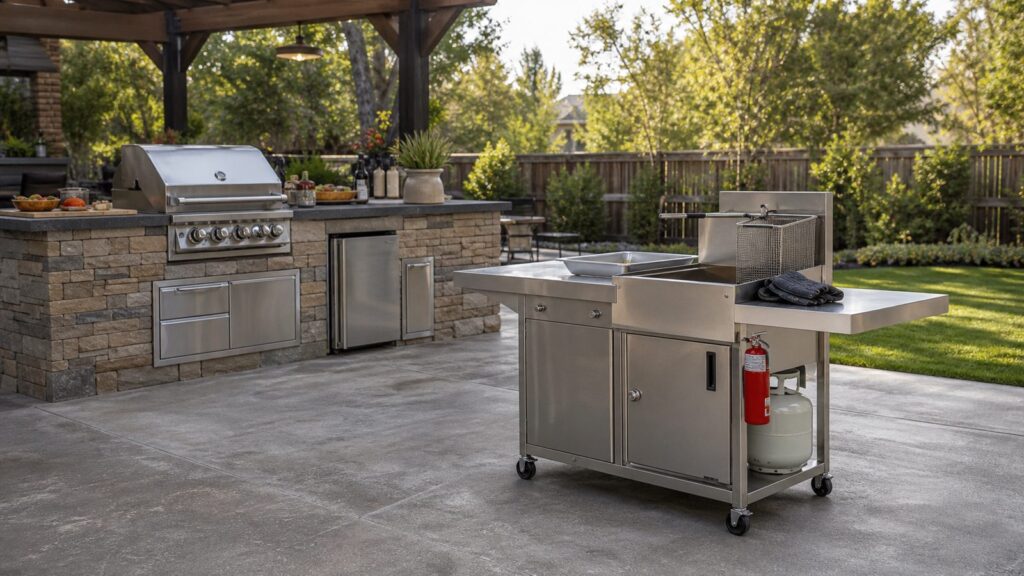
The best deep fryer for an outdoor kitchen is not always the biggest or highest-BTU model. The right choice depends on how often you fry, what you cook, where the appliance will sit, how you will manage hot oil, and whether the fryer needs gas, electric, weather protection, counter space, permits, or professional installation.
For most homeowners, the best choices fall into four groups: a portable propane fryer kit for occasional turkey or fish fries, a dual-basket propane cart for regular outdoor cooking, an outdoor-rated electric fryer for smaller batches near a protected GFCI outlet, or a commercial-grade stainless fryer planned into a full outdoor kitchen. On our job sites, we treat a fryer less like a countertop gadget and more like a high-heat oil appliance. That changes the layout, hardscape, utility rough-ins, fire separation, storage plan, and inspection checklist.
In 2026, portable outdoor fryer kits commonly run about $50 to $400. Serious commercial-style or outdoor-grade fryers usually land around $400 to $4,500 or more depending on capacity, fuel type, stainless construction, and whether the appliance is NSF or commercial-oriented. Adding one to a custom outdoor kitchen is a bigger decision because the total kitchen may already be a $7,000 to $35,000 project, and the fryer can trigger gas, electrical, counter, ventilation, and access-panel requirements.
As an Amazon Associate I earn from qualifying purchases.
PC Slower Than It Used to Be?
A free scan shows the junk files, broken settings and background clutter dragging Windows down - then fixes them in one click.Free scan · Windows 10 & 11Outdated Drivers Are Slowing You Down
One free scan finds every outdated or missing driver and matches the right update for your exact hardware.Free scan · exact hardware matchBest Outdoor Deep Fryer Types by Use Case
Start with how you cook. A family that fries fish twice a month needs a different setup than someone who wants one Thanksgiving turkey each year. The best outdoor fryer is the one that gives you enough oil capacity and heat recovery without creating a handling problem every time you cook.
| Best use case | Recommended fryer type | Typical 2026 cost | Best fit | Main caution |
|---|---|---|---|---|
| Occasional turkey or fish fry | Portable propane fryer kit | $50 to $400 | Open patio or driveway on a level noncombustible surface | Must stay away from walls, eaves, guests, and traffic paths |
| Frequent family fish fries | dual-basket propane fryer cart | $250 to $1,200+ | Dedicated frying zone beside the main outdoor kitchen | More oil means heavier handling and greater spill risk |
| Small batches, cleaner setup | outdoor-suitable electric fryer | $100 to $1,400+ depending on capacity | Covered but well-ventilated area with weather-rated GFCI power | Many indoor fryers are not rated for outdoor use |
| Premium outdoor kitchen | Commercial-grade stainless fryer | $1,200 to $4,500+ | Designed island with utility shutoffs, access panels, and landing space | Needs careful planning before framing and countertop work |
| Safety-first turkey cooking | oil-less turkey fryer or outdoor air fryer | $100 to $400+ | Homeowners who want turkey results without gallons of oil | Texture is different from traditional deep frying |
Portable Propane Fryer Kits
A portable propane fryer kit is the simple answer for someone who fries a turkey once a year or does an occasional seafood boil and fish fry. These kits typically include a burner stand, pot, basket or poultry rack, thermometer, hose, and regulator. Many homeowner units are priced between $50 and $400 at big-box retailers.
#1 Best Overall

- 2-Tank 4 Gal Capacity: The outdoor propane deep fryer features two tanks with a combined capacity of 4 gallons (2 gals each). This allows you to fry larger quantities of food or even cook different types of food simultaneously. Please do not add oil over the Max Fill Line to avoid oil spatter.
- Upgraded Dual Side Tables: The commercial deep fryer has two side tables that provide ample space for prepping ingredients, holding utensils, and keeping essential items within reach. These side tables enhance convenience and efficiency during the cooking process.
- Independent Fire Control: With the commercial deep fryer stand, you can individually control the fire for each tank. The knobs have damping and can be turned to OFF to put out the fire. The hollow panel design makes it simple to observe the flames, ensuring proper heat management. Moreover, the thermometer enables you to accurately monitor the oil temperature.
- Safety Precautions: The commercial fryer comes with several safety precautions. It is explicitly designed for outdoor use only. Proper assembly and tightening of screws are essential for secure operation. A hose connector with CSA Certification meets security standards. It is recommended to wear gloves during operation to protect your hands, and defrosting the food before frying ensures secure and consistent results.
- Intimate Details: Our deep fryer 2 baskets offers durability and easy cleaning. It is rust-resistant and suitable for outdoor use. The dual wind baffles ensure consistent heat by protecting against wind interference. The low basket hanger preserves the heat of fried food, while the high basket hanger facilitates proper oil drainage during cooling. These considerate features enhance your cooking experience.
The appeal is obvious: low cost, fast setup, and no permanent construction. The tradeoff is that the safest place for the fryer is usually not inside the outdoor kitchen island. US fire-safety guidance for turkey fryers calls for a sturdy, level surface, no movement while in use, and at least 10 feet of separation from the home, with no placement under roof eaves. That often puts the fryer on a separate concrete pad or open patio area, not under a pergola or roofed pavilion.
Dual-Basket Propane Fryer Carts
Dual-basket propane fryers are a strong choice for homeowners who cook fish, wings, fries, hush puppies, or shellfish for groups. Two baskets let you stage batches and avoid mixing foods with different cook times. Many units use high-output burners, often in the 50,000 to 100,000 BTU range across single or dual burners.
High BTU output helps oil recover temperature after cold food goes in, but it also raises the stakes. You need a stable base, room around the fryer, a clear route to the propane cylinder, wind awareness, and a landing surface for hot baskets. We prefer these units in a dedicated frying zone next to the outdoor kitchen rather than in the main guest path.
Electric Countertop Fryers Used Outdoors
Electric fryers can be cleaner and easier to control, especially for smaller batches. Pricing varies widely, from about $20 for basic household units to $2,000 for broad small-appliance listings, with serious countertop commercial units commonly around $400 to $1,400 depending on tank size and voltage. Restaurant-oriented examples include 10-pound 120V units near $400 and larger dual-tank 240V models around $1,400.
The key phrase is manufacturer-rated. Many indoor countertop fryers are not built for weather exposure, damp patios, or uncovered outdoor outlets. If an electric fryer belongs in the outdoor kitchen, plan for a weather-rated receptacle, GFCI protection, correct amperage, and a location where the cord is not stretched across a walking path. Larger electric fryers may need a dedicated 120V or 240V circuit.
Built-In and Commercial-Style Fryers
A true outdoor-kitchen fryer should be selected during design, not after the stone veneer and countertops are installed. Commercial-style gas fryers can range from about $1,200 for 35-pound gas models to roughly $2,800 for 75-pound models, with premium outdoor-grade units reaching $4,500 or more. Some published outdoor fryer roundups include commercial propane models around $4,386.
Recommended Free Tools
These appliances need proper support, clearance, ventilation, accessible shutoffs, stainless access doors, and a serviceable utility path. For exposed outdoor kitchens, 304 stainless steel is a common baseline because it handles weather better than lower-grade stainless. Coastal, pool-adjacent, or high-humidity sites may justify higher corrosion resistance and more frequent cleaning.
What Size Outdoor Deep Fryer Do You Need?
Oil capacity matters more than basket count. A fryer with more oil holds temperature better and recovers faster when food is added. It also becomes heavier, harder to drain, more expensive to fill, and more dangerous if tipped or overfilled.
For small family batches, a compact electric or single-basket fryer may be enough. For regular fish fries, look at dual baskets and enough oil volume to keep temperature stable. For turkey, follow the fryer manufacturer’s maximum bird weight and oil-fill instructions exactly. Overfilling is one of the most dangerous mistakes because a frozen or wet turkey can displace oil over the rim and onto the burner.
A practical homeowner sizing guide looks like this: a small 3- to 5-liter electric fryer works for fries, wings, and appetizers; a 10- to 16-quart outdoor fryer handles fish and small gatherings; a larger turkey fryer pot is for whole poultry and high-volume cooking; a 35-pound or larger commercial fryer belongs in a serious outdoor kitchen or event-style setup. More capacity is not automatically better if you do not have a safe way to cool, filter, move, store, and dispose of the oil.
What’s actually slowing this PC down?
Pick the symptom - the matching free tool is one click away.
Fuel Choice: Propane, Natural Gas, or Electric
The fuel decision affects both performance and construction. Propane is the most common outdoor frying fuel because it is portable and powerful. Natural gas can be convenient in a built-in outdoor kitchen, but the appliance must be compatible and the gas line must be sized correctly. Electric is tidy and easier to regulate, but it may need dedicated GFCI-protected power and weather-rated components.
Rank #2

- Large 4-Gal Oil Capacity: Dual stainless steel fry tanks with a max fill line provide a total 4-gal oil capacity for frying fish, fries, chicken, shrimp, and more. Great for outdoor parties, fish fry nights, tailgating, camping, and backyard cooking.
- Powerful 100,000 BTU Heat Output: Two independently controlled high-output burners deliver up to 100,000 BTU total (50,000 BTU each) for fast heat-up, stable heat distribution, and precise temperature control.
- Thoughtful Outdoor Design: Basket hook system allows hands-free draining during cooking for safer and easier frying. Dual wind baffles help block wind to maintain stable heat output, while the front open panel provides clear flame visibility for better heat control.
- Complete Frying Station: More than a traditional propane fryer, this outdoor deep fryer cart features foldable side shelves for food prep, seasoning, and serving. The mobile cart helps create an efficient outdoor cooking setup.
- Backyard Cooking & Mobility: Durable outdoor-ready frame with rolling wheels for easy movement across patios, decks, campsites, or outdoor kitchens. Ideal for portable propane deep frying for backyard entertaining and weekend cooking.
Propane
Propane fryer kits are affordable and flexible. They are also the easiest to misuse. Hoses, regulators, tank location, wind exposure, and open flame all matter. Keep the propane cylinder upright, inspect the hose and regulator before use, and place the tank where no one has to reach across the hot fryer to shut it off. A shutoff you cannot access during a flare-up is poor design.
Natural Gas
Natural gas makes sense when the fryer is part of a planned outdoor kitchen and the homeowner cooks often. It removes tank swaps, but it is not a casual add-on. A licensed plumber may need to size the line for total appliance load, install shutoff valves, pressure test the work, and pull permits. Do not assume a propane fryer can be converted to natural gas unless the manufacturer provides an approved conversion kit.
Electric
Electric outdoor frying works best for smaller, controlled cooking. It avoids propane storage and open burner flames, but it does not eliminate burn or grease-fire risk. The electrical side must be treated seriously. Outdoor receptacles should be weather-rated and GFCI-protected, and higher-capacity fryers may need a dedicated 120V or 240V circuit. Keep cords short, protected, and away from wet traffic areas.
Where the Fryer Belongs in an Outdoor Kitchen Layout
A fryer should not sit wherever there is leftover counter space. It needs its own zone. On our outdoor kitchen builds, we plan a fryer location around four things: heat, oil, people, and cleanup.
For portable turkey fryers, use a sturdy, level, noncombustible surface at least 10 feet from the house and away from roof eaves, siding, deck rails, dry landscaping, and foot traffic. For built-in or cart-style fryers, keep the cooking station out of the main entertaining path. Guests should not have to pass behind the cook while hot oil is being lifted from the fryer.
Provide at least 18 to 24 inches of heat-resistant landing space near the fryer. That landing area is where baskets, sheet pans, thermometers, gloves, and finished food trays go. Without it, people improvise, and improvisation around hot oil is how patios get stained and hands get burned.
Use noncombustible and stain-resistant surfaces around the fryer. Sealed concrete, porcelain pavers, masonry, and properly selected stone or concrete countertops are better choices than absorbent paving or wood decking. Grease splatter is not theoretical. Keep absorbent pads or a washable grease mat available if you fry often.
Safety Rules That Should Drive the Purchase
Outdoor fryers deserve more caution than grills because hot oil adds a second hazard. Traditional gas-fueled turkey fryers are specifically discouraged in NFPA and UL safety messaging because they can tip, overheat, spill, and ignite. Some open-flame turkey fryers have not carried UL safety certification. That does not mean no one can use them, but it does mean the setup and supervision need to be serious.
Use these rules as buying criteria, not afterthoughts:
- Place the fryer on a sturdy, level, noncombustible surface.
- Keep portable turkey fryers at least 10 feet from the home and out from under eaves.
- Do not use a deep fryer under a covered patio, pergola, low roof, or combustible canopy unless the appliance and installation are specifically designed and approved for that condition.
- Never move the fryer while it is hot or filled with oil.
- Thaw and dry food completely before it goes into oil.
- Use the manufacturer’s fill line and test displacement with water before turkey frying.
- Keep children, pets, and guests outside the splash zone.
- Keep a Class K extinguisher or an extinguisher rated for cooking oil fires nearby, and know how to use it.
- Do not spray water on a grease fire.
- Stay with the fryer from preheat through cooldown.
The safest alternative for a homeowner who mostly wants turkey results is often an oil-less turkey fryer or outdoor air fryer. It will not produce the exact same crust as deep oil, but it removes gallons of hot oil from the risk equation.
Permits, Codes, and Utility Rough-Ins
Portable propane fryer kits usually do not require a construction permit by themselves. The moment a fryer becomes part of an outdoor kitchen build, the answer changes. Outdoor kitchens often trigger separate trade permits for gas lines, electrical circuits, plumbing, drainage, and covered structures. Local rules vary, but it is common for gas and electrical work to require licensed trades and inspection.
Quick wins for a faster PC:
Clear out junk files and repair common Windows errorsFree Scan →Fix the driver behind crashes, sound loss and screen glitchesFind Drivers →Repair Windows errors before they cause bigger problemsFix Now →Rank #3

- Heavy Duty Build: The Gas One fryers with baskets large are made employing premium grade, highly durable materials, a combination of aluminum pot, cast iron burner head and rustproof metal body, being easy to clean and designed to withstand the test of intensive use.
- Spacious 18Qt Pot: This propane deep fryer outdoor features a convenient and practical 18qt pot, easily accommodating your cooking needs. The powerful propane burner ensures an even heat distribution, resulting in perfect results every time!
- Double Strainer Baskets: Easily prepare 2 different dishes at the same time with the 2 included strainer baskets, perfect for outdoor cooking, family BBQ, camping or professional chefs! No more wasted time and effort with multiple refills!
- Includes Thermometer: Unlike similar products on the market, this outdoor deep fryer with basket includes an accurate thermometer which clearly tells you when your oil is ready for frying, at the same time monitoring the temperature during the cooking process.
- Endless Frying Possibilities: The Gas One deep frying pan with basket is incredibly versatile and can be employed for frying delicious meats, seafood, shrimp, fish, chicken, cheese, and more. Impress your friends and loved ones with delicious courses cooked to perfection during family dinners, BBQ.
Plan for the fryer before framing the island. Retrofitting after the countertop is installed can mean cutting masonry, moving cabinets, replacing panels, or discovering that the gas line is undersized. A proper built-in fryer layout should include appliance specifications, fuel type, gas input or electrical load, clearances, ventilation requirements, shutoff location, access panels, counter support, and weather protection.
Permit costs vary by municipality. Some 2026 guidance shows trade permits around $60 to $150 each and plan review around $75 to $250, but larger cities, gas pressure tests, panel work, and roofed structures can cost more. The fee is usually minor compared with the cost of opening finished stonework because a utility was missed.
Outdoor Fryer Cost Planning in 2026
The fryer itself is only one line item. For a portable propane kit, the real cost may be the appliance, propane, oil, gloves, thermometer, fire extinguisher, and a safe cooking surface. For a built-in fryer, the appliance can drive changes to framing, counters, ventilation, utilities, inspections, storage, and finishes.
| Item | Typical 2026 range | What affects cost |
|---|---|---|
| Portable outdoor fryer kit | $50 to $400 | Pot size, burner output, stand stability, accessories |
| Electric countertop fryer | $100 to $1,400+ for practical outdoor-kitchen planning | Capacity, 120V vs 240V, commercial features, outdoor suitability |
| Commercial-style fryer | $400 to $4,500+ | Oil capacity, stainless grade, NSF orientation, fuel type, brand |
| Gas line or electrical work | Varies by distance, panel/gas capacity, and local labor | Dedicated circuit, 240V needs, gas sizing, shutoffs, trenching |
| Outdoor kitchen project | $7,000 to $35,000 average installed | Appliances, masonry, counters, utilities, roofing, plumbing, lighting |
| Permits and plan review | Often $60 to $250+ per trade or review item | Jurisdiction, inspections, gas tests, electrical panel work |
If the fryer is the only specialty appliance you want, a portable or cart-style setup may be the better value. If you already plan a full outdoor kitchen with grill, sink, refrigeration, storage, and roof structure, a fryer can make sense if it is designed into the build from day one.
Do these 3 things before closing this tab:
1Clear out junk files and repair common Windows errors2Fix the driver behind crashes, sound loss and screen glitches3Repair Windows errors before they cause bigger problemsWhen to DIY and When to Hire a Pro
DIY is reasonable when the fryer is portable, manufacturer-assembled, used on an open noncombustible surface, and powered by a standard propane cylinder or an existing properly rated outdoor outlet. Even then, read the manual, use the correct oil level, inspect the hose, keep the unit level, and have fire protection ready.
Hire a professional when the fryer connects to a permanent gas line, requires a dedicated electrical circuit, needs 240V power, sits inside a masonry or framed island, is near a roofed structure, or changes drainage and ventilation. Also bring in a pro if the outdoor kitchen includes multiple fuel-burning appliances, because the combined BTU load can exceed what an existing gas branch can safely deliver.
A builder should coordinate the appliance specs with the plumber, electrician, countertop fabricator, and inspector. The goal is simple: the fryer fits, the shutoffs are reachable, the heat has somewhere to go, the surface below can handle grease, and the cook has room to work without crossing guest traffic.
Independent reader supportYour contribution helps us test, update, and keep practical guides available for everyone.Before You Buy: Outdoor Fryer Checklist
Use this checklist before ordering a fryer or approving an outdoor kitchen layout:
Free tools Windows power users keep installed
One-click scans. No signup required.
- Use: Are you frying turkey once a year, fish twice a month, or appetizers every weekend?
- Capacity: Does the oil volume match your food load without becoming too heavy to manage?
- Fuel: Will it run on propane, natural gas, or electric, and is the appliance approved for that fuel?
- Clearance: Can you keep portable open-flame fryers at least 10 feet from the home and away from eaves?
- Surface: Is the fryer on level sealed concrete, porcelain pavers, masonry, or another noncombustible surface?
- Landing space: Do you have 18 to 24 inches of heat-resistant counter or tray space nearby?
- Utilities: Are shutoffs accessible without reaching across the appliance?
- Power: If electric, is the outlet weather-rated, GFCI-protected, and properly sized?
- Weather: Is there a storage cover or protected cabinet for the appliance when not in use?
- Oil handling: Where will hot oil cool, how will it be filtered, and how will used oil be disposed of?
- Permits: Will gas, electric, plumbing, drainage, or a roofed structure trigger local inspection?
- Safety: Is the extinguisher appropriate for cooking oil fires and easy to reach?
Common Mistakes to Avoid
The most common mistake is buying by BTU alone. A 100,000-BTU burner sounds impressive, but heat output does not solve poor stability, undersized baskets, weak wind protection, unsafe clearances, or messy oil handling. For frequent frying, a drain valve, basket geometry, tank size, and cleaning workflow often matter more than the biggest flame.
Another mistake is placing the fryer under a pergola because the grill is there. Fryers behave differently than grills. A pot of oil can boil over, splash, or ignite. Keep open-flame fryer setups out from under overhead combustibles unless the appliance, ventilation, and structure are specifically designed for that use.
Homeowners also underestimate oil management. Five gallons of used oil is heavy, slippery, and not something to pour into a sink, storm drain, or landscape bed. Plan storage containers, cooldown time, filtration if you reuse oil, and disposal according to local waste guidance.
Rank #4
- Complete Set Ready For Frying all foods! Includes Propane Cooker, 3 Fry Baskets, Lid, Thermometer, Gas Regulator & Hose-Large 32 QT Oil Capacity
- The Cooker encases a Dual High-Pressure Propane Burner. Flame & Heat Controlled with Regulator
- Ideal Station - Great addition to the patio or tailgate! This fryer is perfect for everything from fried fish to chicken wings! Bringing friends or family out to party
- Make your own Deep Fry Fish, French Fries, Deep-Fried Chicken, and other delicious dishes!
- Overall Dimensions: 25" x 14" x 35"
Finally, do not let a fryer steal the only prep space. If the outdoor kitchen has one short counter run and the fryer occupies the middle of it, the cook has nowhere safe to set hot baskets. The better layout is a dedicated frying zone with landing space, splash control, and a clear boundary between cooking and entertaining.
The Tool Desk
Outbyte PC Repair FREEClear out junk files and repair common Windows errorsFree Scan →Outbyte Driver Updater FREEFix the driver behind crashes, sound loss and screen glitchesFind Drivers →Our Practical Recommendation
For most homeowners, the best outdoor deep fryer is a portable propane kit or dual-basket cart used in a dedicated open frying zone. It gives you strong performance without forcing a permanent appliance into the island. Spend the money on a stable unit, good thermometer, proper extinguisher, oil containers, and a stain-resistant pad.
For a high-use outdoor kitchen, specify a commercial-grade stainless fryer during design. Use 304 stainless or better where exposure is significant, plan 18 to 24 inches of landing space, keep utility shutoffs reachable, protect the surrounding hardscape, and confirm permits before rough-in. The fryer should feel like part of the work zone, not an afterthought squeezed between the grill and sink.
If you only want fried turkey once or twice a year, consider an oil-less turkey fryer before committing to gallons of hot oil and a permanent fryer bay. A good outdoor kitchen is not measured by how many appliances fit in the island. It is measured by how safely and comfortably people can cook there for years.
Frequently Asked Questions
Can you put a deep fryer in an outdoor kitchen?
Yes, but it should be planned as a high-heat oil appliance. Built-in or commercial-style fryers need proper clearances, noncombustible materials, landing space, accessible shutoffs, and weather protection. Portable turkey fryers are usually better placed in a separate open frying zone.
How far should an outdoor fryer be from the house?
For portable turkey fryers, US fire-safety guidance recommends at least 10 feet from the home, on a sturdy level surface, and not under roof eaves. Keep the fryer away from siding, deck rails, dry landscaping, and guest traffic.
Is propane or electric better for an outdoor fryer?
Propane is better for high-output outdoor frying, turkey frying, and portability. Electric is cleaner and easier to control for smaller batches, but it must be outdoor-suitable and connected to properly rated GFCI-protected power.
Do outdoor deep fryers need a permit?
A portable propane fryer usually does not require a construction permit by itself. A built-in fryer may trigger permits if it involves gas lines, new electrical circuits, 240V power, plumbing, drainage, or a covered outdoor kitchen structure.
How much does it cost to add a fryer to an outdoor kitchen in 2026?
Portable outdoor fryer kits commonly cost $50 to $400. Commercial-style or outdoor-grade fryers often run $400 to $4,500 or more. If gas, electrical, cabinetry, counters, or permits are involved, the fryer becomes part of a larger outdoor kitchen project that often totals $7,000 to $35,000 installed.
Can you use a turkey fryer under a covered patio or pergola?
A traditional open-flame turkey fryer should not be used under a covered patio, pergola, roof eave, or combustible canopy. Use it on a level noncombustible surface in an open area, or choose an appliance specifically designed and approved for the covered outdoor kitchen condition.
Quick Recap
Product prices and availability are accurate as of the date/time indicated and are subject to change. Any price and availability information displayed on Amazon at the time of purchase will apply.

