Free tools Windows power users keep installed
One-click scans. No signup required.
A 400 CFM range hood is often the right answer for a serious home kitchen. It is stronger than the basic 160 to 250 CFM hoods found in many builder-grade kitchens, but it usually stays at or below the common code threshold where makeup air becomes a larger issue. For many 30-inch ranges, standard gas cooktops, electric ranges, and induction layouts, 400 CFM gives you useful ventilation without turning the project into an HVAC redesign.
The best 400 CFM range hood is not one universal model. It depends on whether your hood is under a cabinet, mounted on a wall, built into a custom surround, installed over an island, or limited to recirculating operation. On our kitchen remodels, we look at the appliance, the cabinet layout, the duct path, the homeowner’s cooking habits, and the local inspection requirements before we talk about brand or finish.
As an Amazon Associate I earn from qualifying purchases.
If you want the short version: choose a ducted 400 CFM hood that is at least as wide as your cooking surface, deep enough to cover the front burners, quiet enough that you will actually use it, and compatible with a short, correctly sized duct route. Expect the hood itself to cost about $220 to $700 for most practical models, with premium 400 CFM options reaching $1,500 or more. Installed costs commonly land around $300 to $850 for a straightforward replacement and $650 to $2,500 or more when new ductwork, electrical, cabinets, walls, or roof penetrations are involved.
Quick wins for a faster PC:
Clear out junk files and repair common Windows errorsFree Scan →Fix the driver behind crashes, sound loss and screen glitchesFind Drivers →What 400 CFM Actually Means
CFM stands for cubic feet per minute. A 400 CFM range hood is rated to move up to 400 cubic feet of air every minute under test conditions. That does not mean your installed hood will always move a full 400 CFM in the real kitchen.
#1 Best Overall

- EFFICIENT AIRFLOW: 380 CFM removes smells and odors with ease for a clean kitchen. Ducted range hood vents outside and away from your home. Converts to ductless range hood with Carbon Filter Kit Purchase Part # CFK1-TM (sold separately). Noise level as low as 45 dB on lowest fan speed with rigid ducting (sold separately) under optimal conditions; range hood comes with flexible ducting for convenient installation
- EASY-TO-CLEAN FILTERS: Part of the Vista Collection. Cosmo ARC-FLOW Permanent Filters are dishwasher-safe and extremely durable. No need to replace these range hood filters, simply drop in the dishwasher for easy maintenance and cost savings
- SOFT TOUCH CONTROLS: Range hood equipped with soft touch control panel to manage multiple functions, including fan speed, lights and power
- ENERGY-EFFICIENT LIGHTS: The energy-efficient, 2-watt LEDs are long-lasting and provide the range hood with bright, high lumen lighting for better visibility at night
- 2-YEAR LIMITED PARTS: Our customer support team is based proudly in the USA. Range Hood Product Dimensions: 30 in. (W) x 19.75 in. (D) x Adjustable 25.6 in. - 39.4 in. (H). Electrical: 120V/60Hz, 3-prong plug. Duct Size: 6 in
Airflow drops when the duct is undersized, the run is too long, the installer adds too many elbows, the wall or roof cap is restrictive, the filters are dirty, or the hood is mounted too high. A 400 CFM blower connected to a cramped duct path can perform worse than a lower-rated hood installed with a short, straight, properly sized duct.
For a typical 30-inch residential range, 400 CFM is a practical upper-middle size. Common rules of thumb put wall and under-cabinet hoods at about 100 CFM per linear foot of cooktop. A 30-inch range is 2.5 feet wide, so that rule points to roughly 250 CFM. Gas cooking is often sized by total burner output, using about 1 CFM per 100 BTU. A standard 4-burner gas range around 40,000 total BTU points to about 400 CFM.
That is why 400 CFM is such a common recommendation. It gives a homeowner more capture power for searing, boiling, frying, and regular weeknight cooking, but it is not excessive for a normal residential kitchen when the ducting is planned correctly.
Why 400 CFM Is the Sweet Spot for Many Remodels
The 400 CFM number matters because many jurisdictions use mechanical code language that treats hoods capable of exhausting more than 400 CFM differently. Under common IRC-based requirements, a kitchen exhaust hood over 400 CFM may require makeup air that is approximately equal to the exhaust rate, with automatic controls. Local amendments and inspector interpretation still matter, but 400 CFM is often the line where a simple appliance installation can become a coordinated mechanical project.
Makeup air is not just a small accessory. It can involve a motorized damper, a new duct to the exterior, an interlock with the hood, electrical work, HVAC balancing, and sometimes tempering the incoming air. In cold or hot climates, dumping unconditioned outside air into the house can create comfort and efficiency problems if it is not designed properly.
On remodels where the client wants better-than-basic ventilation but does not do restaurant-style cooking, we often look hard at true 400 CFM models before jumping to 600, 900, or 1,200 CFM. More CFM is not automatically better. A higher-powered hood with poor capture geometry, bad ducting, and a loud fan often gets used less. A quiet, well-installed 400 CFM hood used every time cooking starts is usually the better real-world choice.
Best 400 CFM Range Hood Types by Kitchen Layout
The right category matters more than a brand logo. A good under-cabinet hood will not solve an island cooktop problem, and a beautiful chimney hood can be a headache if the duct path does not line up. Use the kitchen layout first, then narrow the product list.
| Kitchen situation | Best 400 CFM hood type | Typical size | Best fit | Watch out for |
|---|---|---|---|---|
| Standard 30-inch range under cabinets | Under-cabinet ducted hood | 30 inches wide, often 6-inch duct | Most remodels with existing upper cabinets | Cabinet depth, duct alignment, noise at high speed |
| Range on an open wall | Wall-mount chimney hood | 30 or 36 inches wide | Kitchens without upper cabinets above the range | Ceiling height, chimney extension, exposed duct cover |
| Custom wood or plaster hood | Range hood insert with liner | Insert sized to hood cavity | High-end remodels and built-in cabinetry | Clearances, service access, heat protection |
| Island cooktop | Island hood near 400 CFM or larger where allowed | Often 36 inches over a 30-inch cooktop | Open kitchens with no wall behind the cooktop | Capture is harder; oversize width if possible |
| Apartment or no exterior duct route | Ductless convertible hood | 30 inches common | Where exterior venting is impossible | Does not remove moisture, heat, or combustion pollutants outdoors |
Best under-cabinet 400 CFM hood
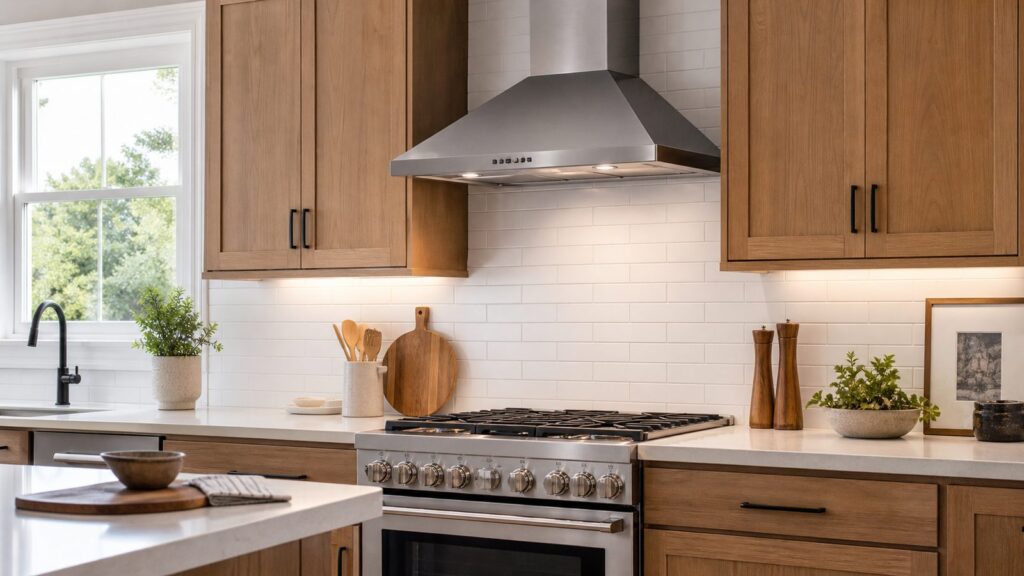
For most homeowners, the best 400 CFM range hood is a ducted under-cabinet unit. It fits below an existing wall cabinet, usually has front controls, LED lights, and removable mesh or baffle filters, and can often connect to an existing vertical or rear duct route.
Look for a model that matches the cooktop width, uses dishwasher-safe baffle filters, and has a duct outlet your kitchen can actually support. Many 400 CFM under-cabinet hoods use a 6-inch round duct, though some allow rectangular transitions. If your existing duct is smaller, do not assume a reducer is harmless. Reducing duct size increases static pressure, noise, and performance loss.
Best wall-mount 400 CFM hood
A wall-mount chimney hood is a good fit when the range sits on an open wall without cabinets above it. These hoods are visible design elements, so finish, proportions, and chimney height matter. A 30-inch wall hood can work over a 30-inch range, but a 36-inch hood gives better side-to-side capture if the layout allows it.
Wall hoods need solid blocking or secure fastening, not just drywall anchors. During rough-in, we verify stud locations, duct centerline, outlet location, mounting height, ceiling height, and whether the chimney cover needs an extension kit. Those details are easier to solve before backsplash tile and finished cabinets go in.
Best 400 CFM insert for a custom hood
For custom cabinetry, a hood insert is usually the correct product. The insert provides the blower, lights, controls, and filters, while the cabinetmaker or finish carpenter builds the surround. Do not install a basic under-cabinet hood inside a wood box unless the manufacturer allows that exact use.
A proper insert should be paired with a liner or noncombustible protection as required by the manufacturer. It also needs enough clearance for filter removal and future service. On our job sites, we coordinate the appliance spec with the cabinet drawings before the hood surround is built. A half-inch mistake in the opening can turn into a field modification nobody priced.
Best near-400 CFM option for island cooktops
Island cooking is harder to ventilate because there are no side cabinets or back wall to help contain the plume. Steam, grease, and smoke spread outward faster. The usual sizing guidance for island hoods is about 150 CFM per linear foot of cooktop, which means a 30-inch island cooktop may justify more than 400 CFM.
If the project needs to stay near 400 CFM because of code or budget, prioritize hood width and depth. A 36-inch island hood over a 30-inch cooktop is often a better choice than a flush 30-inch hood. Use back burners for high-smoke cooking when practical, and avoid mounting the hood higher than the manufacturer allows.
The Tool Desk
Outbyte Driver Updater FREEScan for outdated or missing drivers - takes under a minuteDriver Scan →Outbyte PC Repair FREERepair Windows errors before they cause bigger problemsFix Now →What to Look for Before You Buy
Most online range hood lists focus on price, stainless finish, star ratings, and maximum CFM. Those are not enough. In the field, the hood succeeds or fails because of fit, capture, ducting, sound, and serviceability.
Width and depth
The hood should be at least as wide as the cooking surface. For a 30-inch range, that means a 30-inch hood minimum. Where space allows, especially for island or high-heat cooking, a 36-inch hood gives better capture by adding about 3 inches of coverage on each side.
Depth matters too. Shallow hoods often miss the front burners. A deeper hood captures more of the rising plume before it spreads into the room. This is one reason a well-proportioned 400 CFM hood can outperform a higher-CFM model with poor front-to-back coverage.
Rank #2
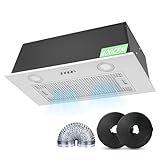
- Disappears Into Your Cabinetry — 24-inch insert range hood installs flush inside your custom cabinet. Only the stainless steel front panel and control buttons are visible for a seamless, built-in look.
- 400 CFM for Compact Cooktops — Perfect for small ranges, apartment stoves, and secondary kitchenettes. Two-speed fan handles daily cooking without excess noise.
- Low-Profile Design with LED Lighting — The slim profile leaves cabinet space for storage above. Built-in LEDs provide focused cooktop illumination.
- Easy-Access Aluminum Filters — Front-loading filters slide out for quick cleaning. Permanent mesh design means no replacement costs.
- Best for Custom Kitchen Builds and Renovations — Designed to integrate with your cabinetry. A favorite of contractors and DIYers who want ventilation without visible appliances.
Duct size and duct route
Plan the duct before buying the hood. A short, straight duct route to an exterior wall or roof is ideal. Every elbow adds resistance. Long horizontal runs, crushed flex duct, small wall caps, and awkward transitions all reduce performance.
Recommended Free Tools
For many 400 CFM hoods, a 6-inch round duct is common. Some models use rectangular outlets or allow adapters. The important point is to follow the manufacturer’s duct requirements. If the manual calls for 6-inch duct and the house has an old 3-1/4 by 10-inch duct with multiple elbows, confirm that the run is acceptable before installation day.
Noise ratings
Noise is one of the most underrated buying factors. Many 400 CFM hoods are loud at maximum speed, sometimes listed around 4 sones or higher. That does not automatically make them bad, but it does mean you should compare sound ratings at normal operating speeds, not only the boost setting.
A quieter hood gets used more. That matters for indoor air quality. Homeowners who hate the fan noise tend to turn the hood on late, run it on the lowest speed, or skip it altogether. In practical terms, a quiet 400 CFM hood is often better than a noisy 600 CFM hood that stays off.
Filters and cleaning
For ducted hoods, stainless baffle filters are usually preferable to thin mesh filters, especially for frequent cooking. They are durable, cleanable, and commonly dishwasher-safe. Mesh filters can work, but they clog faster and need more attention.
Do these 3 things before closing this tab:
1Scan for outdated or missing drivers - takes under a minute2Clear out junk files and repair common Windows errors3Fix the driver behind crashes, sound loss and screen glitchesDuctless hoods require charcoal filters in addition to grease filtration. Those charcoal filters are consumable parts. Depending on cooking frequency, homeowners may replace them every 3 to 6 months. If you cannot buy replacement filters easily, do not buy that hood.
Lighting and controls
LED lighting should illuminate the front and back burners, not just create a bright spot at the wall. Controls should be easy to reach and simple enough to use while cooking. Touch controls look clean, but physical buttons can be easier to operate with wet hands or when steam is rising from the range.
Ducted vs Ductless 400 CFM Range Hoods
If there is a feasible duct route, choose ducted. A ducted hood exhausts smoke, grease particles, steam, odors, heat, and gas combustion byproducts outdoors. That is the strongest recommendation for indoor air quality and moisture control.
A ductless or recirculating hood pulls air through a grease filter and charcoal filter, then sends it back into the kitchen. It can reduce grease and odor, but it does not remove moisture, heat, or combustion pollutants from the home. For electric or induction cooking in an apartment, ductless may be the only reasonable option. For a gas range in a remodel where exterior venting is possible, ducted is the better investment.
Windows Errors? Fix Them Before They Spread
Repair common Windows errors and clear accumulated junk for a smoother, more stable PC - no reinstall needed.Free scan · no reinstallOutdated Drivers Are Slowing You Down
One free scan finds every outdated or missing driver and matches the right update for your exact hardware.Free scan · exact hardware matchSome 400 CFM hoods are convertible, meaning they can be installed ducted or ductless with the right kit. That flexibility is useful, but do not let the word convertible hide the performance difference. A convertible hood installed ductless is still a recirculating appliance.
Real 2026 Costs for a 400 CFM Range Hood
For planning purposes, split the budget into the hood, the installation labor, the ductwork, finish repairs, and any code-driven mechanical work. The hood itself is only one line item.
| Cost item | Typical 2026 range | What affects the price |
|---|---|---|
| Budget 400 CFM hood | $220 to $300 | Basic under-cabinet or insert models, simpler controls, lighter materials |
| Mainstream 400 CFM hood | $300 to $700 | Better stainless, baffle filters, LED lighting, quieter fan options |
| Premium 400 CFM hood | $700 to $1,500+ | Designer finish, higher-end blower, custom insert, specialty controls, brand tier |
| Simple replacement installation | $300 to $850 | Existing duct and electrical are usable, minimal cabinet modification |
| New ducted installation | $650 to $2,500+ | New outlet, wall or roof penetration, duct route, drywall, paint, cabinet work |
| New ductwork adders | $100 to $400+ per linear foot in difficult conditions | Access, elbows, roof work, exterior finishes, soffits, masonry, patching |
A low-cost job is a same-size replacement where the old hood comes down, the new hood lines up with the existing duct, the electrical connection is legal and accessible, and the cabinet does not need cutting. That may be finished in 2 to 4 hours.
A higher-cost job includes new ductwork, a new exterior wall cap or roof cap, electrical relocation, cabinet modification, attic or crawlspace work, siding or stucco repair, drywall patching, and paint. That can become a 1 to 3 day project once trades and inspections are included.
The biggest cost swing is usually ductwork. A straight shot through an exterior wall is much simpler than a duct that has to climb through a cabinet, turn through a ceiling bay, cross an attic, penetrate the roof, and receive proper flashing. Roof penetrations also carry more risk if they are rushed. We prefer to coordinate roofing details carefully instead of treating the cap like an appliance accessory.
Permits, Code, and Makeup Air
Permit requirements vary by city and county, but kitchen exhaust work can touch mechanical, electrical, roofing, and building code. If a project involves new ducting, a new exterior penetration, electrical changes, or a hood over 400 CFM, it is worth checking with the local building department before rough-in.
The common threshold to understand is more than 400 CFM. Where IRC-based language applies, range hoods capable of exhausting more than 400 CFM may need makeup air at a rate approximately equal to the exhaust. A true 400 CFM hood may avoid that requirement in many jurisdictions, but local amendments can differ. Some inspectors also look closely at manufacturer specifications and blower settings, especially where a hood has boost modes.
Makeup air is about house pressure. A strong exhaust fan can pull air down chimneys, through water heater vents, or from garages, crawlspaces, and wall cavities. That can create combustion safety problems and comfort issues. If the home has atmospherically vented gas appliances, fireplaces, or a very tight building envelope, mechanical coordination matters even more.
What’s actually slowing this PC down?
Pick the symptom - the matching free tool is one click away.
Do not vent a range hood into an attic, wall cavity, crawlspace, garage, or soffit cavity. Kitchen exhaust should terminate outdoors through an approved wall or roof cap with a backdraft damper. The duct should be metal, properly sized, and routed as directly as practical.
Rank #3

- EFFICIENT AIRFLOW: 380 CFM with 3 fan speeds and push button controls, this Cosmo under cabinet range hood traps grease and cooking odors. Noise level as low as 45 dB on lowest fan speed with rigid ducting (sold separately) under optimal conditions; range hood comes with flexible ducting for convenient installation
- EASY-TO-CLEAN FILTERS: Cosmo ARC-FLOW Permanent Filters are dishwasher-safe and extremely durable. No need to replace these filters, simply drop in the dishwasher for easy maintenance and cost savings
- MODERN DESIGN: Modern styling to fit a variety of kitchen decors. Made of premium 430 grade, 26-Gauge thickness, easy-to-clean brushed stainless steel
- ENERGY-SAVING LIGHTS: The energy-efficient 1.5-Watt LEDs are long-lasting and provide bright high lumen lighting for better visibility at night
- 2-YEAR LIMITED: Our customer support team is based proudly in the USA. Product Dimensions: 27.8" (W) x 11.5" (D) x 11.4" (H). Electrical Requirements: 120V/60Hz, 3 Prong Plug. Duct Size: 5.9" Round. ETL Listed: ETL Listed products demonstrate compliance to North American safety standards published by relevant NRTLs (Nationally Recognized Testing Laboratories)
When to DIY vs When to Hire a Pro
A homeowner with basic tools can sometimes replace a like-for-like under-cabinet hood. The reasonable DIY scenario is narrow: same width, same duct location, same electrical setup, accessible shutoff, no cabinet cutting beyond minor trim, and no new exterior penetration.
Even then, the work needs care. The hood must be mounted securely, the electrical connection must follow code, the duct joints should be properly sealed, and the damper must open freely. A bad installation can leave you with a loud fan, weak airflow, rattles, air leaks, or grease collecting where it should not.
Hire a pro when the project includes new ductwork, roof or wall cutting, electrical relocation, cabinet modification, tile or backsplash conflicts, custom hood surrounds, island hoods, makeup air, or gas appliance safety questions. Those are not just appliance issues. They involve building envelope, fire safety, moisture control, and inspection risk.
For a remodel, the best time to solve ventilation is before cabinets are ordered and before walls are closed. We like to verify the range centerline, hood width, cabinet layout, duct route, framing conflicts, outlet location, exterior termination, and finish repair scope while changes are still inexpensive.
Our Practical Shortlist Criteria
If we were helping a homeowner shortlist 400 CFM hoods for a typical 30-inch kitchen remodel, we would start with these criteria:
- Ducted exterior venting whenever the home allows it.
- 30-inch minimum width for a 30-inch range, with 36 inches preferred where extra capture is useful and the design allows it.
- 6-inch duct compatibility or another manufacturer-approved duct size that works with the planned route.
- Dishwasher-safe baffle filters for easier maintenance.
- Quiet normal-speed operation, not just an impressive maximum CFM number.
- LED lighting that covers the full cooking surface.
- Serviceable parts, including filters, lights, control boards, and blower components.
- Clear installation manual with mounting height, duct limits, and electrical requirements.
For budget projects, a $220 to $300 under-cabinet hood can be acceptable if it vents outdoors, fits the duct, and has filters the homeowner can clean easily. For most remodels, the better value is usually in the $300 to $700 range. That price band tends to offer better materials, better lighting, and more usable fan speeds without jumping into luxury pricing.
Premium 400 CFM hoods can make sense when the kitchen design calls for a specific finish, a custom insert, quieter operation, or better long-term parts support. Just make sure the premium dollars are buying performance and build quality, not only a nameplate.
How to Use a 400 CFM Hood So It Actually Works
Good installation is only half the result. Homeowners also need to use the hood correctly. Start the fan before the pan gets hot. Use the back burners for high-smoke cooking when practical, because many hood designs capture better from the rear burners. Leave the fan running 10 to 20 minutes after cooking to clear lingering moisture, odors, and pollutants.
Clean grease filters routinely. For frequent cooking, monthly cleaning is a reasonable habit. Heavy frying or wok cooking may require more frequent cleaning. Dirty filters reduce airflow, increase noise, and become a fire concern over time.
Use the right speed. Low speed may be fine for simmering water. Searing, frying, blackening, and high-output gas burners usually need medium or high speed. If the hood is too loud to use at those speeds, that is a buying problem, not just a lifestyle issue.
Final Recommendation
For most standard U.S. kitchen remodels, the best 400 CFM range hood is a ducted, properly sized model matched to the actual duct path. For a 30-inch range under cabinets, choose a 30-inch or 36-inch under-cabinet hood with baffle filters, LED lights, quiet normal speeds, and a manufacturer-approved 6-inch duct route. For open-wall designs, use a wall-mount chimney hood. For custom cabinetry, use a real insert and liner. For island cooking, prioritize width and capture area because 400 CFM has to work harder in open air.
What’s actually slowing this PC down?
Pick the symptom - the matching free tool is one click away.
The biggest mistake is buying the hood before planning the installation. A 400 CFM label on the box does not overcome bad ductwork, poor mounting height, shallow coverage, or code surprises. Plan the route, confirm the clearances, check local requirements, and choose the quietest hood that fits the job. That is how a 400 CFM range hood becomes a useful ventilation upgrade instead of another noisy appliance nobody wants to turn on.
Frequently Asked Questions
Is 400 CFM enough for a gas range?
Yes, for many standard residential gas ranges. A common sizing rule is 1 CFM per 100 BTU, so a 40,000 BTU total burner output points to about 400 CFM. Heavy wok cooking, frequent searing, oversized ranges, or island layouts may need more capture area or higher airflow, subject to code and makeup-air requirements.
Does a 400 CFM range hood require makeup air?
Often no, because many IRC-based requirements apply to hoods capable of exhausting more than 400 CFM. However, local codes and inspector interpretations vary, so confirm before buying, especially if the hood has a boost mode above 400 CFM.
How much does it cost to install a 400 CFM range hood?
A simple replacement commonly runs about $300 to $850 for labor. A new ducted installation with electrical, ductwork, wall or roof penetration, and finish repairs commonly ranges from $650 to $2,500 or more.
Is ductless okay for a 400 CFM range hood?
Ductless is acceptable only when exterior venting is not feasible. It can reduce grease and odors with filters, but it does not remove moisture, heat, or gas combustion pollutants outdoors. A ducted hood is the better choice whenever the home allows it.
What size duct does a 400 CFM hood need?
Many 400 CFM hoods use a 6-inch round duct, though requirements vary by model. Follow the manufacturer’s installation manual. Reducing duct size or adding too many elbows can make the hood louder and reduce real airflow.
Should the hood be wider than the range?
At minimum, the hood should be as wide as the cooking surface. For island cooktops or high-heat cooking, oversizing by about 3 inches per side, such as a 36-inch hood over a 30-inch range, improves capture.
Quick Recap
Product prices and availability are accurate as of the date/time indicated and are subject to change. Any price and availability information displayed on Amazon at the time of purchase will apply.
Free tools Windows power users keep installed
One-click scans. No signup required.

