Quick wins for a faster PC:
Repair Windows errors before they cause bigger problemsFix Now →Fix the driver behind crashes, sound loss and screen glitchesFind Drivers →Clear out junk files and repair common Windows errorsFree Scan →Some links on this page are affiliate links: if you buy through them we may earn a commission, at no extra cost to you.
A good smart dishwasher should not be judged by the app first. It should be judged by how well it fits the kitchen, how quietly it runs, how reliably it dries, how much water and power it uses, and how easily it can be serviced five years from now.
For most homeowners in 2026, the best smart dishwasher is a 24-inch ENERGY STAR model with a stainless tub, third rack, leak alerts, solid drying performance, and noise around 44 dBA or lower if the kitchen is open to living space. Wi-Fi is useful when it gives you remote status, maintenance alerts, diagnostic codes, leak notifications, delayed start, energy reporting, and reminders. Wi-Fi does not magically make dishes cleaner.
| # | Preview | Product | Price | |
|---|---|---|---|---|
| 1 |

|
Kenmore Elite 24" Built-In Dishwasher - FPR Stainless Steel | 42 DBA - TotalFlex 3rd Rack, UltraWash... | $1,201.93 | Buy on Amazon |
As an Amazon Associate I earn from qualifying purchases.
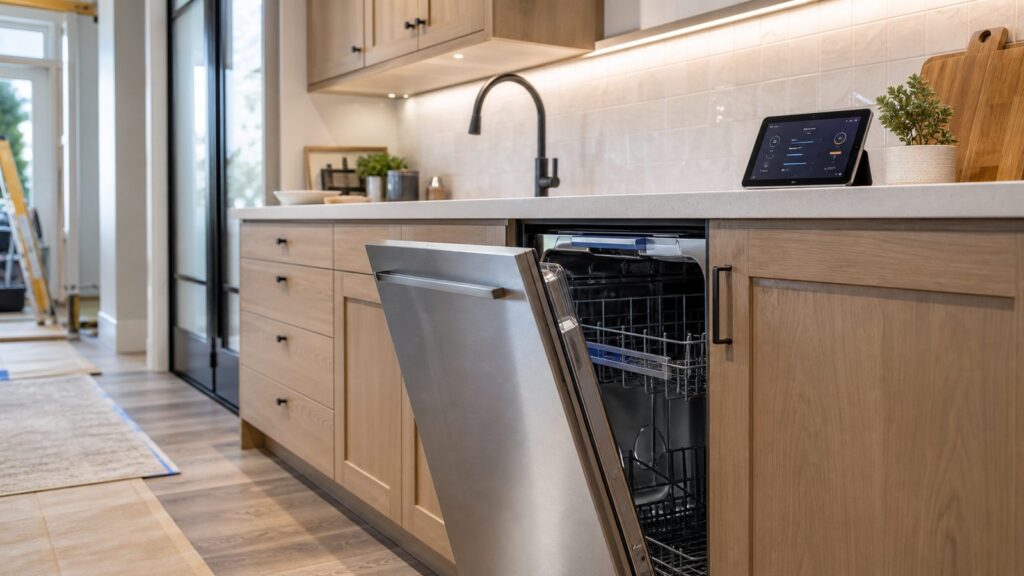
On our kitchen remodels, we treat the dishwasher as part appliance and part infrastructure. Before a homeowner falls in love with a model, we confirm the cabinet opening, finished flooring height, drain route, shutoff access, electrical protection, countertop details, and Wi-Fi signal. That is where smart dishwasher projects either go smoothly or turn into change orders.
What Makes a Smart Dishwasher Worth Buying?
A smart dishwasher is a connected dishwasher, usually Wi-Fi enabled, that communicates with a phone app or smart home platform. Common features include remote cycle status, app-based cycle recommendations, maintenance reminders, diagnostic fault codes, leak detection alerts, voice assistant compatibility, detergent tracking, downloadable specialty cycles, and energy or water-use reporting.
Popular on Amazon
- UltraWash Plus Power Cleaning: 3 pressurized spray arms clean dishes from every angle using fresh, filtered water. Accela Wash option cleans dishes if you're in a hurry. Sani Rinse option gets dishes seriously clean
- SmartWash Adjusts to the Mess: Sensor technology detects soil levels and automatically adjusts the water temperature, pressure, and cycle time. A dishwasher that gives the best clean for every load
- TurboFlex Third Rack + Adjustable Interior: Get 35% more loading space for large utensils with the removable TurboFlex third rack. Need more height? Slide the trays aside to fit tall items in the middle rack. MoreSpace Plus Upper Rack adjusts to 3 heights
- TurboDry for Dry Dishes: A built-in fan pulls moisture and warm air out of the dishwasher while a heating element boosts drying power. Even plastics come out dry and spot-free. Ditch the dish towel
- Whisper-Quiet Wash + Smart Features: This elite dishwasher runs at just 42 dBA with a QuietWash option for a whisper quiet cycle. LED floor light tells you when it's running. Hidden touch controls and a sleek bar handle offer a streamlined look
The useful features are the ones that prevent inconvenience or damage. A leak alert at 2 a.m. matters. A diagnostic code that helps a technician bring the right part matters. A delayed start that runs the dishwasher after peak-rate utility hours can matter. A voice command to start a cycle is nice, but it is not usually the reason to spend more.
For a straightforward replacement, smart dishwashers commonly land around $700 to $1,500 for the appliance. Luxury smart, ultra-quiet, or panel-ready models can run $1,500 to $2,500 or more. Basic non-smart built-ins can still start around $300 to $500, and mainstream ENERGY STAR units often sit around $500 to $1,000.
PC Slower Than It Used to Be?
A free scan shows the junk files, broken settings and background clutter dragging Windows down - then fixes them in one click.Free scan · Windows 10 & 11Outdated Drivers Are Slowing You Down
One free scan finds every outdated or missing driver and matches the right update for your exact hardware.Free scan · exact hardware matchThe smart premium usually buys more than connectivity. It often comes bundled with lower sound ratings, better racks, stainless-steel tubs, advanced drying, stronger leak protection, better filtration, water softening on some models, and cleaner integration with premium cabinetry.
The Best Smart Dishwasher Depends on the Kitchen
Most ranking lists focus on brands. That is useful to a point, but the better starting point is the room itself. A dishwasher that is excellent in a closed galley kitchen may be irritating in an open-plan kitchen. A beautiful panel-ready unit may be the wrong call in a rental or ADU where parts availability and service cost matter more than a hidden front.
Best for Open-Concept Kitchens
Prioritize sound. Premium smart dishwashers commonly advertise roughly 38 to 46 dBA, while budget units are often closer to 50 to 55 dBA. That difference is not subtle when the dishwasher is 12 feet from a sofa or dining table.
For an open kitchen, we like to target 44 dBA or lower when the budget allows. Below about 40 dBA, many homeowners need an indicator light or floor projection because the unit is hard to hear. That is a good problem, but it affects day-to-day use.
What’s actually slowing this PC down?
Pick the symptom - the matching free tool is one click away.
Best for Family Kitchens
Rack flexibility and drying matter more than app novelty. Look for a usable third rack, adjustable middle rack, fold-down tines, bottle jets or specialty zones if your household needs them, and a drying system that performs well with plastics. Families often run five to seven loads per week, so small frustrations compound quickly.
Best for Hard-Water Areas
Hard water can make a great dishwasher look bad. Cloudy glass, mineral buildup, poor detergent performance, and white film are often water issues, not appliance defects. In hard-water regions, a model with a built-in water softener can be worth the upgrade. At minimum, plan on rinse aid, correct detergent dosing, regular filter cleaning, and possibly whole-house or point-of-use water treatment.
Best for Luxury Remodels
Panel-ready smart dishwashers can make a custom kitchen look cleaner, especially when the appliance wall is visible from living space. They also add coordination risk. The cabinet shop needs the manufacturer’s panel dimensions, weight limits, handle location guidance, and spring adjustment requirements before building the front. Guessing here leads to doors that fall open, will not stay down, or rub adjacent panels.
Best for Rentals, ADUs, and Practical Replacements
Choose reliability, service network, leak protection, and parts availability over exotic smart features. In a rental or ADU, the best dishwasher is usually a durable stainless-tub ENERGY STAR model with basic app alerts and a common 24-inch footprint. Avoid rare sizes or overly specialized imports unless you are prepared for longer repair timelines.
2026 Smart Dishwasher Cost Breakdown
The installed cost depends heavily on whether the home already has a proper opening, shutoff, drain, and code-compliant electrical connection. A basic swap is very different from adding a dishwasher to a new island or moving it across the kitchen.
| Project Type | Typical 2026 Cost | What It Usually Includes |
|---|---|---|
| Basic non-smart dishwasher | $300-$500 appliance only | Entry-level built-in unit, usually louder, fewer rack and drying features |
| Mainstream ENERGY STAR dishwasher | $500-$1,000 appliance only | Better efficiency, improved racks, often stainless interior options |
| Smart/quiet stainless-tub dishwasher | $700-$1,500 appliance only | Wi-Fi, app alerts, quieter operation, third rack, better drying |
| Luxury smart or panel-ready dishwasher | $1,500-$2,500+ appliance only | Ultra-quiet operation, hidden controls, custom panel option, premium drying and leak features |
| Straight replacement labor | About $150-$300 labor | Existing opening, working shutoff, usable drain, compliant power |
| Full replacement average | About $540-$2,175 installed | Appliance, labor, basic parts, haul-away depending on scope |
| Broader installed range | About $904-$1,678 per dishwasher | Project conditions, local labor, materials, disposal, and access variables |
For a simple replacement, many homeowners see dishwasher installation labor around $144 to $264, with straightforward jobs often near $194. That number can be realistic when the old dishwasher slides out cleanly and the new one goes into the same 24-inch opening with no plumbing, wiring, flooring, or cabinet surprises.
Costs rise quickly when the project needs a new dedicated electrical circuit, GFCI protection, plumbing tie-in, drain reroute, air gap, countertop drilling, cabinet modification, floor repair, permit, or inspection. Common add-ons include $50 to $150 for haul-away or disposal, $20 to $60 for a supply and drain kit, $10 to $40 for an air gap before labor, and $150 to $600 or more for a custom cabinet panel on a panel-ready unit.
Key Features to Prioritize
ENERGY STAR Efficiency
ENERGY STAR criteria for standard dishwashers list limits of no more than 240 kWh per year and 3.2 gallons per cycle. Compact models have separate limits. ENERGY STAR also states that certified dishwashers use less than half the energy of handwashing and can save about 8,400 gallons of water per year compared with handwashing.
Do these 3 things before closing this tab:
1Clear out junk files and repair common Windows errors2Scan for outdated or missing drivers - takes under a minute3Repair Windows errors before they cause bigger problemsThose are strong numbers, but homeowners should still read the yellow EnergyGuide label. Real operating cost changes with local utility rates, water-heater type, cycle selection, soil level, and how often the machine runs. A family running seven full loads per week will see a different operating pattern than a couple running two.
Leak Detection and Shutoff Alerts
Leak protection is one of the strongest arguments for a smart dishwasher. A slow leak under a dishwasher can damage subfloor, finished flooring, cabinets, baseboards, and ceilings below. In risk-sensitive locations, we often recommend a smart leak detector under or near the unit, a quality braided supply line, an accessible shutoff, and a documented maintenance routine.
Drying Performance
Drying matters as much as washing. Stainless tubs help retain heat. Some models use condensation drying, some use fans, some use door-opening systems, and premium units may use mineral-assisted drying or advanced heat-exchange designs. If you wash a lot of plastic containers, read drying reviews carefully because plastic holds less heat than glass or ceramic.
Noise Rating
For closed kitchens, 48 to 50 dBA may be acceptable. For open-concept homes, target 44 dBA or below when the budget allows. Ultra-quiet units around 38 to 40 dBA can be excellent, but homeowners should expect a visual cycle indicator because the appliance may be nearly silent in normal use.
Rack Layout
Do not buy a dishwasher without loading it in person if possible. Bring a dinner plate measurement, a tall glass, a favorite pan, and a water bottle. Third racks are useful when they fit your utensils and lids, but not all third racks are designed equally. Adjustable racks and fold-down tines are more valuable than a long list of cycle names.
App Diagnostics and Maintenance Alerts
Smart diagnostics can reduce guesswork. A good app can report fault codes, remind you to clean the filter, flag water supply problems, show cycle status, and help service technicians troubleshoot faster. That can be more valuable over ten years than remote start.
Fit, Dimensions, and Cabinet Planning
Most built-in residential dishwashers are 24 inches wide. Compact and ADA models are common in small kitchens, accessory dwelling units, basement apartments, wet bars, and accessibility-focused remodels. Width is only the first measurement.
Before ordering, confirm the finished opening width, height, and depth. Check the flooring condition too. A common remodel problem is old flooring trapped under the existing dishwasher or new flooring installed up to the front legs, effectively locking the appliance in place. If the finished floor height changes, a dishwasher that fit yesterday may not slide out tomorrow.
We also check door swing clearance, handle projection, adjacent drawer pulls, island spacing, and whether the dishwasher door blocks a walkway when open. In tight kitchens, 2 inches can decide whether the layout feels practical.
Panel-ready models need extra coordination. The cabinet front is not just decorative; its size and weight affect the door springs and hinges. The appliance manufacturer’s panel weight limit should be in the cabinet shop’s hands before fabrication. The handle should also be selected early because a heavy appliance pull can change the balance of the door.
Electrical, Plumbing, and Code Notes
Dishwasher installation is not just sliding a box into a hole. Depending on the jurisdiction, the project may involve electrical code, plumbing code, permit rules, and manufacturer requirements. Local rules vary, so a homeowner should verify requirements with the local building department or licensed tradesperson before work begins.
Electrical Requirements
Many modern dishwasher installations require GFCI protection, and some kitchen circuits may also involve AFCI requirements depending on the adopted electrical code and local amendments. A dedicated circuit is often recommended and may be required by the appliance instructions or local code. Hardwired and cord-and-plug installations both need to follow the manufacturer’s instructions.
The Tool Desk
Outbyte PC Repair FREEClear out junk files and repair common Windows errorsFree Scan →Outbyte Driver Updater FREEScan for outdated or missing drivers - takes under a minuteDriver Scan →On our job sites, we want the power connection accessible for service and we want the breaker, receptacle, or disconnect clearly understood before cabinets and countertops are finalized. Old homes can add cost if wiring is outdated, ungrounded, overloaded, or difficult to access.
Drain Routing, Air Gap, and High Loop
Dishwasher drains need protection against backflow. Some jurisdictions require an air gap mounted at the sink or countertop. Others permit a high loop under the sink when installed correctly. This is not a preference decision; it is a local code decision.
If an air gap is required, plan the countertop or sink deck hole before templating stone or solid-surface counters. Drilling a finished countertop later can be expensive, risky, or impossible depending on material and layout.
Water Supply and Shutoff Access
The dishwasher should have a reliable shutoff valve that can be reached without dismantling the kitchen. Supply lines should be in good condition and compatible with the appliance. We generally replace questionable old supply lines during a dishwasher swap because the labor is already open and the risk of reuse is not worth saving a small amount.
Free tools Windows power users keep installed
One-click scans. No signup required.
When to DIY vs. When to Hire a Pro
A capable homeowner can sometimes handle a like-for-like dishwasher replacement. That means the opening is already correct, the shutoff works, the drain route is compliant, the electrical connection is already code-compliant, the floor is level, and the old unit can be removed without damaging cabinets or flooring.
DIY is more reasonable when the job is a basic 24-inch replacement, the appliance uses the same connection type, the drain hose route is already correct, no countertop drilling is required, and the homeowner is comfortable shutting off water and power, checking for leaks, leveling the unit, anchoring it properly, and testing all cycles.
Hire a pro when the dishwasher is moving locations, the kitchen is being remodeled, the unit is panel-ready, the home has old wiring, the shutoff valve is frozen, the floor height has changed, the drain route needs an air gap, the countertop needs drilling, the dishwasher is going into an island, or the appliance instructions call for work outside your comfort level.
For a remodel, the dishwasher should be specified before cabinets are finalized. That lets the builder coordinate the opening, toe kick, panel, countertop, electrical box, water line, drain path, and service access before finish materials are locked in.
Smart Home and Wi-Fi Considerations
Dishwashers often sit inside a metal-lined appliance cavity, under stone countertops, near plumbing, and behind cabinet faces. That is not always friendly to Wi-Fi. Before relying on app alerts, test signal strength in the kitchen, especially if the router is on another floor or at the far end of the house.
If the kitchen has weak signal, solve that with a mesh node or better router placement before assuming the appliance is defective. A smart dishwasher with spotty Wi-Fi can miss the very alerts that made the feature attractive.
Also consider account ownership. Keep the model number, app login, warranty registration, installation manual, and service documents accessible. For rental properties or future resale, transferability matters. An appliance tied to a forgotten email account creates avoidable service friction.
Brand Shortlist Without the Brand Blindness
Current top-reviewed dishwasher lists often favor Bosch 500 and 800 Series models, Miele smart dishwashers, KitchenAid premium models, Samsung smart and quiet models, LG smart dishwashers, and GE Profile. Those brands are worth comparing, but the best choice still depends on the kitchen.
Recommended Free Tools
Bosch is often considered for quiet operation and rack engineering. Miele is often considered for premium build quality and advanced wash systems. KitchenAid tends to appeal to homeowners who want strong racks and drying in a familiar US kitchen package. Samsung and LG often compete well on smart features and value. GE Profile can be a practical fit where service access and mainstream appliance support matter.
The right question is not simply, “Which brand is best?” The better question is, “Which model solves this kitchen’s constraints at a cost that makes sense?” In an open-plan kitchen, noise may decide. In a hard-water area, water treatment may decide. In a custom kitchen, panel compatibility may decide. In an ADU, serviceability may decide.
Our Practical Buying Checklist
Before purchasing, confirm these items:
- Opening size, including finished floor height and countertop clearance
- Standard 24-inch, compact, ADA, drawer, or panel-ready format
- Noise target, preferably 44 dBA or lower for open kitchens
- ENERGY STAR certification and EnergyGuide operating estimate
- Drying system performance, especially for plastics
- Rack layout with your actual dishes and cookware
- Leak detection, leak alert, or shutoff features
- Drain requirement: air gap or approved high loop
- Electrical requirement: GFCI, AFCI, dedicated circuit, cord, or hardwire
- Accessible water shutoff and quality supply line
- Wi-Fi strength at the appliance location
- Local service availability and warranty support
- Model number, manual, app account, and warranty registration storage
If the dishwasher is part of a larger kitchen remodel, make the selection before cabinet shop drawings are approved. That single step prevents many of the common fit and finish problems.
Bottom Line: The Best Smart Dishwasher Is the One That Fits the Build
A smart dishwasher can be a very good investment in 2026, especially if you value quiet operation, leak alerts, diagnostics, flexible loading, efficient water use, and better drying. The best models are not just connected appliances; they are well-integrated kitchen components.
Budget about $700 to $1,500 for a strong smart stainless-tub model, more for luxury or panel-ready designs, and less if you are choosing a basic non-smart replacement. For installation, a simple swap may add about $150 to $300 in labor, while full replacement projects commonly land around $540 to $2,175 depending on the appliance, labor, parts, disposal, and site conditions.
From a builder’s perspective, the winning move is simple: choose the dishwasher early, verify the opening and utilities, respect local electrical and plumbing requirements, and prioritize the features that protect the home and improve daily use. Smart features are worthwhile when they support that goal. They are not a substitute for a properly planned installation.
Frequently Asked Questions
Are smart dishwashers worth it in 2026?
Yes, if the smart features are practical: leak alerts, cycle status, diagnostics, maintenance reminders, delayed start, and energy reporting. Wi-Fi alone does not improve cleaning, so do not pay extra only for voice control or app novelty.
How much does a smart dishwasher cost installed?
A good smart dishwasher commonly costs $700 to $1,500 for the appliance, with luxury or panel-ready models often $1,500 to $2,500 or more. A simple replacement may add about $150 to $300 in labor, while full installed replacement projects often range from about $540 to $2,175 depending on site conditions.
Windows Errors? Fix Them Before They Spread
Repair common Windows errors and clear accumulated junk for a smoother, more stable PC - no reinstall needed.Free scan · no reinstallOutdated Drivers Are Slowing You Down
One free scan finds every outdated or missing driver and matches the right update for your exact hardware.Free scan · exact hardware matchDo smart dishwashers clean better than regular dishwashers?
Not because they are smart. Cleaning performance comes from the wash system, filtration, spray arm design, detergent use, water temperature, soil sensors, and rack layout. Smart features mainly help with alerts, diagnostics, scheduling, and maintenance.
What is a good noise rating for a smart dishwasher?
For an open-concept kitchen, look for 44 dBA or lower when the budget allows. Premium smart models commonly advertise about 38 to 46 dBA, while budget models are often closer to 50 to 55 dBA.
Does a dishwasher need GFCI protection or a dedicated circuit?
Many modern installations require GFCI protection, and a dedicated circuit is often recommended or required by the appliance instructions or local code. Requirements vary by jurisdiction, so confirm with the local building department or a licensed electrician.
Is a dishwasher air gap required?
It depends on local plumbing code. Some jurisdictions require a countertop or sink-mounted air gap, while others allow a properly installed high loop. Confirm this before countertop templating, because adding an air gap later may require drilling finished material.
Do these 3 things before closing this tab:
1Repair Windows errors before they cause bigger problems2Fix the driver behind crashes, sound loss and screen glitches3Clear out junk files and repair common Windows errorsQuick Recap
Product prices and availability are accurate as of the date/time indicated and are subject to change. Any price and availability information displayed on Amazon at the time of purchase will apply.

