Some links on this page are affiliate links: if you buy through them we may earn a commission, at no extra cost to you.
Do not connect space heaters, air conditioners, refrigerators, microwaves, cooking appliances, hair dryers, washing machines, dryers, or other high-wattage and motor-driven appliances to an extension cord, power strip, surge protector, or multi-outlet adapter. Plug them directly into a properly grounded wall receptacle—often on a dedicated circuit—unless the appliance’s own manual expressly permits a specific, correctly rated cord.
This is U.S.-focused guidance for typical 120-volt household electrical systems. The appliance manual, its nameplate, local code, and the condition of the outlet always control.
As an Amazon Associate I earn from qualifying purchases.
Quick reference: what should plug directly into the wall?
| Device | Extension cord | Power strip or surge protector | Preferred setup |
|---|---|---|---|
| Space heater | No | No | Direct wall receptacle |
| Portable or window air conditioner | Usually no | No | Grounded outlet; often a dedicated circuit |
| Refrigerator or freezer | Preferably no; exceptions are model-specific | No | Individual grounded outlet |
| Microwave | Preferably no; follow the manual | No | Dedicated grounded outlet where specified |
| Toaster or toaster oven | No | No | Direct wall receptacle |
| Coffee maker, slow cooker, or electric skillet | No | No | Direct wall receptacle |
| Hair dryer or curling iron | No | No | Wall receptacle, preferably GFCI-protected in a bathroom |
| Washing machine | Usually no | No | Direct grounded wall receptacle |
| Electric dryer, range, or oven | No | No | Code-compliant dedicated circuit and correct receptacle |
| Computer, monitor, TV, charger, or router | Generally suitable if properly rated | Generally suitable if properly rated | Listed, undamaged strip or surge protector |
The U.S. Fire Administration gives broad consumer guidance not to use extension cords with major appliances. Individual manufacturers can permit narrow exceptions for particular models, so a generic list cannot replace the installation instructions.
Why extension cords and power strips can overheat
High current creates heat
Heating appliances can draw a large portion of the capacity of a household circuit. A space heater, toaster, microwave, or hair dryer may place a heavy load on the conductors and connections. A long, undersized, damaged, or poorly connected cord can become hot even when the total load has not immediately tripped the breaker.
Popular on Amazon

- 【4+4 Outlets Power Strip with 4 USB Ports】- The 3-side power strip with 8AC widely outlets and 4 USB charging ports, each USB A port features 5V/2.4A Max output. USB C charging port features 5V/3A MAX. can power up to 12 devices simultaneously.
- 【Surge Protector Power Strip with 3 Side Design & Wide Space】- 3-side design that makes it easier to make the plugs not covering any outlet, and the 8 AC outlets with 1.8 inches long space in between, larger than standard 1.5-inch socket. Larger spacing makes it easier to use for all kinds of equipment. The compact design saves more space, suitable for the home, office, and college dorm room.
- 【Multi Safety Protection】- ETL Certificates. This power strip has overload protection, short-circuit protection, over current protection, over-voltage protection and overheating protection. The surge protector with overload protection protects your electrical appliances from lighting, surges or spikes. The minimum energy-absorbing capacity of 900 Joules. It will automatically cut power to protect connected devices when voltage surge is overwhelming.
- 【6 Ft extension cord with Flat Plug】- The 45° flat plug design prevents the bottom plug from clogging and allows for easy installation in tight spaces; the 6-foot power cord allows for flexibility, and two mounting holes on the back allow for secure installation of this power outlet in a variety of applications.
- 【 Our After Sale Service 】- ETL Certificates. Our friendly and reliable customer service will respond to you within 24 hours. You can purchase with confidence, with our 30-day return and 12-month warranty.
Heat can develop at an undersized conductor, loose plug, worn receptacle, damaged insulation, poor strain relief, or a connection hidden under a rug, bed, or piece of furniture. The Consumer Product Safety Commission explains that defects such as inadequate wire size and poor strain relief can create shock and fire hazards.
A breaker does not eliminate every hot spot
A circuit breaker protects branch-circuit wiring from excessive current, but a bad connection can produce localized heating without immediately exceeding the breaker’s trip threshold. Daisy-chained cords and strips add more connection points where resistance and heat can build up. Never treat a breaker as proof that every cord, plug, and receptacle is safe.
Motors can draw more current at startup
Refrigerators, freezers, air conditioners, pumps, compressors, and workshop equipment have motors that may draw substantially more current when starting. A connection that appears adequate during normal operation may overheat, cause a voltage drop, or trip during startup and repeated cycling.
More outlets do not mean more capacity
A six-outlet or twelve-outlet strip may still be limited to the same total current as a typical household receptacle. One heater, toaster, microwave, or hair dryer can consume much of that capacity by itself. Count the combined load—not the number of available sockets.
Devices that should generally connect directly to a wall receptacle
Space heaters
Never use a portable space heater with an extension cord, power strip, or surge protector. Space heaters are high-wattage heating devices that may run continuously. The Electrical Safety Foundation International advises plugging them directly into a wall receptacle and not sharing that receptacle with another high-load appliance.
Stop using the heater if the plug or receptacle becomes hot. Do not use a loose or damaged outlet, and follow the heater’s required clearance from curtains, bedding, furniture, and other combustibles. See the ESFI heater and extension-cord guidance.
Recommended Free Tools
Also popular on Amazon

- All the Power You Need: Features 12 AC outlets, 1 USB-C port, and 2 USB-A ports to power appliances, mobile devices, and more. Total USB output is shared across all USB ports, with a maximum output of 15W.
- Fast Charge Your iPhone: Use the 20W USB-C port to give your iPhone 15 a high-speed charge from 0-50% in just 26 minutes.
- 8-Point Safety System: Combines surge protection, fire resistance, overload protection, temperature control, and more to protect you and your devices.
- Optimized Layout: Features extra space between outlets to accommodate bulky plugs. The 5 ft cord is ideal for desks (4 - 5 ft wide), bedside tables, and sofa side tables.
- What You Get: Anker 351 Power Strip, 2 mounting screws, welcome guide, our worry-free 18-month warranty, lifetime* $200,000 connected equipment warranty, and friendly customer service.
Portable and window air conditioners
Connect a portable or window air conditioner directly to a properly grounded wall outlet. Many models require or strongly recommend a dedicated circuit, and manufacturers such as GE and Haier warn against extension cords, surge protectors, and multi-outlet adapters.
Some older manuals allow a narrowly specified heavy-duty cord for certain 115-volt models. That is not a general exception: use it only when the exact model’s manual permits it and specifies the required rating and configuration.
Refrigerators and freezers
The safest default is an individual grounded wall receptacle, preferably on a circuit suitable for the appliance. Whirlpool says not to use an extension cord with its refrigerators. GE strongly recommends against one but describes a limited exception involving a listed, three-wire grounding appliance cord rated for at least the appliance’s requirements. Haier describes a separate narrow exception for certain compact refrigerators.
Those differences show why the model manual matters. Do not assume that an exception for one refrigerator applies to another. Consult the appliance instructions and the manufacturer’s guidance from GE, Whirlpool, or Haier.
Outdated Drivers Are Slowing You Down
One free scan finds every outdated or missing driver and matches the right update for your exact hardware.Free scan · exact hardware matchPC Slower Than It Used to Be?
A free scan shows the junk files, broken settings and background clutter dragging Windows down - then fixes them in one click.Free scan · Windows 10 & 11Microwaves
Do not use a power strip or surge protector with a microwave. Direct connection to a properly grounded outlet is preferred, and the manufacturer may specify a dedicated outlet. GE strongly advises against extension cords but describes a limited exception requiring a three-wire grounding-type appliance cord, appropriate listing, and a rating at least equal to the microwave’s electrical rating. Follow the exact microwave manual.
Toasters and toaster ovens
These heating appliances can draw hundreds to more than 1,000 watts. Plug them directly into a wall receptacle rather than a power strip or lightweight extension cord. Do not run a toaster oven through a strip simply because the strip has a circuit breaker.
Also popular on Amazon
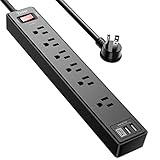
- Power Strip with 6 Outlets & 3USB Ports: 6 AC Surge protector outlets(1680 Joules) including 1 Widely Spaced Outlet, 2 USB A Ports & 1 USB C Port, 6 feet power cord, Surge protector indicator and 10A Overload Protector switch protects against spikes and fluctuations.
- Smart Charging USB Ports: Build in smart charging technology, Each USB A port features 2.4A Max output. USB C charging port features 3A MAX, 3 USB ports can charge almost any USB device (smart phone, tablet, fire stick, e-reader, blue tooth headphones, portable speaker etc).
- Surge Protector outlet: The 6 AC outlets provide surge protector against electrical spikes. with response speed less than 1Ns, and minimum energy-absorbing capacity of 1680 Joules, its response time is much shorter than the single MOV surge protector circuit, It truly provides great protection of your precious plugged-in devices.
- 6 Feet Flat Plug Power cord with Cable Ties: 6 Ft Extension Cord makes it more flexible, Reusable Fastening Cable Ties Can tie up the unused cord and make it better organized. the Mounting hole at the back allows this wall mount power strip to be securely installed in various applications, such as wall mounts, floor mounts, workbenches, under counters & more.
- Our After Sale Service: Our friendly and reliable customer service will respond to you within 24 hours. You can purchase with confidence, with our 30-day return and 12-month warranty.
Coffee makers, slow cookers, and electric skillets
These appliances can operate for long periods and may consume substantial power. Plug one directly into a wall receptacle, avoid combining it with another high-load appliance on the same strip, and never daisy-chain cords or strips.
Hair dryers and curling irons
Hair dryers and curling irons are high-wattage heating devices and should not be connected to a power strip or extension cord. In a bathroom, use a properly installed GFCI-protected receptacle. A GFCI reduces certain shock risks; it does not make an extension cord, power strip, or overloaded circuit suitable for the appliance.
Do these 3 things before closing this tab:
1Fix the driver behind crashes, sound loss and screen glitches2Repair Windows errors before they cause bigger problems3Scan for outdated or missing drivers - takes under a minuteWashing machines
Many manufacturers require washing machines to connect directly to a grounded wall outlet rather than an extension cord, surge protector, or multi-outlet adapter. GE gives that instruction for its washers. Follow the installation requirements for your model and have an electrician install a receptacle if the existing one is inconveniently located.
Clothes dryers and other major appliances
Electric dryers, ranges, ovens, dishwashers, and similar appliances must be installed with the correct voltage, receptacle, grounding, overcurrent protection, and circuit capacity. They are not candidates for household power strips or extension cords. A “heavy-duty” consumer cord does not turn a dryer or range into a safe portable appliance.
Pumps, compressors, tools, and large fans
Large motors and workshop equipment can have high running loads and substantial startup surges. Do not assume that a cord is suitable merely because it is labeled heavy-duty or because a small desk fan works on a strip. Check the equipment manual, cord rating, length, grounding, and intended environment.
What can usually use a power strip?
Power strips are generally intended for lower-power electronics, provided the strip is listed, undamaged, and not overloaded. Suitable examples can include:
Also popular on Amazon
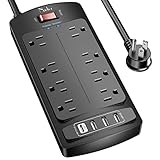
- 【Power Strip with 8AC outlets & 4 USB】- Power bars with surge protector with 8AC outlets & 4 USB charging ports (1 USB C Outlet), 6 Feet Heavy Duty extension cord, surge protector(2700 Joules) with overload protection protects against spikes and fluctuations.
- 【USB- C Fast & Smart Charge】- 4 USB Charging ports, each USB A port features 2.4A Max output. USB C charging port features 3A MAX. Built- with smart technology, detecting charging devices and deliver optimal charging speed automatically, compatible with most USB devices. NOTE: The UCB-C port doesn't support any other devices which need 9~22V charging voltage.
- 【8AC Surge Protector Outlets】- This power Strip provides 2700 joules of surge protection for electronic devices and serves as a reliable power extension cord. (The “Protected” indicator light turns on to indicate that your devices are protected.)
- 【Safety and Certificate】- ETL safety certified, with extension cord and other major components certified by ETL. The over current protection switch limits the power strip's working current to certain setting, so it will not get hot during usage. Environmental protection and fire-resistance PC shell with flame retardant at 1382℉ makes it more durable and longer lifetime.
- 【What You Get】- Nuetsa Power strip, Maunal, 30-day return, our worry-free 12-month, and reliable customer service will respond to you within 24 hours.
- Computers and monitors
- Televisions and audio equipment
- Chargers
- Routers and networking equipment
- Lamps
- Small office electronics
Even these devices must remain within the strip’s maximum amperage or wattage. A power strip is not automatically safe simply because the connected item is electronic. The UL Solutions guide recommends checking the product’s electrical rating rather than counting its outlets.
Independent reader supportYour contribution helps us test, update, and keep practical guides available for everyone.Power strip, surge protector, and extension cord: what is the difference?
- Extension cord: Extends the distance from a wall receptacle. It does not add circuit capacity, and its length, conductor size, grounding, listing, and intended location must match the load.
- Power strip: Adds receptacles and may include a switch or circuit breaker. It does not necessarily provide surge protection and must be plugged directly into a permanently installed receptacle.
- Surge protector: Includes components intended to divert or clamp transient voltage spikes. It still has a maximum voltage and current rating. Surge suppression does not make a heater, microwave, refrigerator, or air conditioner suitable for a strip.
A dedicated circuit is also different from a “dedicated” power strip. A dedicated circuit is branch-circuit wiring and overcurrent protection serving an appliance; adding a strip to an ordinary outlet does not create one.
How to check a setup before using it
- Read the appliance manual. Look for instructions about extension cords, dedicated circuits, grounding, GFCI protection, and required receptacles.
- Find the electrical rating. Check the nameplate or manual for watts, amps, and voltage. In a typical U.S. home, do not assume that a standard 120-volt outlet can safely support every appliance.
- Check the cord or strip label. Its current and voltage ratings must meet or exceed the appliance’s requirements. Length matters; a single wire-gauge number is not a universal safety rule.
- Confirm the configuration. Use the required grounding arrangement and never remove the ground pin or use an adapter that defeats grounding.
- Use a listed product. Look for certification from a recognized testing laboratory, such as UL, ETL/Intertek, or CSA.
- Inspect everything. Do not use frayed, cracked, melted, discolored, scorched, or crushed cords; bent or missing prongs; damaged strain relief; loose plugs; or loose receptacles.
- Keep connections uncovered. Do not run cords under rugs or bedding, through walls, ceilings, floors, or doorways where they can be pinched, or beneath furniture that can crush the connection.
- Never daisy-chain. Do not plug an extension cord into another extension cord, a power strip into another strip, or a strip into an extension cord.
- Monitor the setup. Stop using it if any plug, cord, strip, or receptacle becomes hot.
ESFI provides additional cord-selection and inspection guidance at esfi.org. Workplace users should also know that OSHA requires visual inspection of extension cords and portable cord-connected equipment before use.
What to do when the outlet is too far away
Do not solve a permanent outlet problem by buying an increasingly thick extension cord. Safer options are:
- Move the appliance closer to an appropriate grounded receptacle.
- Use the manufacturer-approved appliance cord only when the manual expressly allows it.
- Ask a qualified electrician to install a receptacle where the appliance is intended to operate.
- Have the electrician evaluate whether the appliance needs a dedicated circuit.
- For temporary outdoor tools, use equipment rated for outdoor use with appropriate GFCI protection and weather-safe connections.
Heavy reliance on extension cords is often a sign that the building needs additional permanent outlets. An electrician should also inspect a loose, warm, damaged, or discolored receptacle rather than simply replacing the cord.
Warning signs: stop using the setup immediately
Unplug the appliance and stop using the cord, strip, and receptacle if you notice:
- A hot plug, cord, power strip, or outlet
- Burning or melted-plastic odor
- Brown, black, or discolored plastic
- Melting, scorch marks, fraying, or exposed conductors
- Buzzing, crackling, sparking, or flickering lights
- A loose plug that falls out easily
- Repeated breaker trips
Do not “fix” repeated trips by installing a larger breaker. The cause could be an overload, short circuit, damaged appliance, or inadequate wiring. Have the circuit and equipment evaluated.
If there is smoke, sparking, or fire
- Move away from the equipment and keep others clear.
- If it is safe to do so, shut off power at the circuit breaker.
- Do not throw water on an energized electrical fire.
- Call emergency services if there is smoke or active fire.
- Do not reuse the outlet, cord, or appliance until the circuit and damage have been inspected.
The practical rule
Use power strips for appropriately rated low-load electronics—not as a way to power major appliances. Heating elements, motors, long-running appliances, and equipment with manufacturer warnings belong in an appropriate wall receptacle, often on a dedicated circuit. When the manual says no extension cord or power strip, that instruction is decisive; when the outlet is missing or unsafe, the correct fix is electrical work, not a more powerful-looking convenience device.
Quick wins for a faster PC:
Repair Windows errors before they cause bigger problemsFix Now →Scan for outdated or missing drivers - takes under a minuteDriver Scan →Clear out junk files and repair common Windows errorsFree Scan →Quick Recap
Product prices and availability are accurate as of the date/time indicated and are subject to change. Any price and availability information displayed on Amazon at the time of purchase will apply.

