What’s actually slowing this PC down?
Pick the symptom - the matching free tool is one click away.
A drill/driver is the more versatile, precise tool for drilling holes and controlled screwdriving. An impact driver is the more compact, high-torque tool for repetitive fastening, long screws, structural fasteners, and lag screws.
Neither tool replaces the other in every job. If you are buying only one tool for general household and construction work, choose a drill/driver. Add an impact driver when you regularly drive large or numerous fasteners. For serious concrete and masonry drilling, choose a hammer drill or rotary hammer—not an impact driver.
As an Amazon Associate I earn from qualifying purchases.
Drill vs. impact driver at a glance
| Characteristic | Drill/driver | Impact driver |
|---|---|---|
| Primary strength | Drilling and controlled fastening | High-torque fastening |
| How it applies force | Smooth, continuous rotation | Rotation plus rapid rotational impacts when resistance rises |
| Accessory holder | Usually a 3/8-inch or 1/2-inch keyless chuck | Usually a 1/4-inch quick-change hex collet |
| Accessory compatibility | Round-shank and hex-shank bits, hole-saw arbors, spade bits, augers and other compatible accessories | 1/4-inch hex-shank accessories; accessories exposed to impact must be impact-rated |
| Fastening control | Usually an adjustable mechanical or electronic clutch | Variable trigger, speed settings and sometimes electronic drive modes; usually no conventional adjustable clutch |
| Best fastening work | Small screws, furniture, cabinets, trim and delicate materials | Deck screws, structural screws, lag screws and repetitive fastening |
| Best for drilling | Most holes, especially large holes and precision work | Some holes with impact-rated hex-shank bits |
| Noise and feel | Smoother and generally quieter | Louder, with distinctive impact noise and more vibration |
| Best first purchase | Usually the drill/driver | Usually the second tool |
The simplest rule is: use the drill to make the hole and the impact driver to drive the fastener. That combination covers far more construction and repair work than either tool by itself.
The Tool Desk
Outbyte PC Repair FREERepair Windows errors before they cause bigger problemsFix Now →Outbyte Driver Updater FREEScan for outdated or missing drivers - takes under a minuteDriver Scan →What is a drill/driver?
A drill/driver combines an electric motor, gear reduction, a variable-speed trigger, forward and reverse controls, and a chuck that clamps the accessory. It also normally has an adjustable clutch for driving screws and a drill setting that provides the tool’s full available drilling torque.
#1 Best Overall
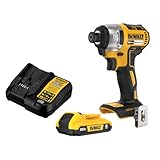
- Brushless motor for increased runtime and durability
- Compact and lightweight for hard to reach areas
- LED light with 20 second delay after trigger release
- Includes: (1) DCF787 1/4 in. Impact Driver (1) DCB203 20V MAX* 2Ah Battery (1) DCB107 Charger (1) Belt Hook
The chuck is the major reason a drill/driver is so versatile. It can hold ordinary round-shank twist bits as well as many hex-shank accessories. Depending on its capacity and the manufacturer’s instructions, a drill can also use spade bits, augers, self-feed bits, hole-saw arbors and specialty accessories.
Speed ranges make the tool adaptable. The low range provides more control and torque for large bits or fastening; the high range is better for smaller bits and faster drilling. As one model-specific example, the DEWALT DCD800 has a 1/2-inch keyless chuck, 15 clutch positions and two speed ranges listed as 0–650 and 0–2,000 rpm. Those specifications describe that model, not every drill/driver.
Why the drill’s clutch matters
The clutch lets you choose how much torque the drill applies before it slips during screwdriving. A low setting is appropriate for small screws or delicate materials; a higher setting is useful for larger fasteners. The drill setting normally bypasses or locks out the clutch for drilling.
Free tools Windows power users keep installed
One-click scans. No signup required.
That repeatable torque limit makes a drill/driver especially useful for:
- Cabinet, furniture and flat-pack assembly
- Hinges, handles and other hardware
- Trim and finish work
- Small screws in soft wood or plastic
- Applications where the screw head must stop at a consistent depth
For example, DEWALT’s drill instructions describe lower clutch numbers as lower torque settings and higher numbers as higher torque settings. Always follow the instructions for the specific tool because clutch scales and operating modes vary.
What is an impact driver?
An impact driver has a motor, gears and a 1/4-inch quick-change hex collet. Its defining feature is a spring-loaded hammer-and-anvil mechanism that delivers rotational impacts when the fastener encounters resistance.
The operating sequence is roughly:
- The motor initially turns the bit normally.
- As resistance increases, the hammer temporarily disengages from the anvil.
- A spring-loaded hammer accelerates and strikes the anvil.
- The strike transfers a short burst of rotational torque through the bit and fastener.
- The cycle repeats rapidly while the tool remains under sufficient resistance.
At light load, an impact driver may rotate without producing noticeable impacts. The hammer-and-anvil action becomes prominent when the fastener is difficult to turn. Bosch describes this mechanism in its impact-driver overview, and Makita discusses the compact hammer-and-anvil design in its tool technology information.
Why an impact driver feels more powerful
A drill applies relatively steady, continuous torque. An impact driver supplies short, high-energy bursts of rotational torque. Those bursts can overcome thread friction and resistance from long fasteners while reducing the amount of continuous twisting force that the user must resist.
This does not mean every impact driver is more powerful than every drill. A high-performance drill can have a high published torque rating, and manufacturers do not consistently use one standardized torque-testing method. Drill torque and impact-driver torque figures should not be treated as directly interchangeable. The Journal of Light Construction’s tool testing discussion and the Power Tool Institute torque procedure explain why advertised numbers need context.
A more useful comparison is task-specific:
- Ordinary drilling: uninterrupted rotation often makes the drill faster and smoother.
- Difficult fastening: the impact driver’s rotational blows can keep a long or large fastener moving after a drill begins to stall.
- Precision fastening: the drill’s clutch generally offers better control.
- High-volume fastening: the impact driver is often more compact and efficient for the task.
The biggest physical difference: chuck versus hex collet
| Drill/driver accessory path | Impact-driver accessory path |
|---|---|
| Round-shank twist bit ↓ 3/8-inch or 1/2-inch chuck ↓ Continuous rotation |
1/4-inch hex impact bit ↓ Quick-change hex collet ↓ Rotational impacts under load |
Drill chucks
A drill’s chuck can usually clamp:
- Ordinary round-shank twist bits
- Hex-shank driver and drill bits
- Spade bits
- Some auger and self-feed bits
- Hole-saw arbors
- Other accessories within the chuck’s capacity and the tool’s operating limits
A 1/2-inch chuck generally accepts larger accessories than a 3/8-inch chuck, but the maximum bit diameter depends on the individual model. A chuck does not automatically make every large accessory suitable; follow the tool’s manual for maximum capacities and operating speeds.
Impact-driver collets
A conventional impact driver accepts 1/4-inch hex-shank accessories through its quick-change collet. A standard round-shank drill bit will not lock directly into that collet. An impact driver can drill only when paired with a compatible hex-shank drilling accessory or an appropriate adapter.
Recommended Free Tools
Most importantly, the accessory chain must be impact-rated. A hex-shank adapter may allow an accessory to fit, but it does not make an ordinary drill bit, socket or arbor safe for impact use. Tool manufacturers warn that non-impact accessories can break under impact loading. See the DEWALT DCF860 manual and impact-accessory ranges such as Milwaukee SHOCKWAVE for the type of accessory labeling to look for.
Which tool is better for drilling?
For most hole-making, choose the drill/driver. Its chuck accepts more bit types, its continuous rotation is smoother, and its speed control is generally easier to manage.
| Drilling task | Better choice | Why |
|---|---|---|
| Pilot holes | Drill/driver | Smooth rotation, easy bit selection and precise starts |
| Large wood holes | Drill/driver | Better suited to spade, auger and self-feed bits |
| Metal drilling | Drill/driver | Conventional twist-bit compatibility and controlled speed |
| Hole saws | Drill/driver | Chuck, continuous torque and speed control are better suited |
| Occasional small holes with a hex bit | Either | An impact driver can work with a suitable impact-rated accessory |
| Brick, block or concrete | Hammer drill or rotary hammer | These tools apply forward percussion for masonry |
Can an impact driver drill holes?
Yes, sometimes—but it is not a complete replacement for a drill. Manufacturers sell impact-ready twist, masonry, step, multi-material and tap-and-drill bits with 1/4-inch hex shanks. For example, see DEWALT’s impact-ready masonry bits and its impact-ready metal bit.
Rank #2

- Ergonomically Designed: Work in tight areas with a compact design that gets into tough spots
- Both tools are designed to fit into difficult to reach spaces
- Complete a wide range of applications with a high-performance motor that delivers up to 300 UWO, and an impact driver delivering up to 1,400 in-lbs of torque
- Both the DEWALT impact driver and drill driver feature integrated LED work lights with a convenient 20-second delay, ensuring enhanced visibility in dimly lit or challenging work areas
- One-Handed Loading - Keep one hand free with a 1/4 in. hex chuck that accepts 1 in. bit tips
Use an impact driver for drilling only when:
- The bit has a compatible 1/4-inch hex shank.
- The bit is explicitly rated or designed for impact-driver use.
- The hole size and material are within the accessory and tool manufacturer’s limits.
- You can accept more noise, vibration and less smooth control.
An impact driver is a poor choice for numerous large holes, hole saws, large spade bits, augers and work requiring especially clean starts. Independent comparisons, including Pro Tool Reviews’ drill-versus-impact-driver coverage, generally find that drills are more effective for ordinary hole-making while impacts become advantageous as fastening resistance increases.
Which tool is better for driving screws?
Use a drill/driver for control
A drill/driver is usually the better choice when the screw is small, the material is delicate or the finished depth matters. Set the clutch low, start slowly and increase the setting only as necessary.
Typical drill/driver fastening applications include:
- Furniture and cabinet assembly
- Hinges, handles and hardware
- Trim and finish work
- Small screws in softwood, plastic or composite materials
- Drywall screws when a clutch-equipped drill or drywall screwgun is available
- Any work where overdriving could damage the surface
Use an impact driver for torque and volume
An impact driver is usually the better choice for:
- Deck screws and fence construction
- Structural screws
- Lag screws
- Long fasteners in dense lumber or engineered wood
- Repeated fastening over a large project
- Stubborn screws that need help breaking free
- Small-to-medium nuts with a correctly rated impact nut driver
The Lowe’s comparison guide and Bosch’s impact-driver information identify long, high-resistance and repetitive fastening as the tool’s primary advantage.
Does an impact driver prevent stripped screws?
No tool prevents stripping by itself. An impact driver can improve bit engagement in some situations because its compact axial impact action helps keep the bit engaged while the fastener turns. But cam-out can still happen because of:
- The wrong bit type or size
- A worn, damaged or poor-quality bit
- Misalignment between the bit and fastener
- Insufficient pressure toward the screw
- Excessive speed or torque
- A damaged screw head
- Continuing to impact after the screw is seated
Impact-specific driver bits use designs such as torsion zones to handle impact loading, but they still have limits. Examples include Bosch Impact Tough bits and Milwaukee SHOCKWAVE bits.
Drill clutch versus impact-driver modes
The drill’s clutch and the impact driver’s electronic modes are not the same thing.
- Drill clutch: mechanically or electronically limits fastening torque and is designed for controlled screwdriving.
- Impact-driver speed settings: limit speed and sometimes impact behavior, but a basic impact driver may still deliver substantial torque as resistance rises.
- Advanced impact modes: some premium models add auto-stop, self-drilling-screw or auto-drive functions to reduce overdriving and workpiece damage.
For example, the Bosch GDR18V-215 includes preset auto-drive modes, while the Makita XPT02Z includes multiple modes and a tightening mode. These features improve control, but they do not turn an impact driver into a conventional clutch-equipped drill.
Regardless of the tool, do not run at full power until the fastener is buried. Start slowly, keep the tool square and release the trigger as soon as the head reaches the intended depth.
Which tool is smaller and easier on the wrist?
Impact drivers are often shorter and lighter than comparable drill/drivers because a 1/4-inch hex collet and impact mechanism can occupy less space than a conventional chuck and clutch arrangement. The exact difference depends on the tool, voltage class, motor and battery, so broad claims such as “50% lighter” are not reliable without comparing specific tool-and-battery combinations.
During difficult fastening, the impact mechanism can reduce continuous torque reaction at the user’s wrist. That does not make an impact driver effortless: it still produces vibration, impulse forces and sudden reactions. A high-torque drill may also require a two-handed grip or side handle, particularly when a bit binds. Grainger’s comparison discusses the trade-off between compact fastening and drilling versatility.
Which tool is quieter?
A drill is generally smoother and quieter because it lacks the repeated hammer-and-anvil strikes of an impact driver. Actual sound depends on the model, speed, material, fastener and load, so there is no universal decibel difference that applies to every drill and impact driver.
Impact-driver noise can be sharp and impulsive, especially during prolonged fastening. Use hearing protection when the tool is loud or used for extended periods. NIOSH noise guidance identifies power tools as potential sources of hazardous exposure, and OSHA’s occupational noise standard addresses exposure and hearing-conservation requirements in workplaces.
Do these 3 things before closing this tab:
1Fix the driver behind crashes, sound loss and screen glitches2Clear out junk files and repair common Windows errors3Scan for outdated or missing drivers - takes under a minuteImpact driver versus hammer drill
These names are often confused, but the mechanisms work in different directions:
- Impact driver: applies impacts around the axis of rotation to increase fastening torque.
- Hammer drill: applies rapid forward-and-back percussion along the axis of the bit to help it cut masonry.
- Rotary hammer: provides heavier-duty forward percussion for frequent, large or deep concrete drilling.
An impact driver is therefore not a substitute for a hammer drill or rotary hammer when drilling brick, block or concrete. A hammer drill/driver can be a useful compromise for occasional masonry holes because it retains ordinary drilling and clutch functions. For example, the Milwaukee M18 FUEL 2904-20 is a hammer drill/driver, not an impact driver.
You may use an impact driver to drive masonry screws after the pilot hole has been drilled, provided the accessory is impact-rated and the anchor or fastener manufacturer permits it.
Rank #3

- Powerful Brushless Motor : GoYwato cordless 1/4 impact driver is equipped with a high-efficiency brushless motor that operates quietly, runs cooler, and has a longer lifespan. With a maximum torque of up to 2655 in-lbs (300 N·m), it is suitable for furniture assembly, frame building, tightening long-rusted screws, and many other applications, providing reliable power to easily handle various tightening tasks and improve work efficiency.
- 2 x 4.0Ah Batteries : GoYwato cordless impact driver set comes with 2 x 4.0Ah batteries and a charger. The two batteries can be used interchangeably, when one runs out of power, you can simply recharge it with the charger while continuing your work with the other. This allows for extended runtime and high efficiency without worrying about power supply issues. Moreover, our batteries are equipped with maximum 75A over-current discharge protection, a short-circuit protection current of up to 230A, and high-temperature discharge protection of up to 70°C. With these safety features, you can work with confidence and enjoy a smoother, seamless experience.
- Two-Way Mode & Reverse Automatic Stop : GoYwato cordless power impact drivers has two modes: forward and reverse. Forward mode is used for tightening, and reverse mode is used for disassembly. Low-speed and high-speed forward modes can be flexibly switched according to different working scenarios and needs. In reverse mode, pressing the "yellow button" switch on the gear display will activate the reverse automatic stop mode. Pulling the speed trigger will activate the braking stop device once the screw loosens, reducing speed and torque to prevent screws from flying out. Pressing the "yellow button" switch again will deactivate the reverse automatic stop mode.
- 1/4-Inch All-Metal Hex Chuck : GoYwato cordless brushless impact driver come with a 1/4-inch hex chuck, use steel ball fix design, drill bit has a relatively large groove area, therefore, when the drill bit is pulled outward, it is a loose drill bit, but it is only limited to being pulled to the position of the groove. When you need to remove the drill bit, simply pull the chuck to release the steel balls and remove it easily without needing to turn the chuck knob. Easily change screwdriver bits or sockets without any tools. Every design element is aimed at enhancing your user experience, making work smoother and more efficient.
- Ergonomic Design : GoYwato cordless impact drill features a built-in bright LED light that activates as soon as you pull the trigger, illuminating dimly lit work areas for clear visibility and safe operation. This compact impact driver features an ergonomic design and weighs only 3.62 lbs (1.64 kg), making it easy to operate even in confined spaces and improving overall work flexibility. The handle is wrapped in soft rubber for a comfortable, secure grip that reduces hand strain during prolonged use, offering a pleasant and effortless working experience.
Impact driver versus impact wrench
An impact driver uses a 1/4-inch hex collet and is primarily intended for driver bits, structural fasteners, lag screws and smaller nut-driving accessories. An impact wrench normally uses a square drive for impact sockets and is designed for larger nuts and bolts, automotive work and lug nuts.
Crashes, No Sound, or Screen Glitches?
Random freezes, missing sound and display glitches usually trace back to one bad driver. Find and replace yours safely.Free scan · under a minuteWindows Errors? Fix Them Before They Spread
Repair common Windows errors and clear accumulated junk for a smoother, more stable PC - no reinstall needed.Free scan · no reinstallA socket adapter can let an impact driver turn a socket, but it does not give the tool the output, square-drive interface or suitability of a dedicated impact wrench. Do not use a 1/4-inch impact driver as a general substitute for an impact wrench on vehicle lug nuts or high-torque automotive fasteners. Use the correct impact-rated socket and tool for the job. The distinction is also covered in Lowe’s tool guide.
Task-by-task recommendations
| Task | Recommended tool | Reason and qualification |
|---|---|---|
| General household repairs | Drill/driver | Broad accessory compatibility and better control |
| Pilot holes | Drill/driver | Smooth rotation and precise bit control |
| Large holes in wood | Drill/driver | Better suited to spade, auger and self-feed bits |
| Drilling metal | Drill/driver | Conventional twist-bit compatibility and speed control |
| Occasional small screws | Drill/driver | Use the clutch to avoid overdriving |
| Furniture and cabinets | Drill/driver | Lower clutch settings protect the material |
| Deck screws | Impact driver | Fast repetitive fastening and high torque |
| Structural screws and lag screws | Impact driver | Better suited to long, high-resistance fasteners |
| Dense hardwood | Impact driver for fastening; drill for holes | Pilot holes may still be needed to prevent splitting |
| Drywall screws | Clutch-equipped drill or drywall screwgun | Better depth control; impacts can overdrive the paper face |
| Stuck screws | Impact driver | Rotational impacts can help break resistance |
| Small nuts and bolts | Impact driver with impact-rated nut driver | Stay within the tool and accessory limits |
| Lug nuts and automotive work | Impact wrench | A 1/4-inch impact driver is not a dedicated wrench |
| Concrete or masonry holes | Hammer drill or rotary hammer | Requires forward percussion, not rotational impact |
| Hole saws | Drill/driver | Chuck, continuous torque and controlled speed are preferable |
| Paint mixing | Drill | Impact action is unnecessary and may damage the accessory |
| Precision assembly | Drill/driver or electric screwdriver | Controlled torque is the priority |
Pilot holes: why an impact driver does not eliminate them
Extra torque does not make a pilot hole unnecessary. Drill one when the fastener is large or long, the wood is hardwood or brittle, the screw is near an edge or end, or the material is MDF, plywood, melamine or another splitting-prone sheet good.
A pilot hole reduces the force required to drive the screw and can reduce splitting, wandering, bending, stripping and damage to the workpiece. For a clean result:
- Select the pilot-hole diameter for the fastener and material rather than guessing.
- Drill to an appropriate depth.
- Add a clearance hole where the screw should pass freely through the first workpiece.
- Use a countersink when the head must finish flush.
- Drive at low speed or on the lowest suitable impact mode.
- Stop as soon as the head reaches the required depth.
The Lowe’s pilot-hole guide provides general guidance, but the fastener manufacturer’s instructions take priority for structural screws, anchors and engineered connections.
Quick wins for a faster PC:
Fix the driver behind crashes, sound loss and screen glitchesFind Drivers →Clear out junk files and repair common Windows errorsFree Scan →Scan for outdated or missing drivers - takes under a minuteDriver Scan →Model examples: why specifications need context
Product specifications illustrate the category difference, but they are not a universal ranking. For example, the U.S. product listings in the research dossier give these model-specific figures:
- DEWALT DCD800 drill/driver: 1/2-inch keyless chuck, 15 clutch positions, 0–650 and 0–2,000 rpm, and a listed 6.37-inch tool length.
- DEWALT DCF860 impact driver: 1/4-inch quick-connect hex chuck, three speeds, up to 2,500 in-lb maximum torque, up to 3,800 rpm and up to 4,500 impacts per minute.
- Milwaukee M18 FUEL 2904-20: listed with 1,400 in-lb torque, up to 2,100 rpm, a 1/2-inch metal chuck, mechanical clutch and hammer-drill mode.
- Milwaukee M18 FUEL 2953 impact driver: listed with 2,000 in-lb torque, up to 3,900 rpm, up to 4,400 impacts per minute and a 1/4-inch hex drive.
These numbers should not be compared as though they were measured under one universal test. Battery, operating mode, bit, fastener, material and manufacturer test method all affect real-world results. Choose based on the work you actually do, not on the largest advertised torque number.
Independent reader supportYour contribution helps us test, update, and keep practical guides available for everyone.Should you buy a drill, an impact driver or both?
If you are buying one tool
Choose a drill/driver. Look for:
- A 12V class model for light household work, or an 18V/20V-class model for heavier construction tasks
- A brushless motor if you expect frequent or demanding use
- A keyless chuck
- Two speed ranges
- An adjustable clutch
- A variable-speed trigger
- A battery platform with reasonably available replacement batteries and compatible tools
- A side handle or electronic anti-kickback protection on high-torque models
One drill/driver can handle ordinary drilling, pilot holes, screwdriving, furniture assembly and many household repairs. A hammer drill/driver is worth considering if occasional masonry drilling is part of the plan.
If you are buying a second tool
Add an impact driver if you regularly build decks, fences, sheds or framing; drive structural screws or lag screws; work in dense lumber; drive hundreds of fasteners; or frequently stall a drill. It is particularly useful as a complementary tool: drill the pilot hole with the drill, then drive the fastener with the impact driver without repeatedly changing accessories.
Quick decision tree
- Need one general-purpose tool? Buy a drill/driver.
- Mostly driving long, large or repetitive fasteners? Buy an impact driver.
- Frequently drilling and fastening on the same project? Own both if the budget and battery platform allow it.
- Drilling concrete, brick or block? Choose a hammer drill or rotary hammer.
- Working on lug nuts or large automotive fasteners? Choose an impact wrench with the correct impact sockets.
How to use either tool without damaging the work
- Match the tool to the job. Do not use an impact driver for serious masonry drilling or a drill’s ordinary chuck accessories in an impact driver unless the complete setup is approved for impact use.
- Inspect the accessory. Replace worn, cracked, bent or damaged bits. Check that sockets, adapters and arbors are impact-rated where required.
- Prepare the material. Drill a pilot hole, clearance hole or countersink when the fastener and material call for it.
- Keep the tool aligned. Hold the bit square to the fastener and apply firm pressure toward the fastener to reduce cam-out.
- Start slowly. Use a low drill speed, low clutch setting or low impact mode until the fastener is established.
- Stop at the correct depth. Release the trigger as soon as the screw is seated. Continued impacting can strip the head, crush the surface or break the fastener.
- Manage bind-up. Use a side handle and two-handed grip with high-torque drills where supplied. Keep your body in a stable position.
- Remove the battery before changing accessories. This prevents accidental starts while fitting bits, sockets or arbors.
- Protect yourself. Wear eye protection, and use hearing protection when noise is loud or exposure is prolonged.
Common problems and fixes
The screw is stripped or overdriven
Use the correct, undamaged bit; keep the tool square; apply axial pressure; start slowly; select a lower drill-clutch or impact mode; and release the trigger immediately when the fastener reaches depth.
The wood splits
Use an appropriately sized pilot hole, move farther from the edge or end, reduce fastening force and consider a clearance hole in the first workpiece. An impact driver’s torque does not compensate for an unsuitable fastener or inadequate preparation.
The bit breaks
The usual causes are a standard accessory in an impact driver, side-loading, the wrong accessory or exceeding its capacity. Use accessories explicitly marked impact-rated or impact-ready. DEWALT’s DCF860 instructions specifically warn that non-impact accessories may break.
The bit will not fit
- Round-shank bit: use a drill chuck.
- 1/4-inch hex impact-rated bit: fits an impact-driver collet and can generally also be held in a drill chuck.
- Ordinary 7/16-inch hex self-feed bit: generally will not fit a standard 1/4-inch impact-driver collet.
- Socket: use an impact-rated nut driver, adapter or the correct impact-wrench accessory as specified by the manufacturer.
The drill twists violently when the bit binds
A large bit can produce substantial torque reaction when it catches. Use the supplied side handle, maintain a two-handed grip, avoid awkward body positions and use electronic kickback protection when the model provides it. A drill clutch may help during fastening, but drilling mode often bypasses the clutch. See the safety information in the DEWALT DCD1007 manual for an example of model-specific precautions.
Recommended Free Tools
Rank #4

- High performance: delivers 1,460 in-lbs. Of torque and max 2,800 rpms/3,100 ipms for quick fastening applications
- Quick and easy: quickly release chuck for easy one-handed bit changes
- Improved visibility: LED light helps in dark work areas
- Applications: fastening screws, lag bolts, and large fasteners
- Includes: (1) CMCF800 impact driver; (1) V20 20-volt MAX 1.3-amp hour lithium ion battery; (1) V20 20-volt MAX lithium ion charger
The impact driver keeps hammering but makes no progress
Release the trigger rather than allowing prolonged impact. Check the fastener size, pilot-hole size, bit engagement, accessory rating and material. The problem may require a different fastener, a larger drill, an impact wrench or another tool entirely. The fastener or workpiece can fail even while the impact driver continues operating; the DCF860 manual cautions users to ensure the fastener and system can withstand the torque produced.
Frequently Asked Questions
Can an impact driver replace a drill?
Not completely. An impact driver can make some holes with 1/4-inch hex-shank, impact-rated drill bits, but a drill/driver is better for ordinary drilling, large holes, hole saws, augers, round-shank bits and precision work. If you need one general-purpose tool, choose the drill/driver.
Can you use regular drill bits in an impact driver?
Not directly if they have round shanks, and ordinary accessories should not be used in an impact mechanism unless the manufacturer specifically approves them. Use a compatible 1/4-inch hex-shank bit marked impact-rated or impact-ready. An adapter only changes the fit; it does not make a non-impact accessory safe.
Can you use impact bits in a drill?
Generally yes, provided the bit has a compatible shank and the drill chuck can clamp it securely. Impact-rated driver bits are designed to tolerate impact loading, so they are suitable for use in a conventional drill, although the drill itself will not produce rotational impacts.
Outdated Drivers Are Slowing You Down
One free scan finds every outdated or missing driver and matches the right update for your exact hardware.Free scan · exact hardware matchPC Slower Than It Used to Be?
A free scan shows the junk files, broken settings and background clutter dragging Windows down - then fixes them in one click.Free scan · Windows 10 & 11Is an impact driver better for wood?
It depends on the task. An impact driver is excellent for long screws, deck screws, structural fasteners and repetitive fastening in dense wood. A drill/driver is better for drilling holes, small screws, furniture, cabinets and delicate work. In hardwood or near an edge, drill a pilot hole regardless of which tool drives the screw.
Is an impact driver better for concrete?
No. An impact driver’s impacts are rotational and are intended mainly to increase fastening torque. Drilling concrete, brick or block requires forward percussion from a hammer drill or rotary hammer. An impact driver may drive a masonry screw after the hole has been made if the accessory and fastener instructions permit it.
Can an impact driver remove lug nuts?
It is not the right general-purpose tool for lug nuts. A 1/4-inch impact driver may turn some small nuts with a suitable impact-rated adapter and socket, but an impact wrench with the correct square drive and impact sockets is designed for automotive lug nuts and larger fasteners.
Does an impact driver have a clutch?
Most conventional impact drivers do not have the same adjustable mechanical clutch found on a drill/driver. Some newer premium models provide speed settings, auto-drive, self-drilling or stop modes that improve control, but these are not identical to a drill clutch.
What’s actually slowing this PC down?
Pick the symptom - the matching free tool is one click away.
Which is better for beginners?
A drill/driver is usually the better first tool because it accepts more accessories and offers a clutch for controlled fastening. Add an impact driver when your projects involve many long or large fasteners.
Do impact drivers drill faster?
Not as a general rule. A drill often makes ordinary holes faster because it provides uninterrupted rotation. An impact driver can be faster when driving difficult or repetitive fasteners, especially after a drill begins to approach its torque limit.
Do impact drivers strip screws?
They can. An impact driver may improve engagement in some situations, but the wrong bit, poor alignment, excessive speed, a damaged screw or continued impacting after seating can still cause cam-out and stripping.
Do you need a pilot hole with an impact driver?
Often, yes. Pilot holes are especially important for large or long screws, hardwood, brittle wood, MDF, plywood, melamine, and fasteners near an edge or end. The impact driver’s torque does not eliminate the risk of splitting or workpiece damage.
What is the difference between an impact driver and a hammer drill?
An impact driver applies rapid impacts rotationally to increase fastening torque. A hammer drill applies rapid forward-and-back blows along the bit to help drill masonry. They are different tools for different jobs.
The Bottom Line
Buy a drill/driver first for versatility. It is the better tool for drilling, pilot holes, large accessories, furniture, cabinets and controlled fastening. Add an impact driver when fastening becomes repetitive, long, large or torque-intensive. Use a hammer drill or rotary hammer for serious masonry drilling, and an impact wrench for lug nuts and larger automotive fasteners.
Quick Recap
Product prices and availability are accurate as of the date/time indicated and are subject to change. Any price and availability information displayed on Amazon at the time of purchase will apply.