Some links on this page are affiliate links: if you buy through them we may earn a commission, at no extra cost to you.
The best concrete finishing tools are the ones matched to the slab, the weather, the mix, and the exact timing window. For a small patio, that may be a straight 2×4 or aluminum screed, magnesium float, edger, groover, broom, curing supplies, and basic PPE. For a commercial floor, it may mean a vibrating screed, bull floats, fresnos, walk-behind or ride-on power trowels, joint saws, sprayers, blankets, and quality-control tools.
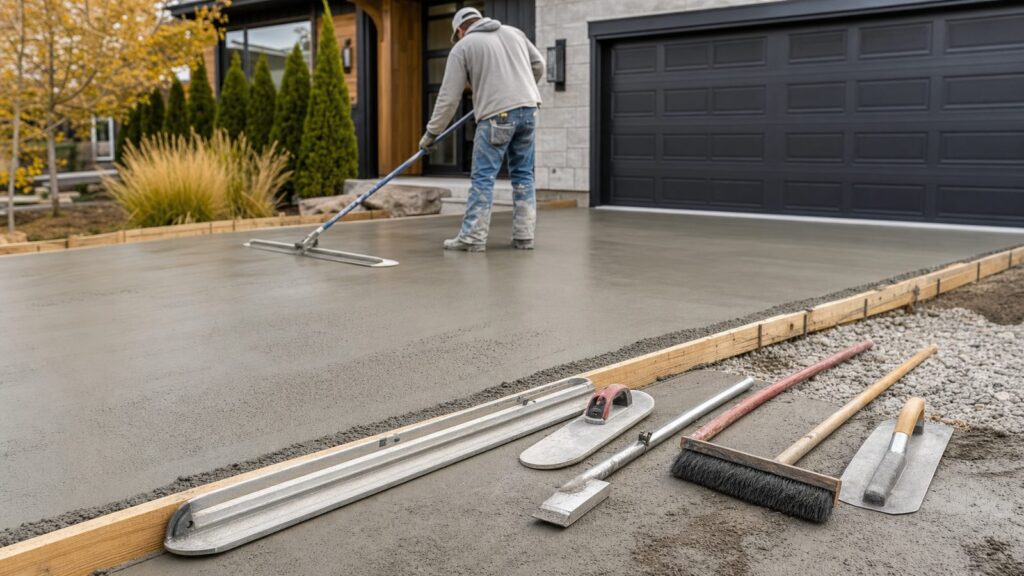
On our job sites, we do not think of concrete finishing as one step. We think of it as a sequence: place the concrete, consolidate it, screed it, bull float or darby it while it is still wet, wait for bleed water to leave, then edge, joint, float, broom, trowel, or power trowel depending on the use of the slab. The tool is only half the story. The timing is what protects the surface from dusting, scaling, blistering, delamination, and uneven texture.
As an Amazon Associate I earn from qualifying purchases.
If you are trying to choose tools for a driveway, patio, garage slab, sidewalk, shop floor, or commercial slab, this guide will give you the practical version: what each tool does, when to use it, what it costs in 2026, what mistakes to avoid, and when the job has outgrown a DIY tool kit.
Start With The Finish You Actually Need
A flawless concrete surface is not always a mirror-smooth surface. A garage floor, basement slab, warehouse floor, driveway, ramp, pool deck, and sidewalk all have different finish requirements. The wrong finish can look good on day one and become unsafe or damaged after the first season.
Popular on Amazon

- Manufactured from an aluminum magnesium alloy, it offers superior strength and lightweight maneuverability, making it ideal for large-scale concrete projects.
- The round ends ensure smooth and precise finishing, while the adjustable bull float bracket allows for customized positioning and control.
- Adjustable angle bracket: Allows flexible pushing and pulling motions for perfect surface finishing.
- Complemented by 4 extendable handles, this kit provides a comprehensive solution for efficient concrete screeding and finishing.
- With its robust construction and user-friendly design, this tool is a must-have for professionals in the construction industry. Seamlessly blend functionality and convenience with this high-quality concrete float set.
For exterior flatwork, the default target is usually a durable, slip-resistant surface with proper drainage. That often means a broom finish, light texture, exposed aggregate, or another traction-friendly surface. A hard steel-troweled exterior slab can be slick when wet, and in freeze-thaw regions it can also increase the risk of scaling, especially when air-entrained concrete is involved.
For interior floors, the priorities change. A slab that will receive flooring needs flatness, a sound surface, compatible curing products, and moisture planning. A polished or exposed concrete floor needs a different level of finishing discipline than a slab that will be covered with carpet or LVP. Commercial floors may require higher floor flatness and levelness tolerances, which cannot be fixed by last-minute troweling if the screeding and placement were poor.
PC Slower Than It Used to Be?
A free scan shows the junk files, broken settings and background clutter dragging Windows down - then fixes them in one click.Free scan · Windows 10 & 11Outdated Drivers Are Slowing You Down
One free scan finds every outdated or missing driver and matches the right update for your exact hardware.Free scan · exact hardware match| Application | Best Typical Finish | Key Tools | What To Watch |
|---|---|---|---|
| Driveway | Broom finish or exposed aggregate | Screed, bull float, edger, groover or saw, broom, curing sprayer | Drainage slope, control joints, traction, freeze-thaw durability |
| Patio | Light broom, swirl, salt finish, or decorative texture | Screed, magnesium float, edger, broom or texture tool | Texture consistency, water runoff away from the house |
| Sidewalk | Broom finish | Screed, bull float or darby, edger, groover, broom | Trip hazards, joint spacing, ADA slope where applicable |
| Garage slab | steel trowel or light broom | Screed, bull float, hand float, steel trowel or power trowel | Flatness, drainage at door, curing, surface dusting |
| Commercial floor | Machine-troweled finish | Laser or vibrating screed, bull float, fresno, walk-behind or ride-on trowel | Flatness tolerances, timing, joint layout, moisture requirements |
| Accessible ramp | Firm, stable, slip-resistant light broom | Screed, level, slope gauge, broom, edger | Maximum 1:12 running slope, maximum 1:48 cross slope, minimum 36-inch clear width |
The Concrete Finishing Sequence
Most finishing problems start because someone used a good tool at the wrong time. Concrete changes fast. Temperature, wind, sun, humidity, subgrade temperature, mix design, water content, slab thickness, and crew size all affect the working window.
The basic order is reliable: place and spread the concrete, consolidate as needed, screed to grade, bull float or darby immediately, wait for bleed water to evaporate, edge and joint at the right stiffness, float the surface, then apply the final finish. That final finish may be a broom, steel trowel, fresno, power trowel, texture mat, or exposed aggregate process.
1. Place, Spread, And Consolidate
Before finishing starts, the concrete has to be placed at the right grade and thickness. A 4-inch slab is common for patios and sidewalks. Driveways often use 4 inches for passenger vehicles and 5 to 6 inches where heavier vehicles, poor subgrade, or local requirements justify it. Commercial slabs may be thicker and reinforced according to engineering requirements.
Concrete rakes, come-alongs, shovels, wheelbarrows, buggies, chutes, pumps, and vibrators are placement tools, not finish tools, but they strongly affect the finish. If the crew drags aggregate away from edges, leaves low spots, or fails to consolidate around forms and reinforcement, the finishing tools have to fight a bad slab from the beginning.
Do these 3 things before closing this tab:
1Clear out junk files and repair common Windows errors2Fix the driver behind crashes, sound loss and screen glitches3Repair Windows errors before they cause bigger problemsInternal vibrators are useful for walls, columns, deep beams, and congested reinforcement, but flatwork needs judgment. Over-vibration can segregate the mix and bring too much paste to the top. Under-consolidation leaves voids and weak edges.
2. Screed Immediately
Screeding cuts the concrete to elevation. For small work, a straight 2×4 or aluminum screed board can work. For wider pours, a magnesium or aluminum straightedge, vibrating screed, roller screed, truss screed, or laser screed may be justified.
The screed should ride on forms, rails, or wet screed pads set to the correct grade. On a driveway or patio, we want positive drainage, commonly around 1/8 inch to 1/4 inch per foot where the layout allows. Water should not sit against the house, garage door, steps, or control joints.
3. Bull Float Or Darby While The Slab Is Still Wet
Right after screeding, use a bull float on larger slabs or a darby on smaller slabs. This embeds aggregate slightly, fills minor low spots, and brings enough cream to the top for finishing. It also knocks down ridges left by the screed.
The Tool Desk
Outbyte PC Repair FREERepair Windows errors before they cause bigger problemsFix Now →Outbyte Driver Updater FREEScan for outdated or missing drivers - takes under a minuteDriver Scan →This is not the time to polish the slab. Too many passes with a bull float or darby can bring excess paste and bleed water to the surface. That weak top layer is where dusting, crazing, and scaling begin. On our crews, bull floating is controlled and purposeful: flatten, close obvious voids, then stop.
4. Wait For Bleed Water To Leave
This waiting period is where a lot of slabs are ruined. After initial floating, water often rises to the surface. If you steel trowel, fresno, or hard-float while bleed water is present, you can trap water below a dense surface layer. The result can be blisters, delamination, scaling, or a dusty weak finish.
There is no fixed wait time that applies to every pour. In hot, dry, windy weather, the surface may tighten quickly, sometimes too quickly. In cool, humid weather, the slab may sit for hours. A good finisher reads the surface by sheen, footprint depth, and how paste responds to the tool.
5. Edge, Joint, Float, And Finish
Once the concrete can support finishing without tearing, edges and control joints are tooled or planned for saw cutting. Hand floats refine the surface. Brooms add traction. Steel trowels densify interior slabs. Power trowels improve production and consistency on larger floors, but they cannot rescue poor screeding, excess water, bad weather planning, or late mobilization.
What’s actually slowing this PC down?
Pick the symptom - the matching free tool is one click away.
Essential Concrete Finishing Tools And When To Use Them
Screeds
A screed is the first true finishing tool. It establishes the plane of the slab. Small slabs can be struck off with a straight lumber board, but aluminum or magnesium screeds stay straighter, are lighter, and are easier to clean. For production work, a vibrating power screed helps consolidate and level the surface faster. Current rental listings commonly put vibrating power screeds around $129 to $139 per day.
Also popular on Amazon
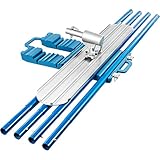
- Premium Quality: The surface of the trowel board, made of magnesium and aluminum alloy, is smooth and sturdy. An extruded float with a comfortable blue-coated aluminum handle that is positioned to give the tool perfect balance.
- Excellent Efficiency: This concrete bull float has a thickened trowel board. Its unique round end design will not warp, or roll up the cement, and can float a large area about 48x8 inch / 1200x200 mm each time, significantly increasing the work efficiency, saving labor force and time, reducing fatigue.
- Adjustable & Flexible: There is a bull float bracket to connect the handle and the trowel. It is designed to be adjustable in the angle and with excellent flexibility in pushing or pulling the handle to make a smooth finishing cement surface. Turn the handle clockwise to push; Turn it counterclockwise to pull. The rigid mounting base and reinforced side panels increasing its stability.
- Full-set Equipment: The concrete float kit equipped with a finishing trowel, a bracket, a rigid mounting base, and side panels, four handles (each handle with a length of 1.8 m), and four screws. To organize your tools conveniently, we also offer you a specially designed square plastic tool box. The concrete trowel kit can be used in all types of concrete finishing work.
- Various Application: Our concrete finishing tools mainly used for smoothing and finishing after the construction of cement pavement. With its light, flexible, efficient, and fast characteristics, widely used in plaster, concrete resurfacing, custom tiling jobs, and different DIY projects, etc.
Use a manual screed for small patios, sidewalk panels, shed pads, and simple forms. Consider a vibrating screed for larger driveways, long sidewalks, shop slabs, or pours where crew fatigue could lead to waves and low spots.
Bull Floats
A bull float is the long-handled float used immediately after screeding. It reaches across the slab while the concrete is still plastic. Magnesium bull floats are common because they are light, durable, and versatile. Wood and resin floats keep the surface more open. Steel is not the right material for this early step.
Rental examples put bull floats with handles around $47 per day, with specialty grooving or rumble-strip bull floats around $50 to $52 per day. Buying a bull float kit with handles often runs $150 to $500 or more, depending on size and handle setup.
Free tools Windows power users keep installed
One-click scans. No signup required.
Darbies
A darby is basically a shorter hand float used on smaller slabs or tight spaces. It fills the same early role as a bull float: flattening and opening the surface after screeding. It is useful for stoops, small pads, steps, landings, and narrow sidewalk sections.
Darbies are often wood, magnesium, or resin. Wood leaves the surface open. Magnesium is the general-purpose choice. Resin or composite tools can smooth the surface without closing it as aggressively as steel.
Hand Floats
Floats refine the slab after bleed water has disappeared and the concrete has stiffened enough to support finishing. A wood float leaves a slightly rougher, more open surface. A magnesium float is a workhorse for exterior concrete and air-entrained mixes. A resin float is a good middle ground when you want a smoother surface without sealing it too early.
For a homeowner kit, a magnesium hand float is usually one of the first tools to buy. Purchase prices commonly range from $15 to $80 for individual hand floats and trowels. For pros, tool condition matters. A float with a damaged edge can leave lines that show up under a broom or trowel finish.
Edgers
An edger rounds the slab perimeter. That small radius is not just decorative. It reduces chipping at exposed edges and gives driveways, sidewalks, patios, and steps a finished look. Edgers are commonly $15 to $75, depending on radius, width, and handle quality.
Use the edger when the concrete is firm enough to hold shape but still soft enough to tool cleanly. If you edge too early, the edge slumps. If you wait too long, you tear the surface or leave a rough, dark line that is hard to blend.
Groovers And Jointing Tools
Groovers create control joints while the concrete is still plastic. Control joints encourage shrinkage cracks to form in planned lines instead of random paths. As a practical rule, joint spacing is often 24 to 30 times the slab thickness in inches. For a 4-inch slab, that means joints are commonly placed around 8 to 10 feet apart, depending on layout, reinforcement, concrete mix, and local practice.
Tooling joints works well for sidewalks, patios, and smaller slabs. Larger slabs are often saw-cut after the concrete can support the saw without raveling. The timing can be just a few hours after finishing or later the same day, depending on the saw, mix, and weather. Waiting until the next day in hot or windy conditions can be too late.
Recommended Free Tools
Brooms
A broom finish remains the practical default for exterior walking and driving surfaces because it adds traction. Use a concrete finishing broom, not a dirty shop broom. The broom should be damp but not dripping. Pull it consistently across the slab after floating and before final set.
Brooms commonly cost $25 to $100. Texture should match the use. A driveway can accept a more pronounced broom than a patio where people walk barefoot. An accessible route needs to remain firm, stable, and slip-resistant without creating harsh ridges or trip hazards.
Steel Trowels
A steel trowel produces a dense, smooth surface. It is appropriate for many interior slabs, garage floors, utility rooms, and floors that will remain exposed or receive certain coatings. It is not the default choice for exterior flatwork.
The risk is timing and mix design. If steel troweling starts before bleed water is gone, the surface can trap water. On air-entrained concrete, hard steel-troweled finishes are especially risky. Industry guidance warns that air entrainment should not be used in flatwork receiving a hard steel-troweled finish; if it is specified anyway, the blistering and delamination risk should be acknowledged up front.
Fresnos
A fresno is a long-handled steel finishing tool used to smooth larger slabs without walking onto them too early. It can produce a flatter, denser surface, but it also closes the surface. That means it should be used carefully and generally after bleed water is gone.
Also popular on Amazon

- The Aluminum-Magnesium Alloy Trowel Board is a high-quality tool designed for professional use in concrete finishing.
- Its smooth and sturdy surface is capable of enduring heavy workloads, ensuring that it remains effective and reliable over time.
- The round ends of the board create a seamless and smooth finish on the concrete surface, enhancing the overall aesthetic appeal of the finished product.
- The adjustable nature of the bracket means that it can adapt to various working conditions and surfaces, making it an indispensable tool for professionals and DIY enthusiasts alike.
- The kit comes with a trowel, an adjustable angle bracket, a plastic carrying case,a nylon shoulder strap and four extendable handles to suit all your requirements.
Fresnos often cost $80 to $250 or more. We see them as a production tool for experienced finishers, not a shortcut for beginners. On exterior slabs, use caution. A fresno can make a surface too tight before brooming if the timing is wrong.
Power Trowels
Walk-behind and ride-on power trowels are made for larger slabs. They improve speed, consistency, and surface density for interior and commercial floors. A walk-behind trowel commonly rents for about $124 to $196 per day. A 6-foot ride-on trowel may rent around $375 per day. Buying a walk-behind power trowel often runs $1,500 to $4,000 or more, while ride-on machines can cost several thousand to tens of thousands of dollars.
A power trowel does not replace proper screeding, bull floating, joint planning, curing, or experienced timing. Used too early, it can damage the surface. Used too late, it may chatter, burn, or fail to close the slab evenly.
Tool Materials Matter: Wood, Magnesium, Resin, And Steel
Concrete finishing tools are not interchangeable just because they have flat bottoms. The material changes what happens at the surface.
Wood floats keep the surface open. They are useful when you want to avoid sealing the slab too early. They can leave a slightly rougher texture, which may be desirable before brooming or for certain exterior finishes.
Magnesium floats are the versatile standard on many job sites. They are lighter than wood, durable, and common for exterior and air-entrained mixes. A magnesium float can smooth the surface without the same sealing effect as a steel trowel.
Resin and composite floats can smooth concrete while still keeping the surface more open than steel. They are useful when the finish needs refinement but the slab should not be closed too aggressively.
Quick wins for a faster PC:
Clear out junk files and repair common Windows errorsFree Scan →Scan for outdated or missing drivers - takes under a minuteDriver Scan →Steel trowels densify and close the surface. That is valuable for many interior floors, but it is exactly why they can be a problem on exterior, air-entrained, or freeze-thaw-exposed flatwork. When durability and traction matter, the shiniest finish is often the wrong finish.
Concrete Finishing Tool Costs In 2026
For one small slab, renting specialty tools and buying only the basic hand tools is usually the best value. For contractors or property owners doing repeated work, owning high-use hand tools makes sense because worn edges, bent blades, and poor handles show up in the finish.
Installed plain concrete flatwork in the United States commonly falls around $6 to $12 per square foot for typical slabs, with many basic driveway and patio projects around $5 to $10.50 per square foot depending on region and scope. Plain gray driveways are often $5 to $8 per square foot. Decorative driveway finishes can run roughly $8 to $21 or more per square foot depending on color, stamping, scoring, staining, exposed aggregate, borders, and complexity.
Ready-mix concrete is commonly planned around $125 to $195 or more per cubic yard in 2026. Standard 3,000 to 4,000 PSI mixes often cluster near $125 to $175 per cubic yard, while some national pricing sources report higher averages. Short-load fees, delivery distance, fuel, admixtures, pump or buggy access, and local demand can move that number quickly.
The Tool Desk
Outbyte PC Repair FREERepair Windows errors before they cause bigger problemsFix Now →Outbyte Driver Updater FREEScan for outdated or missing drivers - takes under a minuteDriver Scan →| Tool Or Item | Typical Buy Range | Typical Rental Example | Best Choice |
|---|---|---|---|
| Hand float or hand trowel | $15-$80 each | Usually not worth renting | Buy if doing any finishing |
| Edger or groover | $15-$75 each | Usually not worth renting | Buy for small jobs |
| Concrete broom | $25-$100 | Limited availability | Buy for exterior work |
| Bull float kit | $150-$500+ | About $47/day | Rent for one-off slabs |
| Fresno | $80-$250+ | Varies by market | Rent unless used often |
| Vibrating power screed | Varies widely | About $129-$139/day | Rent for larger flatwork |
| Concrete vibrator | Varies widely | About $75-$144/day | Rent as needed |
| Walk-behind power trowel | $1,500-$4,000+ | About $124-$196/day | Rent unless used regularly |
| Ride-on trowel | Several thousand to tens of thousands | About $375/day | Pro/commercial use |
Bagged concrete can make sense for fence posts, small repairs, equipment pads, and very small pours. Common 80-pound bags are widely available and intended for pours 2 inches thick or more. For a real slab, bagged concrete becomes inefficient quickly. A 10-foot by 12-foot patio at 4 inches thick needs about 1.5 cubic yards before waste. That is roughly 68 80-pound bags, which is a lot of lifting, mixing, and consistency risk.
Basic Tool Kits By Project Size
Small DIY Slab Kit
For a small pad, walkway panel, trash-can pad, or short patio section, the practical kit is simple: shovel, concrete rake or come-along, wheelbarrow or mixer, straight screed board, magnesium float, edger, groover, broom, level, tape measure, stakes, forms, screws, release agent or form oil where appropriate, gloves, eye protection, rubber boots, knee boards, water source, curing compound or curing blankets, and plastic sheeting.
Do not skip curing supplies. Finishing is not finished when the broom marks look right. Concrete needs moisture and temperature control to gain strength. Poor curing can cause surface dusting, shrinkage cracks, curling, and lower long-term durability.
Driveway Or Patio Crew Kit
For a driveway or larger patio, add a bull float with enough handles to reach across the slab, extra edgers and jointers, stringline or laser level, saw for control joints if joints are not tooled, sprayer for curing compound, evaporation reducer for hot or windy weather, and enough labor to place concrete continuously.
Also popular on Amazon

- Efficient Concrete Tool-The bull float features an enhanced trowel board, measuring a generous 48" x 12", enabling extensive coverage with each pass. Its thoughtfully designed, rounded edges ensure comprehensive smoothing, even in hard-to-reach areas, minimizing blind spots during application. This innovative tool not only expedites the working process but also significantly boosts productivity, reducing overall project time while maintaining superior quality results.
- Excellent Quality-The concrete float's board is crafted from magnesium-aluminum alloy and fabricated through integrated cutting to ensure structural integrity. Sharp edges have been passivated to prevent cuts and ensure user safety. A specialized surface coating resists corrosion from concrete, significantly extending service life and making the tool easier to clean.
- More Flexible Use-Optimized for versatility, the angle between the handrail and board is adjustable to accommodate users of different heights and varied construction site conditions. Rotating the handle clockwise decreases the angle, while rotating it counterclockwise increases the angle, enabling precise customization for comfortable and efficient operation.
- Concrete Finishing Tools-We have prepared four adjustable spliceable pipes, allowing you to select lengths based on your specific needs. The toolbox conveniently stores all accessories for easy transport. Additionally, we include a trowel as a gift to assist with intricate finishing details.
- Versatile Applications-Our concrete bull float kit is primarily designed for leveling concrete surfaces post-construction, effectively adapting to diverse working surfaces across various environments. For optimal results, we recommend utilizing our product again during the final finishing process to achieve a refined, even surface.
Crew size matters. A 600-square-foot driveway can get away from an underprepared crew, especially in July heat or dry wind. Once the truck is on site, there is no convenient pause while someone drives to buy a broom or extra handle.
Commercial Flatwork Kit
For larger commercial slabs, the tool list expands: laser screed or vibrating screed, bull floats, check rods, fresnos, walk-behind or ride-on trowels, pan floats, combination blades, finish blades, joint saws, sprayers, curing compounds, blankets, moisture and temperature tools, and flatness measurement equipment where specified.
Commercial flatwork also needs planning around access, pour sequence, truck spacing, pump placement, reinforcement support, construction joints, saw-cut timing, and curing. The finish depends on logistics as much as tool selection.
Common Finishing Mistakes That Damage Concrete
The fastest way to weaken a slab is adding water to the surface to make finishing easier. That extra water dilutes the cement paste at the top. The slab may look smoother for a few minutes, but the surface becomes more prone to dusting, scaling, crazing, and early wear.
Free tools Windows power users keep installed
One-click scans. No signup required.
Another common mistake is troweling too early. If bleed water is still present, wait. Do not trap it under a closed surface. This matters even more when using steel tools, fresnos, or power trowels.
Overworking the slab is also a problem. Bull floats and darbies are meant to flatten and prepare the surface, not churn it. Too many passes can pull excess paste upward and create a weak top layer. A finish that looks creamy during placement can become dusty months later.
Exterior steel troweling is a frequent durability issue in freeze-thaw climates. Air-entrained concrete is often used outside because the microscopic air voids help the slab resist freeze-thaw damage. A hard steel-troweled finish can trap air and bleed water, increasing the chance of blistering, delamination, or scaling. For driveways, sidewalks, porches, ramps, and patios, a broom or textured finish is usually the better call.
Bad base preparation cannot be fixed with finishing tools. If the subgrade is soft, wet, poorly compacted, or draining toward the structure, the slab may settle or crack no matter how clean the broom lines look. A good finish starts with excavation, base stone, compaction, form alignment, reinforcement placement, and drainage.
Weather Changes The Tool Timing
Concrete does not set by the clock. On hot, dry, windy days, the surface can dry faster than bleed water can rise, which increases plastic shrinkage cracking risk. Crews may need wind breaks, sun control, fogging, evaporation reducer, cooler placement timing, or faster finishing response. Hot subgrades and dark forms can accelerate the problem.
Cold weather slows set time and strength gain. A slab that looks ready may still be soft underneath. Cold weather work may require heated water, accelerators, insulated blankets, ground thawing, or schedule changes. Finishing too early in cold weather can trap water. Finishing too late can leave a torn or uneven surface.
Humidity also matters. High humidity can extend bleed time. Low humidity can make the surface crust while the concrete below remains plastic. That is when inexperienced finishers may think the slab is ready because the top looks dry, then tear or blister the surface with steel tools.
Regional practice matters. In freeze-thaw states, exterior air entrainment, drainage, curing, and avoiding hard steel troweling are major durability decisions. In hot and dry regions, evaporation control and crew readiness may be the difference between a clean broom finish and a slab full of shrinkage cracks.
What’s actually slowing this PC down?
Pick the symptom - the matching free tool is one click away.
Safety, Silica, ADA, And Permit Notes
Fresh concrete is caustic. Wear alkali-resistant gloves, long sleeves, eye protection, and rubber boots. Wet concrete can burn skin, especially when it gets trapped in boots, gloves, or clothing. Wash exposed skin promptly and do not kneel directly in wet concrete.
Silica safety becomes a major issue when cutting, grinding, drilling, or surface-prepping cured concrete. OSHA silica rules for construction require specified controls for covered tasks. Table 1 includes methods such as water delivery systems, dust collection, and respirator use depending on the tool and duration. Dry cutting concrete without dust control is not acceptable job-site practice.
For accessible routes and ramps, finish quality is not only about appearance. Surfaces must be firm, stable, and slip-resistant. ADA ramp guidance includes a maximum running slope of 1:12, maximum cross slope of 1:48, and minimum clear width of 36 inches. That means the crew needs slope verification during forming, screeding, and finishing. A beautiful surface at the wrong slope can still fail the job.
Also popular on Amazon

- 48" x 8" Round-End Bull Float: Cover broad sections of freshly placed concrete with a 48" x 8" aluminum-magnesium alloy blade. Rounded ends help reduce edge marks during push and pull passes when used at the proper angle. Designed for floating freshly screeded concrete on driveways, patios, walkways and warehouse floors.
- Four 56" Extension Handles: Connect the four included snap-button handle sections to suit your slab layout and working distance. Each section measures 56 inches, allowing you to work from the slab perimeter without stepping into freshly placed concrete. Assembled handle length is shorter than the combined section lengths because the connections overlap.
- Adjustable Push & Pull Angle: Twist the connected handle to adjust the bracket and blade pitch for forward and backward passes. A slight leading-edge lift helps the bull float move across fresh concrete. Secure the bracket and check that each handle connection is locked before use.
- Aluminum-Magnesium Alloy Construction: The alloy float board provides a broad working surface for concrete flatwork, while the coated metal handles offer a practical grip for manual operation. Rinse concrete residue from the blade, bracket and handles after use, then dry the components before storage.
- Complete Kit with Assembly Tools: Includes one 48" x 8" bull float board, one adjustable bracket, four 56" extension handles, one hand trowel and three wrenches for assembly and adjustment. Use the bull float for broad-area floating and the hand trowel for small-area touch-ups on patios, driveways, walkways and other concrete flatwork.
Permits vary by city, county, HOA, and project type. Replacing a private patio may not require the same approvals as replacing a driveway apron, sidewalk, curb cut, commercial route, ramp, or work in the public right-of-way. Before cutting curb, changing drainage, altering an accessible route, or replacing municipal sidewalk, verify local requirements.
When To DIY And When To Hire A Pro
DIY concrete finishing is reasonable when the slab is small, access is easy, the finish is basic, weather is mild, and the consequences of cosmetic imperfections are acceptable. A trash pad, small shed pad, short sidewalk panel, or minor repair can be a good homeowner project with the right preparation.
DIY becomes risky when the pour is large enough that timing controls the outcome. As a rough practical line, many homeowners start getting overwhelmed above 100 to 150 square feet, especially at 4 inches thick or more. A 12-foot by 12-foot slab at 4 inches thick is about 1.78 cubic yards before waste. That is enough concrete to demand planning, helpers, and efficient finishing.
Hire a professional crew for driveways, garage slabs, structural slabs, commercial floors, ADA routes, ramps, stamped concrete, exposed aggregate, polished concrete, large patios, slabs requiring pumps or buggies, slabs with drainage problems, and any pour where a failed finish would be expensive to remove. Tear-out alone can add about $1 per square foot or more, and disposal, access, reinforcement, and haul distance can increase that cost.
A professional concrete crew brings more than tools. They bring timing, labor, backup tools, finishing judgment, joint planning, curing practice, and the ability to adapt when the truck is late, the sun comes out, the mix is wetter than expected, or the slab starts setting faster than planned.
How We Stage Tools Before A Pour
Before concrete arrives, every tool should already be on site, clean, and within reach. Forms should be secure. Grade should be checked. Reinforcement should be supported at the right elevation. The route from truck to slab should be clear. Curing products should be ready. The broom should be clean. Extra handles should be assembled. The saw plan should be understood.
On our job sites, we assign the sequence before the truck shows up. One person may manage placement, another screeding, another edges and joints, another bull floating and broom timing. On larger pours, power trowel blades, pans, fuel, and backup tools are checked ahead of time. A $40 missing hand tool can damage a $4,000 pour if nobody notices until the concrete is already stiff.
The best finishing tool is often preparation. Concrete rewards crews that are ready and punishes crews that improvise under time pressure.
Final Recommendation
For most exterior residential flatwork, the best finishing setup is a properly sized screed, bull float or darby, magnesium float, edger, groover or saw-cut plan, concrete broom, and curing supplies. That combination produces durable, attractive, slip-resistant concrete when used at the right time.
Do these 3 things before closing this tab:
1Repair Windows errors before they cause bigger problems2Fix the driver behind crashes, sound loss and screen glitches3Clear out junk files and repair common Windows errorsFor interior slabs, add steel trowels or a power trowel when a dense smooth finish is appropriate. For commercial floors, invest in the right screeding method, machine troweling plan, joint layout, and quality-control process. For air-entrained exterior concrete, be cautious with steel tools and avoid chasing a hard, slick finish that compromises durability.
A flawless slab is not the result of one magic tool. It is the result of correct subgrade preparation, the right mix, enough crew, proper sequencing, disciplined timing, suitable texture, and curing. Buy the hand tools you will use often, rent specialty equipment for one-off pours, and bring in a professional crew when the slab size, finish requirement, or site conditions leave no room for a learning curve.
Frequently Asked Questions
What tools do I need to finish a concrete slab?
For a basic small slab, you need a screed, magnesium float, edger, groover, concrete broom, shovel or rake, wheelbarrow or mixer, level, PPE, and curing supplies. Larger slabs may need a bull float, saw-cut tools, vibrating screed, fresno, or power trowel.
What is the difference between a concrete float and a trowel?
A float is used earlier to level, open, and smooth the surface without sealing it too tightly. A steel trowel is used later to densify and close the surface, usually on interior slabs where a smooth hard finish is desired.
Outdated Drivers Are Slowing You Down
One free scan finds every outdated or missing driver and matches the right update for your exact hardware.Free scan · exact hardware matchPC Slower Than It Used to Be?
A free scan shows the junk files, broken settings and background clutter dragging Windows down - then fixes them in one click.Free scan · Windows 10 & 11When should you bull float concrete?
Bull float concrete immediately after screeding while the slab is still wet and workable. Use it to flatten ridges, embed aggregate slightly, and prepare the surface, then stop before overworking paste and bleed water into the top layer.
Should exterior concrete be steel troweled?
Usually no. Exterior concrete often needs traction and freeze-thaw durability, so a broom or textured finish is normally safer. Hard steel troweling air-entrained exterior concrete can increase the risk of scaling, blistering, or delamination.
Can I rent concrete finishing tools instead of buying them?
Yes. Renting makes sense for bull floats, vibrating screeds, concrete vibrators, fresnos, and power trowels on one-off projects. Buy common hand tools such as floats, edgers, groovers, and brooms if you expect to do more than one small job.
How long should you wait before finishing concrete?
Wait until bleed water has evaporated before hand floating, steel troweling, or power troweling. The exact time can range from under an hour to several hours depending on temperature, humidity, wind, mix design, slab thickness, and subgrade conditions.
Quick Recap
Product prices and availability are accurate as of the date/time indicated and are subject to change. Any price and availability information displayed on Amazon at the time of purchase will apply.

