Free tools Windows power users keep installed
One-click scans. No signup required.
Fallen flowers usually mean your orchid has finished a normal bloom cycle—not that it is dead. For a common moth orchid (Phalaenopsis), start by checking its health and light, then adjust watering and feeding to its growing conditions. A seasonal change in nighttime temperature can help prompt a new flower spike, but no single step guarantees another bloom.
First, check whether the orchid is healthy
Before trying to encourage flowers, look for signs of stress: unusual leaf appearance, spots, pests, or a plant that seems markedly less vibrant. The American Orchid Society advises addressing such problems first; a stressed orchid prioritizes maintaining its health over flowering. A bare flower spike after blooms fall, by itself, is not evidence that the plant is unhealthy.
As an Amazon Associate I earn from qualifying purchases.
Identify the orchid before changing its care
These reblooming cues focus on Phalaenopsis, commonly called moth orchids. Orchids differ in their flowering cues and in what to do with spent spikes, so identify the type if you can. Iowa State University Extension’s reblooming guidance and the American Orchid Society’s Phalaenopsis culture sheet describe care specific to these common indoor orchids.
Give a Phalaenopsis enough bright, indirect light
Insufficient light is a common reason a Phalaenopsis does not rebloom. Aim for bright, indirect light rather than harsh direct sun, which can scorch leaves. Iowa State notes that dark green leaves can indicate too little light; medium grassy-green foliage is a better sign. The University of Maryland Extension and American Orchid Society suggest a north, east, or west window, or a south window with some shade, as possible placements.
#1 Best Overall

- ORCHID PLANT FOOD MIST: Miracle-Gro Indoor Plant Food Mist for Orchids contains nutrients for colorful orchid flowers and more blooms (vs unfed when used as directed)
- NUTRIENTS FOR ORCHID PLANTS: This orchid food feeds plants instantly and mimics natural feeding conditions for healthy Orchids
- FOR INDOOR ORCHIDS: Use this plant food for houseplants with indoor orchid plants, including Phalaenopsis (Moth Orchid), Cattleya, Cymbidium (Boat Orchids), Dendrobium, Dendrobium Nobile, Miltonia, Oncidium (Dancing Lady Orchid), and Paphiopedilum
- SIMPLY SPRAY TO FEED: Use this orchid food spray on leaves, roots, and top of the soil once per week, taking care to avoid orchid flowers; reapply mist once per week
- FEED YOUR ORCHID PLANTS: This bundle comes with two 8 fl. oz. bottles of Miracle-Gro Indoor Plant Food Mist for Orchids for more orchid care; for more spectacular results, use with Miracle-Gro Indoor Potting Mix for Orchids
If you move the plant to brighter conditions, do so gradually. A grow light is an option only if the available window light is inadequate; it is not a required purchase.
Use a seasonal temperature change only when it is safe
A home kept at nearly constant temperatures may not provide a seasonal cue that helps some orchids initiate a flower spike. Guidance varies: Iowa State says many orchid species benefit from several weeks with a nighttime drop of 10–15 degrees, ideally to 55–65°F; the American Orchid Society describes several weeks of autumn nights near 55°F as desirable for Phalaenopsis and notes that nights in the 50s and 60s are a typical seasonal cue. Its reblooming guidance also says daytime temperatures above 82°F inhibit flowering in Phalaenopsis.
Rank #2

- WONDERFULLY ORGANIC - Contains premium organic ingredients that naturally feeds and promotes strong roots, vibrant flowers, and overall better long term plant vigor. Light NPK ratio is ideal to use on all potted indoor and outdoor orchid types.
- FOR VIBRANT, GROWTH & BLOOMS - Made urea free to gently feed your orchid and protect your plants from root burn while encouraging vibrant leaves, spike growth, and stunning blooms and reblooms!
- READY MIXED PLANT MISTER - Already pre-mixed liquid fertilizer in a convenient ready to use spray bottle. Creates a fine mist perfect for gentle weekly feedings that help your plants thrive. Simply grab and spray!
- PERFECT PLANT CARE - Well-balanced mix of all the nutrients your houseplant needs to encourage long term health and vitality. Easy to use spray with no need to poke holes or disrupt the soil in your planter. Perfect for flowers in pots with bark, sphagnum moss, pumice, perlite, and other organic potting mixes.
- FOR ALL ORCHID VARIETIES - Made to use on your phalaenopsis, cattleya, vanda, cymbidium, denbrobium, and other live orchid types grown in and around the house in a pot.
Treat those figures as source-specific guidance, not a universal thermostat setting. The right conditions depend on the orchid type and your setting. University of Maryland Extension advises allowing cooler fall nights but bringing plants inside when evening temperatures dip into the fifties. Do not expose a plant to cold in an attempt to trigger flowering if that exposure could damage it.
Water and feed for growth, not as a bloom shortcut
Water when the medium is nearly dry
Water thoroughly, then let the potting medium approach dryness before watering again. The American Orchid Society notes that needs vary with climate and season; Kew advises watering when the pot feels light and the compost is dry, and reducing winter watering when growth slows. Avoid letting water sit in the crown, where the leaves meet.
Rank #3

- PROFESSIONALLY FORMULATED FOR BLOOMING: Urea-free orchid food containing high-content phosphorus, a powerful blooming agent; endorsed by the American Orchid Society for vibrant, long-lasting blooms
- NUTRIENT-RICH 11-35-15 FORMULA: Balanced ratio of nitrogen, high phosphorus, and potassium; bloom fertilizer for flowers and orchid food for blooming, enhancing color, and maximizing bloom size
- VERSATILE AND EASY-TO-USE: Water-soluble plant food is suitable for every fourth watering schedule; mix one teaspoon per gallon of water to thoroughly soak both the orchid’s root system and foliage; ideal for indoor house plants
- COMPLEMENTS ORCHID PLUS: For routine fertilization, alternate with Better-Gro Orchid Plus plant food as directed; maximizes the potential for healthy growth and abundant blooms in your orchids
- CONVENIENT PACKAGING FOR LONGEVITY: Comes in a handy resealable 16 oz bag to keep the fertilizer fresh and effective for future use
Feed lightly during active growth
Use a balanced orchid fertilizer sparingly while the plant is actively growing, and follow the product label. There is no single formula or schedule that suits every orchid and potting medium. University of Maryland Extension suggests feeding every third or fourth watering for actively growing and flowering plants, while Iowa State recommends weak balanced fertilizer during active spring and summer growth. Maryland advises skipping fertilizer during cooler, lower-light winter conditions. Excessive feeding can favor foliage at the expense of flowers, so more fertilizer is not a shortcut to reblooming.
Choose what to do with the old flower spike
For Phalaenopsis, the spike’s condition helps guide pruning. Use clean, sharp, sterile tools if you cut it.
Rank #4

- Made for Orchids – Specially formulated orchid fertilizer designed to support indoor orchid care and growth.
- Supports Blooming & Flowering – Orchid fertilizer for blooming helps promote vibrant flowers and longer-lasting blooms.
- Encourages Healthy Roots & Growth – Orchid plant food supports strong root systems and overall plant development.
- Liquid Orchid Fertilizer Formula – Fast-absorbing orchid fertilizer liquid for efficient nutrient delivery.
- Made in USA
- Still green: Leave it in place for now if you want to preserve the possibility of buds or a side branch. Repeat blooms from an old spike can happen, but are not guaranteed.
- Yellow, brown, or dried: Trim the spent spike. University of Maryland Extension suggests cutting a yellowed or brown Phalaenopsis spike above a node; removing a dead spike at the base is another way to clear spent tissue.
- Optional attempt after flowering: Iowa State says a moth orchid can be cut above the second node after its final flower. New blooms may appear in 8–12 weeks, but that estimate is not a promise.
- Another orchid type: Iowa State advises cutting most other orchids’ spent spikes at the base rather than treating them like Phalaenopsis.
Repot only when the medium or container calls for it
Repot if the orchid has outgrown its container or the bark has broken down, drains poorly, or stays too wet. Decomposed medium can contribute to root rot. Use commercial orchid bark mix and a pot with good drainage. University of Maryland Extension says indoor potting medium is commonly replaced every 1–2 years; the American Orchid Society gives a usual interval of 1–3 years. These are guides, not deadlines: the medium’s condition matters more than the calendar. Repotting does not replace suitable light or seasonal cues, and unnecessary repotting adds disturbance.
How do I get my orchid to rebloom?
For a healthy Phalaenopsis, provide bright, indirect light, water according to how quickly its medium dries, and feed lightly during active growth. If it is safe for your plant, cooler autumn nights may provide a seasonal cue. Keep a green spike if you want to leave the chance of a side branch; trim a yellowed or brown one. These steps support reblooming, but none can guarantee when—or whether—the orchid will flower again.
Quick Recap
Best Value
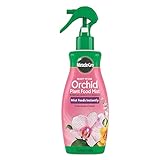
- Mist roots and growing media weekly
- Nutrients are instantly available
- Easy-to-use
- Apply to roots and growing media once a week
Product prices and availability are accurate as of the date/time indicated and are subject to change. Any price and availability information displayed on Amazon at the time of purchase will apply.