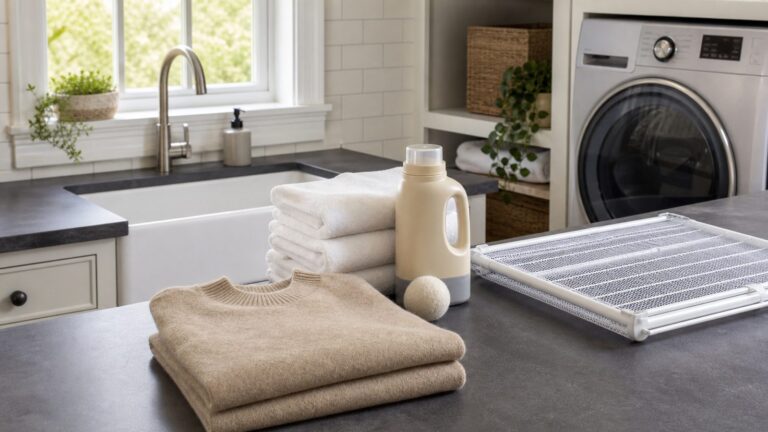
For a washable knitted cashmere or wool sweater, hand washing is the safest default: use lukewarm water—about 30°C / 86°F—with a small amount of mild wool detergent, soak briefly, press the suds through the fabric without rubbing or twisting, rinse gently, press out the water in a towel, reshape the sweater, and dry it flat.
Machine-wash only when the garment’s care label explicitly permits it. The label, construction, trims, and manufacturer’s instructions take priority over general advice. Heat, moisture, friction, pressure, and agitation can make wool fibers interlock, causing felting and permanent shrinkage. Machine-washable and superwash wool has been treated to reduce this risk, but untreated wool and many cashmere garments remain vulnerable.
As an Amazon Associate I earn from qualifying purchases.
First, decide whether the sweater can be washed at home
Cashmere and wool sweaters can often be cleaned at home, but neither fiber has one universal care rule. A plain knitted sweater labeled Hand Wash can generally be washed by hand. A sweater labeled Machine Wash can be washed in the specified gentle or wool cycle. A garment labeled Dry Clean Only should normally go to a professional cleaner rather than being water-washed at home.
Cashmere scarves, stoles, throws, woven garments, and structured pieces may have different requirements from ordinary knitted sweaters. For example, Johnstons of Elgin recommends hand washing knitted cashmere but professional dry cleaning for woven cashmere products.
#1 Best Overall

- Luxury Clothes Brush 8.5 Inch, ideal lint remover for delicate fabrics such as merino and cashmere wool and silk. A pet hair remover and suede shoe brush. Brushing you garments will extend the time needed between dry cleanings that will damage your clothes. It takes less than a minute to brush your clothes clean after each wearing.
- Synthetic bristles are hard and they can scratch the fabric, the natural boar bristles clothe brush is the perfect tool to care for your delicate clothes it will "lift" fabric fibers to remove any accumulated pilling, dust, dirt, fibers and fluff keeping your suits, coats, hats and other garments looking clean and rejuvenated. A great pet hair remover brush.
- A good clothe brush will remove dirt and food accumulated on the outer layers of your clothes before they have a chance to settle into the fabric. These bits which will cause damage to your clothes and shorten their lifespan. The best sweater defuzzer and pet fur remover in the market, give it a quick brush to remove any dust when you pull the clothing from the closet.
- A good clothe brush will remove dirt and food accumulated on the outer layers of your clothes before they have a chance to settle into the fabric. These bits which will cause damage to your clothes and shorten their lifespan. The best sweater defuzzer and pet fur remover in the market, give it a quick brush to remove any dust when you pull the clothing from the closet.
- Kent is the World's oldest brush manufacturer, proudly displaying the Royal Warrant of the Queen since 1777. Today, Kent retains the craftsmanship and unprecedented quality that is their reputation, instilling their expertise in every brush.
| Care instruction | What it means in practice |
|---|---|
| Hand Wash | Wash manually in water and detergent using gentle pressing or squeezing. It is not permission to scrub, rub, twist, or wring. |
| Machine Wash | Use the specified temperature and a wool or delicate cycle. Do not substitute a normal cotton cycle. |
| Do Not Wash | Do not use a domestic water-washing process. Follow the professional-cleaning instruction, if provided. |
| Dry Clean | Professional solvent cleaning is permitted. This does not necessarily mean that it is the only possible method. |
| Dry Clean Only | Treat this as a warning not to water-wash the garment unless the manufacturer or a qualified cleaner confirms that it is safe. |
| Do Not Tumble Dry | Dry the sweater by the label’s specified alternative—normally reshaped and flat. |
| Do Not Bleach | Use no chlorine or oxygen bleach unless the garment’s label specifically permits it. |
In the United States, the FTC Care Labeling Rule requires a care label to state at least one safe regular-care method, but a label does not necessarily list every method that might be possible. The FTC also notes that many cashmere items can be safely washed at home. That does not justify ignoring a specific Dry Clean Only instruction.
Do not wash at home when the construction is risky
Choose a professional cleaner when the sweater has a lining, tailoring, shoulder structure, bonded components, leather or suede, beads, sequins, elaborate embellishment, or complex colorwork that could distort or bleed. Also use professional care for a valuable vintage sweater with an uncertain label, an item with substantial moth damage, or a garment whose label says Dry Clean Only.
Before washing: prepare the sweater
- Read the sewn-in label. Check the method, temperature, bleaching, drying, and professional-cleaning symbols.
- Inspect the garment. Look for stains, holes, loose threads, moth damage, leather or suede details, embellishments, and areas that may bleed.
- Remove pills while the sweater is dry. Use a cashmere comb, fabric shaver, or carefully controlled small scissors. Do not pull pills by hand.
- Turn it inside out. This reduces surface friction and helps protect the visible face of the knit.
- Separate colors. Wash the sweater alone or with similar lightweight colors. Do not leave wet garments stacked together, because dye transfer can occur.
- Test unfamiliar or strongly colored garments. Dab a hidden area with diluted detergent and water, then press with a clean white cloth. If color transfers substantially, stop and use a professional cleaner.
For routine care, wash only when necessary. Wool and cashmere often resist odor and creasing better than many fabrics, so airing a sweater between wears can reduce unnecessary washing. Washing frequency depends on sweat, skin contact, stains, odor, and whether the sweater is worn over a shirt. Johnstons of Elgin gives roughly three or four wears as a practical cashmere example, not a universal rule. A sweater worn directly against the skin may need cleaning sooner; one worn over a base layer may need it less often.
Do these 3 things before closing this tab:
1Repair Windows errors before they cause bigger problems2Scan for outdated or missing drivers - takes under a minute3Clear out junk files and repair common Windows errorsThe safest method: hand-wash cashmere or wool
What you need
- A clean basin or sink.
- Lukewarm water, approximately 30°C / 86°F. Johnstons of Elgin gives approximately 35°C / 95°F for cashmere, so the label should decide when it specifies a temperature.
- A small amount of mild, neutral wool or cashmere detergent.
- A clean, absorbent towel.
- A clean flat drying surface or mesh sweater-drying rack.
Woolmark recommends a mild, neutral detergent and advises avoiding heavy-duty detergents, enzyme-containing biological detergents, and bleach.
Step-by-step hand washing
- Fill the basin. Use lukewarm water rather than hot water. Dissolve a small amount of detergent completely before adding the sweater so concentrated detergent does not sit on one section of fabric.
- Submerge the sweater. Turn it inside out if you have not already done so. Support the garment as you place it in the water; do not drop it in and then pull it out by a sleeve or shoulder.
- Soak briefly. About 10 minutes is a useful general default based on Woolmark’s wool-washing guidance. Manufacturer instructions vary from a few minutes to longer periods, so do not assume every cashmere sweater needs a 30-minute soak.
- Move the suds through the fabric. Gently press or knead the sweater under the water. Do not scrub, rub the fabric against itself, twist, wring, pull, or agitate it vigorously. Avoid lifting a saturated sweater by one part, since its water weight can stretch the knit.
- Drain the wash water. Support the sweater with both hands as you lift it or allow the water to drain around it.
- Rinse thoroughly. Keep the first rinse close to the wash-water temperature to avoid abrupt thermal change. Woolmark’s general wool directions then call for a final cool rinse, while Johnstons recommends rinsing at the same temperature. The practical priority is to avoid sudden hot-to-cold handling and follow the garment’s own instructions.
- Press out water. Do not wring. Gently press the sweater against the side of the basin, supporting its full weight.
- Use a towel roll. Lay the sweater flat on a clean towel, roll the towel and sweater together, and press the roll to transfer water into the towel. Unroll it and repeat with a dry towel if necessary.
- Reshape while damp. Match the original body length, sleeve length, neckline, cuffs, shoulder width, and overall proportions.
- Dry flat. Place the sweater on a clean, light-colored, lint-free towel or a mesh drying rack away from direct heat and sunlight.
Can you machine-wash cashmere or wool?
Only if the care label explicitly permits machine washing. A manufacturer may approve machine washing for one cashmere garment while specifying hand washing for another, even when both are made from 100% cashmere. For example, current product instructions from Everlane include both a hand-wash cashmere example and a cashmere example permitting cold machine washing.
If machine washing is allowed:
- Turn the sweater inside out.
- Put it in a mesh laundry bag if the manufacturer recommends or permits one.
- Select the machine’s wool cycle. Woolmark describes an approved wool cycle as using gentle action at about 40°C / 104°F. If there is no wool cycle, use cold water or a delicate cycle only if the label allows machine washing.
- Use a small amount of mild, neutral wool detergent.
- Wash it separately or with similar lightweight items. Avoid towels, denim, zippers, Velcro, and heavy garments that add friction.
- Do not use a normal cotton cycle, hot cycle, bleach, or an aggressive stain-removal program.
- Remove the sweater promptly when the cycle ends.
- Reshape it and dry it flat unless the label expressly permits tumble drying.
Do not rely on a universal spin-speed rule. Machine programs differ, and Woolmark’s current approved-cycle specification indicates that a high final spin is not inherently harmful when it is part of a suitable wool cycle. The more important risks are unsuitable heat, agitation, and friction. If your machine’s delicate program is aggressive, uses high heat, or has a strong agitator, hand washing is the lower-risk option.
Rank #2

- ✅ Give Your Old Sweaters New Life: Our lint shaver is the right way to care for your sweaters. Designed with delicate materials in mind. It gently removes pills without harming your favorite knitwear.
- ✅ Take The Fuss Out Of Depilling Your Clothes: This nonslip fuzz remover is easier to use than a standard sweater stone. Hold the lint remover at a 90-degree angle, brush in the direction of the knit and you are done.
- ✅ Depill Your Sweaters On The Go: Our compact 3” x 1.7” sweater fuzz remover is travel-friendly and comes with a convenient carrying pouch for easy transportation on your business trips, travels, and holidays.
- ✅ Get A Multi-Functional Lint Remover Shaver: Use this sweater depiller to shave natural wool clothing, cashmere toppers, scarves, or blankets. Don’t throw away your acrylic sweaters when the cuffs wear out: depill them and make them look like new again.
- ✅ Use Your Lint Brush For Years: This sturdy wooden lint comb has the signature Johnson & Smith quality that guarantees long-lasting performance and is backed with our Lifetime Warranty, for your peace of mind.
How to dry and reshape the sweater
Drying is where many washable sweaters are permanently distorted. A wet knitted sweater is heavy and flexible, so hanging it can produce stretched shoulders, a long body, or shoulder humps.
- Dry flat. Use a clean towel or mesh rack and spread the sweater into its original shape.
- Do not use a hanger while wet. The water weight can stretch the knit and leave hanger marks.
- Keep it away from direct heat. Avoid radiators, fireplaces, hot-air vents, heated dryers, and direct sunlight.
- Do not line-dry a wet knitted sweater unless the manufacturer specifically approves that method.
- Turn it once if needed so both sides dry completely.
- Do not store it until it is fully dry. Residual moisture can contribute to odor and storage problems.
If the sweater is very soft or valuable, trace its outline on paper before washing. Use that outline as a blocking guide while the garment is damp. The Woolmark drying and reshaping guide also recommends dampening and reshaping distorted areas rather than stretching the garment aggressively.
What detergent is safe?
Prefer
- A wool-specific or cashmere-specific detergent.
- A mild, neutral detergent designed for delicate protein fibers.
- The smallest effective amount, fully dissolved in the water.
Avoid
- Chlorine bleach.
- Oxygen bleach unless the garment label specifically permits it.
- Heavy-duty laundry detergent.
- Enzyme-containing biological detergent as a routine wash.
- Fabric softener unless the manufacturer specifically permits it.
- Dryer sheets and starch.
- Large quantities of detergent, which can leave residue and require excessive rinsing.
Excessive conditioner can lubricate fibers and allow more of them to migrate to the surface, encouraging pilling, according to Woolmark’s sweater-care material. Popular advice sometimes recommends baby shampoo, ordinary shampoo, or hair conditioner, but these are not necessary universal solutions. A mild, neutral wool detergent is the better-supported default.
How to remove stains from cashmere and wool
For a fresh, small mark
- Blot immediately. Use a clean, white, lint-free cloth to lift liquid without rubbing.
- Dab gently. Use cool or lukewarm water. Rubbing can spread the stain, add friction, and create a fuzzy patch.
- For an oily mark, test first. Apply a very small amount of suitable cashmere detergent to a damp cloth and test an inconspicuous area before treating the stain.
- Remove residue. Blot or rinse carefully. Avoid saturating only one area if that could leave a visible water ring.
- Wash the whole sweater if necessary. Follow the care label rather than repeatedly wetting one spot.
Johnstons of Elgin advises cold-water spot cleaning, gentle dabbing, and testing bright colors first. If color transfers to the test cloth, use professional cleaning. Woolmark publishes more specialized wool procedures for stains such as coffee, wine, milk, grease, ink, and makeup. Those solvent-based or stain-specific procedures should be treated as Woolmark’s wool-specific guidance, not as a universal cashmere recipe.
Send it to a professional cleaner when
- The stain is oily, old, set, or spreading.
- The garment is labeled Dry Clean Only.
- The sweater is lined, tailored, embellished, or trimmed with leather or suede.
- Dye bleeds during a hidden-area test.
- The stain contains ink, paint, hair dye, shoe polish, or an unknown chemical.
- Removing it would require bleach or a strong solvent.
Why sweaters pill—and how to remove pills safely
Pilling occurs when loose fibers tangle into small balls, usually in areas exposed to friction. Common locations include the underarms, sides, cuffs, and areas that rub against a bag or rough outer layer. Pilling is not automatically proof that a sweater is defective; fiber length, yarn construction, looseness, and repeated abrasion all affect it.
The Tool Desk
Outbyte PC Repair FREERepair Windows errors before they cause bigger problemsFix Now →Outbyte Driver Updater FREEFix the driver behind crashes, sound loss and screen glitchesFind Drivers →To reduce pilling:
- Wash less often when airing or spot cleaning is sufficient.
- Turn the sweater inside out.
- Reduce friction from bags, rough coats, jewelry, and abrasive washer loads.
- Use careful hand washing or the approved wool cycle.
- Avoid excessive conditioner.
- Remove pills only while the garment is dry, using a cashmere comb, fabric shaver, or carefully controlled small scissors.
- Never pull pills off by hand, since you may pull out sound fibers as well.
What if the sweater stretches, shrinks, or changes shape?
For stretching or mild distortion
Dampen the affected area with warm water, approximately 30–40°C / 86–104°F. Massage it gently, reshape the sweater flat to its original dimensions, and let it dry in that position. This may improve temporary distortion but cannot guarantee a complete return to the original shape.
Rank #3

- ✅ Give Your Old Sweaters New Life: Our lint shaver is the right way to care for your sweaters. It has 2 mesh sides for different functions, one yellow mesh for acrylic or wool and one black mesh side for cashmere and other delicate fabrics.
- ✅ Take The Fuss Out Of Depilling Your Clothes: This nonslip fuzz remover is easier to use than a standard sweater stone. Hold the lint remover at a 90-degree angle, brush in the direction of the knit and you are done.
- ✅ Depill Your Sweaters On The Go: Our compact 3 x 1.7 inch sweater fuzz remover is travel-friendly and comes with a convenient carrying pouch for easy transportation on your business trips, travels, and holidays.
- ✅ Get A Multi-Functional Lint Remover Shaver: Use this sweater depiller to shave natural wool clothing, cashmere toppers, scarves, or blankets. Don’t throw away your acrylic sweaters when the cuffs wear out: depill them and make them look like new again.
- ✅ Use Your Lint Brush For Years: This sturdy wooden lint comb has the signature Johnson & Smith quality that guarantees long-lasting performance and is backed with our Lifetime Warranty, for your peace of mind.
For shoulder humps caused by hanging, re-wet the stretched areas, gently massage them, reshape the sweater, and dry it flat. Do not pull the garment forcefully into shape.
For a sweater that has shrunk
Distinguish ordinary distortion from severe felting. A misshapen but still soft, open knit may respond to careful damp reshaping. A severely felted sweater becomes denser, tighter, stiffer, and visibly smaller because the fibers have interlocked. Woolmark describes severe felting caused by an incorrect wash as potentially irreversible.
Do not rely on viral remedies involving conditioner, hair treatments, or alternating hot and cold water as guaranteed restoration methods. A textile specialist may be able to assess a mildly damaged garment, but severe felting may not be recoverable.
Free tools Windows power users keep installed
One-click scans. No signup required.
How the shrinking happens
Wool fibers have microscopic surface scales. Heat, moisture, friction, pressure, and agitation can cause those scales to interlock. Once the fibers lock together, the fabric felts and shrinks permanently. That is why water alone is not the whole problem: a controlled, label-approved wash can be safe, while hot water combined with rubbing, twisting, or vigorous machine agitation can damage an untreated sweater.
Superwash or machine-washable wool has been treated to reduce the tendency of the scales to interlock, but that does not make every wool or cashmere garment machine-safe. The care label remains the controlling instruction.
How often should cashmere and wool be washed?
Do not automatically wash a sweater after every wear. Air it in a ventilated area between wears, especially when it has no stain or persistent odor. Spot-clean small marks instead of subjecting the entire sweater to repeated washing. Wearing a base layer can reduce sweat and skin oils reaching the knit.
Rank #4

- Size Details & Material: 10.24 X 1.34 X 1.46 in. The garment clothes brush is made of solid beech wood and pure boar bristle
- Refresh Your Clothes: The boar bristles are soft enough that they will not damage clothing, but stiff enough to remove lint, etc. Gently brushing clothes makes them look better and last longer. Not for very hard fabrics such as denim
- Fast and Efficient: Just a few seconds of brushing will remove lint, fuzz, and dust from suits, velvet, wool, sherpa, sweater, or cashmere. Suitable for removing pet hair from various fabrics
- Widely Used: You can also be creative and put it to more use. This brush can also serve as a hand broom, dust brush, lint remover, etc. For example: cleaning clothes, hats, beds, counters, furniture, car seats, fireplaces keyboards, etc
- Save Your Money: Extend the life of high-quality clothing and reduce the frequency of dry cleaning
Wash when the sweater is visibly soiled, smells after airing, has absorbed sweat, or needs cleaning before storage. The appropriate interval may be a few wears for a sweater worn directly against the skin or substantially longer for one worn over a shirt. The three-to-four-wear recommendation sometimes given for cashmere is a manufacturer’s practical example, not a mandatory schedule.
Windows Errors? Fix Them Before They Spread
Repair common Windows errors and clear accumulated junk for a smoother, more stable PC - no reinstall needed.Free scan · no reinstallOutdated Drivers Are Slowing You Down
One free scan finds every outdated or missing driver and matches the right update for your exact hardware.Free scan · exact hardware matchStorage: protect the clean, dry sweater
- Fold it. Store knitted cashmere and wool flat rather than on a hanger.
- Clean it first. Food, perspiration, and other soils make woolens more vulnerable to clothes-moth damage.
- Dry it completely. Never put a damp sweater into a drawer or container.
- Choose a cool, dry, dark location. A breathable drawer or storage bag is suitable for ordinary storage.
- Use sealed storage strategically. In a moth-prone home or for long-term storage, a clean, dry garment can go into a genuinely airtight container. Do not seal in residual moisture.
- Treat cedar as supplemental only. Cedar may act as a repellent, but it is not guaranteed infestation control and is not a substitute for cleaning, inspection, vacuuming, or sealed storage.
If you suspect moths, inspect seams, cuffs, collars, folds, and nearby closet areas. The damaging stage is the larva, not the adult moth. Guidance from UC Integrated Pest Management and the National Pesticide Information Center recommends cleaning before storage and taking storage and inspection seriously.
If something goes wrong
I used hot water
Stop heating and avoid further agitation. Rinse gently in water close to the current temperature, press out the water without twisting, reshape the sweater flat, and let it dry. If the fabric has become dense and felt-like, permanent damage is possible.
I wrung the sweater out
Stop twisting it. Support the garment with both hands, press it between towels, reshape it, and dry it flat. Check the dimensions as it dries.
I hung it while it was wet
Re-wet the stretched areas with warm water, massage them gently, reshape the sweater, and dry it flat. This can improve shoulder humps and mild distortion, but it cannot guarantee full recovery.
Quick wins for a faster PC:
Fix the driver behind crashes, sound loss and screen glitchesFind Drivers →Repair Windows errors before they cause bigger problemsFix Now →The color ran
Remove the sweater from the water promptly. Keep it separate from other garments, rinse according to the label without rubbing, and do not use bleach or an untested color-restoration product. If the color loss is substantial, contact the manufacturer or a professional cleaner.
Best Value

- 100% NATURAL BOAR BRISTLE: This boar bristle brush is a wooden brush designed as a lint brush for clothes, wool comb, and fabric brush. Use it as a cashmere brush or clothes brush garment brush to care for your favorite pieces. This wool cleaner and wool brush keeps fine knitwear fresh after each wear or before storing. It effectively removes lint, fuzz, and pills, extending garment life and saving you costly trips to the dry cleaner.
- GENTLE ON DELICATE FABRICS–PET HAIR REMOVER: Unlike harsh synthetic brushes, this natural clothing brush and garment brush is effective yet safe on delicate fabrics. Use it as a coat brush or cashmere brush for sweaters daily, whether at home after a long day or before heading out the door. This sweater brush and lint remover brush boar bristle safely lifts dust, dander, and stubborn pet hair without scratching or damaging the material, keeping your favorite clothes looking fresh and well-maintained.
- ERGONOMIC BEECHWOOD HANDLE - COMFORTABLE & DURABLE: Crafted from natural beechwood sourced from Croatia, this wool coat brush and fabric brush for clothes offers a smooth, ergonomic grip that feels balanced and comfortable in your hand. Whether you're quickly freshening up a coat before a meeting or thoroughly brushing multiple garments on laundry day, this wool brush for clothes and cashmere care kit essential ensures long-lasting durability, making it a reliable tool you'll reach for year after year.
- INCLUDED STAINLESS STEEL CLEANING COMB - EASY BRUSH MAINTENANCE: Comes with a 304 stainless steel cleaning comb designed specifically to remove trapped fibers, lint, and dust from the bristles of your boar bristle brush and wooden brush. After each use or whenever you notice buildup, simply comb through the brush head. Regular cleaning keeps your lint brush for clothes, cashmere brush, and garment brush performing like new, extending the life of the brush itself.
- COMPLETE STORAGE & TRAVEL SET - PU LEATHER STRAP + HANGING LOOP: Features a built-in hanging hole on the handle of this clothes brush garment brush and sweater brush with a matching PU leather strap. Simply thread the strap through the hole and hang it on your closet hook, coat rack, or anywhere within easy reach. Whether at home or in a hotel room, your wool brush, cashmere brush for sweaters, and lint remover brush boar bristle stay accessible and ready for daily use — a thoughtful design that keeps garment care simple and convenient.
It still smells after washing
Check that detergent has been fully rinsed out, then dry the sweater completely with airflow. Do not store it damp or repeatedly wash it in an attempt to remove the smell. If the odor persists, have the garment professionally assessed.
My machine has no wool cycle
Use a cold delicate cycle only when the label permits machine washing and the machine’s action is genuinely gentle. If the delicate cycle uses high heat, strong agitation, or a forceful central agitator, hand washing is safer.
Quick-reference checklist
- Check the sewn-in care label and garment construction.
- Do not override Dry Clean Only without professional or manufacturer confirmation.
- Inspect stains, loose threads, trims, and possible moth damage.
- Remove pills while the sweater is dry.
- Use mild, neutral wool or cashmere detergent.
- Use the label’s temperature; otherwise, lukewarm water around 30°C / 86°F is a conservative hand-washing default.
- Keep agitation and friction to a minimum.
- Never scrub, twist, or wring the sweater.
- Press water out in a towel.
- Reshape the sweater while damp.
- Dry it flat, away from direct heat and sunlight.
- Store it folded, clean, and completely dry.
Frequently Asked Questions
Can every cashmere sweater be hand-washed?
No. Many plain knitted cashmere sweaters can be hand-washed, but the garment label and construction control. A lined, structured, embellished, leather-trimmed, woven, or dry-clean-only item may require professional cleaning.
Can I use baby shampoo or hair conditioner to wash cashmere?
They are not necessary universal solutions. A small amount of mild, neutral wool or cashmere detergent is the better-supported choice. Avoid routine enzyme detergents, bleach, and excessive conditioner, which can leave residue and may contribute to pilling.
Can a shrunken wool sweater always be fixed?
No. Mild stretching or distortion may improve with careful damp reshaping, but severe felting makes the fabric denser and smaller and may be irreversible. A textile specialist can assess it, but no home remedy guarantees restoration.
Is dry cleaning always safer for cashmere?
No. Some cashmere garments are specifically designed for hand washing, while others require or permit professional dry cleaning. Follow the individual garment’s label rather than applying a blanket rule to all cashmere.
The Bottom Line
The safest routine is simple: follow the label, use mild wool detergent and lukewarm water, minimize friction, never wring, press the water out in a towel, reshape the sweater, and dry it flat. When the garment is structured, embellished, woven, valuable, stained with a difficult substance, or labeled Dry Clean Only, professional cleaning is the lower-risk choice.
Recommended Free Tools
Quick Recap
Product prices and availability are accurate as of the date/time indicated and are subject to change. Any price and availability information displayed on Amazon at the time of purchase will apply.