Recommended Free Tools
Some links on this page are affiliate links: if you buy through them we may earn a commission, at no extra cost to you.
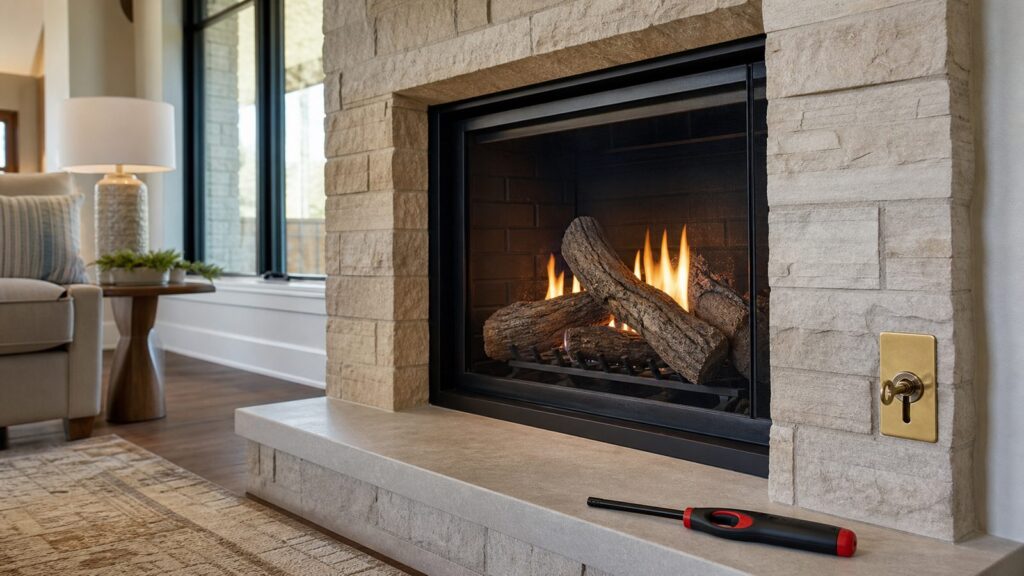
A gas fireplace with a wall key looks simple: insert the key, turn it, light the burner, enjoy the flame. In practice, the safe process depends on what type of fireplace you actually have. A wall key usually operates a manual gas shutoff or control valve in the gas line. It may not be the appliance’s full ignition system.
If you have decorative match-lit gas logs, the wall key may be the main control you use every time. If you have a gas insert, direct-vent fireplace, standing pilot system, wall switch, remote, piezo igniter, or electronic ignition, the correct lighting procedure is the one printed on the appliance label or in the owner’s manual. Mixing those procedures is where homeowners get into trouble.
As an Amazon Associate I earn from qualifying purchases.
Here is the short version: make sure there is no gas odor, confirm working carbon monoxide alarms, clear the firebox, open the damper or verify the venting setup, place a long lighter at the burner, then turn the wall key counterclockwise slowly just enough to start gas flow. Once the flame lights, adjust in small movements. If you smell gas, hear a delayed whoosh, see flame rollout, cannot identify the appliance type, or the fireplace does not light within a few seconds, stop and call a licensed plumber, HVAC/fireplace technician, or the gas utility.
30-Second Safety Checklist Before You Turn the Key
On our job sites, we treat any gas appliance as a system: fuel, ignition, venting, combustion air, clearances, shutoff access, and alarms. Before lighting a wall-key fireplace, run this checklist first.
#1 Best Overall

- 4-Pack Utility Lighters for Everyday Use – Includes four long stem utility lighters for BBQ, kitchen, candles, fireplace, grill, gas stove burners, camping, and household lighting needs.
- Flexible Long Stem for Hard-to-Reach Places – The extended flexible shaft helps you safely reach deep grills, candle jars, fireplaces, BBQ pits, and kitchen burners without getting too close to the flame.
- Wind-Resistant Multi-Purpose Flame – Designed as a wind resistant lighter for outdoor grilling, barbecue, camping, fire pits, and indoor use around the kitchen, candles, and fireplace.
- Easy Trigger Design & Assorted Colors – Click n Flame long lighters feature an easy push-button trigger, comfortable grip, and assorted colors, making them practical for BBQ, candle lighting, fireplace, and kitchen use.
- Great Value Pack for Home, Grill & Candles – This 4 pack of long lighters gives you multiple ready-to-use lighters for different rooms, outdoor cooking, emergency use, and everyday household convenience.
- No gas odor: If you smell rotten eggs or sulfur, do not light the fireplace. Do not operate switches. Leave the area and call the gas utility or emergency services from outside or a safe location.
- Working CO alarms: Carbon monoxide alarms should be installed on every level of the home and outside sleeping areas. Test them before fireplace season and replace expired units.
- Clear firebox: Remove paper, packaging, toys, pet items, loose decorations, dust piles, and anything stored near the burner or logs.
- Correct fireplace type: Confirm whether it is a match-lit gas log set, vented log set, ventless appliance, insert, or factory-built gas fireplace with its own controls.
- Venting confirmed: Open the damper for vented logs unless the manufacturer says otherwise. Keep exterior vents clear of leaves, snow, lint, and debris.
- Long lighter ready: Use a fireplace match or long butane lighter. A short lighter puts your hand too close to the burner.
- Manual nearby: If the unit has a pilot knob, igniter button, remote receiver, battery box, or electronic control module, follow the manufacturer’s instructions.
If you cannot pass that checklist, do not improvise. A basic diagnostic or service visit commonly runs about $125 to $350 in many U.S. markets in 2026. That is cheaper than guessing with gas, flame, and exhaust inside a finished home.
What the Wall Key Actually Does
The wall key fits into a square-stem valve, often mounted in the wall, floor, hearth, or fireplace surround near the firebox. Turning the key opens or closes a manual gas valve. In many installations, counterclockwise opens the valve and clockwise closes it.
Do these 3 things before closing this tab:
1Clear out junk files and repair common Windows errors2Scan for outdated or missing drivers - takes under a minute3Repair Windows errors before they cause bigger problemsThat valve may feed a simple match-lit gas log burner. In that setup, the homeowner places the ignition source near the burner first, then opens the valve slowly. The key controls the gas flow and flame height.
In other homes, the wall key may be only a service shutoff ahead of a more complex appliance. A gas insert or direct-vent fireplace may have a gas valve, pilot assembly, thermocouple, thermopile, ignition module, remote receiver, wall switch, or safety interlock inside the unit. In those cases, turning the wall key on does not mean the fireplace should light with a match.
Match-Lit Gas Logs vs Gas Inserts
This distinction matters enough to slow down for it. Decorative match-lit gas logs usually sit inside an existing masonry or approved factory-built fireplace. You see ceramic logs and a burner pan or tube. The wall key often controls the burner directly.
A gas insert is a self-contained appliance installed into an existing fireplace opening. It often has a glass front, sealed or semi-sealed combustion system, blower, pilot controls, rating plate, and manufacturer-specific instructions. Many direct-vent units should not be operated with the glass removed or lit manually unless the manual specifically allows it.
Quick wins for a faster PC:
Clear out junk files and repair common Windows errorsFree Scan →Fix the driver behind crashes, sound loss and screen glitchesFind Drivers →Ventless gas fireplaces and log sets are their own category. They are designed to burn very cleanly in the room, but they still add moisture and combustion byproducts indoors and may be restricted by local code or building policy. If you are not sure whether your fireplace is vented or ventless, stop and identify it before lighting.
How to Turn On a Match-Lit Gas Fireplace With a Wall Key
These steps apply to a decorative match-lit gas log set where the wall key controls the burner gas flow. They do not override the owner’s manual, appliance label, local code, lease terms, or instructions from your gas provider.
1. Open the Fireplace Doors or Screen
If your fireplace has operable glass doors, open them before lighting unless the manufacturer says otherwise. Screens can usually stay in place if they do not block access. Never light a gas burner behind closed decorative glass doors unless the fireplace is designed and labeled for that use.
Rank #2

- One 4-pack of BIC Classic Edition Multi-purpose utility lighters
- Safe, dependable, long-lasting lighters from America's No. 1 Lighter Brand
- The long durable metal wand on this multi purpose lighter helps keep fingers away from flame – great for grills, fireplaces and candles
- Each long lighter is child-resistant*, safe and 100% quality inspected
- Every BIC stick lighter undergoes more than 50 separate, automatic quality checks during the manufacturing process
2. Open the Damper or Confirm the Venting Requirement
For vented gas logs in a chimney, the damper must be open before lighting. Many vented gas log installations also require a damper clamp so the damper cannot fully close. For direct-vent and ventless appliances, follow the manufacturer’s instructions instead of assuming a chimney damper is involved.
3. Check for Gas Odor
Pause before you insert the key. Smell near the fireplace, near the valve, and low to the floor. Natural gas and propane are odorized so leaks are easier to detect. If you smell gas, do not attempt to light the fireplace. Leave the area and call the gas utility or emergency services from a safe location.
4. Find the Ignition Point
Look for the burner tube, pan, or the area where the flame is intended to start. Keep your face, hair, clothing, and hands out of the firebox opening. Use a long lighter or long fireplace match so the ignition source is already in position before gas is released.
5. Insert the Key Fully
Push the key all the way onto the square valve stem. A loose key can round the stem, slip while the valve is open, or fail to close the valve fully. Universal replacement fireplace keys commonly cost about $7 to $40 in 2026, often in 1/4-inch or 5/16-inch sizes. Decorative keys and longer keys cost more, especially with specialty finishes.
6. Light First, Then Open the Gas Slowly
Ignite the long lighter or match and hold the flame at the burner. With the flame already in place, turn the wall key counterclockwise slowly. A quarter-turn to half-turn is a common starting range for many match-light log sets, but valve behavior varies. Use the smallest movement that starts gas flow.
The burner should light promptly. Once it lights, remove the lighter and adjust flame height gradually with small key movements. Do not crank the valve wide open. A sudden whoosh, delayed ignition, flame rollout, or flame leaving the burner area means shut the gas off and call a pro.
7. Stay Nearby for the First Few Minutes
Watch the flame pattern. It should be stable and mostly contained around the burner and logs. Some yellow flame is normal on many decorative gas log sets, but heavy soot, black smoke, flame impingement in the wrong place, or a smell that does not clear quickly is not normal.
How to Shut Off a Wall-Key Gas Fireplace
Turn the key clockwise until the flame goes out and gas flow stops. Do not force the valve beyond its stop. Wait a few minutes and confirm there is no lingering gas odor.
Remove the key and store it in a known place away from children and guests. A labeled hook in a nearby utility closet, cabinet, or mechanical area is better than leaving the key in the valve. Leaving the key installed makes it too easy for a child, guest, or contractor to open the valve by mistake.
Free tools Windows power users keep installed
One-click scans. No signup required.
Rank #3

- 【EXTENDED & DURABLE】-V3 features a reinforced telescoping stainless-steel body that extends to a massive 38 inches (3.2 ft) — our longest reach ever. Designed for long-distance ignition tasks where stability and control matter most.
- 【FLAMELESS PLASMA ARC】-Powered by upgraded dual-arc plasma technology that uses plasma flameless arc technology for high energy ignition that’s smoke-free, dust-free, and windproof — reliable in any weather.
- 【Multi-Purpose Use】-Perfect for igniting fireplaces, furnaces, stoves, grills, candles, fireworks, pilot lights, fire pits, bbq, campfires, and hard-to-reach ignition points. A bright forward facing LED helps you find your point of ignition.
- 【Design Note】-V3 uses a rigid telescoping body with forward facing LED for maximum reach and stability. For customers who prefer a flexible rotating neck design, XTENDR ARCS also manufactures a separate model.
- 【User-Friendly】-Equipped with both a battery indicator, and ignition counter. USB-C fast charging restores power quickly, and the lighter can be used hundreds of times per charge depending on ignition duration.
If the flame does not go out when the key is turned clockwise, or if the valve feels stripped, loose, seized, or unreliable, leave the area and call for service. Do not try to repair a gas valve with pliers.
When to DIY, Call a Pro, or Call the Utility
A homeowner can usually operate a known, properly installed, match-lit gas log set. Troubleshooting gas piping, moving a shutoff, replacing a valve, diagnosing pilots, and opening walls or floors around gas lines belong to licensed trades.
| Situation | Best Action | Why It Matters |
|---|---|---|
| You know it is a match-lit gas log set, there is no gas odor, the damper is open, and the key fits correctly. | Reasonable to light yourself using a long lighter and slow key movement. | This is the normal homeowner-facing use case for many wall-key fireplaces. |
| The fireplace has a pilot knob, igniter button, remote, wall switch, sealed glass front, or electronic controls. | Use the manufacturer’s lighting instructions or call a fireplace technician. | The wall key may only be a shutoff, not the ignition control. |
| You smell gas before lighting, after shutoff, or while the fireplace is off. | Leave the area and call the gas utility or emergency services from outside. | Do not operate lights, switches, phones, or lighters inside the affected area. |
| The burner does not light within a few seconds. | Turn the key clockwise to off, wait, ventilate as appropriate, and call a pro. | Repeated attempts can allow unburned gas to collect in the firebox. |
| The key is missing, loose, rounded, or the valve is stiff. | Replace the correct key or have the valve inspected. | A poor fit can damage the stem or prevent full shutoff. |
| You are remodeling the wall, hearth, tile, stone, cabinets, or built-ins around the fireplace. | Coordinate with a licensed plumber or fireplace technician before finishes go in. | Valves, service panels, vents, and clearances must remain accessible. |
Common Mistakes That Create Real Risk
The most dangerous mistake is turning the wall key wide open before the lighter is in position. That can release too much unburned gas into the firebox. If ignition is delayed, the result can be a loud whoosh, flame rollout, cracked logs, damaged glass, or injury.
The second mistake is using a short lighter. Your hand should not be inside the firebox when gas starts flowing. Use a long butane lighter or fireplace match and approach from the side of the burner if the layout allows it.
Windows Errors? Fix Them Before They Spread
Repair common Windows errors and clear accumulated junk for a smoother, more stable PC - no reinstall needed.Free scan · no reinstallOutdated Drivers Are Slowing You Down
One free scan finds every outdated or missing driver and matches the right update for your exact hardware.Free scan · exact hardware matchAnother common mistake is assuming every gas fireplace with a key is match-lit. Many are not. A direct-vent insert with a sealed glass front and electronic ignition should be treated like an appliance, not like an open log lighter.
We also see valves buried during remodels. A tile installer, cabinet crew, or homeowner may cover a valve, trim plate, or service panel because it interrupts the design. That creates a service problem and may create a code problem. Gas shutoffs need to remain accessible. If the finish plan includes stone slabs, tile returns, built-ins, floating shelves, or a fireplace wall with a TV recess, locate the valve and access panels before layout is finalized.
Costs in 2026: Keys, Valves, Service, and Repairs
Costs vary by market, appliance type, access, and whether the issue is a simple missing key or a failing gas control system. The ranges below are realistic planning numbers for U.S. homeowners in 2026.
| Item or Service | Typical 2026 Cost | Notes |
|---|---|---|
| Replacement fireplace key | $7 to $40 | Universal 1/4-inch and 5/16-inch keys are common. Length and finish affect price. |
| Wall or floor trim plate | $10 to $50 | Also called an escutcheon. Match the valve size and finish. |
| Basic gas fireplace diagnostic or service visit | $125 to $350 | Peak fall and winter scheduling can cost more. Some companies credit the diagnostic toward repair. |
| General gas fireplace repair | $200 to $1,000 | National 2026 repair ranges often fall here, with many smaller repairs around a few hundred dollars. |
| Gas fireplace valve replacement | $150 to $300 average; $250 to $420 in some local price sheets | Access, leak testing, old fittings, and finish repair can raise the total. |
| Major valve, control board, line, or access repair | $500 to $1,200+ | Complex jobs can reach $1,200 to $2,500 when parts, access, and finish restoration are substantial. |
| New gas fireplace or insert installed | $2,300 to $8,000+ | Appliance, venting, gas line condition, permits, and finish materials drive the final number. |
If the key is simply missing, replacing it is usually inexpensive. Measure the valve stem and choose the correct key size. If the key slips or the stem is already rounded, do not keep forcing it. A damaged valve stem can turn a $20 key problem into a valve replacement, finish repair, and leak-test visit.
If the fireplace has not been serviced in years, budget for a full inspection before heating season. Annual service is especially smart for rentals, recently purchased homes, fireplaces that sat unused for a year or more, and homes where remodel dust may have entered the firebox, burner, pilot assembly, or blower compartment.
Rank #4

- [Flexible Long Neck Lighter & 360°Rotation ]:Weeleesh butane lighter has 9.8inc long 360°flexible stainless steel hose,6.7inc long stainless steel handle and 16.5inc in total length.The long-handled gas lighters can rotate 360 freely for your needs,The long neck design protects you from burning especially when lighting for cookers,wild explorer,wood burners,large candles and tea lighter.To follow USPS safety regulations,all lighters will be shipped without butane gas.
- [Utility Torch Lighter]Weeleesh butane torch lighter produces a powerful 2200°F flame, perfect for any task. Great for lighting candles,fireworks, fireplaces,grills, and BBQs.It’s also ideal for camping and hiking.
- [Visible Fuel Level Window]This refillable butane lighter has a 5ml fuel capacity for long-lasting use. The visible fuel level window lets you easily check when it’s time to refill, ensuring you always know your butane status.
- [Refillable & Adjustable Torch Lighter]Our butane lighter is refillable with any brand of butane (using a long nozzle stem). The adjustable flame wheel at the end allows you to easily control the flame height, giving you extra height whenever you need it.
- 【Quality Assurance】:We strive to provide you the highest quality products and the best service, you own 12 months promised warranty, please feel free to contact us if there is any doubt.
Code, Permits, and Shutoff Access
Gas work is not just a handyman task. Local fuel gas codes and the International Residential Code framework address appliance shutoffs, sediment traps, connector limits, combustion air, venting, and access. Exact requirements depend on jurisdiction, appliance listing, and installation details.
For homeowners, the practical rule is simple: operating an existing key valve is one thing; moving, replacing, concealing, extending, or modifying gas piping is permit-and-licensed-trade territory in many areas. Even when a permit is not required for a small repair, leak testing and proper materials still matter.
During remodels, we plan fireplace walls before the pretty materials are ordered. Tile, stone, millwork, cabinets, hearth extensions, mantels, and TV walls all need to respect gas valve access, appliance service panels, required clearances, vent paths, and manufacturer installation instructions. A valve behind a fixed cabinet panel or continuous stone face may look cleaner for a month, then become expensive the first time service is needed.
The Tool Desk
Outbyte Driver Updater FREEFix the driver behind crashes, sound loss and screen glitchesFind Drivers →Outbyte PC Repair FREERepair Windows errors before they cause bigger problemsFix Now →Carbon Monoxide and Venting Basics
Gas fireplaces burn cleaner than wood fireplaces, but they still involve combustion. Carbon monoxide is odorless and can be deadly. Install CO alarms on every level of the home and outside sleeping areas. Follow the alarm manufacturer’s placement instructions and replacement date.
Keep vents clear. For direct-vent fireplaces, exterior terminations can be blocked by snow, leaves, mulch, patio furniture, or construction debris. For chimney-vented gas logs, the chimney should be inspected and the damper position verified. For ventless appliances, follow the manufacturer’s room-size, run-time, maintenance, and air-quality requirements exactly.
Warning signs include headaches, dizziness, nausea, unusual moisture on windows, soot, stale odors, lazy flame, or alarms sounding. If a CO alarm activates, leave the home and call emergency services. Do not open the fireplace and investigate while people remain inside.
Planning a Fireplace Wall During a Remodel
In kitchen, bath, and room remodels, fireplaces often become part of a larger layout decision. Open-plan kitchens connect to living rooms. Fireplace walls get new tile, stone, plaster, built-ins, shelving, cabinets, mantels, soundbars, and large TVs. That is the right time to make the gas fireplace safer and easier to maintain.
Before finish work starts, identify the appliance model, gas valve location, vent route, required clearances, and service access. If the wall key is in an awkward spot, ask a licensed plumber whether relocation is allowed and practical before tile or stone is installed. If the fireplace is old, unreliable, or missing documentation, schedule service before the final surround is closed up.
We also coordinate CO alarm locations, outlet placement, low-voltage wiring, mantel heights, hearth dimensions, and combustible clearances early. A good fireplace wall is not just centered and attractive. It is serviceable, code-aware, and designed so the next technician does not have to remove finished materials to reach a shutoff or control panel.
Best Value

- 【EXTENDED & DURABLE】-Redesigned V2 grill lighter extends to 30.75 inches for safe distance from heat. Built with a sturdy stainless steel tube and smooth rotating hose for controlled lighting.
- 【MULTI-PURPOSE USE】-Perfect as a stove lighter, kitchen lighter, electronic grill lighter, candle lighter, fireplace lighter, fire pit lighter, pilot lighter, barbecue lighter, and fireworks lighter.
- 【FLAMELESS PLASMA ARC】-Uses plasma flameless arc technology for high energy ignition that’s smoke-free, dust-free, and windproof — reliable in any weather.
- 【BUILT-IN SAFETY】-Includes a safety lock switch and automatic 10-second shutoff to help prevent accidental use around children and pets.
- 【QUALITY YOU CAN TRUST】-XTENDR ARCS V2 is built to last. Questions or concerns? Our U.S. based brand and support team responds within 24 hours.
Bottom Line
To turn on a wall-key gas fireplace safely, identify the fireplace type first. For a known match-lit gas log set, clear the firebox, open the damper if required, check for gas odor, place a long lighter at the burner, insert the key fully, and turn counterclockwise slowly until the flame lights. Adjust with small movements. To shut off, turn clockwise until the flame stops, then remove and store the key.
Do not keep trying if it does not light promptly. Do not light anything if you smell gas. Do not treat a pilot or electronic ignition fireplace like a match-lit log set. And during any remodel, keep gas valves, vents, and service panels accessible before the finish materials lock the layout in place.
What’s actually slowing this PC down?
Pick the symptom - the matching free tool is one click away.
Frequently Asked Questions
Which way do you turn a gas fireplace key to turn it on?
Most wall-key fireplace valves open counterclockwise and close clockwise. Turn slowly and use small adjustments. The appliance label or owner’s manual should override any generic instruction.
Is it safe to light a gas fireplace with a wall key yourself?
It can be safe if it is a known match-lit gas log set, there is no gas odor, the damper or venting setup is correct, and you use a long lighter. If the fireplace has a pilot, remote, wall switch, sealed glass, or electronic ignition, follow the manufacturer’s instructions or call a pro.
What should I do if I smell gas before or after turning the key?
Do not light the fireplace, do not operate switches, and do not keep troubleshooting indoors. Leave the area and call the gas utility or emergency services from outside or another safe location.
Why will my gas fireplace not light even though the wall key is on?
Possible causes include a closed upstream shutoff, clogged burner, pilot problem, failed thermocouple or thermopile, electronic ignition issue, air in the line, incorrect lighting procedure, or a faulty valve. Shut it off and call a licensed fireplace, HVAC, or plumbing technician.
Quick wins for a faster PC:
Repair Windows errors before they cause bigger problemsFix Now →Fix the driver behind crashes, sound loss and screen glitchesFind Drivers →Clear out junk files and repair common Windows errorsFree Scan →Can I leave the fireplace key in the wall valve?
It is better to remove it after use and store it in a labeled location away from children and guests. Leaving the key installed makes accidental gas flow more likely.
How much does it cost to replace a gas fireplace key or valve in 2026?
A replacement key commonly costs about $7 to $40. A trim plate often costs $10 to $50. Gas fireplace valve replacement commonly runs about $150 to $300 on average, with some local 2026 pricing around $250 to $420 or more depending on access, labor, and leak testing.
Quick Recap
Product prices and availability are accurate as of the date/time indicated and are subject to change. Any price and availability information displayed on Amazon at the time of purchase will apply.

