Raspberries are manageable in a home garden when five basics are right: plant disease-free stock in full sun and well-drained soil, choose a cultivar suited to your climate, keep the row narrow, support the canes, and prune according to the plant’s fruiting type. The most important distinction is whether your raspberry fruits on second-year canes (summer-bearing or floricane-fruiting) or on current-season canes (fall-bearing or primocane-fruiting).
For many beginners, a locally adapted early- or mid-season primocane-fruiting red raspberry managed for one fall crop is the simplest choice. It can be cut to the ground during dormancy, avoiding the confusion of managing two cane ages. In a short-season area, however, a late fall crop may not ripen before frost, making a summer-bearing cultivar the better option.

As an Amazon Associate I earn from qualifying purchases.
First, decide whether raspberries fit your yard
Raspberries are not difficult, but they are long-term plants. A well-managed planting may remain productive for roughly 5 to 15 years, depending on the cultivar, soil, disease pressure, pests, and climate. The right site matters more than simply adding fertilizer.
What’s actually slowing this PC down?
Pick the symptom - the matching free tool is one click away.
- Sun: Choose the sunniest practical location. Raspberries tolerate some partial shade, but shade usually reduces both yield and fruit quality.
- Drainage: The soil should hold moisture without staying saturated. Waterlogged or heavy soil greatly increases the risk of Phytophthora root and crown rot.
- Air movement: Good circulation helps foliage and berries dry, but avoid a highly exposed site where winter winds can damage canes.
- Space: Leave room to harvest and prune from both sides of the row. An unmanaged patch quickly becomes a dense, thorny thicket.
- Crop history: Avoid planting where tomatoes, potatoes, peppers, eggplants, strawberries, or other brambles have recently grown. As a conservative rule, OSU recommends avoiding susceptible crops for approximately five years because of Verticillium wilt risk; follow your state Extension service if it gives a different crop-specific interval.
- Wild brambles: Do not plant immediately beside old or wild bramble patches when possible. They can harbor pests and diseases.
If water stands for days after rain, do not expect mulch or fertilizer to solve the problem. Use a raised bed or mound, improve the site’s drainage, or choose another location. A high water table or persistently wet clay may make raspberries a poor choice unless you can create a genuinely well-drained root zone.
#1 Best Overall

- Everbearing Variety: Enjoy two harvests of sweet, delicious red raspberries each year with this Heritage variety that produces fruit in both summer and fall, providing you with an extended harvest season for fresh berries throughout the growing months
- Mature Plants: Receive 3 large, 2-year-old bare root canes that are already established and ready to produce fruit sooner than younger plants, giving you a head start on your raspberry harvest with vigorous, well-developed root systems
- Cold Hardy: These Heritage raspberry plants are bred to withstand harsh winter conditions, making them ideal for northern climates and ensuring reliable growth and fruit production year after year even in challenging weather
- Sweet Flavor: Savor the classic, sweet taste of Heritage raspberries that are perfect for fresh eating straight from the garden, freezing for year-round enjoyment, or using in your favorite baking recipes, jams, and desserts
- Easy Growing: These vigorous and low-maintenance plants thrive in home gardens with minimal care, producing reliable yields season after season, making them an excellent choice for both beginner and experienced gardeners looking for consistent fruit production
Check the USDA 2023 Plant Hardiness Zone Map before choosing a cultivar. The map describes average annual extreme minimum temperatures; it does not account for summer heat, humidity, wet soil, late spring frosts, wind, snow cover, or your yard’s microclimate. Local growing experience and state Extension recommendations are equally important.
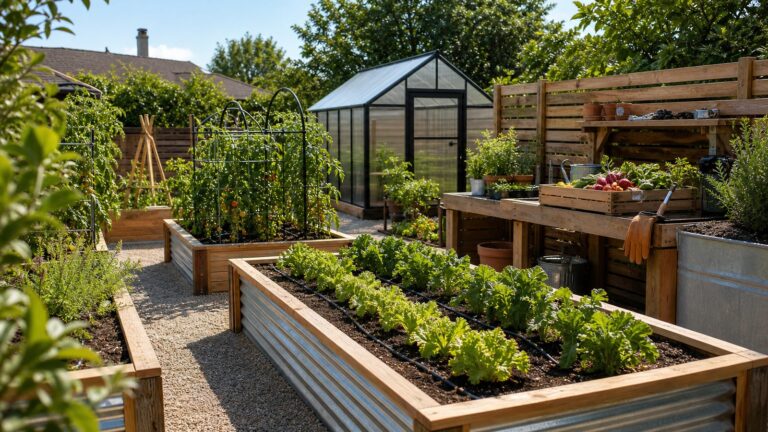
For a small garden, a narrow raised bed is often a better investment than trying to force raspberries into poor native soil. Containers are another option, but they require large containers and more frequent watering.
Choose the right raspberry type
Raspberry names such as “everbearing” can be misleading. The key question is not berry color but the age of the cane that carries the fruit.
Free tools Windows power users keep installed
One-click scans. No signup required.
| Common label | Technical label | Where fruit forms | Main harvest | Advantages | Limitations |
|---|---|---|---|---|---|
| Summer-bearing | Floricane-fruiting | Second-year canes | Summer | Concentrated crop; useful for fresh eating, freezing, and jam | Requires correct overwintering and management of two cane age classes |
| Fall-bearing or everbearing | Primocane-fruiting | Current-year canes, usually near the tips | Late summer and fall | Simple pruning; can fruit on first-year growth | Late cultivars may be stopped by frost, and the total crop can be lower |
| Black raspberry | Usually floricane-fruiting | Second-year canes | Summer | Intense flavor; excellent fresh or processed | Different pruning; often more winter- and disease-sensitive |
| Purple raspberry | Usually a floricane-fruiting hybrid | Second-year canes | Summer | Vigorous, flavorful fruit; useful for processing | Large, thorny plants with regional adaptation differences |
| Yellow or gold raspberry | Usually a color form of a red raspberry | Depends on the cultivar | Depends on the cultivar | Distinctive color with the same general culture as red raspberries | Some cultivars are late or soft, and ripeness can be harder to judge by color |
Red and yellow raspberries may be either summer-bearing or primocane-fruiting. Most black raspberries are summer-bearing. Always read the nursery description rather than assuming that “yellow,” “red,” or “everbearing” tells you how to prune.
Which type is best for a beginner?
Choose a primocane-fruiting cultivar managed for one fall crop if you want the simplest pruning, have limited space, or are concerned about winter injury to overwintering canes. Choose a summer-bearing cultivar if you want a concentrated summer harvest, live where fall arrives early, or prefer to freeze and process a large crop at once.
Primocane varieties can also be managed for two crops, but that does not guarantee a larger total harvest. It is a more complicated system, and the summer crop comes from overwintered cane sections that may suffer winter damage.
Choose a cultivar for your climate
Do not look for one nationally “best” raspberry variety. Select in this order:
Recommended Free Tools
- Fruiting type: summer-bearing or primocane-fruiting.
- Winter hardiness for your local conditions.
- Early, mid-season, or late ripening.
- Heat and drought tolerance if summers are hot.
- Root-rot tolerance if drainage is less than perfect.
- Resistance to important local cane diseases and Raspberry bushy dwarf virus.
- Thorniness, plant height, vigor, and trellis requirements.
- Intended use: fresh eating, freezing, jam, or an extended harvest.
Regional examples illustrate why location matters:
- Cold-climate Extension lists commonly include ‘Boyne’ and ‘Nova’ for cold hardiness. Primocane examples used in northern regions include ‘Autumn Britten,’ ‘Polana,’ ‘Heritage,’ ‘Joan J,’ and ‘Caroline.’ These are examples, not universal recommendations; consult the University of Minnesota cultivar information and your local Extension service.
- ‘Jewel’ is often recommended as a black raspberry in northern areas, but it is generally less cold-hardy than many red cultivars.
- In the Pacific Northwest, root-rot resistance can be decisive. The OSU Pacific Northwest cultivar guide discusses cultivars such as ‘Cascade Bounty,’ ‘Cascade Prize,’ ‘Prelude,’ and ‘Cascade Delight’ with differing disease profiles.
- In Pennsylvania and other cooler areas, late primocane cultivars may not finish before frost. The Penn State variety guidance is a useful example of why harvest timing must be matched to the local growing season.
Order early from a reputable nursery. Desirable cultivars may sell out before spring, and some cultivars may be protected by plant patents, which can restrict propagation or sale.
Buy clean planting stock
Buy certified, virus-indexed, disease-free plants from a reputable berry nursery. Bare-root dormant plants are economical and well suited to early-spring planting. Healthy potted or plug plants can be planted later, after the danger of hard frost according to local conditions.
Avoid digging suckers from an old patch or accepting “free” plants from a neighbor unless the disease status is known. Viruses cannot be cured, and shared suckers can carry infected roots, soilborne pathogens, or pests. A cheap plant can therefore contaminate the new planting before it begins.
Prepare the soil before planting
Test the soil
Test the future row several months before planting if possible. Sample the upper 12 to 18 inches, where much of the raspberry root system will grow. A practical target pH is approximately 5.6 to 6.5; Illinois gives a similar range of about 5.8 to 6.5.
The Tool Desk
Outbyte PC Repair FREERepair Windows errors before they cause bigger problemsFix Now →Outbyte Driver Updater FREEFix the driver behind crashes, sound loss and screen glitchesFind Drivers →Rank #2

- Plant Type & Variety: Heritage Everbearing Red Raspberry, a hardy perennial producing large, sweet-tart berries in summer and fall.
- Plant Age & Size: Each pack contains 5 large 2-year-old bare root canes, established roots with multiple buds ready to sprout.
- Growth & Habit: Canes grow 4–6 ft tall, upright and thornless to moderately thorny, suitable for trellising or open row planting.
- Sun & Light Requirements: Full sun (6–8 hours/day) promotes maximum fruit production. Partial shade reduces yield and fruit size.
- Culinary Uses & Benefits: Perfect for fresh eating, pies, jams, smoothies, freezing, or preserving. Rich in vitamin C and antioxidants, delivering both flavor and nutrition.
Use the soil-test recommendation to decide whether to add lime to raise pH, sulfur to lower it, or nutrients to correct a deficiency. Incorporate finished compost when needed to improve soil structure and organic matter, but do not treat compost and fertilizer as interchangeable. Compost can improve a heavy or sandy soil; it is not a precise substitute for a tested nutrient application.
Do not automatically add a high-nitrogen fertilizer before planting because raspberries are described as heavy feeders. OSU recommends supplying nitrogen after planting rather than relying on an assumed preplant requirement.
Prepare the row
- Remove turf, perennial weeds, and their roots.
- Correct drainage and pH before plants arrive.
- Mark the row so it can be kept approximately 12 to 18 inches wide.
- Install the trellis before the canes become difficult to manage.
- Prepare irrigation, preferably drip tubing or a soaker hose.
Plant raspberries step by step
- Prepare for delivery. Plant bare-root stock promptly. If delayed, keep roots cool and moist or heel the plants into moist soil or sawdust. Do not allow roots to dry.
- Dig a wide, shallow hole or trench. It should be wide enough to spread roots laterally without bending or coiling them.
- Set the plant at the correct depth. Place potted plants with the container mix level with the surrounding soil. For bare-root plants, follow the nursery’s instructions. OSU specifies the highest point where the roots attach to the cane at 1–2 inches below the soil surface, while other Extension guidance describes crown position differently for certain stock types. The safe practical rule is to plant at the nursery’s original depth and never bury the crown deeply.
- Spread the roots. Fan them outward through the soil rather than packing them into a tight bundle.
- Backfill carefully. Firm the soil gently to remove large air pockets, but do not compact it heavily.
- Water immediately. Thoroughly settle the soil around the roots.
- Cut back bare-root canes. OSU recommends cutting long bare-root canes to approximately 6 inches; other regional guidance gives 8–12 inches for red raspberries. Follow the nursery’s instructions for your stock.
- Mulch. Apply mulch after planting, keeping the crown and cane base free of buried, wet material.
- Remove first-year flowers if establishment is the priority. This is especially useful for potted or plug plants. Primocane cultivars may produce a small first-year fall crop when planted early and grown in a sufficiently long season, but timing and yield vary.
Plant spacing
Spacing depends on cultivar vigor, fruiting type, trellis design, and whether you are creating a hedgerow or individual hills:
- Red or yellow raspberries: commonly 18–24 inches to 2–3 feet apart; vigorous summer-bearing plants may need about 2½ feet.
- Black raspberries: commonly 3–4 feet apart because they are managed as individual hills rather than a spreading hedgerow.
- Purple raspberries: approximately 3 feet or more, depending on vigor.
- Row centers: at least 6½–8 feet in some home-garden guidance; 8–10 feet is common for wider hedgerow or hill systems.
Do not squeeze the rows together simply to fit more plants. You need walking and harvesting access, and a crowded row stays wet longer and is more difficult to prune.
Build a simple raspberry trellis
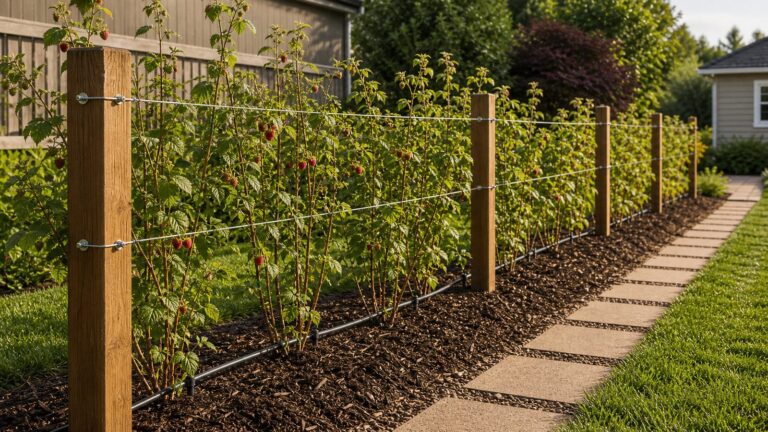
Even cultivars described as upright or self-supporting benefit from support. A trellis keeps fruit off the ground, limits wind breakage and cane sprawl, improves airflow, and makes pruning and harvesting safer and faster.
For a backyard row, use sturdy end posts approximately 5–6 feet long, with roughly 1–2 feet underground. Run durable wire or twine along both sides of the row. A simple open-field system can use wires at approximately 2, 3, and 4 feet above ground.
Primocane varieties often need only removable wires or twine at about 2 and 4 feet. Floricane varieties may need additional lower and upper support because fruiting laterals extend along the cane. A T-trellis with a cross-arm about 18 inches wide is useful for primocane, black, and purple raspberries.
Keep the trellis far enough from a wall or fence that fruiting laterals can be harvested from both sides. If you plan to mow primocanes for a single fall crop, make sure low wires, irrigation lines, and sensors can be removed or lifted first.
See the UMN home trellis guidance and its pruning and training diagrams for system-specific layouts.
Water, mulch, and fertilize correctly
Watering
Raspberries have much of their active root system in the upper soil profile, so consistent moisture is more useful than alternating drought and flooding. From flowering through harvest, use 1–1½ inches of water per week as a general starting point; other Extension guidance gives 1–2 inches during the growing season depending on soil and climate.
- Use a rain gauge rather than watering by the calendar.
- Check the soil several inches down before irrigating.
- Expect sandy soil, containers, hot weather, and heavy fruiting plants to need more frequent watering.
- Prefer drip irrigation or a soaker hose.
- Keep foliage and fruit dry when practical.
- Do not keep the soil continuously saturated.
Mulch and weed control
Keep grass and perennial weeds out of the row. Shallow raspberry roots are easily damaged, so avoid deep cultivation. A 2–3-inch mulch layer is a practical home-garden amount; some Maine guidance uses 3–4 inches of wood chips, bark, pine needles, or rotted leaf mulch.
Mulch conserves water and suppresses weeds, but excessively wet mulch or poorly drained soil can worsen root rot. Red and yellow raspberries send up root suckers outside the intended row. Cut or hoe unwanted suckers at soil level and sever connecting roots when necessary. Never allow herbicide to drift or overspray onto the plants; raspberries are especially sensitive to glyphosate.
Do these 3 things before closing this tab:
1Scan for outdated or missing drivers - takes under a minute2Clear out junk files and repair common Windows errors3Fix the driver behind crashes, sound loss and screen glitchesFertilizer
Do not use “apply 10-10-10 every spring” as a universal raspberry prescription. The correct rate depends on the soil test, organic matter, cultivar, vigor, and fertilizer analysis. Excess nitrogen produces lush, crowded growth and can aggravate some diseases, including spur blight.
As an advanced reference, UMN lists approximately:
- Planting year: 2–2½ ounces of actual nitrogen per 10 feet of row, depending on fruiting type.
- Established floricane varieties: about 2–3 ounces of actual nitrogen per 10 feet of row.
- Established primocane varieties: about 3 ounces of actual nitrogen per 10 feet of row, with additional nitrogen sometimes needed for late-fruiting types.
These are amounts of actual nitrogen, not ounces of the fertilizer product. A 10-percent nitrogen fertilizer requires twice as much product by weight as a 20-percent nitrogen fertilizer to supply the same nitrogen. Split applications are preferable to one large dose. Calculate from the product label or use your state Extension recommendation; the UMN nutrient-management guide explains the distinction.
Prune raspberries by fruiting type
Most pruning mistakes come from failing to identify a primocane and a floricane.
- Primocane: a first-year cane. It is usually green, though color and texture change with age. On primocane-fruiting varieties, it produces the main fall crop.
- Floricane: a second-year cane that has overwintered. It typically becomes browner and woodier. On summer-bearing varieties, it carries the summer crop and dies after fruiting.
When uncertain, do not cut everything down until you know the cultivar. Cutting every cane to the ground is correct for a primocane planting managed for one fall crop, but it removes the following summer’s crop from summer-bearing raspberries.
Summer-bearing red or yellow raspberries
- During the growing season, remove suckers outside the intended row.
- Immediately after harvest, cut the spent floricanes—the brown canes that have already produced fruit—to ground level.
- Remove diseased, broken, and weak canes.
- In late winter or early spring, thin the remaining canes to an open canopy.
- Keep the active row approximately 12–18 inches wide.
- Retain an open stand rather than a solid wall. Regional recommendations range from roughly 3–4 canes per linear foot to 4–6 canes per linear foot; UMN describes spacing fruiting canes about 6 inches apart. Use these as system-specific ranges, not a universal number.
- Tie the retained canes to the trellis.
Critical rule: do not remove the current-season green primocanes. They are next year’s fruiting canes.
Primocane-fruiting red or yellow raspberries: one fall crop
This is usually the simplest system:
- After fruiting in late fall, or while dormant in late winter or early spring, cut every cane to ground level.
- Before cutting or mowing, remove or raise low trellis wires, irrigation lines, and sensors.
- Allow new canes to emerge in spring and produce the fall crop on that season’s growth.
- Thin new growth to maintain an open, narrow row.
This approach sacrifices the early-summer crop but removes overwintering cane disease and avoids many winter-injury problems.
Primocane-fruiting raspberries: two crops
To obtain a possible summer crop and a fall crop, leave selected canes over winter. In spring, remove the dead fruiting tips back to the last visible fruiting node. Space retained canes about 6 inches apart. The lower portions may produce a modest summer crop, while new primocanes produce the late-summer or fall crop.
This method is more complicated and may not increase total yield. It is worthwhile mainly when two harvest windows are more valuable to you than simple maintenance.
Black and purple raspberries
Black and purple raspberries are usually trained as individual hills rather than as a spreading red-raspberry hedgerow:
- When new primocanes reach approximately 24–30 inches, pinch out their tips. This encourages lateral branches.
- After harvest, cut spent floricanes to ground level.
- During dormancy, shorten side branches to approximately 12–18 inches.
- Retain approximately 4–5 strong canes per hill.
- Tie those canes to a post or trellis.
Black raspberries are particularly vulnerable to anthracnose and Verticillium wilt in many areas. Certified stock, site selection, sanitation, and airflow are especially important. The UMN cane-disease guide provides useful diagnostic photographs and management details.
Rank #4

- You will receive healthy bare root plants. We always send extra plants. We want to make sure you are completely satisfied.
- You will see growth within 3 weeks. The most important part of planting these plants is to make sure you have at least 30% sand mixed into the soil.
- Our bare-root raspberry plants will not arrive with any soil when we ship them to you. The plants will be a dormant cane and healthy root systems. They will be packaged with damp strips of paper to keep the roots from drying out*. As much as they appear to be lifeless, they are actually dormant, which is a necessary resting state that helps with future fruit production. As a bonus, dormant plants experience less transplant shock, so their chances of survival are improved!
- Raspberry plants are as simple to grow as garden veggies, like tomatoes and peppers, but they go dormant in the fall and winter and come back each spring to bloom and fruit during the summer and fall!
Pollination: one cultivar is usually enough
Raspberries are generally self-fruitful, so you normally do not need a second cultivar for fruit set. They are not independent of insects, however: bumblebees, honeybees, and native bees transfer pollen and improve fruit set and berry completeness.
Poor pollination can produce small, misshapen, or crumbly berries. Encourage bee activity with suitable flowering plants and avoid insecticide applications during bloom unless treatment is genuinely necessary, permitted by the label, and timed to protect pollinators. See OSU’s berry-pollination guidance for the distinction between self-fruitful plants and pollinator activity.
Quick wins for a faster PC:
Repair Windows errors before they cause bigger problemsFix Now →Scan for outdated or missing drivers - takes under a minuteDriver Scan →Clear out junk files and repair common Windows errorsFree Scan →Harvest and store the fruit
Pick raspberries when they are fully colored for the cultivar, plump, and tender. A ripe raspberry separates easily from the white receptacle or core with a gentle pull. If it resists, leave it to ripen longer.
- Harvest every 3–4 days under ordinary conditions, and more often during hot, wet, or spotted-wing-drosophila-prone weather.
- Pick when the fruit is dry if possible.
- Use shallow containers and avoid piling berries deeply.
- Refrigerate immediately.
- Do not wash until just before eating.
- Cool rapidly to approximately 33°F for the best quality. Properly harvested fruit may retain fresh quality for roughly 3–7 days.
- Freeze or process fruit promptly if it will not be eaten quickly.
As a regional benchmark, OSU reports approximately 18–27 pounds per 10 feet of row for a mature summer-bearing red or yellow planting. This is not a guaranteed backyard yield; primocane and black raspberry yields are commonly lower, and climate and management make a large difference.
Independent reader supportYour contribution helps us test, update, and keep practical guides available for everyone.Prevent the pests and diseases that ruin crops
Spotted-wing drosophila
Spotted-wing drosophila (SWD) is one of the most important modern raspberry pests in many U.S. regions. Unlike ordinary fruit flies, females can lay eggs in ripening fruit. Larvae develop inside berries, sometimes with little visible warning until the fruit softens or collapses.
- Harvest ripe fruit promptly—often daily during peak season.
- Remove overripe, damaged, and fallen fruit.
- Do not leave cull fruit beside the row.
- Use fine exclusion netting after flowering and once fruit is present. Do not cover plants during bloom if the netting prevents pollinators from reaching flowers.
- Use pesticides only under current local Extension guidance and exactly according to the product label, including crop, rate, timing, and preharvest interval.
See the UMN SWD guidance and OSU’s netting demonstration.
Outdated Drivers Are Slowing You Down
One free scan finds every outdated or missing driver and matches the right update for your exact hardware.Free scan · exact hardware matchPC Slower Than It Used to Be?
A free scan shows the junk files, broken settings and background clutter dragging Windows down - then fixes them in one click.Free scan · Windows 10 & 11Gray mold and fruit rot
Gray mold is encouraged by wet fruit, crowded canopies, overripe berries, poor air circulation, and overhead irrigation. Start with cultural controls: keep the row narrow, thin canes, use drip irrigation, harvest promptly, remove rotten fruit, and maintain sanitation. The UMN raspberry-disease guide covers additional symptoms and controls.
Root and crown rot
Possible symptoms include cane dieback beginning near the base, wilting or collapsing fruiting laterals, poor vigor, dark or water-soaked crown tissue, and reddish-brown roots beneath the outer tissue. Drainage is the primary prevention. Raised beds can help, but they will not reliably rescue infected stock planted into a chronically wet site.
Cane diseases
Spur blight, cane blight, and anthracnose are favored by wet conditions, crowded rows, wounds, and poor sanitation. Reduce risk by maintaining a narrow row, improving airflow, using drip irrigation, handling canes carefully, removing spent floricanes after harvest, and cutting out infected material. Remove diseased plant material from the planting rather than leaving it in the row.
Viruses and crumbly fruit
Raspberry bushy dwarf virus can cause crumbly, poorly formed berries even when the plant retains normal vigor. The virus is pollen-borne and can spread through pollinator visits; there is no cure for an infected plant.
If crumbly fruit persists, do not assume the cause is simply underwatering. Check pollination conditions, compare symptoms across cultivars, and contact a local Extension plant-diagnostic service. Remove confirmed infected plants and replace them with certified stock. Crumbly fruit is a symptom, not a diagnosis.
Best Value

- Thornless & Easy to Harvest: Joan J is a nearly thornless raspberry variety, making picking fast, comfortable, and kid-friendly.
- Large, Sweet Red Raspberries: Produces big, firm, bright red berries with excellent flavor—ideal for fresh eating, freezing, jams, and desserts.
- Everbearing / Fall-Bearing Variety: Fruits on new canes, providing reliable late-summer to fall harvests and easier pruning than summer-bearing types.
- Cold Hardy & High Yielding: Thrives in a wide range of climates (USDA Zones 4–8) and delivers heavy crops once established.
- Live, Healthy Plant Ready to Grow: Shipped dormant or actively growing (seasonal). Performs best in full sun with well-drained soil and regular watering.
Insects and animals
- Japanese beetles and mites: Scout the foliage regularly and consult current local Extension recommendations before treating.
- Birds: Use bird netting or fine exclusion netting where necessary.
- Deer: Fence the planting if browsing is common.
- Rabbits: Use chicken wire or hardware cloth around the planting during winter.
- Squirrels: Secure netting and remove fallen fruit.
Any netting must be firmly secured and checked so animals cannot become trapped.
Diagnose common raspberry failures
| Symptom | Likely causes | First response |
|---|---|---|
| No fruit | Wrong pruning, shade, a late cultivar, winter injury, or frost | Identify the cane type and review pruning; check light and local harvest timing |
| Crumbly berries | Poor pollination or Raspberry bushy dwarf virus | Improve bee habitat and seek a plant diagnosis if the problem persists |
| Mushy berries with larvae | Spotted-wing drosophila | Harvest more often, remove culls, and consider exclusion netting |
| Gray mold | Wet fruit, dense canopy, or overripe berries | Improve airflow, use drip irrigation, and harvest promptly |
| Cane dieback | Cane disease, winter injury, borers, or root rot | Inspect the cane and crown; remove affected material and check drainage |
| Yellow or white drupelets | Heat or sunscald | Improve site protection; fruit is generally edible |
| Patch spreading everywhere | Root suckers | Maintain a narrow row and sever unwanted suckers at soil level |
Yellow leaves, wilting, cane death, and poor fruit can have several causes. Treat the table as a starting point, not a definitive diagnosis. When the cause is unclear, submit a sample or photographs to your state or county Extension plant clinic.
Growing raspberries in containers
Raspberries can grow in containers, but ordinary small pots are inadequate for a perennial plant with an expanding root system.
- Use a container at least 2 feet deep; a 20–30 gallon container is a practical size.
- Use a well-drained potting medium rather than heavy garden soil.
- Prefer a primocane-fruiting cultivar for easier pruning.
- Thin a 20–30 gallon container to approximately 5–8 primocanes, depending on cultivar vigor.
- Provide an obelisk, trellis, or other sturdy support.
- Monitor water and fertilizer more closely than you would for an in-ground row.
- Expect lower total production than from a well-managed in-ground planting.
Black and purple raspberries are often easier to manage as individual container plants because they do not produce the same spreading root suckers as red raspberries. Place containers where they receive full sun and cannot dry out unnoticed during hot weather. Follow the OSU home raspberry guide for additional container considerations.
Seasonal raspberry-care calendar
Before planting
- Check your USDA zone and local Extension recommendations.
- Order certified, disease-free stock.
- Soil-test the future row.
- Correct drainage and pH.
- Remove turf and perennial weeds.
- Install the trellis and irrigation.
Spring
- Plant dormant bare-root stock as soon as the soil is workable.
- Plant potted or plug stock after the danger of hard frost according to local conditions.
- Water immediately.
- Apply the first split fertilizer application if recommended.
- Prune dormant canes according to fruiting type.
- Thin shoots and maintain row width.
Summer
- Irrigate consistently from flowering through harvest.
- Tie or tuck canes into the trellis.
- Remove unwanted suckers.
- Tip black raspberry primocanes at 24–30 inches.
- Scout for Japanese beetles, mites, cane diseases, and SWD.
- Harvest ripe fruit frequently.
After harvest
- Remove spent floricanes from summer-bearing varieties immediately or soon after harvest.
- Remove diseased canes from all types.
- Keep fallen and overripe fruit out of the patch.
- For a single fall crop, cut primocane varieties during dormancy rather than automatically after the last berry.
Late fall and winter
- Protect vulnerable cultivars from winter injury according to local guidance.
- Use a rabbit fence where browsing is common.
- In cold climates, consider primocane cultivars or varieties with documented hardiness.
- Do not leave diseased canes in the planting.
A practical decision guide
| Choose this option | When it makes sense |
|---|---|
| Summer-bearing raspberry | You want a concentrated summer crop, live in a short-fall-season region, or are willing to manage two cane ages |
| Primocane raspberry | You want simple annual pruning, a fall harvest, or better avoidance of overwintering cane injury |
| Raised bed | Native soil stays wet, is heavy clay, or has a high water table that can be corrected by elevating the root zone |
| Container | Garden soil is unsuitable or space is limited, and you can provide a deep, large container with frequent irrigation |
Do not plant raspberries in the proposed location if water stands for days after rain, the site has a recent history of susceptible crops and no alternative location, you cannot access both sides of the row, or you cannot provide regular harvest and pruning. Also avoid a cultivar whose harvest consistently overlaps your region’s first hard frost.
Frequently Asked Questions
Should I cut all raspberry canes to the ground?
Only if the plants are primocane-fruiting and you want one fall crop. Do not cut every cane to the ground on summer-bearing raspberries, because their current-season canes carry next summer’s fruit.
Do I need two raspberry varieties for pollination?
Usually not. Raspberries are generally self-fruitful, so one cultivar can produce fruit. Bees are still needed to transfer pollen; poor pollination can cause small, misshapen, or crumbly berries.
How long does it take raspberries to produce fruit?
Summer-bearing raspberries generally do not produce a meaningful crop in the planting year. Primocane varieties may produce a first-year fall crop if planted early, grown in a long enough season, and kept vigorous, but timing and yield vary by stock type and cultivar.
Why are my raspberries spreading outside the row?
Red and yellow raspberries produce root suckers. Cut unwanted shoots at soil level and sever connecting roots when needed. Maintain the productive row at approximately 12–18 inches wide.
Can raspberries grow in a pot?
Yes, but use a container at least 2 feet deep, preferably 20–30 gallons, with well-drained potting medium, sturdy support, and regular irrigation. Primocane-fruiting cultivars are usually easiest in containers.
The Bottom Line
The reliable raspberry formula is simple: start with certified plants suited to your region, give them full sun and excellent drainage, test the soil instead of blindly fertilizing, support the canes, keep the row narrow, irrigate consistently, and identify the cane type before pruning. If you want the least complicated system, grow an adapted primocane cultivar for one fall crop. If your season is short or you want a concentrated summer harvest, choose a suitably hardy summer-bearing cultivar and preserve its current-season canes for the following year.
Quick Recap
Product prices and availability are accurate as of the date/time indicated and are subject to change. Any price and availability information displayed on Amazon at the time of purchase will apply.