Free tools Windows power users keep installed
One-click scans. No signup required.
Some links on this page are affiliate links: if you buy through them we may earn a commission, at no extra cost to you.
The lasting way to get rid of bathroom mold is to control the moisture that feeds it. Find and repair the leak, condensation problem, or ventilation failure first. Then assess the size of the growth and the material it has affected, protect yourself, clean mold from hard surfaces, and remove porous materials that cannot be completely cleaned and dried.
A small patch on tile or glass may be a reasonable DIY project. Mold covering more than about 10 square feet, growing inside walls or ceilings, involving sewage-contaminated water, or returning after cleaning calls for professional evaluation.
As an Amazon Associate I earn from qualifying purchases.
Before you clean: determine whether it is a DIY job
Mold is a symptom of excess moisture. In a bathroom, the source may be obvious—such as shower condensation or a dripping faucet—or hidden behind caulk, beneath a cabinet, around a toilet, inside a wall, or above a ceiling.
Inspect the shower and tub joints, grout, caulk, plumbing connections, the toilet supply line and base, sink plumbing, ceiling penetrations, cabinet bases, and the wall or ceiling around the bathroom. Look for recurring dark spots, peeling paint, swollen drywall, soft materials, persistent condensation, or a musty odor. Do not begin by spraying the visible stain if water is still entering the area.
Popular on Amazon
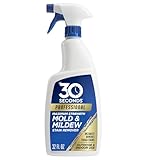
- BRIGHTER RESULTS INSTANTLY: Noticeably brightens indoor and outdoor surfaces, removing black mold and mildew stains as you watch, with no scrubbing or pressure washing required for fast, visible results
- NO SCRUBBING REQUIRED: Avoid the hassle and backbreaking work of scrubbing tough stains; the PRO formula lifts mold and mildew stains on contact so you simply apply, watch and rinse where needed
- 2X STRONGER FORMULA: The PRO formula is 2X stronger than the standard 30 SECONDS Outdoor Cleaner, made for your toughest black mold and mildew stains and messes on both indoor and outdoor surfaces
- OUTDOOR AND INDOOR USE: Use on siding, fences, decks, concrete floors, brick walls, drywall, wood, kitchen surfaces, bathroom tile and grout, bathtub soap scum and showers where mold and mildew can grow
- REMOVES BLACK MOLD STAINS & MORE: Targets stubborn black mold and mildew stains on a wide range of surfaces, giving a brighter, cleaner result indoors and outdoors without scrubbing or pressure washing
A small cleanup may be suitable for a homeowner when all of these are true:
- The affected area is smaller than about 10 square feet—roughly a 3-by-3-foot patch.
- The mold is on a hard, nonporous surface such as tile, glass, metal, fiberglass, or a sound finished surface.
- There is no sewage or other contaminated water involved.
- You do not suspect mold inside a wall, ceiling, cabinet, insulation, or HVAC system.
- The moisture source can be repaired and the area can be dried fully.
Stop and arrange professional help if the area is larger, water damage is extensive, porous materials are broadly affected, the mold keeps returning, or the source cannot be found. If an HVAC system may be contaminated, do not run it until it has been evaluated; the system could distribute mold through the building.
What’s actually slowing this PC down?
Pick the symptom - the matching free tool is one click away.
Who should not clean bathroom mold?
People with asthma, COPD, chronic lung disease, significant mold allergies, or weakened immune systems may face a greater health risk during cleanup. They should get appropriate medical guidance and, in some cases, stay away from the moldy space while it is being cleaned. Children should not perform mold cleanup.
Damp or moldy environments can cause no symptoms in some people, but others may develop nasal congestion, sore throat, coughing, wheezing, burning or itchy eyes, skin irritation, or worsening asthma. Seek medical care for breathing difficulty, a severe reaction, or persistent symptoms. Avoid treating a symptom as proof of so-called “mold toxicity”; a clinician is the right person to assess health concerns.
How to remove a small amount of mold safely
1. Repair the moisture source first
Fix leaking supply lines, drains, faucets, shower valves, toilet connections, roof or wall penetrations, and failed shower joints before cleaning. If the problem is condensation, determine why the room stays damp: inadequate exhaust, a fan that vents into an attic or wall cavity, insufficient heating, or humidity that remains high after showers.
Dry wet materials promptly. Materials that stay wet for roughly 24 to 48 hours may need removal or replacement, particularly when they are porous. Cleaning mold while the wall or ceiling is still damp only hides the immediate evidence while the growth continues behind the surface.
Recommended Free Tools
2. Prepare the room and protect yourself
Open a window if outdoor conditions make that helpful, and run an exhaust fan that vents outdoors. Avoid creating an air current that carries moldy dust into the rest of the home. In particular, do not point a portable fan directly at the moldy surface.
For a small cleanup, gather a NIOSH-approved N95 respirator, protective gloves, and sealed goggles. Goggles that seal against dust and small particles provide more protection than open-vent safety glasses. An N95 filters particles; it is not a substitute for ventilation or protection from chemical vapors, so follow the cleaner’s label and leave the area if you develop irritation or breathing symptoms.
Remove towels, toiletries, and other movable items from the work area. Bag disposable cleaning materials before taking them through the house. Keep children and anyone at elevated health risk out of the room during the work.
3. Clean hard, nonporous surfaces
Tile, glass, metal, fiberglass, and other hard surfaces can usually be cleaned by physically scrubbing the mold away with detergent and water. Work from the least affected area toward the most affected area, avoid splashing, and follow the product label if you use a cleaning solution.
- Apply detergent and water to the affected surface.
- Scrub until visible mold and residue are removed.
- Rinse or wipe as appropriate for the surface.
- Dry the surface and nearby joints, edges, and ledges completely.
Physical removal matters. Simply killing mold does not remove the mold particles or residue, and dead mold can still trigger allergic reactions in sensitive people.
4. Treat bleach as an optional, limited-use chemical—not the default cure
Routine use of chlorine bleach or another biocide is not generally necessary for ordinary mold cleanup. The essential work is correcting moisture, scrubbing the surface, removing residue, and drying it. Sterilizing an entire bathroom is neither practical nor required once the moisture problem is controlled.
Also popular on Amazon

- KILLS MOLD: EPA-registered formula kills mold and helps control mold and mildew on hard, nonporous surfaces when used as directed
- CLEANS AND DISINFECTS: Ready-to-use disinfectant cleaner provides non-acid cleaning performance while disinfecting treated hard, nonporous surfaces
- INHIBITS MILDEW GROWTH: Helps inhibit the growth of mold and mildew and the odors they cause when applied according to label directions.
- BLEACH-FREE FORMULA: Bleach-free cleaner deodorizes treated surfaces and leaves behind a fresh scent
- READY-TO-USE SPRAY: 32 fl oz trigger bottle is designed for household, commercial and industrial cleaning applications
CDC guidance allows a solution of no more than 1 cup of household bleach per 1 gallon of water for some hard-surface cleanup. If you choose bleach, check the product label, use it only on a compatible surface, provide ventilation, and follow all directions. Never mix bleach with ammonia, vinegar, acids, or any other cleaning product. Mixing cleaners can produce dangerous gases.
Do not assume that vinegar, hydrogen peroxide, essential oils, or a branded “mold killer” is universally better. No spray can compensate for a leak, wet drywall, failed caulk, or a bathroom fan that does not exhaust outdoors.
5. Handle grout and caulk according to their condition
Surface mold on intact grout or caulk may come off with careful scrubbing. If the grout is soft or crumbling, the caulk has separated, the joint repeatedly becomes moldy, or staining extends behind the caulk bead, cleaning alone is unlikely to solve the problem.
The durable repair sequence is:
- Remove failed or mold-affected caulk and damaged grout.
- Find and correct the moisture source.
- Clean the exposed substrate.
- Allow the joint and substrate to dry completely.
- Apply new bathroom-appropriate caulk or grout according to the manufacturer’s instructions.
Never paint or caulk over visible mold. The new coating may peel, and the trapped moisture can allow growth to continue underneath.
6. Remove porous materials that cannot be cleaned completely
Drywall, ceiling tile, insulation, carpet, cardboard, fabric, and other absorbent materials can hold mold in pores and crevices. If they are visibly moldy, swollen, soft, repeatedly damp, or impossible to dry fully, replacement is often safer and more effective than repeated surface spraying.
A small, superficial mark on a sound painted wall is not the same as a bathroom ceiling that is sagging or soft. Do not cut into a wall or ceiling casually if plumbing, electrical wiring, or structural components may be present. Extensive removal should be assessed by an appropriately qualified professional.
Quick wins for a faster PC:
Clear out junk files and repair common Windows errorsFree Scan →Scan for outdated or missing drivers - takes under a minuteDriver Scan →Repair Windows errors before they cause bigger problemsFix Now →Why bathroom mold keeps returning
Recurring mold usually means the bathroom is still receiving or retaining too much moisture. Common causes include:
- A shower or tub leak behind the wall or under the floor.
- Failed caulk or grout allowing water into the assembly.
- A toilet supply connection, toilet base, sink trap, or cabinet connection that drips slowly.
- An exhaust fan that is undersized, not working, or vented into an attic, wall cavity, or other interior space.
- Condensation on cold walls, ceilings, pipes, or windows.
- Humidity that remains high long after the shower ends.
- Wet towels, shower curtains, bath mats, or standing water that are not drying.
Cleaning the spot without correcting one of these conditions is why the problem often appears to be “immune” to mold sprays.
How to keep mold from coming back
Keep bathroom humidity under control
Use a digital hygrometer to see what the bathroom’s humidity actually does during and after a shower. The meter diagnoses the conditions; it does not remove mold. CDC recommends keeping indoor humidity as low as possible and no higher than 50% all day. EPA describes below 60% as a control target, with 30% to 50% considered ideal.
If humidity remains high, use air conditioning or a dehumidifier as appropriate for the building and climate. A portable dehumidifier can provide supplemental humidity control, but it is not a replacement for repairing a leak or exhausting shower air outdoors. Empty and clean the unit as directed and maintain its filter, drain, and collection components so it does not become a source of moisture or biological contamination.
Exhaust shower moisture outdoors
Run the bathroom exhaust fan during a shower and afterward. The duct must discharge outdoors—not into an attic, wall cavity, crawlspace, or another room. Venting into a concealed space simply moves the moisture to a location where it can damage framing, insulation, and sheathing.
If the bathroom lacks effective mechanical ventilation, a properly installed bathroom exhaust fan may be the most important improvement. Installation may require new ductwork, an exterior termination, electrical work, or access above the ceiling, so use a qualified installer when the work exceeds your skills or local requirements. Clean the grille and maintain the fan so dust does not reduce airflow.
As a useful benchmark—not a universal requirement for every existing home—EPA Indoor airPLUS guidance describes controls that run a demand-controlled bathroom fan while the room is occupied and for at least 20 minutes afterward, or until humidity falls below 60%. The right runtime depends on the fan, ducting, room, climate, and control system.
Opening a window during and after a shower can help when outdoor air is relatively dry and clean. In hot, humid, rainy, or polluted weather, an open window may add moisture or pollutants; mechanical exhaust, air conditioning, or dehumidification may work better.
Also popular on Amazon
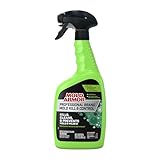
- KILLS, CLEANS & PREVENTS MOLD AND MILDEW: Kill and clean up mold and mildew on your hard, non-porous surfaces with MOLD ARMOR Professional Brand Mold Kill & Control.
- FAST RESULTS, NO SCRUBBING REQUIRED: This mold and mildew cleaner features a fast-acting formula that produces visible results in minutes without scrubbing.
- IDEAL FOR USE ON laminate, linoleum, sealed grout, stainless steel and plastic surfaces. Professional Brand Mold Killer eliminates bacteria and viruses on shower stalls and garbage cans as well as in your bathroom, bedroom and basement.
- EASY TO USE: Test on an inconspicuous area before use. Apply to stains and wait 10 minutes. Rinse with water or wipe with a damp sponge within 15 minutes of application. Rinse food contact surfaces with potable water.
- INHIBIT NEW MOLD GROWTH: To prevent mold and mildew growth, thoroughly wet surface, allow to air dry and repeat every 7 days. Effective against Aspergillus niger. Pre-clean heavily soiled surfaces.
Dry the surfaces and contents
- Wipe water from shower walls, ledges, and floors when practical.
- Spread the shower curtain so it can dry instead of folding wet layers together.
- Hang towels so they dry fully, and do not store damp towels in a poorly ventilated bathroom.
- Repair dripping fixtures promptly.
- Keep bath mats and washable fabrics dry between uses.
- Check the ceiling, corners, cabinet bases, and plumbing access points periodically for new moisture.
These habits reduce surface moisture, but they cannot substitute for repairing a leak or fixing inadequate ventilation.
Use moisture-tolerant materials when repairing the room
When replacing trim or finishes in a wet area, choose materials that do not readily absorb water. EPA gives PVC molding as one example of a bathroom material that may be used instead of a more porous material such as wood. If you are renovating, discuss moisture-resistant bathroom trim and appropriate substrates with the installer rather than relying on paint alone.
Mold-resistant paint or additives may have a role after the surface has been cleaned, dried, and repaired. They are a finishing measure, not a way to seal in active mold or wet materials.
Independent reader supportYour contribution helps us test, update, and keep practical guides available for everyone.A practical bathroom mold-prevention schedule
| When | What to do | What it reveals |
|---|---|---|
| During every shower | Run the exhaust fan and keep water directed into the tub or shower enclosure. | Whether moisture is being removed at its source. |
| After every shower | Keep the fan running, spread the curtain, and wipe standing water when practical. | Whether surfaces are drying instead of staying damp. |
| Weekly | Clean the fan grille, inspect caulk and grout, and check under the sink and around the toilet. | Reduced airflow, failed joints, and small plumbing leaks. |
| Monthly | Check humidity readings and inspect corners, ceiling penetrations, cabinet bases, and painted surfaces. | Persistent high humidity or concealed moisture clues. |
| After any leak | Stop the water, dry materials promptly, and assess porous materials for removal. | Whether the damage can be dried or needs professional evaluation. |
When to call a mold-remediation or restoration professional
Arrange an evaluation by an experienced professional mold remediation or water-damage restoration provider when:
Outdated Drivers Are Slowing You Down
One free scan finds every outdated or missing driver and matches the right update for your exact hardware.Free scan · exact hardware matchPC Slower Than It Used to Be?
A free scan shows the junk files, broken settings and background clutter dragging Windows down - then fixes them in one click.Free scan · Windows 10 & 11- The moldy area is larger than about 10 square feet.
- There has been substantial water damage or the materials stayed wet for an extended period.
- Sewage or other contaminated water caused the damage.
- Mold may be inside walls, ceilings, cabinets, insulation, or HVAC components.
- Porous materials are extensively affected or cannot be dried promptly.
- Mold returns after cleaning because the leak, condensation, or ventilation problem remains unresolved.
- A resident has a significant respiratory condition, immune suppression, or another health concern that makes cleanup risky.
When comparing contractors, look for demonstrated mold-cleanup or water-damage experience, check references, and ask what recognized professional or government guidance the provider will follow. Be cautious of anyone who promises that a single spray, test, or treatment will permanently make the bathroom safe without investigating the moisture source.
Do you need a mold test?
Usually, no. CDC does not recommend routine home mold testing because there are no established health-based indoor mold limits, and short-term air sampling does not reliably determine whether a home is safe or what health risk a person faces. A visual inspection, moisture investigation, and attention to musty odors are generally more useful for deciding what needs to be cleaned, dried, repaired, or removed.
The color of a mold patch also does not establish that it is more or less dangerous. Treat any indoor mold growth as evidence of a moisture problem rather than trying to identify a supposedly more hazardous color or species.
Frequently Asked Questions
Is black mold more dangerous than other bathroom mold?
Color does not reliably identify a mold’s health risk. CDC and NIOSH advise treating any indoor mold growth as evidence of a moisture problem and addressing the moisture, rather than trying to classify the patch by color. People with breathing difficulty, severe reactions, or persistent symptoms should seek medical care.
The Tool Desk
Outbyte Driver Updater FREEScan for outdated or missing drivers - takes under a minuteDriver Scan →Outbyte PC Repair FREERepair Windows errors before they cause bigger problemsFix Now →Can I use bleach to remove bathroom mold?
Bleach is not the default solution. Scrubbing with detergent and water, removing residue, drying the surface, and correcting the moisture source are the central steps. CDC materials allow no more than 1 cup of household bleach per 1 gallon of water for some hard-surface cleanup, provided the label and ventilation requirements are followed. Never mix bleach with ammonia, vinegar, acids, or other cleaners.
Should I paint over mold or apply new caulk over it?
No. Paint and caulk applied over moldy or damp surfaces are likely to peel and can conceal continuing moisture. Remove the failed material, clean and dry the substrate, correct the source, and then refinish or recaulk.
How do I know if bathroom mold is too extensive for DIY cleanup?
Professional evaluation is appropriate for areas larger than about 10 square feet, sewage contamination, extensive water damage, suspected hidden mold, affected HVAC systems, broadly damaged porous materials, recurring growth, or cleanup situations involving someone with a significant respiratory condition or weakened immune system.
Will a home mold test prove that my bathroom is safe?
No. Routine testing is not generally recommended because there are no established health-based indoor mold limits and short-term samples cannot reliably establish safety. Inspect the visible growth, locate the moisture source, and assess whether materials can be cleaned and dried completely.
Do these 3 things before closing this tab:
1Fix the driver behind crashes, sound loss and screen glitches2Repair Windows errors before they cause bigger problems3Scan for outdated or missing drivers - takes under a minuteThe Bottom Line
Bottom line: Remove bathroom mold by fixing the water problem, cleaning or removing the affected material, and drying the area completely. Keep it away with outdoor exhaust, humidity control, prompt leak repairs, and regular inspections. If the growth is extensive, hidden, sewage-related, embedded in porous materials, or repeatedly returning, skip the spray-and-repeat cycle and call a qualified professional.
Quick Recap
Product prices and availability are accurate as of the date/time indicated and are subject to change. Any price and availability information displayed on Amazon at the time of purchase will apply.

