Free tools Windows power users keep installed
One-click scans. No signup required.
To fix moisture behind a wall, find and correct the water source first. Then dry the assembly, assess damaged materials, and repair the wall using a design suited to its climate and construction. Do not paint over a wet wall or add interior plastic sheeting as a quick fix: either can hide or trap moisture without solving the cause.
A damp patch may come from a plumbing or roof leak, rain or foundation water, humid air leaking into a cavity, or condensation on a cold surface. Those problems can look alike, so the first job is to follow the water rather than assume that a stain means condensation.
As an Amazon Associate I earn from qualifying purchases.
How to tell what is making the wall wet
Look for patterns before opening or repairing the wall. Note when the dampness, staining, musty smell, peeling paint, or buckling appears and whether it changes after rain, snowmelt, plumbing use, showers, or a spell of cold or hot weather. Also note the exact location: a patch below a window, beside a pipe, near a roofline, at the base of a basement wall, or on an exterior wall can point toward different sources.
Keep a short record of what you observe: the location, when it appears, what the weather was like, and whether plumbing, cooking, showering, or heating and cooling had been in use. This can help distinguish a moisture pattern from a one-time mark and give a plumber or building specialist useful context. It does not identify the source on its own; stains can appear away from the point where water entered, and more than one moisture mechanism can be involved.
#1 Best Overall

- Wellness Indicator: This humidity meter with humidity level icon indicates air conditions - DRY/COMFORT/WET, allowing this humidity sensor to ensure you’re always aware of changes to your home/household with just a quick glance
- High Accuracy & Quick Refresh Rate: This inside thermometer features a high accuracy of +/-2 to 3%RH and +/-1°F, making it ideal for measuring fluctuating readings like those found in a greenhouse, data measurements are updated every 10 seconds to give you the latest updates on your environment
- High & Low Records: This hygrometer digital thermometer displays high/low temperature and humidity levels to allow you to make proper comparisons using your home’s data
- Healthier Home & Environment: This thermometer hygrometer with temperature and humidity monitor ensures proper indoor humidity that achieves important health benefits for skin and allergen, can also serve as a refrigerator thermometer, freezer thermometer, reptile thermometer, soil thermometer, humidor hygrometer, cigar hygrometer, and more
- Practical Design: This indoor room thermometer features a tabletop stand and a magnetic back, place the temperature monitor on your counter or fridge; °F/°C selector; Includes 1 AAA battery
Check accessible areas around the affected wall. Look for roof and window leaks, failed flashing, blocked or poorly directed downspouts, ponding water, plumbing connections, and HVAC equipment or ducts that may leak. In a basement, check whether surface water drains away from the foundation and whether the wall becomes damp after rain. Do not assume that an indoor humidity problem explains water that appears in one recurring, localized spot.
Bulk water: leaks, rain, and foundation entry
Liquid water can enter through a leaking roof or pipe, failed window or wall details, poor drainage, or a foundation. A leak may be hidden behind drywall or in a pipe chase, and the visible mark may be some distance from the entry point. Moisture that appears after rain or plumbing use is a reason to investigate those systems, not proof by itself of the precise leak location.
“Condensation” does not rule out a leak. Both a concealed leak and condensation can leave dampness or staining, so a persistent or unexplained wet area may require inspection by a plumber or building-envelope professional. Likewise, room humidity readings cannot establish that a wall is free of bulk water. Follow evidence from the wall and nearby systems rather than relying on a single clue.
PC Slower Than It Used to Be?
A free scan shows the junk files, broken settings and background clutter dragging Windows down - then fixes them in one click.Free scan · Windows 10 & 11Outdated Drivers Are Slowing You Down
One free scan finds every outdated or missing driver and matches the right update for your exact hardware.Free scan · exact hardware matchCondensation and air leakage
Condensation forms when humid air meets a surface colder than the air’s dew point. In a heating climate, that cold surface may be on the exterior side of a wall assembly. In a hot, humid climate, outdoor air entering a cooled wall can encounter a cold interior surface. The season and the wall’s construction therefore matter when diagnosing condensation.
Moisture can travel with moving air through gaps as well as diffuse through materials as vapor. Air leakage can carry moisture into a wall cavity and deposit it on a cold surface; adding a vapor retarder alone does not stop air movement or correct the leak path. The repair may need to address water entry, air control, insulation, and drying together.
Rank #2

- Face Icon Comfort Indicator: Humidity temperature gauge features face icons to indicate DRY/COMFORT/WET air conditions, quickly informs you how to adjust your humidifier or dehumidifier to achieve optimal comfort.
- Highly Accurate Sensors: This temperature humidity sensor features a high accuracy of +/-1°F/°C and +/-2% to 3%RH, making it ideal for measuring dynamic environments like greenhouses.
- Fast Refresh Rate: This digital indoor thermometer refreshes every 10 seconds to provide the latest updates for temperature and humidity readings.
- Compact Display with Large Digits: This digital thermometer indoor outdoor features a compact LCD display with large bold digits, allowing you to read the room thermometer indoor from any angle and distance.
- Mini Size, 3-Way Mount, Use Anywhere: Compact mini humidistat with 3 placement options — Tabletop Stand / Magnetic Back / Hanging Mount, easily fits a nursery, baby room, craft room, grow tent, greenhouse, chick brooder, RV, outdoor patio, kitchen, guitar room, office or cellar.
These are different transport paths, so do not treat “moisture” as one problem with one universal product solution. A roof or plumbing leak calls for stopping liquid-water entry. Humid indoor air may call for ventilation or dehumidification as well as investigating air movement. Vapor diffusion is a separate consideration in selecting wall layers. A wall can also have overlapping problems—for example, a rain-entry issue and a cavity surface made vulnerable by air leakage—so correcting just one path may not resolve recurring wetness.
Use gauges as clues, not a hidden-wall diagnosis
A humidity gauge or meter can show room-air relative humidity and how it changes over time. It cannot reveal the condition of every concealed surface. A consumer moisture meter may help compare readings at different locations, but a single reading does not prove the source or provide a definitive diagnosis of the wall. The EPA supports using a humidity gauge or meter to measure indoor humidity; it does not specify a consumer building-material meter as a way to diagnose a hidden wall.
The Tool Desk
Outbyte PC Repair FREERepair Windows errors before they cause bigger problemsFix Now →Outbyte Driver Updater FREEFix the driver behind crashes, sound loss and screen glitchesFind Drivers →For recurring or concealed wetness, get the right expertise for the suspected cause: a plumber for a likely pipe leak, a building-envelope or building-science specialist for wall behavior and rain entry, or a qualified restoration professional for substantial water damage or contamination. Near electrical equipment, or where there may be structural damage, avoid treating a reading or surface inspection as clearance to proceed.
Fix the problem in the right order
Repairing the finish before stopping the water can conceal damage while the wall remains wet. Work through the cause, drying, and rebuilding in sequence. The extent of opening or removal depends on what is wet, how long it has been wet, and whether the water is contaminated. The aim is not simply to make the visible surface look better; it is to stop the moisture path and ensure affected materials are dry or appropriately removed before closing the wall.
- Stop active water entry. Repair a confirmed plumbing or roof leak. Correct rain entry, flashing, drainage, or HVAC condensate problems when those are implicated. Direct surface water away from the foundation rather than allowing it to pond beside the wall. If the location of a concealed leak is uncertain, seek help to find it rather than patching the most visible stain.
- Reduce indoor moisture when it is part of the problem. Use kitchen and bathroom exhaust that discharges outdoors, vent the clothes dryer outdoors, and consider a dehumidifier if a room remains too humid. Persistent humidity may also warrant checking HVAC operation or sizing. These steps do not replace repairing a roof, pipe, foundation, or wall leak. A dehumidifier addresses room air; it does not correct a wet wall assembly by itself.
- Dry the building and contents promptly. The U.S. Environmental Protection Agency advises drying wet buildings and furnishings quickly, generally within 24–48 hours, to reduce the chance of mold growth. That is a general drying target, not a guarantee that every material will be dry or undamaged by that point. Wet porous materials may need removal or professional assessment, depending on the extent and conditions. Do not interpret the time interval as a reason to close a wall before the cause has been fixed and the assembly assessed.
- Assess hidden damage before closing the wall. Visible staining may not show the full extent of wet insulation, mold, or material deterioration. Open or remove materials only as needed and safely. Extensive growth, persistent water, suspected structural damage, or water from flooding or sewage calls for experienced professional help; ordinary drying advice is not a substitute for special procedures after contaminated-water events. EPA recommends professional expertise when structural integrity may be affected.
- Rebuild for the actual wall and climate. Consider how the wall sheds bulk water, controls air movement, handles vapor diffusion, insulates, and dries. The right arrangement depends on the climate, whether the wall is above or below grade, the cladding, insulation location, and existing layers. Check applicable local code and have complex or insulated wall assemblies assessed before adding layers. A repair that blocks one moisture path but also blocks the assembly’s drying path can leave a continuing problem.
- Repair the finish last. The EPA’s homeowner guidance is direct: “Do not paint over wet or moldy walls. First, fix the water problem, and then paint.” Once the source has been resolved and the wall is dry, repair and repaint as appropriate. A fresh coat of paint can cover a stain, but it does not verify that a leak has stopped or that hidden materials have dried.
Why an interior vapor barrier is not a universal fix
A vapor retarder slows vapor diffusion through a material; it is not a substitute for stopping bulk water or controlling air leaks. Adding a very restrictive layer in the wrong place can limit a wall’s ability to dry. That is why “put plastic on the warm side” is not a safe rule for every location or wall. A generic interior plastic sheet can be particularly risky when the existing assembly and its drying direction have not been identified.
Rank #3

- 1-【Widely Application】The digital LCD monitor can be used in home, office, garage, schools, hotels, laboratories, kindergartens, aquaculture, instrument workshop, warehouse, reptile tank terrarium, aquarium, hermit crab habitat, and other places where temperature/humidity measurement is required.
- 2-【Fast Response】Built in sensitive sensor that measures every 10 seconds with 24 sensitive VENTS to provide updated and accurate readings, wide measuring range: work temperature from 0℃ to 70℃(+32°F ~ +158°F), work humidity from 10% to 99% RH.
- 3-【Healthy Living Monitor】This portable thermo-hygrometer Measures Indoor humidity and temperature in time, help to adjust the humidifier, dehumidifier settings and humidistats, great for monitoring family's living conditions and health by preventing colds, dry skin, great for your work and life.
- 4-【Fahrenheit/Celsius】The Temperature display can achieve the mutual conversion between Fahrenheit (°F) and Celsius (°C). Temperature measurement accuracy: ±1°F, Humidity measurement accuracy: ±3%RH.
- 5-【Long Service Life】This thermo-Hygrometer Powered by one LR44 button cell and one backup button cell. Each LR44 button cell’s working time up to 10 months. Any problem in use, We will definitely Provide you a satisfactory solution.
The U.S. Department of Energy says the need for a vapor retarder depends on climate zone and cladding, and that one is not required in many cases. Its vapor-permeance classes are defined by perm rating:
Do these 3 things before closing this tab:
1Clear out junk files and repair common Windows errors2Fix the driver behind crashes, sound loss and screen glitches3Repair Windows errors before they cause bigger problems| Class | Vapor permeance | What the classification tells you |
|---|---|---|
| Class I | 0.1 perm or less | A very low-permeance retarder; the rating alone does not establish that it belongs in a particular wall. |
| Class II | Greater than 0.1 through 1.0 perm | A middle permeance range; the rating alone does not select the correct material or location. |
| Class III | 1.0 perm or more | A higher permeance range; the rating alone does not prove that an assembly will manage moisture safely. |
These classes describe vapor permeance, not a complete wall design. The direction of seasonal moisture movement, the wall’s ability to dry, and its other control layers still matter. A class rating is not a product recommendation and should not be used by itself to select a layer for an existing damp wall.
Below-grade and warm-humid wall cautions
For interior-insulated below-grade walls, DOE Building Science Education warns against placing a Class I vapor retarder on the interior side of air-permeable insulation: moisture may be trapped and unable to dry inward. It gives a similar caution for above-grade walls in warm-humid climates. These are assembly-specific cautions, not a blanket prescription for every basement or climate.
Adding insulation changes temperatures within a wall. If humid air can leak to a surface made colder by that change, condensation risk may also change. For a retrofit, have the complete assembly considered—including existing layers and drying paths—instead of choosing insulation or a vapor retarder by itself. The question is not only which material slows vapor, but also how the wall will manage rain, air leakage, insulation, and drying after the change.
Control indoor humidity and prevent recurrence
The EPA recommends keeping indoor relative humidity below 60%, ideally between 30% and 50% where possible. A humidity gauge can help identify trends and show whether a room is persistently humid. A dehumidifier can help manage excess room humidity, for example in a damp basement, but it is not a repair for water entering through a pipe, roof, foundation, or wall. Treat the humidity target as one part of moisture management, not proof that a concealed wall is dry.
Rank #4

- Face Icon Comfort Indicator: Humidity temperature gauge features face icons to indicate DRY/COMFORT/WET air conditions, quickly informs you how to adjust your humidifier or dehumidifier to achieve optimal comfort
- Highly Accurate Sensors: This temperature humidity sensor features a high accuracy of +/-1°F/°C and +/-2% to 3%RH, making it ideal for measuring dynamic environments like greenhouses
- Fast Refresh Rate: This digital indoor thermometer refreshes every 10 seconds to provide the latest updates for temperature and humidity readings
- Compact Display with Large Digits: This digital thermometer indoor outdoor features a compact LCD display with large bold digits, allowing you to read the room thermometer indoor from any angle and distance
- Multiple Placement Options: This humidistat has 3 placement options - Tabletop Stand / Magnetic Back / Hanging Mount, place the wall thermometer anywhere you wish such as living room, baby room, kitchen, greenhouse, guitar room, office or cellar
- Run kitchen and bathroom exhaust fans so they discharge outdoors, and vent the clothes dryer outdoors.
- If a room remains humid, consider a dehumidifier and maintain it according to its instructions.
- Keep roof and wall drainage working, direct downspout discharge away from the foundation, and correct ponding or poor grading.
- Investigate recurring stains promptly rather than covering them. If a musty smell or condensation returns after a repair, revisit the diagnosis.
Prevention means keeping both water and moisture pathways in view. Drainage and sound roof and wall details help manage rain and surface water; outdoor-vented exhaust and humidity management help with indoor moisture; and a wall design suited to its climate manages air movement, vapor diffusion, and drying. No one of these measures compensates for a known leak left unrepaired.
Independent reader supportYour contribution helps us test, update, and keep practical guides available for everyone.When to call a professional
Get professional help when the source is concealed or recurring, moisture is near electrical equipment, mold is widespread or hidden, insulation is wet or deteriorating, or you suspect rot or structural damage. A wall that needs to be opened or redesigned around new insulation may also require a specialist. Water from flooding or sewage needs appropriate expertise because contamination changes cleanup requirements.
- Plumber: when the evidence points to a pipe, fixture, or plumbing connection.
- Building-envelope or building-science specialist: when rain entry, condensation, insulation, air leakage, or the wall’s drying behavior needs assessment.
- Qualified restoration or remediation professional: for substantial water damage, extensive hidden contamination, or a cleanup beyond a small, straightforward repair.
The EPA recommends professional expertise when a concealed leak is difficult to locate and when structural integrity may be affected. Avoid closing a wet wall or relying on a cosmetic repair when the underlying condition has not been established. The appropriate professional depends on the suspected source: a plumber can investigate plumbing, while wall assembly behavior or rain entry may call for envelope expertise.
Choose a repair by the wall, not the stain
Before selecting materials or closing an opened wall, make sure the repair addresses the conditions that caused the moisture and leaves a safe path for drying. These questions help frame that decision:
- What is the source? Distinguish plumbing, roof or rain entry, foundation water, humid indoor air, air leakage, and HVAC condensation.
- What are the climate and season? Heating and cooling conditions can change which surfaces are cold and the direction of moisture drive.
- How is the wall built? Identify whether it is above or below grade, its cladding and drainage details, where insulation sits, and whether vapor-control layers already exist.
- Where can the assembly dry? Consider whether it can dry toward the interior, exterior, or both after the proposed repair.
- How extensive is the damage? A small surface issue differs from concealed wet insulation, mold, rot, contaminated water, or possible structural damage.
- How will the repair be verified? Confirm that the water source has stopped and the materials are dry; a concealed stain or new finish is not proof that the underlying problem is gone.
There is no universal wall recipe or single product rating that resolves every case. Compare proposed repairs by whether they stop the identified source, suit the climate and construction, preserve a viable drying path, and can be checked before the finish is restored. If those conditions are unknown, get the assembly assessed before adding an impermeable layer or closing it up.
Best Value
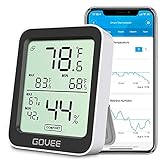
- Smart Features: The Govee Wireless Thermometer Hygrometer supports all basic functions as well as smart functions such as remote monitoring and temp humidity graphs. Our humidity meters are reliable and easy to use for homes, greenhouses and more.(Only supports 164ft Bluetooth connection)
- High Accuracy and Fast Refresh Time: With the Swiss-made smart hygrometer sensor, the temperature is accurate up to ±0.54°F while the humidity is ±3%RH, a 40% increase. Up to 2S refresh speed always gives you the lastest changes of temp and humidity.
- Upgraded Display: This room humidity gauge is easy to read due with a 3-inch bright LCD screen with large numbers. The max/min temp humidity records and the comfort indicators (dry/comfort/wet) will keep you aware of the indoor humidity at any time.
- Smart App Alerts: You'll receive an instant alert once the temperature or humidity is out of its preset range. Know the status of your bedroom, baby room, wine cellar, basement, plant nursery or other areas, even when you're not beside the device.
- Free Data Storage: Make plans according to historic temp and humidity data. The 20-day curve graphs provide a clear data-changing track. You can export data from the past 2 years and convert it to a CSV format. Stay on track of your daily routine.
Frequently Asked Questions
How can I tell if a damp wall is a leak or condensation?
Look for patterns: note whether the dampness follows rain, snowmelt, plumbing use, showers, or seasonal hot or cold weather, and inspect nearby roofs, windows, plumbing, drainage, and HVAC equipment. Leaks and condensation can look alike, and a stain may be away from its source, so an unexplained or recurring wet spot may need professional investigation.
Should I put a vapor barrier on the inside of a damp wall?
Not as a generic fix. The need and location of a vapor retarder depend on climate, cladding, and the complete wall assembly. A restrictive layer in the wrong place can trap moisture or limit drying; DOE specifically cautions against an interior Class I retarder over air-permeable insulation in certain below-grade and warm-humid wall assemblies.
How humid should my home be to help prevent moisture problems?
EPA recommends keeping indoor relative humidity below 60%, ideally 30–50% where possible. A humidity gauge can track room air, while outdoor-vented exhaust and a dehumidifier can help manage excess indoor humidity. These measures do not replace fixing a leak or other water-entry problem.
How quickly should a wet wall be dried?
EPA advises drying wet buildings and furnishings quickly, generally within 24–48 hours, to reduce the chance of mold growth. This is a general target, not a guarantee that all materials are dry or undamaged; wet porous materials, extensive water, or contaminated water may need professional assessment.
When should I call a professional about moisture behind a wall?
Seek help for a concealed or recurring leak, moisture near electrical equipment, widespread or hidden mold, wet or deteriorating insulation, suspected rot or structural damage, or flooding or sewage. Use a plumber for suspected plumbing leaks, an envelope or building-science specialist for wall and rain-entry issues, and qualified restoration or remediation help for substantial damage or contamination.
The Bottom Line
Find the moisture source before repairing the finish. Stop water entry, manage indoor humidity where relevant, dry and assess the assembly, and rebuild for the actual climate and wall. Avoid generic interior plastic sheeting, and do not paint over wet or moldy material.
Quick Recap
Product prices and availability are accurate as of the date/time indicated and are subject to change. Any price and availability information displayed on Amazon at the time of purchase will apply.
Recommended Free Tools