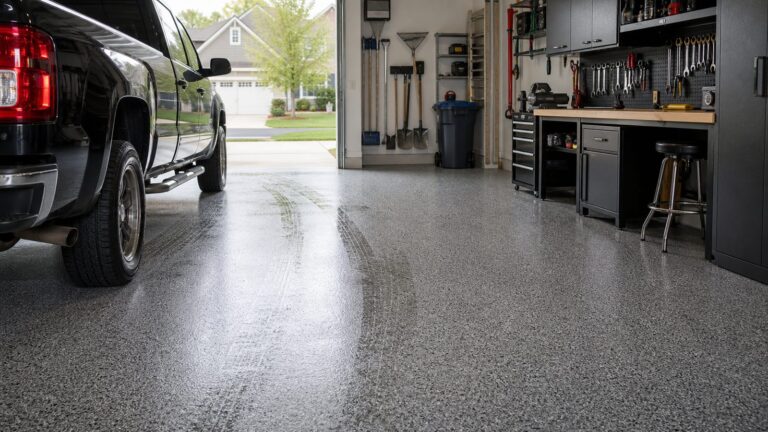
Choose a protective coating by matching the exposure and the condition of the surface—not by choosing a resin name first. Identify what the coating must resist, inspect the concrete or metal, then select a compatible, product-specific system and prepare the surface to its requirements. A label such as “epoxy” does not by itself establish that a product is suitable for a particular chemical, immersion, traffic, or substrate.
Start with the exposure the surface must withstand
Write down the service conditions before comparing products. A coating exposed to occasional splashes has a different job from one kept underwater, and a floor crossed by vehicles faces different stresses from a wall that is only washed periodically. The best choice is the system whose documented limits match the actual conditions—not the one with the broadest-sounding label.
As an Amazon Associate I earn from qualifying purchases.
Record the kinds of exposure
- Water: Note whether water contact is occasional, frequent washdown, prolonged wetting, or continuous immersion. Include wet-and-dry cycling and any moisture concerns beneath or within the substrate.
- Chemicals: Identify the specific chemical or cleaning agent, its concentration if known, temperature, and whether contact is a splash, spill, intermittent wash, or immersion. For chemical service, ask the manufacturer for resistance information covering those conditions; general statements such as “chemical resistant” are not enough to establish suitability.
- Corrosion and weather: For metal, consider the environment that can drive corrosion. For either substrate, record sunlight exposure and whether the finish must retain its appearance outdoors.
- Mechanical stress: Describe traffic, abrasion, impact, equipment movement, and the consequences of wear-through. A low-traffic surface and a heavily used industrial floor should not be assumed to need the same coating build.
- Cleaning and temperature: List cleaning methods, detergents or chemicals, water temperature, and the temperature range expected during service and application.
- Use requirements: Note required appearance, color, texture, slip characteristics, and whether cracks need to be bridged. These requirements can narrow the options, but they do not override substrate or exposure compatibility.
The American Concrete Institute’s 2024 guide, ACI PRC-515.2-24, covers selecting protective treatments for concrete exposed to aggressive chemicals. It treats its guidance as a starting point, not a substitute for confirming that a specific product is available and appropriate for the application. Its central caution is: “In all cases, specific recommendations from material producers should be followed instead of the general guidance given in this guide, as individual treatment types vary widely within a specific product type.”
Free tools Windows power users keep installed
One-click scans. No signup required.
Inspect the substrate before choosing the system
A coating can only perform as intended when the substrate is suitable and prepared for it. Determine what the surface is made of, what condition it is in, and what existing layers or contamination may interfere with adhesion. Inspection findings influence both the coating choice and the preparation work.
#1 Best Overall

- Valued Carpenter Pencil Set: You will get 2 pcs solid carpenter pencils with 26 piece 2.8 mm refills, 1 replaceable sharpener, 1 plastic storage box.The complete carpenter pencils combination allows you to finish your work faster and more easily
- Deep Hole Marker Pencil: The deep-hole construction pencils adopts 45mm elongated tip design, which is more convenient to mark in the small hole or in other tight areas that other carpenter markers cannot reach
- Carpenter Pencils with Sharpener: The sharpener is screwed into the top of the work pencil, which won't get lost either. Built-in pencil sharpener that keep the lead with pointed and smooth to Improves line of sight in fine work
- Stronger Solid Lead: This work pencil is matched with a 2.8 mm thick lead , which is much thicker and stronger during the drawing process of construction work, it will not break or damage easily
- Marks on Various Surfaces: 3 colors solid construction pencil can marks on various surfaces,such as metal, plastic, wood, paper etc. Ideals for woodworkers, contractors, craftsmen, builders, merchants and masons
What to check on concrete
- Look for unsound, weak, or deteriorated areas, along with cracks, voids, laitance, and other defects.
- Identify dirt, oils, other contamination, existing coatings, and any moisture-related problems.
- Consider whether the surface is smooth, rough, or uneven and whether the selected system calls for a particular profile.
- Establish whether defects need assessment or repair before coating. A protective coating should not be treated as a repair for unsound concrete.
Concrete composition and condition vary, so preparation intensity cannot be decided from the word “concrete” alone. AMPP’s guidance on concrete preparation and coating selection emphasizes that the appropriate work depends on how compromised the surface is. A product’s moisture limits and preparation instructions also matter; do not assume that a surface that looks dry meets them.
What to check on metal
- Identify the metal type and note corrosion, contamination, old coating, and areas where the surface is damaged.
- Determine whether the specified cleaning method and surface profile can be achieved on the actual structure.
- Check whether the old coating is to remain, be repaired, or be removed, and whether the proposed system is compatible with it.
- Consider access, enclosure, dust control, and other site constraints that may affect the specified preparation method.
Do not assume that a coating described for “metal” is suitable for every metal or for a corroded, previously coated surface. Confirm the substrate and condition against the current product documentation and project specification.
Understand the main coating categories
Concrete protection can involve penetrating treatments, sealers, or film-forming coatings. Film-forming products may also be described by build, such as thin-build or thick-build systems. These terms help organize the options, but category descriptions are not performance guarantees. Formulation, application, substrate preparation, and service conditions determine whether a particular product will work.
Rank #2

- Ergonomically Designed: Work in tight areas with a compact design that gets into tough spots
- Compact and Lightweight: Both tools are designed to fit into difficult to reach spaces. The 1/4" impact driver has a length of 5.55 in. and weighs just 2.8 lbs, while the 1/2" drill/driver measures only 7.5 in. and weighs 3.6 lbs
- Both the DEWALT impact driver and electric drill driver feature integrated LED work lights with a convenient 20-second delay, ensuring enhanced visibility in dimly lit or challenging work areas
- One-Handed Loading - Keep one hand free with a 1/4 in. hex chuck that accepts 1 in. bit tips
- Power drill cordless with 1/2" single sleeve ratcheting chuck provides tight bit gripping strength, making bit changes faster and more secure
| Category | What it generally does | What to verify |
|---|---|---|
| Penetrating treatment | Penetrates into concrete rather than relying only on a continuous film at the surface; silane and siloxane treatments are among the families identified by ACI. | Confirm the product’s approved substrate, intended exposure, application requirements, and whether its protection meets the project need. Do not assume a penetrating treatment performs like a film-forming coating. |
| Sealer | Provides a treatment for concrete, with properties that depend on the particular product and system. | Check the intended service, moisture and vapor considerations, appearance, preparation, and reapplication or maintenance information stated by the manufacturer. |
| Thin-build film-forming coating | AMPP describes thin-build coatings as generally easier to apply and suited to smoother conditions with lower traffic or impact, with limited resistance to mechanical stress. | Confirm whether its documented build and performance are suitable for the actual traffic, impact, abrasion, chemical, and water exposure. |
| Thick-build or high-build system | AMPP describes thick-build systems for more routine or severe abrasive, mechanical, or chemical stress, including some high-traffic and immersion uses. | “High-build” does not prove that a product suits a particular chemical, immersion condition, or substrate. Verify the exact product limits, system layers, and installation conditions. |
ACI lists epoxy, polyurethane, silane/siloxane, and other treatment families for concrete. The family name alone does not establish suitability: two products in the same broad category can differ in intended use and requirements. If a protective material is bonded to concrete, ACI says bond strength should be evaluated and producer or specifier requirements met.
For metal, evaluate the complete compatible coating system rather than shopping for a topcoat in isolation. Depending on the specification, the system may include surface preparation, a primer, intermediate layers, stripe coats, and a topcoat. DoD facilities criteria include specific compatibility restrictions—for example, alkyd coatings must not be applied directly to concrete or zinc-rich surfaces. That is a system-specific rule to follow where applicable, not a reason to infer compatibility from resin names alone.
Match the coating build and system to the job
Use the exposure record and inspection findings together. A coating that can tolerate a chemical under intermittent contact may not be documented for continuous immersion. A system intended for a smooth, lightly stressed surface may not be suited to repeated impact or heavy traffic. Likewise, a product that is appropriate for one concrete condition may not be suitable for a different substrate or existing coating.
Rank #3

- 【Great Compatibility】This Katerk 1/4 inch hex shank bit holder is specifically designed for 1/4 inch hex shank drill bits. It's compatible with most 1/4 fast hex handles, hex sockets, various electric screwdrivers, and handheld screwdrivers. The bit holder makes it a valuable addition for any handyman.
- 【Secure and Safe】Built with a secure backup nut design, each drill bit holder securely locks onto your bits, ensuring they stay firmly in place. Additionally, our bit holder incorporates a high-quality steel ball rolling design that holds up to several kilograms of weight, ensuring your various drill bits don't fall off.
- 【Easy One-Handed Operation】The bit holder for impact driver allows you to change bits single-handedly, simplifying your workflow. Its multi-color design further allows for quick identification of the drill bit you need.
- 【Compact and Convenient】Thanks to its compact size, this 1/4 inch bit holder is easy to carry around. The bit holder allows for easy attachment to various tools, making this a convenient addition to your construction accessories. The Katerk bit holder is cast from high-quality alloy material, promising a long product lifespan. Despite its rugged strength, the bit holder remains lightweight, making it portable.
- 【Cool Christmas Gift For Men Stocking Stuffers】 This screwdriver bit holder, driver bit holder, impact bit holder, can be given as a gift to your loved one, especially for anyone involved in construction or electrical work. It's a must-have for stocking stuffers for men and women, tools gifts for dad, tech gadgets for men, gifts for dad, gifts for him, gifts for husband, gifts for boyfriend, cool gadgets for men, and cool gifts for dad.
Compare the actual performance questions
- Substrate: Is the product approved for this concrete or metal type and condition?
- Exposure pattern: Does the documentation cover splash, washdown, cycling, or immersion as applicable?
- Chemicals: Does resistance information address the exact agent and relevant concentration, temperature, and contact pattern?
- Weather and light: Are outdoor use and expected sunlight addressed, including any limits on appearance or exposure?
- Wear and impact: Is the stated service suitable for the anticipated traffic, abrasion, and mechanical stress?
- Moisture and vapor: Are the substrate’s moisture condition and any permeability or vapor requirements addressed?
- Movement and cracking: If crack-bridging is needed, is that performance documented for the specific system and conditions?
- System fit: Are primer, intermediate layers, topcoat, and substrate mutually compatible?
- Practical installation: Can the required preparation, application conditions, recoat schedule, and curing conditions be achieved on site?
- Maintenance: Is there a repair or maintenance approach compatible with the selected system?
When comparing products, compare evidence for the same conditions. A published film thickness, coverage, or cure time is useful only when it applies to the named product and its stated installation conditions. Do not turn one product’s value into a general property of a resin family.
The Tool Desk
Outbyte PC Repair FREERepair Windows errors before they cause bigger problemsFix Now →Outbyte Driver Updater FREEScan for outdated or missing drivers - takes under a minuteDriver Scan →Plan surface preparation as part of the coating system
Surface preparation is not an optional preliminary. It is part of the system because it affects adhesion and the condition of the surface receiving the coating. The chosen product and project specification should determine the required cleanliness, profile, and preparation method. Confirm the result rather than assuming that a surface is ready because it has been cleaned.
Concrete preparation
AMPP describes a range of methods for concrete. Lower-impact cleaning may be appropriate when a surface is in good condition; more compromised surfaces can require more aggressive mechanical preparation. Depending on inspection findings and product instructions, methods may include cleaning, grinding, abrasive blasting, shot blasting, scarifying, or related mechanical work.
Rank #4

- Long Nib and Deep Hole Marker: Our mechanical carpenter pencil with 45mm nib is designed for easy marking of deep holes or narrow areas. These construction pencils are the great choice for woodworking tools, construction tools, carpenter tools, contractor tools, wood carpentry tools and architect tools
- Extra Refills in 2 Colors for Versatile Marking: The construction mechanical pencil comes with 12 extra 2.8mm refills, including 6 red and 6 black refills. The black refill is suitable for light surfaces, while the red wax is perfect for dark surfaces. Our carpenter mechanical pencil makes sure that you'll have an ample supply for extended use
- Built-in Sharpener: Our construction pencil comes with a built-in sharpener to ensure the mechanical pencil tip is always sharp and ready for use. Never buy an extra pencil sharpener again. A great tool for any woodworker pencil, contractor pencils. The refill can easily be extended or retracted with a simple click of the pencils mechanical, allowing you to work more efficiently and accurately
- Portable Clip Design: Our deep hole construction pencil features a portable clip design, easy to carry and attach to your pocket or tool box, so that you can keep the carpenter pencils mechanical close at hand, making it a convenient tool to have on the go. Great gifts choice for carpenters
- Stronger Pencil Lead: The black refills are made of lead, sturdy and smooth. The red refills are made of wax, clear and light. These marking pencils are much thicker and stronger than normal pencils during the marking process of construction work, suitable for various surfaces, such as glasses, metal, boards, floors, walls, furniture, etc. The written marks can be easily wiped with a wet paper towel when needed
Choose the method that addresses the actual surface and produces the profile required by the selected system. Plan for dust and debris control, access, and a way to verify the finished surface. A consumer concrete grinder, wire brush, or dust-extraction setup may be useful where the specified work allows it, but consumer equipment does not substitute for industrial blasting when blasting is required. Do not use a tool simply because it is available; confirm that it can achieve the specified preparation.
Steel and other metal preparation
Steel preparation may call for abrasive blasting or a specified power-tool cleaning method. The DoD facilities guide discusses a power-tool alternative when blasting cannot be performed, with profile requirements tied to the coating manufacturer’s requirements. The appropriate method is therefore a specification and system decision—not a universal rule that one preparation method is always acceptable.
Do these 3 things before closing this tab:
1Fix the driver behind crashes, sound loss and screen glitches2Clear out junk files and repair common Windows errors3Scan for outdated or missing drivers - takes under a minuteManufacturer installation instructions also illustrate why directions must be kept in context: one described system prefers abrasive blasting for steel and requires mechanical preparation for concrete. Those instructions apply to that system; they should not be converted into a general specification for every coating. Confirm the required cleanliness and profile for the selected product, and resolve site constraints with the specifier and manufacturer before work begins.
Best Value

- Milwaukee Ink all Fine Point Marker, Black, 4 Per Pack
- 4 per pack Features Clog Resistant Marker Tip Writes through Dusty, Wet and Oily Surfaces Durable Marker Tip for Writing on Concrete, OSB and Rough Surfaces
- Clog resistant tip writes on dusty, wet and oily surfaces and is optimized for rough surfaces such as OSB, cinderblock and concrete
- Hard hat clip- attaches for easy access
- Quick dry time with reduced smearing and marking
Check the current product documents before purchase or specification
Once a candidate system appears to fit, use its current technical data sheet and installation instructions to check the details. Product variants and instructions can change, and local availability or regulatory requirements may differ. If a requirement is not clear in the documentation, ask the manufacturer rather than filling the gap with a general rule about epoxy, polyurethane, or another coating family.
- Approved substrates and any restrictions for concrete, steel, other metals, existing coatings, or repairs.
- Required preparation method, cleanliness, surface profile, and acceptable substrate condition.
- Moisture limits or other substrate-condition requirements.
- Primer requirements and compatibility of all layers in the proposed system.
- Mixing instructions and ratio, if the product is multi-component.
- Application temperature and humidity limits, recoat window, curing requirements, and film thickness.
- Documented chemical resistance for the actual chemical and exposure conditions.
- Outdoor and UV behavior, appearance, and any maintenance requirements relevant to the job.
- Safety requirements, local product variant, and applicable regulatory approvals.
Do not select a product on coverage, cure time, or thickness figures without checking the conditions attached to those figures. They are product- and application-specific, not universal values for a coating category.
Use a decision sequence to narrow the options
- Describe the service. List water and chemical contact, weather and sunlight, traffic, impact, abrasion, cleaning, temperatures, and finish requirements.
- Identify and inspect the surface. Record the substrate, corrosion or concrete defects, contamination, moisture concerns, existing layers, and access limitations.
- Set the required performance. Define what must resist the exposure and whether the job calls for a penetrating treatment, sealer, or film-forming system. For film-forming concrete options, consider the expected mechanical and chemical stress when evaluating build.
- Find candidates for the exact service. Review product documentation for the substrate and exposure rather than relying on a generic resin label or consumer listing.
- Confirm the full system. Check preparation, primer, intermediate layers, topcoat, and compatibility across the substrate and service conditions.
- Check site feasibility. Verify that required preparation equipment and application, recoat, and cure conditions can be provided at the job site.
- Resolve uncertainties before work. Obtain the current manufacturer guidance and project-specification approval for unusual, aggressive, or severe exposure.
Common selection mistakes to avoid
- Choosing by resin name: “Epoxy” or “polyurethane” does not identify the product’s specific service limits or establish compatibility with every substrate.
- Ignoring contact pattern: Chemical splash, washdown, and immersion are not interchangeable. Verify the product’s resistance information for the actual conditions.
- Coating over defects: A protective coating is not a substitute for assessing and addressing unsound concrete, corrosion, or other substrate problems.
- Skipping preparation: A coating’s stated performance presumes the preparation and application requirements are followed. Cleaning alone may not create the required profile.
- Mixing incompatible layers: Primer, intermediate coat, and topcoat must be suitable for one another and for the substrate and service.
- Using a generic specification: Preparation and system details vary by product and project. Follow current product documentation and the applicable project specification.
- Treating a shopping listing as a specification: A consumer product listing or tool description does not prove industrial suitability, chemical resistance, or compliance with project requirements.
- Assuming universal lifespan or coverage: Service life, coverage, cure, and resistance depend on the product, preparation, application, and exposure. Use only figures documented for the exact system and conditions.
When to involve the manufacturer or specifier
Seek project-specific guidance when exposure is unusual or severe, when chemicals or immersion are involved, when the substrate is deteriorated or previously coated, or when preparation cannot follow the stated method. Provide the manufacturer or specifier with the substrate type and condition, exposure details, preparation constraints, and intended application conditions. That information makes it possible to assess the complete system rather than recommending a coating based on a product-family name.
Outdated Drivers Are Slowing You Down
One free scan finds every outdated or missing driver and matches the right update for your exact hardware.Free scan · exact hardware matchWindows Errors? Fix Them Before They Spread
Repair common Windows errors and clear accumulated junk for a smoother, more stable PC - no reinstall needed.Free scan · no reinstallACI’s guide and AMPP’s concrete preparation guidance help frame the decision, while the DoD’s UFC 3-190-06 gives facilities coating criteria, including system compatibility considerations. These references do not replace the current technical data sheet and installation instructions for the specific product being proposed.
Quick Recap
Product prices and availability are accurate as of the date/time indicated and are subject to change. Any price and availability information displayed on Amazon at the time of purchase will apply.