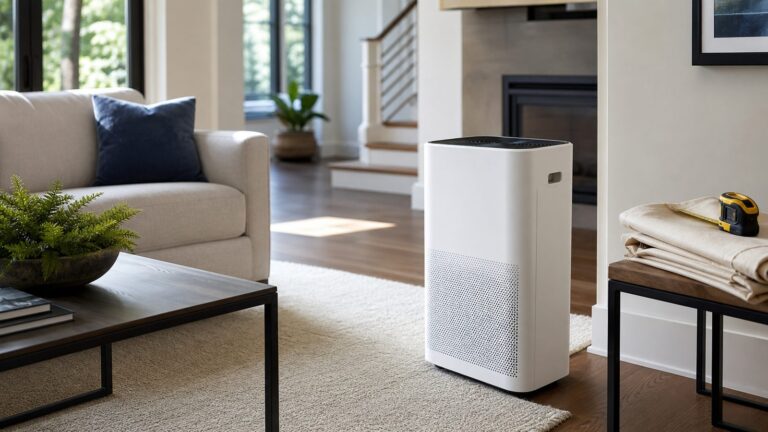
Choose a portable particle air cleaner by its clean air delivery rate (CADR) and the size of the area it will serve—not by a “room size” label alone. A HEPA filter is one common way to capture airborne particles, but a room purifier is only a supplemental control: reduce dust where it is generated and use clean-air ventilation where practicable.
Start with the area the cleaner must serve
Measure the floor area connected to the work zone. For a rectangular room, multiply its length by its width. A 15-by-20-foot room, for example, has 300 square feet of floor area. If the work area opens into an adjoining space, consider the combined connected area rather than sizing only for the room where the purifier sits. A unit chosen for a small enclosed room may be inadequate for a large or open layout.
As an Amazon Associate I earn from qualifying purchases.
EPA’s Guide to Air Cleaners in the Home, 2nd edition (2018), gives minimum estimated CADRs for areas up to 600 square feet, assuming an 8-foot ceiling:
| Area served | Minimum estimated CADR |
|---|---|
| 100 sq. ft. | 65 cfm |
| 200 sq. ft. | 130 cfm |
| 300 sq. ft. | 195 cfm |
| 400 sq. ft. | 260 cfm |
| 500 sq. ft. | 325 cfm |
| 600 sq. ft. | 390 cfm |
These values are useful as a starting point, not as a precise prediction of dust levels. For instance, if the measured area is 300 square feet, the table gives a minimum estimated CADR of 195 cubic feet per minute (cfm). A product’s stated area rating should be checked against its CADR and the conditions used for that rating; the words “large room” do not tell you how the manufacturer arrived at the label.
#1 Best Overall

- 𝗪𝗛𝗬 𝗖𝗛𝗢𝗢𝗦𝗘 𝗔𝗛𝗔𝗠 𝗩𝗘𝗥𝗜𝗙𝗜𝗗𝗘 𝗔𝗜𝗥 𝗣𝗨𝗥𝗜𝗙𝗜𝗘𝗥𝗦: AHAM (Association of Home Appliance Manufacturers) is an ANSI-accredited organization that sets strict standards for appliance performance. Air purifiers with the AHAM VERIFIDE seal have been independently tested for air cleaning performance, safety, and energy efficiency. When you choose an AHAM certified air purifier, you're choosing a product trusted for reliable and effective indoor air quality improvement
- 𝗥𝗘𝗠𝗢𝗩𝗘 𝗣𝗢𝗟𝗟𝗨𝗧𝗔𝗡𝗧𝗦 𝗘𝗩𝗘𝗥𝗬𝗪𝗛𝗘𝗥𝗘: Our Pre-Filter and Main Filter capture lint, hair, pet dander, fine airborne pollutants, and smoke particles, helping achieve a cleaner environment for you
- 𝗛𝗘𝗟𝗣𝗦 𝗠𝗔𝗞𝗘 𝗢𝗗𝗢𝗥𝗦 𝗢𝗗𝗢𝗥𝗟𝗘𝗦𝗦: The air purifier helps neutralize smoke, odors, and fumes. You'll love the feeling of breathing clean air at home
- 𝗨𝗦𝗘 𝗜𝗧 𝗔𝗡𝗬𝗪𝗛𝗘𝗥𝗘: With the Levoit Core Mini-P, you can focus on your activities in the bedroom, kitchen, or office. It offers an auto-off display, sleep mode for fewer interruptions, and relaxing aromatherapy, all while operating more quietly than a whisper
- #𝟭 𝗔𝗜𝗥 𝗣𝗨𝗥𝗜𝗙𝗜𝗘𝗥 𝗕𝗥𝗔𝗡𝗗: Levoit has sold over 6.5 million products worldwide and has been a pioneer in air purification technology for 6 years.
EPA’s current indoor-filtration guidance (2026) offers a separate rule of thumb: choose a smoke CADR of at least two-thirds of the room’s floor area in square feet. For example, that rule points to a smoke CADR of at least 200 cfm for a 300-square-foot room. The 2018 table gives 195 cfm for the same area, while the 2026 rule gives 200 cfm. They are close estimates, but they are different guidance conventions. These are sizing estimates, not construction-dust test results or guarantees of a particular airborne dust concentration. Use one sizing convention consistently when comparing options, and make clear which one you are using.
Adjust for ceilings and open plans
The 2018 area estimates assume an 8-foot ceiling. EPA advises sizing for a larger area when ceilings are higher. A connected open-plan area also increases the volume the cleaner must serve. If one room opens into a hallway or adjoining work area and the cleaner is intended to serve all of it, include those connected spaces when estimating the area rather than using only the footprint immediately around the unit.
If a single unit cannot suitably serve the full area, using multiple units may be an option. The available EPA guidance does not define a universal number or placement pattern for construction work, so do not treat a particular arrangement as a guaranteed solution. Think about which connected spaces the unit is expected to serve, and size each cleaner for the area it is intended to cover. In a layout with doors or partitions, the area actually connected during operation may differ from the whole floor plan.
Windows Errors? Fix Them Before They Spread
Repair common Windows errors and clear accumulated junk for a smoother, more stable PC - no reinstall needed.Free scan · no reinstallCrashes, No Sound, or Screen Glitches?
Random freezes, missing sound and display glitches usually trace back to one bad driver. Find and replace yours safely.Free scan · under a minuteUnderstand what CADR tells you
CADR, or clean air delivery rate, is a measure of how quickly an air cleaner delivers particle-filtered air. It helps match a unit to an area, but it is not a rating for every pollutant and does not tell you that a work area is safe. In this comparison, look at CADR as a way to judge particle-cleaning capacity, then consider the size and layout of the space, the speed at which the rate is achieved, and whether the cleaner can be run for the needed periods.
EPA says CADR values are typically measured at the highest fan speed. Higher speed and longer operating time generally increase filtration, but a high-speed setting may be noisy enough that people turn the unit down or off. This makes operating speed more than a comfort detail: the maximum rating matters only if the cleaner can actually be operated at a useful speed in the intended setting. Compare the CADR figures on a like-for-like basis and check whether the stated figure is associated with the high setting.
When comparing two units, check the CADR relevant to the particle-cleaning task and the speed at which the rating is achieved. Do not choose solely by the highest number on a product page without checking the area served and the likely operating conditions. A high maximum CADR is less useful if the cleaner will not be run at that setting in the actual space. EPA does not certify or recommend particular air-cleaner brands or models, so the decision rests on comparing published specifications and the needs of the space rather than looking for an EPA-approved model.
Choose filtration for the pollutant you are addressing
Particles: look for substantiated performance
Construction dust is particulate matter, so prioritize a cleaner with a published CADR and a particle filter appropriate to the device. HEPA is one common filter type used in portable cleaners for particle filtration. Do not treat the words “HEPA” or “air purifier” by themselves as proof that a model can serve the area: check the CADR and the rated area conditions too. A filter description explains one part of the device; CADR helps you judge the amount of particle-filtered air the cleaner delivers.
What’s actually slowing this PC down?
Pick the symptom - the matching free tool is one click away.
Rank #2

- Efficient Particle Filtration: FULMINARE air purifier uses an H13 HEPA filter. Simply turn it on and maintain a clean and peaceful environment and give families health.
- High Circulation Rate: The air purifier for home adopts dual-channel technology with a 360° air outlet, evenly covering rooms up to 1,086 ft² (based on 5 air changes per hour). The small portable air purifier is easy to place anywhere you want. One is enough to effectively improve your indoor air quality.
- Low Decibel Operation: FULMINARE H13 air purifiers for bedroom is so nice to light sleepers, allowing investors to sleep soundly each night. Set your air purifiers to sleep mode and, the air purifier will run at a near-silent noise level is around 20db at low fan speed. Ultra-quiet but enough to clean your room air at night, bringing you a smooth and sweet sleep.
- Independent Night Light and 5 Timers: It is designed to serve both as an air purifier and a night light. Dual function design makes it a good choice for babies and young children, who can find the softly glowing light or a soothing night time companion. Besides, the air purifiers come with 2-4-8-10-12 five-timers that fit your needs while you're away from home.
- Notice:1. Please open the bottom base cover to get the charging adapter(Plug-in design no battery required). 2 Remove the plastic packaging of the filter before running the air purifier. 3. The air purifiers for pets in time to replace them (3 Months Normally, Search FULMINARE PU-P05 Air Purifier Replacement Filters to get independent filter replacements).
EPA cautions that “No air cleaner or filter will eliminate all of the air pollutants in your home.” A particle cleaner cannot remove dust still being generated, and its rating does not establish a safe exposure level for a particular task, material, or worksite. In particular, a room-size estimate should not be read as a construction-specific performance test. Treat it as a way to compare room-cleaning capacity, not a certification of protection.
Gases and odors: CADR does not apply
Particle CADR does not rate removal of gases or odors. If those are also a concern, EPA points to activated carbon or another gas-specific absorbent. EPA notes that there is no widely used rating system for performance against gases and that the amount of carbon matters. A thin carbon layer or a product’s odor-related claim should not be mistaken for a measured gas-removal rating.
Keep the two questions separate when comparing products: how much particle-filtered air does the unit deliver, and does it have an appropriate gas-specific absorbent for any gas or odor concern? A strong particle CADR does not answer the second question. If the concern is only construction dust, carbon is not a substitute for the particle-filtration information you need to compare units.
Avoid ozone generators in occupied spaces
EPA states: “Do not use ozone generators in occupied spaces.” Ozone can irritate the airways, and EPA says ozone concentrations within public-health standards do not effectively remove viruses, bacteria, mold, or other biological pollutants. Ozone generation is not a substitute for particle filtration. A device marketed around ozone should not be selected as a way to address construction dust in an occupied area.
The Tool Desk
Outbyte PC Repair FREERepair Windows errors before they cause bigger problemsFix Now →Outbyte Driver Updater FREEScan for outdated or missing drivers - takes under a minuteDriver Scan →Compare operating conditions and upkeep before buying
A useful comparison is not just the CADR printed on a package. Check the details that determine whether the cleaner can run effectively in your work area and remain usable over time. Make a short comparison list before buying, so a unit with an attractive label does not obscure a lower useful airflow, incompatible filter, or unsuitable operating cost.
- CADR and area basis: Record the particle CADR, the area it is meant to serve, and any ceiling-height assumptions. Note whether you are comparing against EPA’s 2018 area estimates or its 2026 smoke-CADR rule of thumb. Do not compare CADR as if it measured gas filtration.
- Noise at useful airflow: Find out how loud the unit is at the speed needed for the area. Since higher fan speeds generally increase filtration, noise may affect whether it can be operated for longer periods. Consider the speed likely to be used, not only a quiet-mode specification.
- Filter compatibility: Confirm that replacement filters are available for the exact device and that the replacement matches its model. A filter that happens to fit physically is not necessarily the right replacement for that cleaner.
- Replacement cost: Include filter replacement in the practical cost of keeping the cleaner operating. The cited EPA guidance does not establish a universal replacement interval or price for all devices. Check the device’s instructions and the availability and price of its compatible filters rather than assuming every model has the same upkeep needs.
- Gas filtration, if needed: Treat carbon or another absorbent as a separate consideration; particle CADR does not measure that performance. The amount of carbon matters, and there is no widely used rating system to make gas-removal comparisons as straightforward as particle CADR comparisons.
EPA says all filters require regular replacement and dirty, overloaded filters will not work well. Follow the selected device’s instructions for compatible replacements and maintenance rather than assuming that a filter that physically fits is suitable. Maintenance is part of the selection decision: a cleaner that cannot be kept supplied with the correct replacement filter may not remain useful over time.
There is no single replacement schedule or filter price that applies to every model in the EPA guidance. For a realistic cost comparison, look up the replacement filter for the exact model and consider its price alongside the unit’s specifications. Do not infer long-term cost from the initial device price alone, and do not substitute an unverified filter simply because its dimensions appear close.
Rank #3

- Personal Air Purifier: Designed for small space use, this convenient, portable travel air purifier cleans 6ft² of air in 12 minutes*, so you can breathe fresher air in your personal space and tackle common issues, such as allergies, sinus problems, colds, nasal swelling, and more.
- True HEPA Filter: The 2-stage filtration system eliminates 99.97% of germs. Stage 1 is an Activated Carbon Pre-Filter that traps odors and harmful gasses, while the Stage 2 True HEPA Filter eliminates dust, dander, pet hair, pollen, mold spores, and smoke in the air.
- CORDLESS & TRAVEL-FRIENDLY: The rechargeable lithium-ion battery lasts up to 12 hours on low setting, so you can use the purifier with or without an outlet. You can even purify the air inside your car for cleaner air to and from any location. Weighing less than 1 pound, it’s a lightweight and portable option for anyone on-the-go.
- Customized Features: The adjustable handle allows you to place the air purifier either upright or on its side to find the best position, or even remove the handle when you don’t need it. Choose from 3 fan speeds (low, medium, or high) to find the air purification that works best for you. Place the fan speed on high and the purifier can even double as your own personal cooling fan.
- 5-Year Manufacturer's Warranty: This mini air purifier comes with a 2-in-1 filter, USB charging cable, and Pure Enrichment’s guaranteed 5-Year Manufacturer’s Warranty. Our customer support team provides daily quality service and peace of mind to millions worldwide all from a brand you can trust. *Coverage area based on AHAM standard of CADR (4 CFM) x 1.55.
Use the purifier as one layer of dust control
A portable cleaner treats airborne particles after they have entered the air; it does not prevent dust from being created. EPA recommends reducing pollutants at the source and ventilating with clean air. It also says a cleaner alone cannot ensure adequate air quality when significant sources persist and ventilation is insufficient. The practical implication is to plan for source control and clean-air ventilation along with the purifier, not to expect a room unit to solve a substantial, ongoing dust source on its own.
Recommended Free Tools
For construction or renovation, think of the room cleaner as supplemental to the work controls appropriate to the task. Reduce or capture dust where it is generated, separate dusty work from occupied areas where practicable, and use appropriate ventilation and work practices. The right details depend on the task and material; a general-purpose consumer room purifier should not be treated as equivalent to a temporary professional high-efficiency air-filtration device used in construction-related settings.
An EPA-indexed 2017 article by Newcomer, Lapuma, Brandys, and Northcross, “Capture efficiency of portable high efficiency air filtration devices used during building construction activities,” identifies portable high-efficiency air filtration devices as tools used in construction-related environments, including abatement and remediation contexts. The indexed record does not provide a capture-efficiency figure to apply to a consumer purifier. That distinction matters: the existence of professional temporary devices does not show that an ordinary household unit has the same performance, and it does not justify transferring a numerical efficiency claim to a different product.
Use the cleaner as one part of a broader plan: consider how dust will be reduced where it is generated, whether dusty work can be separated from occupied areas, and how clean air will be supplied. A room unit may help with particles in the air, but it does not replace work practices or task-specific controls, and it cannot guarantee that air is safe if a significant source continues.
Independent reader supportYour contribution helps us test, update, and keep practical guides available for everyone.Consider HVAC filtration or a DIY cleaner only with clear limits
Central HVAC filtration
A central HVAC filter can supplement room cleaning if the system can accommodate it. EPA advises using at least MERV 13, or the highest rating the system can handle. MERV is a filter rating; the key qualification is that the equipment must be able to handle the selected filter. Check the equipment manufacturer’s guidance or consult an HVAC technician when unsure. Installing a filter the system cannot handle may be unsuitable.
HVAC filtration only operates while the system is running and is not the same as a portable unit dedicated to a particular work area. Consider it a possible supplement across the system, not an automatic replacement for a cleaner chosen for a defined zone. A higher filter rating is not helpful if it is not compatible with the equipment.
Fan-and-filter DIY builds
A well-built fan-and-filter cleaner can reduce airborne particles and may be useful when a commercial cleaner is unavailable. Its performance depends on design, materials, assembly, and maintenance, and can vary between builds or after reassembly. That variability makes a DIY build harder to compare with a commercial device that has a known CADR and stated area basis.
Rank #4

- Personal Air Purifier: Designed for small space use, this convenient, portable travel air purifier cleans 6ft² of air in 12 minutes*, so you can breathe fresher air in your personal space and tackle common issues, such as allergies, sinus problems, colds, nasal swelling, and more.
- True HEPA Filter: The 2-stage filtration system eliminates 99.97% of germs. Stage 1 is an Activated Carbon Pre-Filter that traps odors and harmful gasses, while the Stage 2 True HEPA Filter eliminates dust, dander, pet hair, pollen, mold spores, and smoke in the air.
- CORDLESS & TRAVEL-FRIENDLY: The rechargeable lithium-ion battery lasts up to 12 hours on low setting, so you can use the purifier with or without an outlet. You can even purify the air inside your car for cleaner air to and from any location. Weighing less than 1 pound, it’s a lightweight and portable option for anyone on-the-go.
- Customized Features: The adjustable handle allows you to place the air purifier either upright or on its side to find the best position, or even remove the handle when you don’t need it. Choose from 3 fan speeds (low, medium, or high) to find the air purification that works best for you. Place the fan speed on high and the purifier can even double as your own personal cooling fan.
- 5-Year Manufacturer's Warranty: This mini air purifier comes with a 2-in-1 filter, USB charging cable, and Pure Enrichment’s guaranteed 5-Year Manufacturer’s Warranty. Our customer support team provides daily quality service and peace of mind to millions worldwide all from a brand you can trust. *Coverage area based on AHAM standard of CADR (4 CFM) x 1.55.
EPA generally prefers commercial cleaners with known CADR for routine room selection because that rating helps match a unit to an area. A DIY build without a comparable, established CADR is harder to size reliably. Do not assume that the presence of a fan and filter alone demonstrates that a particular build will provide the same particle-cleaning rate as a rated commercial cleaner.
A practical selection sequence
- Define the zone: Measure the room and include connected open areas that the cleaner is expected to serve. If the cleaner is intended for a closed room only, use that room’s area; if it is expected to cover a larger connected layout, measure that layout instead.
- Account for height: If the ceiling is higher than 8 feet, use EPA’s advice to size for a larger area rather than relying unadjusted on the 2018 estimates, which assume an 8-foot ceiling.
- Set a CADR target: Use either the 2018 EPA area estimates or the 2026 two-thirds smoke-CADR rule of thumb, and keep the convention clear when comparing models. For 300 square feet, for example, those methods suggest 195 cfm and at least 200 cfm, respectively.
- Check the particle filter and rating: Look for a published CADR relevant to particle removal and verify the area assumptions. Treat HEPA as filter information, not a substitute for matching airflow to area.
- Check likely operating speed: Consider noise at the speed needed to provide useful airflow in the zone, not just the quietest setting or maximum rating in isolation. EPA notes CADR is typically measured at the highest fan speed.
- Check ongoing operation: Verify compatible replacement filters are obtainable and account for regular filter changes. Include replacement cost in the practical comparison, but do not expect one universal price or change interval to apply to all devices.
- Decide whether gases or odors are also in scope: If so, consider a suitable gas-specific absorbent separately; CADR will not answer that question. The amount of carbon matters, and gas-removal performance does not have a widely used rating system.
- Plan source controls and ventilation: Determine how dust will be reduced at the task and how clean air will be supplied. Separate dusty work from occupied areas where practicable. Do not rely on the purifier as the only control.
Frequently Asked Questions
What CADR do I need for a construction-dust air purifier?
Start with the area the cleaner is expected to serve and the sizing convention you are using. EPA’s 2018 home guide estimates a minimum of 195 cfm for 300 square feet with an 8-foot ceiling; EPA’s 2026 rule of thumb points to a smoke CADR of at least 200 cfm for the same floor area. These are estimates, not construction-dust test results or guarantees of a particular dust concentration.
Do these 3 things before closing this tab:
1Scan for outdated or missing drivers - takes under a minute2Clear out junk files and repair common Windows errors3Fix the driver behind crashes, sound loss and screen glitchesDoes HEPA filtration mean a portable purifier is suitable for my work area?
Not by itself. HEPA describes a common particle-filter type, while CADR helps compare how much particle-filtered air the cleaner delivers. Check the published CADR, area basis, and ceiling assumptions as well as the filter information.
Will a room air purifier remove construction odors or gases?
Particle CADR does not rate gases or odors. EPA points to activated carbon or another gas-specific absorbent for those concerns, but there is no widely used rating system for gas-removal performance, and the amount of carbon matters.
Can a portable air purifier replace dust controls at the worksite?
No. EPA recommends source reduction and clean-air ventilation and says a cleaner alone cannot ensure adequate air quality when significant sources persist and ventilation is insufficient. Treat a portable room cleaner as supplemental to appropriate work practices and controls for the task.
How often should I replace the purifier’s filter, and how much will it cost?
EPA says filters need regular replacement and that dirty, overloaded filters will not work well, but its guidance does not establish one replacement interval or price for every device. Follow the selected model’s instructions, confirm the replacement is compatible, and check its cost when comparing ongoing upkeep.
Can I use a DIY fan-and-filter cleaner instead of a commercial purifier?
A well-built DIY cleaner can reduce airborne particles and may be useful when a commercial unit is unavailable, but performance varies with design, materials, assembly, and maintenance. EPA generally prefers commercial cleaners with known CADR for routine sizing because that rating helps match a unit to an area.
The Bottom Line
Choose a portable particle cleaner with a published CADR suited to the full area it will serve, adjusting for open layouts and ceilings above 8 feet. Compare noise at useful airflow and confirm compatible replacement filters are available. Use the purifier as a supplement—not a substitute—for reducing dust at its source and supplying clean air.
Quick Recap
Product prices and availability are accurate as of the date/time indicated and are subject to change. Any price and availability information displayed on Amazon at the time of purchase will apply.