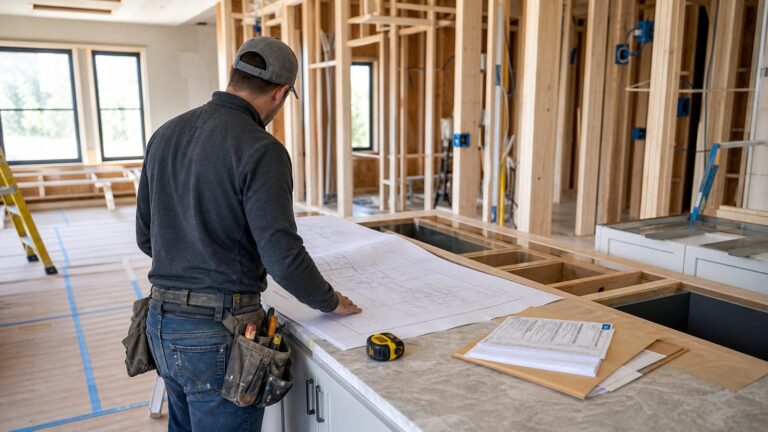
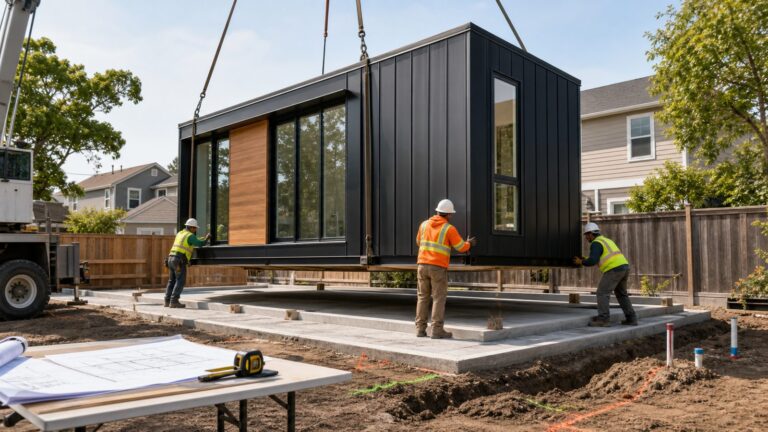
Start with your local building or planning authority’s permit record and any permit or notice posted at the site. Compare the approved work with what is happening, then document your property’s condition before work changes the site. A permit mismatch or missing posted permit is a reason to ask the authority—not proof by itself that the work is unlawful. The actual risk depends on the work, ground conditions and your building, so distance alone cannot tell you whether your property is safe.
1. Find the permit record and compare it with the work
- Identify the authority. Search the official website for the building or planning department responsible for the property’s city or county. Look for its permit-record search, often searchable by street address or parcel number. If you cannot find a record or understand the result, contact the department directly.
- Check the site. Look for a posted permit or construction notice and note its project description, permit details and any listed owner, contractor or contact. Keep a photo or copy of the notice if you can do so safely.
- Compare the scope. Does the approval describe the work you can see—for example, demolition, excavation, an addition or structural alterations? A difference between the record and visible work, or a permit that is not displayed where one is expected, should be referred to the local authority for clarification.
- Ask about the record. Ask whether the permit is current, what work it authorizes, whether inspections or violations are recorded, and how to report a concern. Permit systems and the amount of public information available vary by locality.
Philadelphia provides one example, not a nationwide process: its Department of Licenses and Inspections says permits must be posted at the job site and that the description can be compared with work in progress. Its Atlas includes property information about permits, inspections, violations and licenses; the city also directs residents to 311 for concerns. See Philadelphia’s construction-next-door FAQs for those local options.
As an Amazon Associate I earn from qualifying purchases.
When you review a record, distinguish the basic permit status from the work’s detailed scope. A record may identify a project without answering whether a particular method, stage or protection measure is authorized. If the portal does not show plans or documents, ask the department what information is publicly available and how to request clarification. Write down the permit number, project address, date you checked, and the department’s response. That creates a useful reference if the work or your concern changes later.
Free tools Windows power users keep installed
One-click scans. No signup required.
A missing record online does not necessarily settle whether a permit is required: systems differ, records can be difficult to search, and the relevant approval may be listed under another address or parcel. Give the authority the project location and a plain description of what you can see, then ask it to verify the status. Do not enter a site or confront workers to investigate; use the public record and official contact channels.
#1 Best Overall

- 16MP Sensor: Captures detailed photos with a CMOS sensor for everyday shooting
- Optical Zoom: 4x optical zoom with a 27mm wide angle lens for flexible framing indoors or outdoors
- Full HD Video: Records 1080p video for travel clips, family moments, or simple vlogging
- Memory Support: Works with Class 10 SD, SDHC, or SDXC cards up to 512GB
- LCD Screen and Battery: 2.7in LCD screen with 2 AA alkaline batteries for convenient on-the-go use
2. Work out what is planned and what could pose a risk
Construction next door does not create one predictable level of risk. The method and scale of the work, local soil and topography, and the condition and construction of your building all matter. Excavation, piling, demolition and work affecting foundations or other structural elements warrant more attention than the mere fact that a project is nearby. There is no universal safe-distance rule that determines whether a home will be affected.
Ask the owner or contractor for information in writing. Useful questions include:
- What work will take place, and when will each disruptive stage start?
- Will the work involve excavation, piling, demolition, basement work or changes to a structure?
- What measures are planned to protect neighboring buildings?
- Will the site or adjacent buildings be monitored, and who will review the results?
- Who is the named contact for questions or reports of damage?
A conversation can clarify the plans, but it does not replace the authority’s permit record or a written notice that local rules may require. Whether neighbors must receive notice, and what documents or protection measures are required, depends on the jurisdiction and work involved.
Windows Errors? Fix Them Before They Spread
Repair common Windows errors and clear accumulated junk for a smoother, more stable PC - no reinstall needed.Free scan · no reinstallOutdated Drivers Are Slowing You Down
One free scan finds every outdated or missing driver and matches the right update for your exact hardware.Free scan · exact hardware matchFor example, Philadelphia identifies certain work categories that require additional protection documents, including some deep excavations near an adjacent building, specified party-wall alterations and work near historic structures. Those triggers are local; consult the city’s guidance on construction that impacts an adjacent property rather than applying Philadelphia procedures elsewhere.
Make the questions specific to the project stage. If excavation is planned, ask when it will begin and what protection or monitoring is planned for nearby buildings. If demolition or structural alterations are involved, ask who is responsible for coordinating those activities and how neighbors should report a concern. For any monitoring, ask what is being monitored, who evaluates the observations, and whom to contact if you notice a change. These questions help you understand the plan; they are not a substitute for an engineering review.
Compare the answers with what you can observe and with the approved project description. If a contractor describes a different scope from the permit record, ask the local department whether the difference matters. Do not assume that a change is unauthorized just because it looks different from the outside: the authority is the appropriate place to confirm what approval covers. Keep the question, response and date together with your project notes.
3. Make a baseline record before the site changes
Photograph the visible condition of your property before construction begins, or as soon as you learn work is imminent. Philadelphia L&I specifically recommends timestamped photographs. A phone is usually sufficient if it records the date; a separate digital camera is optional, not a requirement.
- Take wide views of each accessible exterior elevation and closer images of visible cracks, gaps, uneven surfaces or other existing conditions.
- Photograph accessible interior areas that concern you, including walls, ceilings and openings. Do not enter the construction site or take risks to reach a better angle.
- Keep notes with each image: date, location, direction of view and a brief description. Include prior repairs or visible deterioration as existing conditions rather than implying they are new.
- Keep the original files, and make a backup. Save copies of posted notices, permit information and written communications with the owner, contractor or authority.
Photos and notes create a useful record of visible conditions; they do not diagnose structural safety or establish who is legally responsible for later damage. Avoid editing originals. If you make annotated copies for your own reference, retain the unaltered files too.
For a consistent comparison, take some wider images that show where a detail sits in the room or on the building, then closer images of the condition itself. Use the same locations and viewpoints when you take follow-up photographs. Notes can identify a wall, room, floor or exterior elevation so you can find the spot again. If a crack or other condition was repaired before the project, record that history when you know it; a baseline should describe what was visible, not make a conclusion about cause.
Rank #2

- 16MP Sensor: Captures detailed photos with a CMOS sensor for everyday shooting
- Optical Zoom: 5x optical zoom with a 28mm wide angle lens for flexible framing indoors or outdoors
- Full HD Video: Records 1080p video for travel clips, family moments, or simple vlogging
- Memory Support: Works with Class 10 SD, SDHC, or SDXC cards up to 512GB
- Rechargeable Battery: Included LB-012 lithium-ion battery charges in the camera over USB with the supplied adapter in about 2 hours; charge it for at least 4 hours before first use to maximize battery life
Preserve the original image files and their timestamps rather than relying only on images sent through messaging services or edited for convenience. Back up the files somewhere you can access later. A written note can help explain why you took a photograph and what you observed, but keep observations separate from assumptions. For example, note the date you first saw a change and its location, rather than labeling it as construction damage before it has been assessed.
4. Decide whether a professional condition survey is warranted
A formal pre-construction condition survey is a more systematic baseline than personal photographs. It may be worth asking about when the work includes substantial excavation or another higher-impact method, or when your building is older, vulnerable or already showing concerning conditions. A qualified building professional can document existing conditions and advise whether and how monitoring should be done.
What’s actually slowing this PC down?
Pick the symptom - the matching free tool is one click away.
The survey’s scope should reflect the proposed work, the soil and the building’s vulnerability; a generic radius borrowed from another project is not a sound substitute for that assessment. Singapore’s Building and Construction Authority explains the purpose and project-dependent scope of pre-construction surveys in its “Be Good Neighbours” guide. Ask the project team whether a survey and monitoring plan exist, and consider independent advice if you need a separate record of your property.
For a building-specific risk assessment or suspected new structural damage, seek a suitably qualified local structural engineer or building surveyor. Check the professional’s local licensing or registration and agree on the scope of the assessment. A general-purpose photograph, vibration reading or informal visual check is not a substitute for a qualified assessment of the building and site.
A survey is most useful when its purpose and coverage are clear. Ask what parts of the property will be inspected, how existing conditions will be described, and whether the professional recommends follow-up checks during particular work stages. The appropriate level of detail depends on the project and the property; a brief visual record and a more extensive assessment are not interchangeable in every situation. If you arrange an independent survey, ask the professional what records you will receive and keep them with your dated photographs and correspondence.
There are several ways to build a record, and each answers a different question. Permit records help establish the approved scope and any information the locality publishes. A conversation with the owner or contractor can clarify timing and contacts. Your own photographs are a low-cost record of visible conditions, while a professional survey can provide a more systematic assessment. None of these methods alone answers every question about structural safety or legal responsibility.
5. Keep a log while work is underway
Use a dated log to record the stages of work, noticeable noise or vibration, visible changes and communications. Record what you observed rather than diagnosing the cause—for example, describe when a crack appeared and where it is, instead of concluding that nearby work caused it. Felt vibration or ordinary construction noise alone does not prove structural damage.
Technical assessment of vibration is site-specific. The England Environment Agency’s guidance for environmental-permit operators says that topography, local soil and the receiving building affect vibration transmission, and that risk assessment may call for suitably qualified specialists. It is operator-focused guidance for England, not a homeowner test or universal vibration threshold. See Noise and vibration management: environmental permits, updated May 12, 2026.
Keep entries simple and chronological. Note the date and time, what work was visibly occurring if known, what you noticed, and where. If you contact the contractor or authority, record whom you spoke with and what they said, then save any follow-up in writing. A consistent log can help you describe the sequence of events to a professional or official. It cannot by itself show that the work caused a condition, and noise or vibration observations should not be treated as technical measurements.
Rank #3

- Latest Digital Camera Built-in Fill Light : This compact digital camera is paired with a powerful CMOS processor and image stabilization to help you take & record the most exciting moments in 44 MP quality images & FHD 1080P quality videos anywhere, anytime. Plus, there is also a built-in fill light to help you take high quality pictures even in low light&dark settings, making this the perfect camera for all indoors/outdoors situations.
- Long-Lasting Battery Life & 16X Digital Zoom :This point and shoot camera will retain its battery charge even after long use. The controls and functions are easy to operate making this the perfect choice for children, teens and younger. This kids camera supports 16x digital zoom, you can zoom in or out the subject by pressing the W/T button for taking still photos to zoom in or out on distant objects and capture all the details you need.
- Multifunctional & Portable Digital Camera: This cheap digital camera is slim enough to fit in your pocket. You'll easily be able to take it with you on all your indoor/outdoor activities and adventures and ideal for beginners, children and teenagers. This kids digital camera is equipped with 20 filters, anti-shaking, self-timer, continuous shooting, date stamp, time-lapse recording, smile capture, internal MIC and speaker (recording sound videos), great for your daily photography needs.
- WEBCAM & PAUSE FUNCTION : More than just a FHD 1080p digital camera, it also works as a webcam for video calls and vlogging. Connect the camera to the computer, press shutter and power button at the same time and the camera will automatically turn on webcam mode for all your video calling and live streaming needs. The pause function allows you to pause when seeing playback videos.
- A Must Have Photography Device : This digital camera with SD card made from high-quality materials, this retro camera is safe and durable. Perfect for all ages to develop & improve their photographic abilities and observation skills. Our dedicated and experienced 24/7 support team is available for all after purchase troubleshooting, questions and technical help.
If a concern appears intermittent, note when it occurs rather than trying to infer what is happening beneath the ground or inside a wall. Avoid placing equipment on neighboring property or attempting to measure or inspect work yourself. Assessment methods depend on the site and building, and the Environment Agency guidance directs regulated operators toward risk-based assessment and suitable specialists where vibration issues are indicated.
The Tool Desk
Outbyte Driver Updater FREEFix the driver behind crashes, sound loss and screen glitchesFind Drivers →Outbyte PC Repair FREERepair Windows errors before they cause bigger problemsFix Now →6. Respond promptly if damage appears
- Record the change. Take new photographs from comparable viewpoints and note the date, location and what changed. Preserve the original files and any related notices or messages.
- Notify the responsible contact in writing. Tell the owner or contractor what you observed, when you first noticed it, and where it is. Keep a copy of the message and any response. Philadelphia L&I gives the same practical direction: “If a construction project causes damage, notify the property owner or contractor.” Its FAQ is a local source for that guidance.
- Contact the local authority when appropriate. Ask how to report work that appears unsafe, inconsistent with its permit or unpermitted, and what information to provide. A suspected mismatch is for the authority to assess; do not treat it as a confirmed violation.
- Get qualified help for serious concerns. If you see significant movement, a new serious crack or another immediate safety concern, seek qualified local structural advice and follow local emergency directions. The available guidance does not establish one crack size, vibration level or distance that serves as a universal emergency threshold.
Keep communications and check the applicable local insurance and legal procedures. Rights, notice requirements, reporting channels, deadlines and remedies vary by location. For instance, Philadelphia says that, for specified covered applications filed on or after January 1, 2023, the owner or developer must provide adjacent owners a copy of the contractor’s general-liability insurance certificate; that rule’s scope is local and should be verified against current city guidance. See the city’s construction-next-door FAQs.
When you report a concern, separate what you know from what you suspect. Give the location and date of the condition, explain whether it is new or changed from the baseline you recorded, and attach clear images if the recipient requests them. Ask what information the authority needs and whether it will inspect or refer the issue. Keep copies of the report, confirmation number if one is provided, and any response. The appropriate process may differ for a permit question, a safety concern and a property-damage dispute.
Do not wait to create a record while you are deciding who is responsible. Prompt documentation and written notice help preserve a clear account of what you observed. If the condition seems serious or you are concerned about immediate safety, seek qualified local advice and follow local emergency directions rather than relying on photos or a message to the contractor as a safety assessment. Insurance disclosure requirements and procedures vary, so ask the local authority or a qualified local adviser what applies to your situation.
Independent reader supportYour contribution helps us test, update, and keep practical guides available for everyone.7. Check which local protections apply
Examples from other jurisdictions show why a neighbor’s rights cannot be inferred from a rule found online for another place. New York City’s building code includes adjoining-structure protection, notification and preconstruction-survey provisions for defined circumstances; those provisions are not general rules for other cities. Review the relevant chapter of the New York City Building Code only if the property is in New York City.
In Victoria, Australia, the state building authority describes a building surveyor determining whether protection work is required when adjoining land is at risk of significant damage. Check the current local law and consult the relevant surveyor; the Victorian Building Authority’s adjoining-property guidance applies to that jurisdiction.
Party-wall procedures are another location- and circumstance-specific issue. GOV.UK explains what happens when applicable party-wall procedures govern work in England and Wales; they do not automatically cover every project beside a home. See When works begin and verify whether those procedures apply to your property and the proposed work.
These examples point to the same practical step: verify the rule with the authority responsible for your property, rather than assuming that a neighbor’s notice or protection requirement applies everywhere. Some jurisdictions specify particular work that triggers extra documents, surveys, protection measures or notice; others may use different processes. The existence of a permit does not guarantee that nearby construction cannot affect a building, and the absence of a notice in your mailbox does not alone establish a violation. Ask the local authority what requirements apply to the specific work and location.
What to have ready when you contact the authority
- Your property address and, if available, the project address or permit number.
- A concise description of the work and the discrepancy or concern you observed.
- Dates, location notes, photographs and copies of relevant notices or communications.
- A specific question: whether a permit is required or current, whether the work matches its approved scope, what protection or notice rules apply, or how to report a safety concern.
Provide facts and ask the authority to explain the applicable process. No project address, site plans or property condition can be assessed in the abstract; a local department and qualified professional are the appropriate sources for a property-specific answer.
Quick wins for a faster PC:
Scan for outdated or missing drivers - takes under a minuteDriver Scan →Repair Windows errors before they cause bigger problemsFix Now →Fix the driver behind crashes, sound loss and screen glitchesFind Drivers →Rank #4

- 16MP Sensor: Captures detailed photos with a CMOS sensor for everyday shooting
- Optical Zoom: 5x optical zoom with a 28mm wide angle lens for flexible framing indoors or outdoors
- Full HD Video: Records 1080p video for travel clips, family moments, or simple vlogging
- Memory Support: Works with Class 10 SD, SDHC, or SDXC cards up to 512GB
- Rechargeable Battery: Included LB-012 lithium-ion battery charges in the camera over USB with the supplied adapter in about 2 hours; charge it for at least 4 hours before first use to maximize battery life
It can help to organize your records before making the call or submitting a report. Keep the permit details, a short timeline, your clearest photos, and copies of written messages in one place. State what you want clarified: permit status, project scope, a local protection requirement, or the route for reporting a new condition. If the department refers you elsewhere, write down the office and contact information it provides. A focused question is easier to route than a general statement that construction feels concerning.
Frequently Asked Questions
How can I check whether construction next door is permitted?
Search the official building or planning authority’s permit record for the project address or parcel, and check for a posted permit or notice at the site. Compare the described approved work with what you can observe. If the record is unclear, missing or appears inconsistent, ask the local authority to verify it; a mismatch or missing posting is not by itself proof of a violation.
Can nearby construction damage my house?
It can depend on the work method and scale, local soil and topography, and your building’s construction and condition. Excavation, piling, demolition and work affecting foundations or structural elements deserve particular attention, but proximity alone does not establish risk. There is no universal safe-distance rule.
What should I do if construction causes cracks or other damage?
Photograph the condition promptly from clear, comparable viewpoints, note the date and location, and preserve the original files. Notify the owner or contractor in writing and keep the message and response. Contact the local authority about suspected unsafe or unpermitted work, and seek qualified local structural advice for serious movement or an immediate safety concern.
How can I show that a condition changed during construction?
Create a dated baseline before work begins: take wide and close photographs of accessible areas, add notes identifying each location, and keep originals and backups. If a new condition appears, photograph it from similar viewpoints and log when you noticed it. This record can help describe the sequence, but it does not establish cause or legal responsibility by itself.
Should I hire someone to inspect my property before construction starts?
A formal condition survey may be worth considering for substantial excavation or other higher-impact work, or if the building is older, vulnerable or already showing concerning conditions. A qualified local professional can determine the appropriate scope based on the work, soil and building. Ask the project team whether a survey and monitoring plan exist, and consider independent advice if you need a separate record.
Does a contractor have to notify every nearby owner?
There is no universal answer. Notice and protection requirements depend on local rules, the type of work and the circumstances. Philadelphia, New York City, Victoria and England and Wales each have jurisdiction-specific examples, but their procedures should not be applied elsewhere. Ask the authority responsible for your property what applies.
Do noise or felt vibration prove that my home has structural damage?
No. Noise or felt vibration alone does not prove structural damage, and no universal vibration reading or threshold is established here as a homeowner test. Soil, topography and the receiving building affect vibration transmission. If you have a concern, keep a dated observational log and seek a qualified assessment appropriate to the site.
Do these 3 things before closing this tab:
1Clear out junk files and repair common Windows errors2Fix the driver behind crashes, sound loss and screen glitches3Repair Windows errors before they cause bigger problemsThe Bottom Line
Use the local permit record to understand the approved scope, ask what protection and monitoring are planned, and create a dated baseline before work changes the site. If a new condition appears, document it promptly, notify the responsible contact and ask the local authority how to proceed. Permit status, damage risk, notice duties and remedies depend on the specific project, property and jurisdiction.
Quick Recap
Product prices and availability are accurate as of the date/time indicated and are subject to change. Any price and availability information displayed on Amazon at the time of purchase will apply.