Do these 3 things before closing this tab:
1Repair Windows errors before they cause bigger problems2Fix the driver behind crashes, sound loss and screen glitches3Clear out junk files and repair common Windows errorsRecycled textile fibres can help control cracking and improve some tensile, flexural or post-cracking properties of concrete, but they do not reliably raise every strength measure or improve every aspect of durability. Results depend on the fibre material and preparation, dosage, dispersion, concrete mix and test exposure. In particular, compressive strength may stay similar or fall, while workability often becomes more difficult as fibre content rises.
What counts as a recycled textile fibre?
The term covers different materials, not one interchangeable additive. Recycled polyester or PET, nylon, cellulose-rich fibres and blended textile waste can differ in geometry, surface and behaviour in a cement matrix. Shredded fabric is also not automatically equivalent to a purpose-made concrete fibre, virgin polypropylene, recycled bottle fibre or a textile grid.
As an Amazon Associate I earn from qualifying purchases.
Preparation matters: fibre length, aspect ratio, surface properties and treatment affect how fibres disperse and anchor in the hardened concrete. A result from one prepared fibre stream should not be treated as a performance claim for arbitrary textile waste.
The Tool Desk
Outbyte Driver Updater FREEFix the driver behind crashes, sound loss and screen glitchesFind Drivers →Outbyte PC Repair FREERepair Windows errors before they cause bigger problemsFix Now →How fibres affect strength
Fibres can bridge cracks, helping delay crack growth and improve tensile response, strain capacity, toughness or post-cracking behaviour. Those effects are distinct from compressive strength. A mix can perform better in one measure and worse in another, so “stronger concrete” is too broad a conclusion.
#1 Best Overall

- Package Include: 1 Pack x Fiberglass Chop Strands(Weight: 4.4LB/ Pack,Length: 3/4 inch,Material: Glass Fibers)
- Anti-cracking Fiber Glass Chop Strands: Our fiber mesh for concrete can improve the high temperature stability and low temperature resistance, greatly prevent the cement from cracking, extend the service life of road surfaces. Fiber additive helps prevent cracks in concrete walls, floors, and structures.
- Seepage Proofing Concrete Fiber Glass:ZENFUN fiber glass strands are greatly increase the density of cement, which solve the drawbacks of the cement, avoiding penetration, enhance impermeability and frost resistance performance
- How to Use: Put sand, cement, and chopped fiber glass together, and then add appropriate amount of water, and finally evenly mixed; Please note that the mixing time is 30 to 60 seconds longer than without fiber glass.
- Wide Applications: ZENFUN white fiber glass set is suitable for building wall, garden floor, Swimming pool construction, etc; perfect for countertop reinforcement to solve water seepage problem, and also suitable for some repairing works or mixed with other fillers.
Compressive strength
There is no consistent guarantee of higher compressive strength. A 2021 review reports that small doses have improved compressive strength in some concrete mixes below 40 MPa, among varied studies; that is a review-level pattern, not a recommended dosage or universal result. Higher fibre contents may reduce compressive strength when fibres disperse poorly, form clumps or contribute to voids.
One specific example illustrates the mixed outcome. In Haigh and colleagues’ 2024 laboratory study, a combined mix containing shredded polyester from used high-visibility vests and silica-fume-modified kraft fibres reached 44 MPa compressive strength at 28 days, equal to that study’s control. The finding applies to that mix and method, not to recycled textile fibres in general. The authors wrote: “The combination of textile and SFKFs can achieve a compressive strength of 44 MPa, which is the same as the control.” Read the 2024 study.
Rank #2

- Package Content: The package contains 4.4 pounds of white chopped fiberglass, with individual fibers measuring 0.78 inches /2 cm in length, made from fiberglass
- Usage Instructions: Mix sand, cement, and glass fiber evenly, add appropriate water and stir thoroughly, extending mixing time by 30-60 seconds compared to mortar without glass fiber
- Waterproof and Leak Prevention: Can be mixed into cement mortar, the high volume of fiber strands increases cement density, significantly enhancing impact and seismic resistance while resolving leakage issues; improves mortar toughness and enhances floor water proofing performance
- Enhance Crack Resistance: Adding glass fiber to concrete enhances high-temperature stability and low-temperature resistance, suppressing the formation of micro-cracks
- Wide Application: White chop fiberglass is suitable for building walls, ponds, garden surfaces, road construction, courtyard steps, partial repair projects, or blending with other fillers
Tensile and flexural strength
Tensile and flexural results can move differently from compressive results—and from each other. In the same 2024 experiment, the combined fibre mix had a 28-day tensile strength of 3.58 MPa, compared with 3.41 MPa for its control. Yet every fibre-containing mix in that study had lower flexural strength than the control: the control measured 2.87 MPa, compared with 2.62 MPa for the textile-only mix and 2.38 MPa for the combined mix. These are laboratory values for the study’s materials and proportions, not expected results for another project.
What’s actually slowing this PC down?
Pick the symptom - the matching free tool is one click away.
A 2025 review describes generally improved tensile and flexural strength and ductility across the studies it considered. It reports an apparent optimum around 0.5% by volume in that varied literature, with higher contents associated with agglomeration, voids, poorer workability and possible compressive-strength loss. Because the review spans different natural, synthetic and blended fibres, that figure is not a universal optimum or a mix-design instruction. Read the 2025 review.
Rank #3
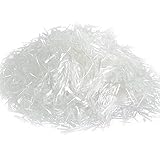
- Anti-cracking: Mixing fiberglass and mortar together, the irregular distribution of fiberglass in the mortar enhances the toughness of mortar, and inhibits the formation of fine cracks
- Waterproof and Impermeable: A large number of fiber filaments increase the density of cement, which can effectively solve the problem of penetration. It is very suitable for wet place such as basements, pond, Exterior wall
- Impact Resistance: High-strength fiber filaments are attached to each other as a dense net to hold the cement tightly. It can effectively enhance the impact and seismic performance of cement
- How to Use: Evenly mix sand, cement and fiberglass together, then add an appropriate amount of water, and finally stir (the stiring time is 30-60 seconds longer than without fiberglass)
- Dosage: Use 1 lb. (1 pkg) per cubic yard (27 cubic feet) of concrete. You can add a little more in the area with strong impact or severe freeze-thaw
How fibres affect durability
Durability is not a single property. Freeze–thaw resistance, thermal cycling, chloride transport, water absorption and chemical exposure are different endpoints. A favourable result for one does not prove improvement in the others or establish longer service life in the field.
Freeze–thaw and thermal cycling
Haigh and colleagues’ 2025 experiment tested waste textile and cardboard fibres under thermal and freeze–thaw cycles. After 100 freeze–thaw cycles, the study’s 2.5% polyester textile specimen, labelled T2.5, recorded 45 MPa compressive strength and 4.3 MPa tensile strength. These are post-cycle measurements for that specimen and test setup; they do not establish how another fibre, concrete mix or field exposure will perform. Read the 2025 study.
Rank #4

- EFFECTIVE CRACK CONTROL – Helps reduce shrinkage cracks in concrete, mortar, and cement mixes for improved durability. HIGH-STRENGTH FIBER REINFORCEMENT – Disperses evenly throughout the mix to help improve tensile strength and structural integrity. EASY TO USE ADDITIVE – Simply add during mixing without special tools, ideal for professionals and DIY users. MULTI-PURPOSE APPLICATION – Suitable for concrete repair, flooring, sidewalks, slabs, mortar, and cement applications. SUSTAINABILITY-FOCUSED GREEN FIBER – Designed to deliver reliable reinforcement performance for various construction environments.
Chloride exposure
An earlier study of recycled PET-fibre cement composites measured chloride permeability as well as freeze–thaw and chemical exposures. It reported only a slight chloride-permeability difference from the control and described both control and fibre specimens as having high chloride permeability. Crack-control benefits or a strength gain should therefore not be assumed to mean a substantial improvement in chloride resistance. Read the recycled-PET study.
Quick wins for a faster PC:
Scan for outdated or missing drivers - takes under a minuteDriver Scan →Repair Windows errors before they cause bigger problemsFix Now →Why dosage and workability matter
Adding fibres can make fresh concrete harder to work with. Reviews report declining workability as fibre content increases; fibres can also clump or distribute unevenly. If dispersion is poor, the intended crack-bridging effect may be less consistent, while clumps and voids can undermine strength. Polyester fibres in the 2024 study bonded predominantly through physical interactions, and microscopy showed clumping in some regions.
Best Value
- 【Concrete Fiber Reinforcement】Our glass fibers are designed for concrete applications, enhancing the impact and earthquake resistance of concrete, greatly preventing the cement from cracking, extend the service life of road surfaces. Fiber additive helps prevent cracks in concrete walls, floors, and structures and add strength to your project.
- 【Excellent Concrete Fiber Glass】Adding fiberglass to your mixture greatly increases the density of cement, which solves the drawbacks of the cement, avoiding penetration, enhancing impermeability and frost resistance performance, and ensuring long-term protection of structural integrity.
- 【Easy to Use】Our fiberglass is 3/4 inch in length and can be easily mixed into your concrete mix, then add an appropriate amount of water, and finally evenly mix. Increasing cement density, enhancing mortar toughness, simplifying the reinforcement process, and improving efficiency.
- 【Wide Application】The fiberglass is suitable for various concrete applications, this glass fiber plays a good role in reinforcing cement mortar and is suitable for building walls, garden floors, swimming pool construction, etc; and also suitable for some repairing works or mixed with other fillers.
- 【Package Include】You will receive 1 Pack x Fiberglass Chop Strands, Add more for high impact or severe freeze or thaw areas(Weight: 6.6LB/ Pack, Length: 3/4 inch).
Review findings across waste synthetic fibres such as polyester, nylon and polyethylene likewise report workability reductions as fibre content rises. These broad patterns should not be transferred automatically to every post-consumer textile material: fibre type, dosage basis, geometry and mix all matter. Read the 2024 review of waste synthetic fibres.
How to judge a result for a specific concrete mix
Before applying a reported result to a project, compare like with like. A percentage by volume cannot be directly compared with a percentage based on cement mass, and a strength value is meaningful only with its control, curing age and test conditions.
- Fibre: identify the source and composition, preparation, length and surface characteristics.
- Dosage: confirm the amount and what it is measured against.
- Fresh concrete: check workability and whether the fibre can be dispersed uniformly.
- Hardened performance: examine compressive, tensile and flexural results separately, with the control mix and test age.
- Durability: identify the exact exposure and endpoint—such as freeze–thaw cycling or chloride transport—rather than treating “durability” as one result.
Setunge and Cwirzen’s 2021 review describes gains in strain capacity, crack control, durability and energy absorption across studies, while also noting that the evidence spans differing materials and mixes. It is useful context, not a substitute for matching the fibre and test conditions to the intended application. Read the 2021 review.
What the evidence does—and does not—support
The evidence supports treating recycled textile fibres as a mix-design variable that may improve crack-related behaviour and selected performance measures, with meaningful trade-offs in workability and sometimes strength. It does not establish one best fibre, a universally effective dosage, a general increase in service life, or structural code compliance. Project use requires performance evidence for the specific materials, proportions, production process and exposure; the cited laboratory results alone do not approve a structural design.
Quick Recap
Product prices and availability are accurate as of the date/time indicated and are subject to change. Any price and availability information displayed on Amazon at the time of purchase will apply.