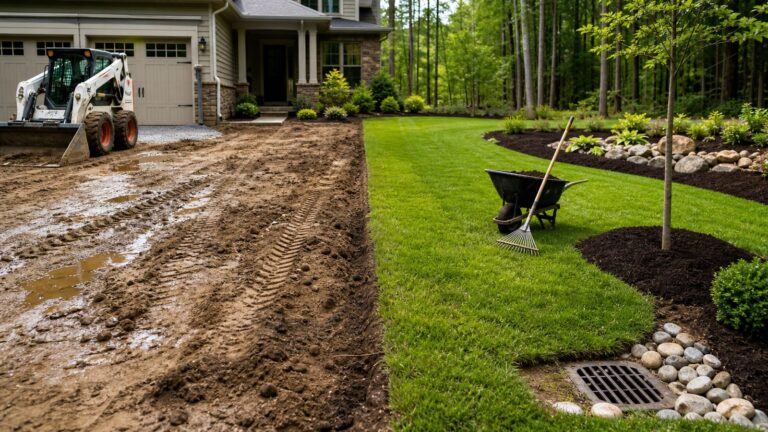
Rail trails manage water by keeping it moving without letting it build up speed or volume on the path. That takes coordinated planning at two scales: drainage across the trail tread, and the ditches and cross-drains inherited from the railroad corridor. A trail can still flood or erode if either system is blocked, interrupted, or poorly maintained.
How do rail trails manage stormwater runoff?
They manage runoff through a connected system of grading, drainage features, and outlets. On the trail itself, the aim is to shed water off the tread rather than let it collect or travel along the path. Across the wider corridor, the aim is to preserve or redesign the drainage that moves water through and alongside the former railroad bed.
As an Amazon Associate I earn from qualifying purchases.
These two scales interact. A trail may drain adequately in isolation yet still be vulnerable if construction blocks a corridor ditch or cross-drain. Conversely, an intact railroad drainage system does not prevent erosion if water is allowed to concentrate and run along the trail surface. Design therefore needs to consider the trail, the existing corridor drainage, the surrounding catchment, and the places where water ultimately flows.
Rails-to-Trails Conservancy’s Trails as Resilient Infrastructure guide discusses grading and tread drainage; the Federal Highway Administration’s 2021 report Rails with Trails: Best Practices and Lessons Learned addresses railroad drainage and runoff from trail surfaces. Those sources describe design considerations, not a universal set of dimensions or a substitute for site-specific engineering.
#1 Best Overall

- Valued Carpenter Pencil Set: You will get 2 pcs solid carpenter pencils with 26 piece 2.8 mm refills, 1 replaceable sharpener, 1 plastic storage box.The complete carpenter pencils combination allows you to finish your work faster and more easily
- Deep Hole Marker Pencil: The deep-hole construction pencils adopts 45mm elongated tip design, which is more convenient to mark in the small hole or in other tight areas that other carpenter markers cannot reach
- Carpenter Pencils with Sharpener: The sharpener is screwed into the top of the work pencil, which won't get lost either. Built-in pencil sharpener that keep the lead with pointed and smooth to Improves line of sight in fine work
- Stronger Solid Lead: This work pencil is matched with a 2.8 mm thick lead , which is much thicker and stronger during the drawing process of construction work, it will not break or damage easily
- Marks on Various Surfaces: 3 colors solid construction pencil can marks on various surfaces,such as metal, plastic, wood, paper etc. Ideals for woodworkers, contractors, craftsmen, builders, merchants and masons
What happens to railroad drainage ditches when a rail trail is built?
Railroad corridors commonly have ditches running alongside the tracks and ballast. Cross-roadbed drainage pipes connect the lateral ditches beneath the tracks, allowing water to pass through the corridor. These features are part of how the railroad bed stays drained; they are not incidental spaces that can be filled or redirected without considering what they do.
The FHWA report says maintaining the integrity of the railroad drainage system is of paramount importance in rail-with-trail design. If a proposed trail affects an existing ditch or swale, the report says a new drainage system must be designed. That means identifying the existing drainage function and coordinating with the railroad or corridor owner before work changes it.
Assess the existing system before fixing the trail layout
During planning, establish where the ditches and cross-drains are, how they connect, and whether they are functioning. Consider their condition and the railroad’s maintenance practices as part of that assessment. A trail alignment that appears straightforward on a plan may have consequences if it occupies a ditch, obstructs an outlet, or otherwise changes where corridor water can go.
Windows Errors? Fix Them Before They Spread
Repair common Windows errors and clear accumulated junk for a smoother, more stable PC - no reinstall needed.Free scan · no reinstallOutdated Drivers Are Slowing You Down
One free scan finds every outdated or missing driver and matches the right update for your exact hardware.Free scan · exact hardware matchIf a replacement or new cross-roadbed pipe is needed, its design and installation should be determined by the project’s engineering requirements. The guidance identifies cross-roadbed drainage pipes as a system component, but does not prescribe a universal pipe material, diameter, or specification.
Rank #2

- Ergonomically Designed: Work in tight areas with a compact design that gets into tough spots
- Compact and Lightweight: Both tools are designed to fit into difficult to reach spaces. The 1/4" impact driver has a length of 5.55 in. and weighs just 2.8 lbs, while the 1/2" drill/driver measures only 7.5 in. and weighs 3.6 lbs
- Both the DEWALT impact driver and electric drill driver feature integrated LED work lights with a convenient 20-second delay, ensuring enhanced visibility in dimly lit or challenging work areas
- One-Handed Loading - Keep one hand free with a 1/4 in. hex chuck that accepts 1 in. bit tips
- Power drill cordless with 1/2" single sleeve ratcheting chuck provides tight bit gripping strength, making bit changes faster and more secure
Coordinate work that touches railroad property or operations
For a rail-with-trail, identify who is responsible for the trail-side drainage features and coordinate work that could affect railroad property or operations. The trail owner, corridor owner, and railroad may have different maintenance responsibilities. Clarifying them in planning helps prevent a drainage feature from being overlooked simply because responsibility is unclear.
How do rail trails prevent water from eroding the tread?
Trail grading can direct water across and off the tread instead of allowing it to travel along the path, gathering speed and concentrating flow. Rails-to-Trails Conservancy describes outslope and grade reversals as ways to achieve this. Their suitability depends on trail conditions; the guide does not make one slope or configuration appropriate for every trail.
Outslope
An outslope means the outside edge of the tread is lower than the inside edge, so water can shed across the path. In choosing how to grade a trail, designers need to account for the site and the intended users. A general description of outslope is not, by itself, a construction specification.
Quick wins for a faster PC:
Scan for outdated or missing drivers - takes under a minuteDriver Scan →Clear out junk files and repair common Windows errorsFree Scan →Grade reversals and outlets
A grade reversal changes the trail’s grade so that water can leave the tread rather than continuing down it. Strategic outlets can redirect excess flow. Their location matters: the design needs to consider erosion and sediment risk both at the outlet and in the receiving area. An outlet that simply concentrates water at a vulnerable spot can transfer the problem rather than resolve it.
Rank #3

- 【Great Compatibility】This Katerk 1/4 inch hex shank bit holder is specifically designed for 1/4 inch hex shank drill bits. It's compatible with most 1/4 fast hex handles, hex sockets, various electric screwdrivers, and handheld screwdrivers. The bit holder makes it a valuable addition for any handyman.
- 【Secure and Safe】Built with a secure backup nut design, each drill bit holder securely locks onto your bits, ensuring they stay firmly in place. Additionally, our bit holder incorporates a high-quality steel ball rolling design that holds up to several kilograms of weight, ensuring your various drill bits don't fall off.
- 【Easy One-Handed Operation】The bit holder for impact driver allows you to change bits single-handedly, simplifying your workflow. Its multi-color design further allows for quick identification of the drill bit you need.
- 【Compact and Convenient】Thanks to its compact size, this 1/4 inch bit holder is easy to carry around. The bit holder allows for easy attachment to various tools, making this a convenient addition to your construction accessories. The Katerk bit holder is cast from high-quality alloy material, promising a long product lifespan. Despite its rugged strength, the bit holder remains lightweight, making it portable.
- 【Cool Christmas Gift For Men Stocking Stuffers】 This screwdriver bit holder, driver bit holder, impact bit holder, can be given as a gift to your loved one, especially for anyone involved in construction or electrical work. It's a must-have for stocking stuffers for men and women, tools gifts for dad, tech gadgets for men, gifts for dad, gifts for him, gifts for husband, gifts for boyfriend, cool gadgets for men, and cool gifts for dad.
These features should be considered together with the corridor’s larger drainage system. The objective is not merely to move water off the trail at any point, but to avoid creating a discharge that causes a new problem downstream or interferes with an existing ditch or cross-drain.
Why water bars are not a universal answer
The resilient-trails guide cautions against relying on water bars in the contexts it covers. It notes that they can collect sediment and debris and can be inaccessible. A design should not assume that adding a water bar automatically solves a drainage issue; the effect on access, clogging, and ongoing upkeep also matters.
How does the trail surface affect runoff?
The FHWA’s 2021 report identifies surface choice as a runoff consideration and says runoff impact is higher with a paved trail. It does not give a universal runoff ratio or quantify the effect for a particular project. Treat this as a planning factor: consider how the proposed surface may affect local drainage alongside the catchment, grading, outlets, and corridor drainage design.
Surface choice is one part of a broader decision. Relevant considerations include whether construction will interrupt an existing ditch or cross-drain, whether water will shed from the tread or be concentrated at a discharge point, and what erosion and sediment risks exist at receiving areas. Accessibility and user comfort matter too, as does whether the design can be inspected and maintained over time.
Rank #4

- Long Nib and Deep Hole Marker: Our mechanical carpenter pencil with 45mm nib is designed for easy marking of deep holes or narrow areas. These construction pencils are the great choice for woodworking tools, construction tools, carpenter tools, contractor tools, wood carpentry tools and architect tools
- Extra Refills in 2 Colors for Versatile Marking: The construction mechanical pencil comes with 12 extra 2.8mm refills, including 6 red and 6 black refills. The black refill is suitable for light surfaces, while the red wax is perfect for dark surfaces. Our carpenter mechanical pencil makes sure that you'll have an ample supply for extended use
- Built-in Sharpener: Our construction pencil comes with a built-in sharpener to ensure the mechanical pencil tip is always sharp and ready for use. Never buy an extra pencil sharpener again. A great tool for any woodworker pencil, contractor pencils. The refill can easily be extended or retracted with a simple click of the pencils mechanical, allowing you to work more efficiently and accurately
- Portable Clip Design: Our deep hole construction pencil features a portable clip design, easy to carry and attach to your pocket or tool box, so that you can keep the carpenter pencils mechanical close at hand, making it a convenient tool to have on the go. Great gifts choice for carpenters
- Stronger Pencil Lead: The black refills are made of lead, sturdy and smooth. The red refills are made of wax, clear and light. These marking pencils are much thicker and stronger than normal pencils during the marking process of construction work, suitable for various surfaces, such as glasses, metal, boards, floors, walls, furniture, etc. The written marks can be easily wiped with a wet paper towel when needed
The available guidance does not establish a universal “best” surface or complete engineering comparison for every setting. A surface decision should be made in the context of the project’s site-specific drainage design rather than treated as a stand-alone answer to runoff.
Independent reader supportYour contribution helps us test, update, and keep practical guides available for everyone.How should a project plan drainage on a rail corridor?
A practical planning sequence is to understand the water system before finalizing trail grading and construction details. Each decision should account for both the tread and any inherited corridor drainage it could affect.
- Map existing drainage. Locate lateral ditches, swales, cross-roadbed pipes, and outlets. Assess their condition and how they connect through the corridor.
- Identify conflicts with the proposed trail. Determine whether the alignment or construction would occupy, alter, or obstruct an existing ditch, swale, pipe, or outlet. If a ditch or swale is affected, plan a new drainage system rather than assuming the existing one can be removed without replacement.
- Coordinate with the corridor owner or railroad. Discuss changes to the existing system and clarify responsibility for features on or near railroad property. Account for relevant railroad maintenance practices.
- Plan tread grading and outlets together. Evaluate outslope, grade reversals, and strategic outlets in relation to the site. Consider where discharged water will go and whether the outlet or receiving area could be vulnerable to erosion or sediment buildup.
- Include surface and access considerations. Consider the FHWA report’s warning that runoff impact is higher with a paved trail, along with accessibility and user comfort. Do not treat any one feature as a universal design prescription.
- Define inspection and maintenance responsibility. Identify who will inspect trail-side drainage, clear obstructions, and coordinate any work that could affect railroad property or operations.
- Confirm applicable requirements. Check with responsible agencies about current federal, state, and local requirements and any permits needed for the actual project, especially where floodplain work is involved.
The FHWA report references FRA’s drainage regulation at 49 CFR § 213.33 and FHWA floodplain regulation, 23 CFR Part 650 Subpart A, for work in a base floodplain. These references are not a complete project-specific permitting determination. Requirements and approvals should be confirmed with the agencies responsible for the site.
Recommended Free Tools
How often do rail trails need drainage maintenance?
Drainage needs ongoing inspection and maintenance, but the cited guidance does not set a universal inspection schedule. Rails-to-Trails Conservancy lists drainage upkeep among routine trail-maintenance tasks. Leaves and sediment can fill or block outlets, so managers need to check whether relevant features remain clear and functioning and remove debris where needed.
Best Value

- Milwaukee Ink all Fine Point Marker, Black, 4 Per Pack
- 4 per pack Features Clog Resistant Marker Tip Writes through Dusty, Wet and Oily Surfaces Durable Marker Tip for Writing on Concrete, OSB and Rough Surfaces
- Clog resistant tip writes on dusty, wet and oily surfaces and is optimized for rough surfaces such as OSB, cinderblock and concrete
- Hard hat clip- attaches for easy access
- Quick dry time with reduced smearing and marking
The appropriate schedule for a particular trail is not established by the sources cited here. Trail managers should set inspection practices for their own features and responsibilities rather than infer a standard interval. On a rail-with-trail, they should also coordinate work that could affect railroad property or operations.
What can happen when inherited drainage is overlooked?
The FHWA report’s H.U.M. Trail example shows why corridor drainage belongs in planning. The trail in McHenry County, Illinois, experienced recurrent flooding after it was built without adequate improvement to an existing railroad drainage ditch. Heavy rainfall in 2007 caused severe damage, and reconstruction required the trail to close for several months.
This is a documented case, not a measure of how often rail trails flood or a forecast for other projects. It illustrates a specific risk: if a trail project does not adequately address drainage already serving the corridor, water problems can persist and lead to substantial repair and closure.
The Tool Desk
Outbyte PC Repair FREEClear out junk files and repair common Windows errorsFree Scan →Outbyte Driver Updater FREEScan for outdated or missing drivers - takes under a minuteDriver Scan →Quick Recap
What to check before construction
- Existing lateral ditches, swales, cross-roadbed pipes, and outlets are identified and their functions understood.
- Any ditch or swale affected by the trail has a designed replacement drainage system.
- Trail grading sheds water from the tread without allowing it to concentrate along the path or create a vulnerable discharge.
- Surface runoff, accessibility, and user comfort are considered together rather than in isolation.
- Inspection, debris clearing, and responsibility for drainage maintenance are assigned.
- Coordination with the railroad or corridor owner and applicable agency requirements is addressed.
Product prices and availability are accurate as of the date/time indicated and are subject to change. Any price and availability information displayed on Amazon at the time of purchase will apply.