PC Slower Than It Used to Be?
A free scan shows the junk files, broken settings and background clutter dragging Windows down - then fixes them in one click.Free scan · Windows 10 & 11Outdated Drivers Are Slowing You Down
One free scan finds every outdated or missing driver and matches the right update for your exact hardware.Free scan · exact hardware matchMicrowave ovens turn household electricity into electromagnetic energy, usually near 2.45 GHz. A magnetron generates that energy, a waveguide directs it into a metal-lined cavity, and the food absorbs part of it. Molecular and ionic motion converts the absorbed energy into heat. Heat then continues moving through the food by conduction and, in liquids, convection.
This is why a microwave can heat food quickly without making it radioactive—but also why heating can be uneven, containers can become hot, and sealed foods or overheated liquids can be dangerous.
As an Amazon Associate I earn from qualifying purchases.
What are microwaves?
Microwaves are a portion of the electromagnetic spectrum, alongside radio waves, infrared radiation, visible light and X-rays. In a microwave oven, they are non-ionizing radiation. They do not have enough energy per photon to ionize atoms in the way X-rays can.
“Radiation” therefore does not automatically mean radioactivity or nuclear contamination. At sufficiently high exposure, microwave energy can heat materials and living tissue, but it does not make food radioactive. The U.S. Food and Drug Administration (FDA) explains that energy absorbed by food becomes heat and does not remain as microwave radiation.
#1 Best Overall

- Microwave output power 1000 watts, input power 1600 watts. External dimensions 20.6 x 14.6 x 11.8 inches (WxDxH); includes 12.4-inch glass turntable.
- Smart Sensor Technology for Optimal Cooking: Automatically adjusts cooking time and power based on food humidity, ensuring perfectly cooked meals every time. Say goodbye to overcooked or undercooked dishes.
- 6 Preset Menus: This countertop microwave features 6 preset menu options for popular foods like pizza, veggie, sensor reheat and more.
- 10 Unique Power Levels with clock and kitchen timer: Tailor your cooking power levels for greater culinary flexibility, making it an essential kitchen tool. Perfect for everything from deodorization to boiling liquids.
- Easy Defrost & One touch start: Defrost your frozen food by weight or by time. Quick access to start the microwave from 1 to 6 minutes cooking at full power.
Why do microwave ovens use about 2.45 GHz?
Most consumer microwave ovens operate near 2.45 GHz. This is a practical engineering choice, not a magical frequency at which every water molecule resonates perfectly.
The frequency is in an industrial, scientific and medical radio band. It offers a useful compromise between interaction with water-containing foods, practical cavity dimensions, established magnetron technology and regulatory allocation of the band. Food heating results from dielectric losses and ionic effects across molecular responses—not from all water molecules vibrating at one precise resonance.
A Technical Safety BC engineering report identifies consumer magnetrons as producing electromagnetic radiation close to 2.45 GHz.
Recommended Free Tools
The main parts of a microwave oven
Power supply
The appliance receives alternating-current electricity from the wall. Its power supply converts that electricity into the high voltage and operating conditions required by the microwave generator.
Magnetron
The magnetron is a high-power vacuum tube that converts electrical energy into microwave-frequency electromagnetic energy.
In simplified terms, a heated cathode releases electrons. A positively charged anode attracts them, while a magnetic field bends their paths. Cavities built into the anode interact with the moving electrons and produce microwave-frequency oscillations. An antenna transfers the generated energy to the waveguide.
Waveguide
The waveguide is a metal channel that carries microwave energy from the magnetron into the cooking cavity. It directs the energy rather than allowing it to spread randomly through the appliance.
Metal cooking cavity
The oven’s metal interior reflects microwaves. This keeps most of the energy inside the cavity and creates the electromagnetic field in which the food is heated. Reflections are useful, but they also produce strong and weak field regions, which contributes to uneven cooking.
Turntable or mode stirrer
A rotating glass turntable moves the food through different parts of the field. It does not make the microwaves stronger; it changes the food’s position relative to the hot and cold zones.
Some ovens use a mode stirrer, rotating antenna or another cavity design instead of—or in addition to—a turntable. These systems improve average exposure over time but cannot guarantee perfectly uniform heating.
Door mesh and safety interlocks
The door contains a viewing window covered by a conductive metal mesh or perforated screen. The holes are much smaller than the microwave wavelength, so visible light can pass through while microwave transmission is greatly limited.
Quick wins for a faster PC:
Repair Windows errors before they cause bigger problemsFix Now →Scan for outdated or missing drivers - takes under a minuteDriver Scan →Clear out junk files and repair common Windows errorsFree Scan →Rank #2

- CONVENIENT MICROWAVE: Prepare quick and easy meals in a snap with our powerful microwave. It packs 1000 of output power and features a range of settings for press-and-go speed.
- POWERFUL SETTINGS: This microwave has ten power levels with multi-stage cooking. You can fully customize your cooking with six one-touch options, including popcorn, potato, and pizza. Defrost by weight or by time settings to make quick work of any task.
- PERFECT SIZE: Measuring 1.1 cu ft, this microwave is the ideal small-space solution that offers full-sized cooking in a compact space. It features an easy-to-clean interior and exterior and is perfect for the home or office.
- ALL YOU NEED: This microwave has a clear LED display with a kitchen timer and clock that lets you easily keep track of time. Easy-to-view interior lighting lets you keep an eye on your dish, and a child safety lock adds additional security.
- FARBERWARE: From weeknight favorites to family feasts they'll never forget, Farberware helps today's families craft the meals that make memories and bring everyone together.
Mechanical latches and interlock switches are designed to stop microwave generation when the door opens. The FDA describes U.S. requirements involving two independent door interlock systems plus a monitoring system intended to stop operation if the interlocks fail.
How a microwave heats food: the energy path
- Electricity enters the oven. Household AC power supplies the appliance.
- The power supply provides high voltage. This enables the magnetron to operate.
- The magnetron generates microwaves. Electrical energy becomes microwave-frequency electromagnetic energy.
- The waveguide carries the energy. It directs the microwaves into the cooking cavity.
- The metal cavity reflects the waves. Reflections create a changing electromagnetic field throughout the oven.
- The food absorbs some of the energy. Polar molecules and ions respond to the alternating electric field.
- Absorbed energy becomes heat. Imperfect molecular response and ionic movement dissipate energy as thermal energy.
- Heat spreads through the food. Conduction moves heat from hotter regions to cooler ones, while convection can circulate heat in liquids.
How microwave energy becomes heat
The main technical term is dielectric heating. The microwave’s alternating electric field repeatedly changes direction. Polar molecules tend to reorient with the changing field, while dissolved ions move through the food. Because these responses are not perfectly frictionless or instantaneous, some electromagnetic energy is dissipated as heat.
Water-rich foods often absorb microwave energy readily, but microwaves do not heat only water. Salt and other dissolved ions can contribute through ionic conduction, and the food’s fat, sugar, density, temperature and structure also affect how it heats.
Fats and sugars may become extremely hot even though their microwave absorption differs from water. A container may become hot mainly because heat transfers from the food into it, rather than because the microwave field heats the container directly.
Do microwaves cook food from the inside out?
Not in the simple sense often claimed. Microwaves can penetrate below the surface, unlike a conventional oven that mainly transfers heat inward from a hot surface. But penetration is limited and depends on food composition, moisture, density, thickness, shape, temperature and whether the food is frozen.
In a thick food, the outer regions may absorb substantial microwave energy while the center is later heated by ordinary conduction. Microwaves heat beyond the surface, but they do not heat every part of a thick food equally or instantly.
This is why a large frozen meal can have hot edges and a cold center. The edges thaw first, absorb energy differently and transfer heat toward the middle only gradually.
Why is microwave heating uneven?
Standing-wave patterns
Reflections from the metal cavity interfere with one another. The result is a standing-wave pattern containing areas where the electric field is stronger and areas where it is weaker. Food sitting in a weak region may heat less efficiently than food sitting in a strong region.
What’s actually slowing this PC down?
Pick the symptom - the matching free tool is one click away.
The IEEE Technology Navigator identifies standing-wave patterns and differences in the dielectric properties of nonhomogeneous foods as important causes of uneven heating.
Food shape and thickness
- Thin edges and corners can overheat.
- Thick centers may remain cold.
- Irregular shapes receive different amounts of energy in different regions.
- A ring-shaped arrangement often heats more evenly than a dense pile.
Composition and moisture
Different parts of a meal may contain different amounts of water, salt, fat or sugar. They therefore absorb microwave energy at different rates. As food heats, its moisture distribution and electrical properties can change as well.
How to improve evenness
- Spread food into a shallow, even layer.
- Arrange dense food in a ring when appropriate.
- Stir or rotate food partway through heating.
- Use shorter intervals for delicate or uneven foods.
- Allow food to stand after heating so conduction can reduce temperature differences.
- Check the center rather than judging doneness from the edges.
What does the turntable actually do?
The turntable moves the food through the cavity’s standing-wave pattern. A point that was in a weak field moves into a stronger field, and vice versa. Over time, this averages exposure across more of the food.
Rank #3

- Two-Step Child Lock: This mandatory safety feature for microwaves helps prevent unintended use by younger family members, please open the machine according to the steps shown in the figure.
- Microwave output power 900 watts, input power 1400 watts. External dimensions 18.7*13.3*10.7 inches (WxDxH); includes 10.6-inch glass turntable.
- 6 Preset Menus: This compact microwave features 6 preset menu options for popular foods like popcorn, pizza, potato and more.
- 11 Unique Power Levels with clock and kitchen timer: Tailor your cooking power levels for greater culinary flexibility, making it an essential kitchen tool. Perfect for everything from deodorization to boiling liquids.
- Easy Defrost & One touch start: Defrost your frozen food by weight or by time. Quick access to start the microwave from 1 to 6 minutes cooking at full power.
It reduces hot and cold spots but does not eliminate them. If the turntable is removed, does not rotate or is not present by design, follow the manufacturer’s instructions. The oven may use a mode stirrer or another method to redistribute the field.
Free tools Windows power users keep installed
One-click scans. No signup required.
Why do microwave ovens have lower power settings?
On many traditional magnetron ovens, a lower setting does not mean the magnetron continuously produces a perfectly proportionate lower-power field. Instead, the oven may cycle full-power microwave generation on and off, creating pulses separated by idle periods.
Some newer ovens use inverter-style power supplies that can provide more continuous control at lower settings. The exact behavior is model-dependent, so the manufacturer’s manual is the authority. An inverter can improve power-control behavior, but it does not guarantee perfectly even heating or make an oven inherently healthier.
Why can metal spark in a microwave?
Metal reflects microwave energy. Depending on its shape, thickness, location and proximity to other conductive surfaces, it can block energy from reaching food or concentrate electric fields strongly enough to cause arcing.
Sparks are especially likely around sharp edges, points, gaps, crumpled foil and metallic trim. Possible results include arcing, damage to nearby materials or damage to the oven.
Metal does not automatically “explode,” and some ovens or packaged foods may include smooth, purpose-designed metal components. However, the manufacturer’s instructions control. The FDA generally advises against metal pans and aluminum foil unless the oven’s instructions specifically allow them.
Use particular caution with:
- Metal twist ties.
- Plates with metallic decoration.
- Takeout containers with metal handles.
- Crumpled foil or foil with sharp edges.
- Empty metal containers.
If arcing occurs, stop the oven and remove the suspected cause when safe. If sparks continue without an obvious removable cause, discontinue use and arrange qualified service.
What does “microwave-safe” mean?
A microwave-safe label generally means the container is intended to withstand microwave use without melting, deforming, cracking from thermal stress, degrading dangerously or causing arcing under the stated conditions.
It does not mean the container will stay cool. Hot food can transfer heat into glass, ceramic, paper or plastic. It also does not mean that the item is safe in a conventional oven, on a stovetop, under a broiler or in a toaster oven.
Do these 3 things before closing this tab:
1Scan for outdated or missing drivers - takes under a minute2Repair Windows errors before they cause bigger problems3Fix the driver behind crashes, sound loss and screen glitchesPlastic suitability depends on the particular product and intended use. Do not rely solely on a generic plastic-number rule. Follow the container’s instructions and the microwave manufacturer’s manual.
Why do liquids sometimes erupt after heating?
A smooth container of water can sometimes become hotter than its normal boiling point without visibly boiling. This is called superheating. If the container is moved or something is added afterward, rapid bubble formation can trigger sudden boiling and splashing.
Rank #4

- Two-Step Child Lock: This mandatory safety feature for microwaves helps prevent unintended use by younger family members, please open the machine according to the steps shown in the figure.
- Microwave output power 900 watts, input power 1400 watts. External dimensions 18.7x 13.3x 10.7 inches (WxDxH); includes 10.6-inch glass turntable.
- 6 Preset Menus: This compact microwave features 6 preset menu options for popular foods like popcorn, pizza, potato and more.
- 11 Unique Power Levels with clock and kitchen timer: Tailor your cooking power levels for greater culinary flexibility, making it an essential kitchen tool. Perfect for everything from deodorization to boiling liquids.
- Easy Defrost & One touch start: Defrost your frozen food by weight or by time. Quick access to start the microwave from 1 to 6 minutes cooking at full power.
To reduce the risk:
- Use an appropriate container.
- Follow the oven’s instructions for heating liquids.
- Avoid excessive heating times.
- Use conservative intervals when you are unsure.
- Allow the liquid to stand briefly.
- Handle it carefully and assume it may be hotter than it looks.
The FDA warns about injuries from superheated water and recommends following the instructions for the specific oven.
Why can sealed foods be dangerous?
Microwave heating can turn water into steam. If steam cannot escape, pressure can build inside the food or container.
The Tool Desk
Outbyte Driver Updater FREEScan for outdated or missing drivers - takes under a minuteDriver Scan →Outbyte PC Repair FREERepair Windows errors before they cause bigger problemsFix Now →Examples include whole eggs in shells, unpierced potatoes, sausages with intact skins, tightly closed containers and foods covered by an unvented skin or membrane. Pierce, vent or cut foods as directed by a reliable recipe or the manufacturer’s instructions.
Do not seal a container tightly while heating unless it is specifically designed for that use. Covers should generally allow steam to escape according to the product instructions.
What about grapes and similar objects?
Certain arrangements of small, water-rich objects can concentrate electromagnetic fields and produce plasma or arcing. Grapes are a commonly cited example. This is an unusual edge case, but it is not a safe experiment to reproduce. Keep unusual objects out of the oven unless the manufacturer or a reliable cooking instruction specifically identifies them as suitable.
Are microwaved foods radioactive?
No. Microwave ovens use non-ionizing electromagnetic energy. The food absorbs some of that energy and converts it into heat. The energy does not make the food radioactive, and microwave radiation does not remain in the food after the oven is switched off.
Are microwave ovens safe?
For a properly functioning, compliant oven used according to its instructions, the FDA considers microwave ovens safe. In the United States, the FDA has regulated microwave-oven manufacture since 1971. Its stated leakage limit is 5 milliwatts per square centimeter, measured approximately 2 inches from the oven surface.
That is a U.S.-specific regulatory figure; requirements can differ by jurisdiction. The practical hazards most users encounter are usually heat-related:
- Burns from hot food or containers.
- Steam escaping from covered food.
- Erupting liquids.
- Fires or arcing from unsuitable materials.
- Damage caused by operating an empty oven where the manual prohibits it.
Stop using the oven if the door is bent or warped, the hinges or latches are damaged, the seals are visibly compromised or the door does not close firmly. If the oven appears to generate microwaves with the door open, stop using it immediately and contact the manufacturer or a qualified service provider.
Independent reader supportYour contribution helps us test, update, and keep practical guides available for everyone.Why should an empty microwave be avoided?
Food or liquid normally absorbs some of the microwave energy. With nothing inside to absorb it, more energy can be reflected within the cavity. Depending on the design, this can stress or damage components such as the magnetron.
Recommended Free Tools
Some manufacturers permit specific short tests; others prohibit empty operation. Follow the manual for the particular model rather than relying on a general rule.
Best Value
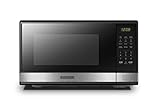
- Pre-programmed buttons for popcorn, potato, pizza, frozen vegetable, beverage and dinner plate.Frequency : 60 Hz
- 1000 Watts Output with 10 power settings, clock and kitchen timer, 30 seconds express cooking, Input power: 1600W
- Large LED digital display, easy-to-read control panel, child safety lock, interior light, removable 12.4” glass turntable
- Push-button door release for easy access
- Dimensions (L x W x H): 20.6” x 14.8” x 11.8”; Color of door frame is stainless steel, enclosure is black
Does microwave cooking destroy nutrients?
Microwave cooking does not inherently destroy more nutrients than conventional cooking. Nutrient retention depends on the food, time, temperature, amount of water, covering and whether the food is reheated repeatedly.
Because microwave cooking can be fast and may use little added water, it can preserve some vitamins and minerals better than prolonged boiling. That does not mean every microwave method preserves every nutrient. Avoiding excessive time and water is usually more important than the heating method’s name.
Why do some foods heat better than others?
Microwave performance depends on several interacting factors:
- Water content: Water-rich regions often absorb energy readily.
- Salt and ions: Dissolved ions can contribute to dielectric heating.
- Density: Dense food takes longer for heat to conduct into its center.
- Thickness: Thick portions are more likely to have cold interiors.
- Shape: Corners and thin edges can heat faster.
- Frozen state: Frozen regions generally respond differently from thawed regions.
- Fat and sugar: These can become very hot and may continue transferring heat after cooking.
- Surface area: Smaller or thinner portions generally heat more evenly.
Microwave cooking is therefore both electromagnetic and thermal. The waves deposit energy unevenly, and ordinary heat transfer then redistributes it.
Microwave versus convection microwave
A basic microwave uses microwave energy to heat food. A convection microwave adds a heating element and fan, allowing hot air to circulate and providing more conventional oven-like browning and roasting.
A convection model can be useful when one appliance needs to handle both rapid reheating and baking or crisping. It is more complicated than a basic microwave, and its cookware, modes and installation requirements vary by model.
The U.S. Department of Energy includes microwave ovens with or without thermal elements and convection microwave ovens in its definitions and energy-efficiency standards.
Do these 3 things before closing this tab:
1Scan for outdated or missing drivers - takes under a minute2Repair Windows errors before they cause bigger problems3Fix the driver behind crashes, sound loss and screen glitchesAre microwave ovens energy-efficient?
A microwave can use less energy than a conventional oven for small portions because it heats the food directly and does not need to heat a large cavity. This is not universal: the result depends on portion size, cooking time, appliance efficiency, standby power and whether a convection or grill element is active.
For a large meal or a task requiring browning, a conventional oven may be more suitable. For reheating one portion or cooking a small amount quickly, a microwave is often a practical choice. U.S. energy standards and test procedures are administered through the DOE.
Common microwave myths, corrected
| Claim | What is more accurate |
|---|---|
| “Microwaves cook from the inside out.” | They can penetrate below the surface, but penetration is limited and heat must still conduct through thick food. |
| “Water resonates at exactly the microwave frequency.” | Heating involves dielectric losses, polar-molecule response and ionic conduction; it is not a single perfect resonance. |
| “All metal explodes.” | Metal reflects microwaves, while geometry and field concentration determine whether arcing occurs. Follow the manual. |
| “The turntable makes cooking perfectly even.” | It averages exposure across field regions but does not eliminate hot and cold spots. |
| “Microwave radiation remains in food.” | Absorbed energy becomes heat; food does not become radioactive. |
| “Microwave-safe means the container stays cool.” | Food can transfer substantial heat into a microwave-safe container. |
| “Microwaving destroys nutrients.” | Nutrient retention depends on time, temperature, water and the food; fast cooking with little water can preserve nutrients well. |
Practical troubleshooting
| Problem | Likely cause | Useful response |
|---|---|---|
| Cold center and hot edges | Standing-wave distribution, thick shape, frozen center or limited conduction | Use a thinner layer, arrange food in a ring, stir, heat in intervals and allow standing time. |
| Food dries out | Excessive heating time or uncovered cooking | Use shorter intervals, cover or vent appropriately and add moisture where suitable. |
| Container becomes dangerously hot | Heat transferred from the food or unsuitable cookware | Use microwave-safe cookware and oven mitts; check the container’s instructions. |
| Sparks or arcing | Metal, metallic trim, foil edges, food residue or damaged cavity coating | Stop the oven and remove the cause when safe. Discontinue use if arcing persists. |
| Liquid erupts after heating | Superheating | Use shorter intervals, let the liquid stand and handle it cautiously. |
| Oven operates with door open | Possible failed interlock or serious defect | Stop using it immediately and contact the manufacturer or qualified service provider. |
The bottom line
A microwave oven follows a straightforward chain: electricity → magnetron → waveguide → reflective cavity → food absorption → heat conduction. Its speed comes from depositing electromagnetic energy within the food rather than heating a large surrounding oven cavity first. Its limitations—uneven heating, cold centers, hot containers and occasional arcing—come from the same physics.
Use compatible cookware, vent foods that can build pressure, handle liquids cautiously, stir and rest food when appropriate, and follow the manual for your specific oven. A damaged door or an oven that runs with the door open is not a minor cooking problem; stop using it.
Free tools Windows power users keep installed
One-click scans. No signup required.
Quick Recap
Sources
- FDA: Microwave Ovens
- EPA: Non-Ionizing Radiation Used in Microwave Ovens
- Technical Safety BC: Microwave Ovens—Hazards and Safe Practices
- IEEE Technology Navigator: Microwave Ovens
- U.S. Department of Energy: Microwave Ovens
- FDA Product Code RCR: Consumer Microwave Ovens
Product prices and availability are accurate as of the date/time indicated and are subject to change. Any price and availability information displayed on Amazon at the time of purchase will apply.