What’s actually slowing this PC down?
Pick the symptom - the matching free tool is one click away.
Some links on this page are affiliate links: if you buy through them we may earn a commission, at no extra cost to you.
Most homeowners looking for gutter alternatives are really asking a bigger question: how do I move roof water away from my house without creating maintenance headaches, foundation problems, or an eyesore?
The honest answer is that traditional gutters are still the baseline solution for many homes. In 2026, national gutter installation and replacement pricing commonly runs about $4 to $40 per linear foot, with average project totals ranging from roughly $724 to $2,055 on smaller or simpler jobs and $2,000 to $6,000 for many average-size homes. Seamless aluminum gutters remain the professional default in much of the U.S., often around $6 to $20 per linear foot, with many quality installs landing near $12 to $18 per linear foot.
As an Amazon Associate I earn from qualifying purchases.
Free tools Windows power users keep installed
One-click scans. No signup required.
But gutters are not perfect. They clog, pull loose, ice up, overflow in valleys, look wrong on some homes, and can be difficult to route on additions, tight lots, modern rooflines, or houses with poor discharge options. On our job sites, we treat gutter alternatives as roof-water management systems, not decorative substitutes. The question is not, “Can I skip gutters?” The question is, “Where will the water go during a real storm?”
Below are nine gutter alternative ideas worth considering, including what they cost, where they work, where they fail, and when they should be paired with gutters instead of replacing them.
#1 Best Overall

- FUNCTIONAL DOWNSPOUT DESIGN: The rain chains for gutters have a length of 8.5 feet. Water cascades down each ring creating a beautiful water feature. Cross bar included for installation. Requires no tools and installation guide is included.
- STYLISH APPEARANCE: Contemporary style rain chain downspout adds a visually appealing accent to your gutters. As with all rain chains, some splashing can be expected. Modern matte black finish provides a simple, elegant, and modern look.
- VERSATILE: The rain chain black is beautifully assembled with 57 links. Each link of the rain chains for gutters measures 2-inches in diameter. Purchase an additional rainchain downspout substitution and extend to meet your desired length.
- PREMIUM QUALITY CONSTRUCTION: The downspout alternative is assembled by skilled artisans to provide long-term durability and stability. Artistic and functional in design, the rain chain is made of high-quality aluminum and is rust resistant.
- INCREASE CURB APPEAL: The rain chain is a beautiful smart green alternative to replacing traditional gutter downspouts. Complete the look by adding one of our gutter reducer kits, basins, or anchoring stakes.
Start With a Roof-Water Audit Before Choosing an Alternative
Before spending money on rain chains, drains, gravel trenches, or new landscaping, walk the house during or right after a hard rain. A good drainage plan starts with observation, not product selection.
We look at six things first: roof area, roof pitch, valleys, overhang depth, ground slope, and soil type. A 12-foot section of roof edge under a small porch behaves very differently from a 42-foot rear roof plane with two valleys dumping into one corner. Clay soil behaves differently from sandy soil. A house with a basement has a different risk profile than a slab-on-grade house with excellent slope.
Do these 3 things before closing this tab:
1Repair Windows errors before they cause bigger problems2Fix the driver behind crashes, sound loss and screen glitches3Clear out junk files and repair common Windows errorsAs a working rule, water should move away from the foundation first, then infiltrate or store safely. Do not let a decorative drainage feature hold water against the wall. In areas with expansive clay soils, such as parts of Texas, Colorado, and California, the International Residential Code includes drainage provisions that make discharge distance and approved drainage systems especially important. Where IRC R801.3 applies, roof drainage should discharge at least 5 feet away from foundation walls or to an approved drainage system.
Also check local rules. Some municipalities restrict stormwater discharge to sidewalks, neighboring properties, streets, or sanitary sewer lines. If trenching is involved, call 811 before excavation. Even a shallow French drain can cross irrigation lines, low-voltage lighting, gas service, electrical conduit, or communication lines.
Quick Comparison: What Each Gutter Alternative Does Best
Some options below can replace gutters in limited conditions. Others are better as complements. A rain barrel, for example, does not replace a gutter run because it needs a gutter and downspout to feed it. A French drain does not catch water at the roof edge; it manages water after it reaches grade. That distinction matters.
| Alternative | Best Use | Typical 2026 Cost Range | True Replacement or Supplement? | Main Failure Risk |
|---|---|---|---|---|
| Rain chains with basins | Visible downspout replacement at porches and entries | Low material cost plus labor, basin, anchoring, and drainage | Supplement; replaces downspout, not gutter | Splashing and overflow in heavy rain |
| Drip edge | Protecting fascia and directing roof-edge runoff | Roughly $150 to $1,000 as an alternative-system item | Supplement | Water still lands near the foundation |
| Drip path or rock trench | Homes with wide overhangs and positive grade | $10 to $20 per linear foot installed; pipe adds about $5 to $15 per linear foot | Limited replacement | Erosion, splashback, or overload at valleys |
| French drain | Moving water away below grade | About $10 to $35 or $20 to $40 per linear foot depending on design | Usually supplement | Clogging, poor slope, no legal outlet |
| dry well | Sites with no daylight outlet | About $1,200 to $5,200; average around $3,110 | Supplement or discharge endpoint | Poor soil infiltration or undersizing |
| Rain barrel or cistern | Water reuse and small-storm capture | Low cost for small barrels; more for cisterns, pads, pumps, and overflow | Supplement | Fills quickly without overflow routing |
| Rain garden or bioswale | Absorbing and filtering roof runoff | DIY often $1 to $5 per sq. ft.; pro installs can reach $4 to $35 per sq. ft. | Supplement or endpoint | Poor sizing, standing water, wrong plants |
| Grading, berms, and swales | Foundation protection and surface routing | Varies widely by soil, access, and restoration | Can be a replacement on simple rooflines | Water directed to neighbors or low spots |
| Permeable paving | Roof runoff landing on patios, walks, or drives | Commonly $10 to $30 per sq. ft.; some projects $10 to $40 per sq. ft. | Supplement | Sediment clogging and poor base design |
1. Rain Chains With Catch Basins
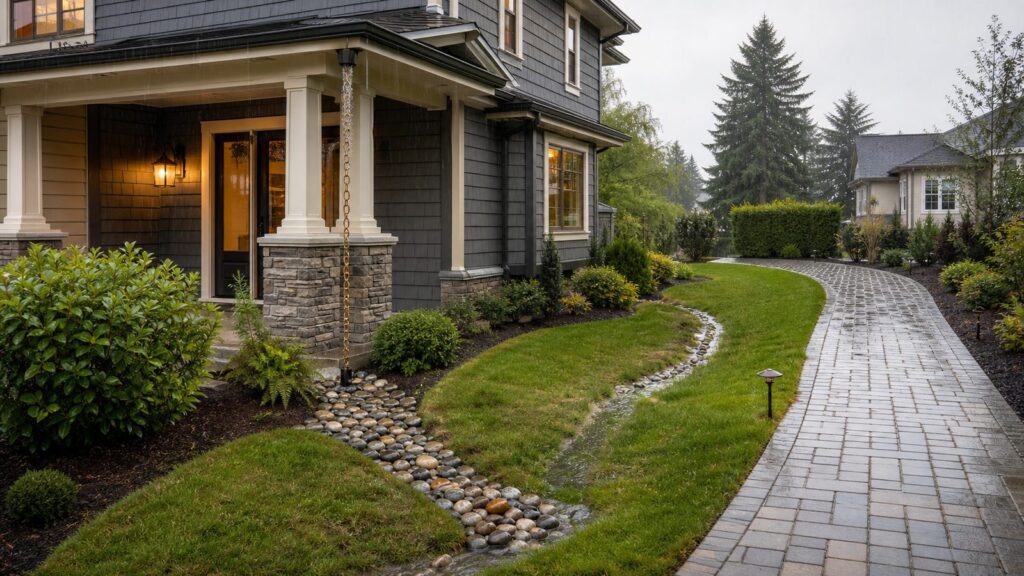
Rain chains are one of the most attractive gutter alternatives, but they are often misunderstood. A rain chain replaces a downspout, not the gutter itself. It guides water from a gutter outlet down a chain of cups, links, or decorative elements into a basin, drain, gravel bed, or underground piping.
Recommended Free Tools
They work best at front porches, garden walls, courtyards, and low-volume roof sections where a metal downspout would look bulky. Copper, aluminum, stainless steel, and powder-coated chains are common. A basic chain can be inexpensive, but the real cost is the complete assembly: outlet adapter, hanger, anchoring, splash basin, stone bed, catch basin, drain line, and overflow route.
On projects where we use rain chains, we usually anchor the bottom so wind does not swing the chain into siding or trim. We also avoid placing a chain directly over mulch or bare soil. A 2-foot by 2-foot decorative bowl may look finished, but it can be overwhelmed quickly during a summer thunderstorm. For a larger roof plane, the chain should discharge into a basin connected to a drain line, dry well, rain garden, or daylight outlet.
Best fit
Use rain chains where appearance matters and the roof area is modest. They are especially useful when a downspout would interrupt an entry elevation or where a homeowner wants visible water movement as part of the landscape.
Watch-outs
Rain chains can splash in wind, ice up in freezing climates, and overflow when roof valleys concentrate water. Do not treat them as a fix for poor grading. They still need a controlled receiving area below.
Crashes, No Sound, or Screen Glitches?
Random freezes, missing sound and display glitches usually trace back to one bad driver. Find and replace yours safely.Free scan · under a minuteWindows Errors? Fix Them Before They Spread
Repair common Windows errors and clear accumulated junk for a smoother, more stable PC - no reinstall needed.Free scan · no reinstall2. Drip Edge Flashing
Drip edge is metal flashing installed along roof edges to help direct water away from fascia and into a controlled drop line. It is a roof-edge detail, not a whole-house drainage system.
Drip edge is commonly installed during roof replacement, when shingles can be lifted or replaced correctly. Retrofitting it after the roof is finished can be more labor-intensive because installers may need to work under existing shingles without damaging them. As a gutter alternative-system cost, 2026 pricing is often roughly $150 to $1,000 depending on roof perimeter, access, fascia condition, and whether it is part of a larger roofing project.
Drip edge is valuable even if you keep gutters. It helps protect the fascia board, reduces water curling under the roof edge, and improves the transition into gutters, chains, or drip paths. Where gutters are removed, drip edge can create a cleaner line of runoff, but that runoff still has to land somewhere safe.
Best fit
Use drip edge as part of a roof replacement, fascia repair, or gutter redesign. It is especially helpful on homes where water stains, fascia rot, or shingle-edge deterioration show that roof-edge water is not being controlled.
Watch-outs
Drip edge alone does not stop splashback, soil erosion, basement seepage, or foundation moisture. It should usually be paired with a drip path, positive grading, or another ground-level drainage system.
3. Drip Paths and Rock Trenches
A drip path is a controlled strip of stone, pavers, or gravel placed below the roof drip line. It catches water as it falls from the roof and reduces erosion. A more robust version uses a rock trench with washed stone, geotextile fabric, and sometimes perforated pipe to move water away from the house.
Rank #2

- EFFICIENT RAINWATER MANAGEMENT: This 8.5-foot rain chain is crafted from powder-coated aluminum with a modern matte black finish, offering a stylish gutter chain downspout alternative. As rainwater flows through the rain catcher chain, it creates a smooth, controlled cascade—ideal for rain chains for gutters for smooth water flow and easy, tool-free installation.
- MODERN DECORATIVE DESIGN: Featuring 15 large hammered cups, this decorative rain chain delivers a sleek, contemporary look. The minimalist profile makes it a standout among modern rain chains for gutters, enhancing curb appeal while functioning as a decorative rain chains for outside solution.
- HEAVY-DUTY & EXPANDABLE: Each cup of the rain chain for gutters measures 3.5 inches in diameter (bottom of cup has 1-inch diameter) and 2.5 inches in height, forming a large rain chain for gutters designed for steady water flow. This hanging rain chain is fully customizable—connect multiple sets to extend length or remove links to shorten, making it a versatile outdoor rain chain.
- DURABLE ALL-WEATHER CONSTRUCTION: Built from high-quality aluminum, this heavy duty rain chain resists rust, corrosion, and harsh weather. Engineered for long-term performance, it’s a reliable choice for durable rain chains for gutters used year-round.
- STYLISH & SUSTAINABLE DOWNSPOUT ALTERNATIVE: Upgrade traditional drainage with rain chains for gutters that combine function and design. Pair this gutter rain chain with a rain chain anchor, basin, or adapter to create one of the most elegant decorative rain chains for gutters available.
This is one of the few options that can work without gutters on the right house. The roof should have generous overhangs, siding that tolerates splash exposure, and grade that slopes away from the foundation. The soil should drain reasonably well, and high-volume areas such as valleys should be handled separately.
Current contractor pricing commonly puts simple drip-path materials around $5 to $10 per linear foot, with professional installation around $10 to $20 per linear foot. Adding perforated pipe can add roughly $5 to $15 per linear foot. For 150 linear feet with drainage pipe, a realistic installed range can be about $2,250 to $5,250 depending on excavation, stone depth, fabric, pipe outlet, and restoration.
On our job sites, we prefer washed angular stone over pea gravel when the trench has to resist movement. We typically separate stone from soil with geotextile fabric so fines do not migrate into the drainage layer. Where the trench carries water, we include slope and an outlet; a flat trench beside the foundation is just a wet trench.
Best fit
Drip paths work well for simple rooflines, sheds, detached garages, cabins, and houses with wide eaves and strong surface drainage. They are also useful under roof sections where installing a gutter is impractical.
Watch-outs
They perform poorly in tight side yards, clay soils, high-volume valleys, and areas with poor foundation clearance. If the trench is near the house, include a discharge route that moves water away instead of storing it against the wall.
4. French Drains
A French drain is a below-grade drainage trench built with washed stone, geotextile fabric, and usually perforated pipe. It collects water from the soil or surface and carries it to a legal outlet. For roof runoff, a French drain is usually a companion to gutters, drip paths, or catch basins rather than a direct replacement.
Installed pricing in 2026 commonly runs about $10 to $35 per linear foot or $20 to $40 per linear foot depending on trench depth, pipe size, stone volume, access, outlet, surface restoration, and cleanout details. A shallow yard drain is different from a deeper foundation drain, and the price should reflect that.
A proper French drain needs slope. A common target is about 1 percent, or 1/8 inch per foot, though site conditions and local practice vary. It also needs somewhere to discharge: daylight on a downhill slope, a storm system where allowed, a dry well, or another approved drainage destination. Cleanouts matter because buried systems eventually need service.
We often see failed drains that were built with round rock, no fabric, no slope, no cleanouts, or no real outlet. Those systems may work for a season and then turn into a buried reservoir beside the foundation.
Best fit
Use a French drain when roof runoff reaches grade and needs to be intercepted and moved away. It is useful along patios, retaining walls, drip paths, and tight side yards where surface swales are not practical.
The Tool Desk
Outbyte PC Repair FREEClear out junk files and repair common Windows errorsFree Scan →Outbyte Driver Updater FREEFix the driver behind crashes, sound loss and screen glitchesFind Drivers →Watch-outs
Do not connect roof water to a French drain that runs beside the footing unless the system is designed for that volume and has a safe outlet. Adding roof runoff to an already wet foundation zone can make moisture problems worse.
5. Dry Wells
A dry well is an underground storage and infiltration system. It receives water from a downspout, catch basin, French drain, or area drain, stores it temporarily, and lets it soak into surrounding soil. Dry wells are most useful when there is no practical downhill outlet.
Costs vary with excavation depth, tank volume, soil conditions, access, piping distance, and permitting. In 2026, common dry well pricing ranges from about $1,200 to $5,200, with one national average around $3,110 and a normal range near $1,334 to $5,139.
The key issue is soil infiltration. A dry well in sandy soil can perform well. A dry well in dense clay may fill and stay full, which means the next storm has nowhere to go. Before installing one, test infiltration and confirm separation from foundations, septic systems, wells, property lines, and any local setback requirements.
Quick wins for a faster PC:
Fix the driver behind crashes, sound loss and screen glitchesFind Drivers →Clear out junk files and repair common Windows errorsFree Scan →Scan for outdated or missing drivers - takes under a minuteDriver Scan →Rank #3

- EFFICIENT RAINWATER MANAGEMENT: This 8.5-foot rain chain is crafted from powder-coated aluminum with a modern matte black finish, offering a stylish gutter chain downspout alternative. As rainwater flows through the rain catcher chain, it creates a smooth, controlled cascade—ideal for rain chains for gutters for smooth water flow and easy, tool-free installation.
- MODERN DECORATIVE DESIGN: Featuring 8 large lotus-style cups with wide flared mouth with slightly indented and defined petals, this decorative rain chain delivers a sleek, contemporary look. The minimalist profile makes it a standout among modern rain chains for gutters, enhancing curb appeal while functioning as a decorative rain chains for outside solution.
- HEAVY-DUTY & EXPANDABLE: Each cup of the rain chains for gutters measures 4.5 inches wide (bottom of cup has 0.75-inch diameter) and 2.25 inches in height, forming a large rain chain for gutters designed for steady water flow. This hanging rain chain is fully customizable—connect multiple sets to extend length or remove links to shorten, making it a versatile outdoor rain chain.
- DURABLE ALL-WEATHER CONSTRUCTION: Built from high-quality aluminum, this heavy duty rain chain resists rust, corrosion, and harsh weather. Engineered for long-term performance, it’s a reliable choice for durable rain chains for gutters used year-round.
- STYLISH & SUSTAINABLE DOWNSPOUT ALTERNATIVE: Upgrade traditional drainage with rain chains for gutters that combine function and design. Pair this gutter rain chain with a rain chain anchor, basin, or adapter to create one of the most elegant decorative rain chains for gutters available.
Sizing should be based on roof area and local storm intensity. A small plastic well may be fine for one downspout from a porch roof. It is not enough for half the roof of a two-story house unless the design accounts for storage volume and overflow.
Best fit
Dry wells are useful for homes on flat lots, urban lots, and properties where downspouts cannot legally or practically discharge to the street, alley, or daylight slope.
Watch-outs
Every dry well needs an overflow plan. During storms larger than the design capacity, water must leave safely without backing up against the house.
6. Rain Barrels and Cisterns
Rain barrels and cisterns reduce small-storm runoff and provide water for gardens, planters, and landscape beds. They are not stand-alone gutter replacements because they need a gutter and downspout to deliver water into the container.
A typical residential rain barrel holds about 50 to 100 gallons. That sounds like a lot until you do the math. One inch of rain on 1,000 square feet of roof produces roughly 623 gallons of water. A single 55-gallon barrel can fill quickly, sometimes in one short storm. That is why overflow routing is not optional.
Good rain barrel details include a screened inlet, tight lid, stable level base, accessible spigot, overflow hose or pipe, mosquito control, and winterization in freezing climates. Larger cisterns can store hundreds or thousands of gallons, but they require more planning: structural support, pump selection, filtration, backflow protection where connected to irrigation, and local code review.
Best fit
Use rain barrels where irrigation reuse is the goal and the overflow can be routed to a rain garden, dry well, swale, or approved drain. They work especially well on sheds, garages, garden structures, and selected downspouts from the main roof.
Watch-outs
A full barrel is heavy. Water weighs about 8.34 pounds per gallon, so a 55-gallon barrel holds about 459 pounds of water before counting the barrel itself. Place it on a stable base, not loose soil or a leaning stack of blocks.
7. Rain Gardens and Bioswales
Rain gardens and bioswales are landscape-based drainage systems that collect, slow, filter, and infiltrate runoff. They can be attractive, but they should be designed as drainage features first and planting beds second.
A rain garden is typically a shallow depressed area planted with species that tolerate both wet and dry conditions. A bioswale is more linear and is often used to convey water across a site while slowing it down. Both can work well as discharge points for downspouts, rain chains, drip paths, and yard drains.
DIY rain garden materials are often about $1 to $5 per square foot or $3 to $5 per square foot when homeowners do the digging and planting themselves. Professionally designed and installed rain gardens can run much higher, often $4 to $35 per square foot depending on excavation, soil amendments, plant selection, stone, edging, underdrains, and grading. Some landscape installations land around $22 to $26 per square foot.
Location matters. A rain garden should not be placed against the foundation. It needs enough distance, the right elevation, and an overflow route for storms larger than its design capacity. We also avoid placing them where water already stands for days. That usually signals poor infiltration, compaction, or a high water table.
Quick wins for a faster PC:
Repair Windows errors before they cause bigger problemsFix Now →Scan for outdated or missing drivers - takes under a minuteDriver Scan →Clear out junk files and repair common Windows errorsFree Scan →Best fit
Rain gardens and bioswales are excellent when the yard has enough space and soil capacity to absorb runoff. They are also useful where local stormwater programs encourage or require on-site infiltration.
Watch-outs
The common failure is undersizing. A small planting bed at the end of a large roof plane can wash out, drown plants, or overflow toward the house. Size it to roof area, soil infiltration, and local rainfall.
Rank #4

- Bigger Size Cups: 3.7in X 3.7in; chain length 8.5 feet; 12pcs Cup;Big enough to catch the rain coming out of the larger downspout and avoid rainwater splashing
- Functional Design: The rain chain adapter is designed to fit in the rain gutter over the drain hole where there’s a downspout. The rain chain holder captures rainwater and tapers down to direct the water from the gutter into the rain chain downspouts. Adding a touch of modernity and artistic ambiance to your outdoor space.
- Premium Quality Material: We use the highest quality materials and craftsmanship in the production of all our rain chains and accessories. If there is any part missed or defective during shipping, please let us know, we will send replacement at first time.
- Easy Installation: The rain chain comes with easy-to-understand installation instructions, requiring no specialized tools. With just a few simple steps, you can effortlessly install it.
- Optimal Water Flow: Our Square-shaped black rain chain cleverly guides the flow of rainwater, creating a graceful waterfall effect that adds soothing sounds and visual appeal to your outdoor space.
8. Ground Grading, Berms, and Swales
Sometimes the best gutter alternative is not attached to the roof at all. Proper grading, shallow swales, and low berms can move water away from the foundation before it becomes a problem.
A swale is a shallow, shaped channel that carries water across the yard. A berm is a raised soil feature that redirects flow. Used together, they can move roof runoff toward a drainage area, rain garden, dry well, street-side inlet where allowed, or natural low point that does not affect the house or neighbors.
For foundation protection, the grade near the house should slope away consistently. Many builders use a practical target of about 6 inches of fall within the first 10 feet where site conditions allow. That is not always achievable on tight lots, but the principle holds: water should not sit beside the foundation.
Costs vary too widely for a single meaningful number because grading can mean anything from reshaping a small planting bed to bringing in equipment, hauling soil, rebuilding walks, adjusting irrigation, and replacing turf. The important point is that grading often solves the root problem instead of adding a product on top of bad site drainage.
Best fit
Use grading, berms, and swales when water currently moves toward the house, pools beside a slab, or crosses a walkway. They are especially useful when multiple downspouts or roof planes discharge into the same yard area.
Watch-outs
Do not redirect water onto a neighboring property, across a public sidewalk, or into a location that freezes into a slip hazard. In many jurisdictions, that can create a code issue or a civil dispute.
Free tools Windows power users keep installed
One-click scans. No signup required.
9. Permeable Paving Near Roof Drip Lines
Permeable paving allows water to pass through joints or porous surfaces into a stone reservoir below. It can be a smart option where roof runoff lands on patios, walkways, courtyards, or driveways.
Installed costs in 2026 commonly run about $10 to $30 per square foot, with some sources citing $10 to $40 per square foot and $2,000 to $8,000 for 200 square feet. The price depends heavily on excavation depth, base stone, edge restraints, underdrains, soil type, existing concrete removal, and site access.
The paver surface is only part of the system. Performance comes from the open-graded stone base and the ability to store and drain water. In clay soils or freeze-thaw regions, an underdrain may be needed. If roof runoff carries leaves, shingle grit, mulch, or soil across the pavers, the joints can clog and the surface behaves like ordinary pavement.
Maintenance is part of the specification. Periodic vacuuming or cleaning helps preserve infiltration. Sand should not be swept into permeable paver joints unless the system is specifically designed for it; many systems use clean aggregate in the joints instead.
Do these 3 things before closing this tab:
1Repair Windows errors before they cause bigger problems2Scan for outdated or missing drivers - takes under a minute3Clear out junk files and repair common Windows errorsBest fit
Use permeable pavers where hardscape is already planned or where runoff currently splashes onto concrete and races toward the house. They pair well with drip edges, roof overhangs, area drains, and underdrain systems.
Watch-outs
Do not assume permeable pavers can absorb unlimited roof runoff. Large roof planes may still need gutters, catch basins, or an underdrain to prevent saturation.
When to DIY and When to Hire a Pro
Some gutter alternatives are reasonable DIY projects. Others should be designed and installed by a contractor, landscaper, roofer, or drainage specialist.
DIY can make sense for a single rain chain on a small porch roof, a basic rain barrel connected to an existing downspout, a short decorative drip path, or a small rain garden placed well away from the foundation. Even then, the work should include overflow routing, stable bases, splash control, and a plan for heavy storms.
Best Value

- FUNCTIONAL WATER FLOW DESIGN: This rain chain gutter adapter creates a beautiful cascading water feature while efficiently directing rainwater from your gutter into rain chains for gutters. The matte black rain chain adapter helps prevent splashing and overflow, even during heavy rainfall.
- PREMIUM ALUMINUM CONSTRUCTION: Handcrafted by skilled artisans, this rain chain adapter for gutter is made from premium aluminum for long-lasting durability. Naturally rust resistant, it pairs perfectly with matte black rain chains for gutters and withstands year-round outdoor exposure.
- ENHANCES CURB APPEAL: Add a refined architectural accent to your home with this elegant rain gutter adapter. Designed to complement rain chains for gutters with adapter systems, it upgrades the look of your downspout while improving water control.
- EASY & SECURE INSTALLATION: This gutter downspout adapter installs easily at the top of the gutter opening. The solid brass nut and bolt feature a center groove to securely hang and stabilize rain chains for gutters for heavy rain, making it ideal for rain chain installation kits.
- SIZE & FIT DETAILS: Measures 5 x 3.5 x 3 inches, with top opening of 2 inches and bottom opening of 1.75 inches and includes a solid brass bolt for stability. Compatible as a downspout adapter, gutter adapter, or rain chain adapter—please measure your gutter opening to ensure proper fit before installation.
Hire a pro when the project involves roof-edge flashing, second-story work, long trenching, buried pipe, dry wells, poor soil drainage, basement moisture, steep lots, expansive soils, retaining walls, driveways, or any connection to a municipal storm system. Also bring in help if water is already entering the basement or crawlspace. At that point, the cost of guessing can exceed the cost of doing the drainage plan correctly.
For buried systems, ask for specifics: pipe diameter, slope, stone type, fabric, cleanout locations, discharge point, dry well volume, and restoration scope. A proposal that says only “install drainage” is not detailed enough.
Permits, Codes, and Safety Notes
Drainage work touches more than landscaping. Roof runoff can affect foundations, sidewalks, neighboring lots, wells, septic systems, and public infrastructure.
Before excavation, call 811 and mark utilities. For deeper trenches, follow trench safety requirements. For roof-edge work, use proper fall protection and ladders rated for the job. Wet roofing, steep slopes, and two-story gutter lines are not good places to improvise.
Recommended Free Tools
Check local requirements for stormwater discharge, dry wells, rain gardens, and permeable paving. Some areas require permits or inspections for underground infiltration systems. Others offer rebates for rain barrels, rain gardens, or permeable surfaces. In wildfire-prone areas, debris management near roof edges and walls may affect material choices. In northern climates, freeze-thaw cycles and ice discharge must be considered. In clay soil regions, foundation moisture control should drive the design.
Which Gutter Alternative Should You Choose?
If foundation protection is the top priority, start with grading, properly sized gutters, downspout extensions, French drains, or dry wells. If appearance is the main concern, consider rain chains, concealed drainage, drip paths, or redesigned downspout locations. If stormwater compliance or water quality is the goal, rain gardens, bioswales, dry wells, and permeable paving are usually stronger choices.
For many homes, the best answer is a hybrid system. Gutters plus underground drains. Rain chains plus catch basins. Drip paths plus perforated pipe. Rain barrels with overflow to a rain garden. Permeable pavers with a designed stone reservoir and underdrain.
The right system should handle ordinary rain quietly and have a clear overflow route for the storm that exceeds expectations. If you can stand outside during a heavy rain and see water moving away from the house without erosion, splashback, pooling, or neighbor impact, the system is doing its job.
Frequently Asked Questions
Can a house work without gutters?
Yes, but only when the roof design, overhangs, grading, soil, and foundation conditions support it. Homes with wide eaves, strong positive grade, and good soil drainage may use drip paths, swales, or other systems. Homes with basements, clay soils, tight lots, or concentrated roof valleys usually still need gutters or a professionally designed drainage system.
What is the cheapest gutter alternative?
A simple drip path or rain chain can be among the lower-cost options, but cheap is not always effective. A rain chain still needs a basin or drain below, and a drip path needs proper slope and splash control. If the alternative lets water collect near the foundation, it can become expensive later.
Are rain chains as effective as downspouts?
Rain chains can work well for smaller roof areas and visible locations, but they are less controlled than enclosed downspouts during wind-driven or heavy rain. They should discharge into a basin, drain, stone bed, or rain garden with an overflow route.
Do French drains replace gutters?
Usually no. French drains collect and move water after it reaches the ground. Gutters collect water at the roof edge before it splashes against siding or foundation areas. In many cases, the best system uses gutters or drip paths to control roof water and French drains to carry it away.
What’s actually slowing this PC down?
Pick the symptom - the matching free tool is one click away.
How far should roof water drain from the foundation?
A practical target is to move roof water at least 5 feet away from the foundation or to an approved drainage system, especially in areas where IRC roof drainage rules apply. More distance may be needed for basements, expansive soils, or poor site drainage.
What is the best low-maintenance gutter alternative?
Proper grading and swales are often the lowest-maintenance options because they use the shape of the land rather than hardware. Permeable pavers, French drains, dry wells, and rain gardens can work well, but they require periodic inspection, cleaning, or sediment control.
Quick Recap
Product prices and availability are accurate as of the date/time indicated and are subject to change. Any price and availability information displayed on Amazon at the time of purchase will apply.

