Some links on this page are affiliate links: if you buy through them we may earn a commission, at no extra cost to you.
A good lid organizer should do one thing well: let you grab the right lid without unloading half a cabinet. For most homeowners, that means separating cookware lids from food-container lids, measuring the real cabinet opening, and choosing a rack that matches the weight and shape of the lids you actually own.
In 2026, the useful price range is still fairly modest. Simple adhesive door holders and small plastic bins often run about $8 to $20. Adjustable cabinet racks usually land around $15 to $35. Premium pull-out lid and tray organizers commonly cost $35 to $75 before installation. Professionally installed pull-out cabinet accessories are a different category, often around $140 to $350 per cabinet insert when labor and minor fitting are included.
As an Amazon Associate I earn from qualifying purchases.
On our kitchen remodels, lid clutter is usually a symptom of a larger storage problem. If lids are piled under the cooktop, plastic lids are mixed with pot lids, and baking sheets are leaning into plumbing, the kitchen was never given a real storage plan. The eight organizer types below solve different problems. The right choice depends less on brand and more on cabinet depth, door clearance, hinge layout, lid weight, and whether you are doing a quick cleanup or planning a larger cabinet upgrade.
Quick Comparison: The 8 Best Lid Organizer Types
Before buying anything, sort your lids into four groups: pot and pan lids, food-storage lids, baking sheets or trays, and specialty lids from appliances or mixing bowls. Each group stores differently. A shallow plastic bin that works beautifully for square food-container lids will be a poor choice for a heavy 12-inch glass saute pan lid. A steel pull-out that handles glass lids may be overkill for a renter with five plastic containers.
#1 Best Overall

- 14 Adjustable Dividers: This pot lid organizer comes with 14 adjustable dividers, you can adjust the width according to the size of your pans or other cookware. Please Note: the overall size of this shelf is 22.83"W x 7.09"D x 7.15"H, check the size of your pot lids, pans and other cookware (especially the large size) before purchase, to ensure our rack fit your kitchenware. Please feel free to contact us if you have any questions.
- Expandable Pot and Pan Organizer: Designed as expandable for storage such as heavy pans, large platters, cutting board and other bakeware. It can be used on a countertop, cabinet and even under the sink.
- 2 DIY Methods: This pot rack has 2 DIY methods. You can use it as a expandable organizer or two separate pot lid racks. The length can easily expands from 12'' to 29'', which allows the flexibility to store in a pantry, cabinet, under the sink, or on countertop.
- Durable Material: Our pot and pan organizer rack is made of heavy duty iron, It's designed to hold even your heaviest cast iron pans. It is extremely robust and durable.
- Keep Your Countertop Tidy: Our pot organizer rack will help keep your pots, pans, lids, trays, plates, cookie sheets and cutting boards well organized and easy to reach.
| Organizer type | Best for | Typical 2026 cost | Install level | Capacity range |
|---|---|---|---|---|
| Adhesive cabinet-door lid holders | Small saucepan lids, rental kitchens, quick fixes | $8-$14 per set of 4 | No-drill DIY | 3-4 lids per set |
| Food-container lid bin | Plastic storage lids near prep or cleanup zones | About $15-$25 | No-drill DIY | 15-40 thin lids depending on size |
| Freestanding wire rack | Mixed pot lids in a cabinet or pantry | $15-$35 | No-drill DIY | 6-10 lids |
| Expandable pot-lid rack | Variable lid sizes and changing cookware sets | $18-$35 | No-drill DIY | 6-12 lids |
| Pull-out cabinet lid organizer | Deep base cabinets, heavy lids, trays, cutting boards | $55-$75 retail; $140-$350 installed | Moderate DIY or pro | 18-30 items depending on width |
| Screw-mounted door rack | Heavier lids on solid cabinet doors | $20-$45 | DIY with drilling | 4-8 lids |
| Drawer pegboard lid insert | Deep drawers in remodeled kitchens | $20-$36 for lid insert, plus drawer system | DIY or cabinetmaker | About 6 lids per compact insert |
| Vertical bakeware and lid divider | Sheet pans, cutting boards, oversized lids | $20-$60 | DIY or pro | 6-12 vertical items |
1. Adhesive Cabinet-Door Lid Holders
Adhesive lid holders are the smallest, fastest, and least expensive fix. They are usually sold as individual clips or small paired brackets that stick to the inside of a cabinet door. A common set costs about $8 to $14 and holds roughly three or four pot lids, depending on lid diameter and handle shape.
This type works best for lightweight lids from small saucepans, stockpot lids with low-profile knobs, and renters who cannot drill into cabinetry. It is also useful when the cabinet interior is too crowded for a freestanding rack but the inside of the door is unused.
The Tool Desk
Outbyte PC Repair FREEClear out junk files and repair common Windows errorsFree Scan →Outbyte Driver Updater FREEFix the driver behind crashes, sound loss and screen glitchesFind Drivers →Where It Works Best
Use adhesive holders on clean, smooth, durable cabinet doors. Painted doors, thermofoil, laminate, and sealed wood can work if the surface is flat and dry. Avoid damp under-sink cabinets, flaking paint, textured veneer, and doors that already flex when opened. Adhesive pads need firm pressure and curing time. If the instructions say to wait 24 hours before loading the rack, wait the full day.
What to Check Before Buying
Close the cabinet door with the largest lid held in place before committing to the final layout. Lid handles and knobs often project 1 to 2 inches farther than expected. Face-frame cabinets, shelf pins, hinges, and interior shelves can all interfere with the lid when the door swings shut.
We do not use adhesive holders for heavy glass lids on job sites unless the manufacturer specifically rates the product for that weight and the cabinet surface is appropriate. A fallen glass lid can chip a cabinet floor, crack tile, or injure a child standing nearby. For heavy lids, step up to a steel rack, screw-mounted system, drawer insert, or pull-out.
2. Divided Food-Container Lid Bin
Food-storage lids are their own problem. They are thin, light, and usually rectangular or round. They do not belong in the same rack as cookware lids. A divided plastic lid bin, often in the $15 to $25 range, is usually the cleanest solution for food-container lids.
Do these 3 things before closing this tab:
1Clear out junk files and repair common Windows errors2Scan for outdated or missing drivers - takes under a minute3Repair Windows errors before they cause bigger problemsLook for adjustable dividers, non-slip feet, and a length that fits the shelf depth. Many upper cabinets are about 11 to 12 inches deep inside, while base cabinets may be closer to 21 to 23 inches usable depth. Measure the actual open space before buying. The exterior cabinet size is not enough.
Best Placement
Put plastic lid storage near the prep or cleanup zone. In many kitchens, that means an upper cabinet near the dishwasher, a base drawer near the sink, or a pantry shelf close to the counter where leftovers are packed. The goal is to keep containers and lids close enough that the system survives daily use.
Before buying a bin, discard orphaned lids and mismatched containers. Homeowners often discover that one-third of the pile has no matching bottom. Buying storage for items that should be thrown away wastes space and makes the cabinet harder to use.
3. Freestanding Wire Pot-Lid Rack
A freestanding wire rack is the classic no-drill pot-lid organizer. It sits on a shelf or cabinet floor and holds lids vertically in slots. Most decent versions cost about $15 to $35 and handle six to ten lids. Powder-coated steel or chrome-plated steel is usually better than thin plastic for cookware lids because it resists bending and handles heat-warped or slightly uneven lids better.
Quick wins for a faster PC:
Fix the driver behind crashes, sound loss and screen glitchesFind Drivers →Clear out junk files and repair common Windows errorsFree Scan →This is the organizer we suggest when a homeowner wants a low-risk test before committing to cabinet modifications. It can move from a base cabinet to a pantry shelf, from a rental to a future home, or from lid duty to cutting-board duty.
Rank #2

- 【Multifunction】Made of coated heavy metal, structurally very strong. Perfect for organizing plates, cutting boards, bakeware, cooling racks, pots & pans, serving trays, and reusable containers.
- 【Adjustable】The 7 dividers adjust in increments of 0.43 inch to securely hold various sizes of lids.
- 【Space Saving】Keep your cabinets orderly, It is good for smaller or busy kitchens, counter top, cupboard or even under the sink.
- 【No Installation Required】You can find all the accessories in the package, No extra tools are required.Just insert the dividers into the frames and you’re ready to go.
- 【Easy Access】: Always within reach, no more hassle from cluttered, tangled cookware
Cabinet Fit
Measure three things: width, depth, and vertical clearance above the tallest lid. A 12-inch domed glass lid with a high knob may need 4 to 5 inches of clear vertical height while tilted in a rack. Also check the door opening. A 15-inch base cabinet may have a clear opening closer to 12 or 13 inches after the face frame and hinges are accounted for.
For safety, do not place a lightweight freestanding rack on a high shelf with heavy glass lids. Pulling one lid can drag the whole rack forward. In lower cabinets, add a grippy shelf liner if the rack slides on a slick cabinet floor.
4. Expandable Pot-Lid Rack
An expandable rack is similar to a freestanding rack, but its width adjusts. This is useful when the cookware set is still changing or when one organizer needs to fill an odd cabinet width. Expect to pay about $18 to $35 for a good adjustable model.
The main advantage is flexibility. You can tighten the rack for a narrow cabinet, expand it for a pantry shelf, or reposition dividers to handle different lid thicknesses. Some racks can also store pans, cutting boards, or baking sheets if the dividers are tall and rigid enough.
Where It Falls Short
Expandable racks can become unstable if they are stretched too wide and heavily loaded. Check how the center section locks. If the rack depends only on friction and thin wire, it may twist when loaded with heavy stainless or glass lids. For a deep base cabinet with daily-use cookware, a pull-out with ball-bearing slides is usually more ergonomic.
In a small kitchen, this organizer is often the best value when placed next to the range or cooktop. Keeping pot lids in the cooking zone matters. A neat lid rack across the room is still a bad workflow if you cook every night.
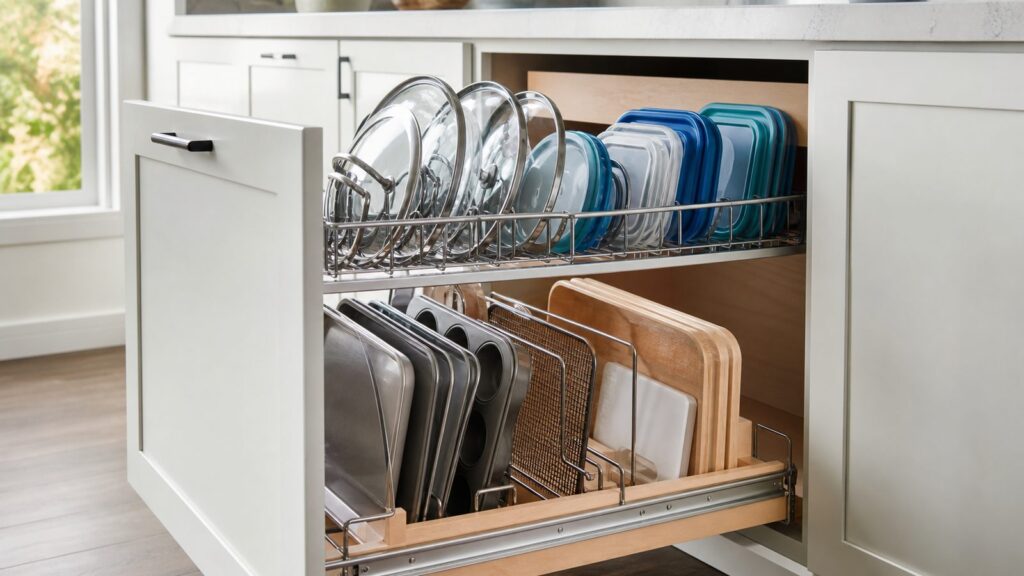
5. Pull-Out Cabinet Lid and Tray Organizer
A pull-out lid organizer is the upgrade choice for deep base cabinets. These units mount to the cabinet floor and slide forward so the homeowner can reach lids, trays, baking sheets, and cutting boards without bending into the back of the cabinet. Retail pricing commonly runs about $55 to $75 for a quality pull-out lid or tray organizer. Installed by a handyman, carpenter, or remodeler, the total often lands around $140 to $350 per cabinet when the cabinet needs only minor work.
For heavy lids, look for full-extension ball-bearing slides. Full-extension hardware lets the rack come all the way out, not just halfway. That matters in a 24-inch-deep base cabinet because the back 6 to 8 inches are otherwise hard to reach. Soft-close slides cost more, but they are worth considering in a premium kitchen or a cabinet used several times a day.
Measure Like a Contractor
Measure the clear cabinet opening, not the door width and not the face-frame width. Record the inside width at the narrowest point, the usable depth from the front obstruction to the back panel, and the height under any shelf. Check hinges, door swing, plumbing, gas lines, shelf supports, and the thickness of the cabinet floor. Many pull-outs need a flat, sound bottom panel thick enough to hold screws.
Pull-outs are excellent for accessibility because they reduce bending, reaching, and unloading stacked items. For older homeowners or anyone with shoulder, back, or mobility limitations, a pull-out is often more than an organization upgrade. It changes whether the cabinet is comfortable to use.
6. Screw-Mounted Cabinet-Door Rack
A screw-mounted door rack is a stronger version of the adhesive door holder. It fastens to the inside of the cabinet door and can usually hold more weight, assuming the cabinet door itself is solid enough. Typical pricing is about $20 to $45.
Outdated Drivers Are Slowing You Down
One free scan finds every outdated or missing driver and matches the right update for your exact hardware.Free scan · exact hardware matchPC Slower Than It Used to Be?
A free scan shows the junk files, broken settings and background clutter dragging Windows down - then fixes them in one click.Free scan · Windows 10 & 11Rank #3

- 【Multifunction】Made of coated heavy metal, structurally very strong. Perfect for organizing plates, cutting boards, bakeware, cooling racks, pots & pans, serving trays, and reusable containers.
- 【Adjustable】The 7 dividers adjust in increments of 0.43 inch to securely hold various sizes of lids.
- 【Space Saving】Keep your cabinets orderly, It is good for smaller or busy kitchens, counter top, cupboard or even under the sink.
- 【No Installation Required】You can find all the accessories in the package, No extra tools are required.Just insert the dividers into the frames and you’re ready to go.
- 【Easy Access】Always within reach, no more hassle from cluttered, tangled cookware
This option works well on solid wood doors or sturdy plywood doors. It is less ideal on thin panels, weak particleboard, damaged doors, or older hinges that already sag. A door rack puts extra leverage on hinges every time the door opens. Four glass lids may not sound like much, but the repeated swing load can loosen screws over time.
Installation Notes
Use screws that are short enough that they will not poke through the finished face of the door. Many cabinet doors have a recessed center panel that is thinner than the rail and stile around it. Drill pilot holes, hold the rack level, and test door closure with the deepest lid before installing every screw.
We treat door-mounted racks as a targeted solution, not a cure-all. They are best for a few frequently used lids, not an entire cookware collection. If you need to store ten heavy lids, use a pull-out, drawer, or base-cabinet rack instead.
7. Drawer Pegboard Lid Insert
Deep drawers are one of the best places to store lids in a remodeled kitchen. A pegboard insert lets you move posts around to hold lids, bowls, containers, plates, or cookware. Lid-specific pegboard accessories commonly cost about $20 to $36 before the drawer pegboard system itself.
This is not always the cheapest option because it depends on having the right drawer. A shallow drawer will not handle tall domed lids. A deep drawer with full-extension slides, however, can outperform most cabinet racks. You see everything from above, the lids stay separated, and the drawer can be planned near the range, island, or cleanup area.
Best Use in a Remodel
If you are replacing cabinets, plan lid storage before ordering boxes. It is far easier to specify a deep drawer, peg system, or narrow pull-out during design than to retrofit storage after countertops are installed. Kitchen planning guidance supports task-based storage, which means lids should live near the task they support: pot lids near cooking, food-storage lids near prep and cleanup, and tray storage near ovens.
For custom and semi-custom kitchens, this is where a construction team can add real value. Lid storage should be coordinated with tray dividers, trash pull-outs, spice pull-outs, corner storage, and pantry zones so the whole kitchen works as a system.
8. Vertical Bakeware, Tray, and Oversized Lid Divider
Some lids do not fit normal lid racks. Oversized stockpot lids, griddle lids, sheet pans, cooling racks, cutting boards, and serving trays usually need vertical dividers. These can be freestanding metal racks, screw-mounted dividers, or built-in cabinet partitions. Expect roughly $20 to $60 for common retail versions, with custom built-ins costing more when bundled into cabinet work.
Recommended Free Tools
Vertical dividers are especially useful above a wall oven, beside a range, in a pantry cabinet, or in a base cabinet with a wide opening. They stop the familiar problem of stacked sheet pans sliding forward every time one item is removed.
Material Choice
Powder-coated steel and chrome-plated steel are common for retail dividers. Stainless steel is more durable in damp or hard-use areas but costs more. Bamboo can look good in a pantry or drawer, but we avoid it under sinks or near leak-prone plumbing. Particleboard and thin engineered wood dividers should be kept dry and lightly loaded.
If the divider is mounted to the cabinet, confirm that screws have enough material to bite into. A divider installed into a thin cabinet floor or loose shelf can pull free when loaded with heavy cutting boards.
Rank #4
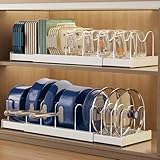
- 【Expandable Design】The pots and pans organizer measures (12.6"~22.4") L*7.9" W*6.3" H, which can be stretched freely to adapt to different cabinet sizes, suitable for small apartments to large kitchens, large capacity to meet the storage needs of different pots and pans, compatible with a full range of kitchen utensils from frying pans to soup pots.
- 【Dual-purpose Lid Rack】This lid organizers inside cabinet can be used to store the lids of pots, pans, and utensils, as well as the lids of food storage boxes. Whether it is placed in the kitchen cabinet or on the countertop, it will give you a clean and tidy kitchen environment.
- 【Upgrade Base】The base of kitchen cabinet organizer is made of one-piece ABS material, which is sturdy and durable, with a smooth surface without burrs, protecting the non-stick coating. Compared with metal pot racks on the market, it is more friendly to pot paint and avoids metal scratches.
- 【Stainless Steel Dividers】Our pot lid organizer is equipped with 9 adjustable stainless steel dividers. Compared with other iron organizers on the market, it is stronger, more durable, waterproof, and rust-proof. You can freely adjust the spacing according to the size of your items to enhance the firmness of the items.
- 【Ventilated and Moisture-proof Structure】The hollow layered design accelerates air circulation, avoids water accumulation and mold, and it is fully competent even in humid areas.
How to Measure Before You Buy
Most lid organizer mistakes happen before the product ever comes out of the box. Homeowners measure the outside of a cabinet and assume the organizer will fit. That is not how cabinets work.
What’s actually slowing this PC down?
Pick the symptom - the matching free tool is one click away.
Measure the clear opening first. In a face-frame cabinet, the frame can reduce usable width by more than an inch. A 15-inch cabinet may have a clear opening closer to 12 inches. Frameless cabinets usually offer more usable access, but hinges and doors still matter. Measure width at the narrowest point, usable depth from front to back, and height under shelves or drawers.
Next, measure the lids. Record the diameter of the largest round lid, the height of the tallest knob or handle, and the thickness of the lid edge. A rack slot that fits a flat stainless lid may not fit a domed glass lid with a bulky rim. For food-container lids, measure the tallest rectangular lid and the depth of the cabinet shelf where the bin will sit.
Finally, test movement. Hold the lid where the organizer will go, then close the cabinet door slowly. Watch hinges, shelf pins, plumbing, and the front frame. In base cabinets, pull-outs also need room for the slide and handle clearance. If the cabinet has a center stile, confirm that the pull-out can pass through the opening.
Cost Guide for 2026
For most kitchens, lid organization is a low-cost upgrade. The key is knowing when a $20 product solves the problem and when the cabinet itself needs better storage hardware.
Free tools Windows power users keep installed
One-click scans. No signup required.
| Project | Typical 2026 cost | Good fit | Watch for |
|---|---|---|---|
| Adhesive lid holders | $8-$20 | Small lids, rentals, no-drill installs | Surface damage, weak adhesion, low weight capacity |
| Plastic food-lid bin | $15-$25 | Food-storage lids near dishwasher or prep zone | Buying before decluttering mismatched containers |
| Wire or expandable rack | $15-$35 | General pot-lid storage in cabinet or pantry | Sliding, tipping, poor fit in face-frame cabinets |
| Premium pull-out organizer | $35-$75 retail | Deep base cabinets and heavy lids | Cabinet-floor strength, door clearance, slide quality |
| Professionally installed pull-out | $140-$350 per cabinet | Accessibility upgrades, remodel punch lists, heavy use | Minimum trip charges, blocking, repairs, soft-close upgrades |
| Cabinet replacement context | Stock cabinets often $100-$300 per linear foot installed; full cabinet projects commonly $2,000-$13,000+ | Full kitchen remodels or failing cabinets | Labor market, cabinet grade, layout changes, custom features |
Hidden costs are usually small but real. Failed adhesive can pull paint or veneer from a door. Overloaded door racks can loosen hinge screws. A pull-out may need blocking, shelf-liner replacement, or a hinge adjustment. If a carpenter has a minimum trip charge, installing one organizer may cost nearly as much as installing several at once.
Independent reader supportYour contribution helps us test, update, and keep practical guides available for everyone.When to DIY and When to Hire a Pro
DIY is the right call for adhesive holders, food-lid bins, freestanding racks, and most expandable racks. These usually take 10 to 30 minutes after measuring and decluttering. The only tools you may need are a tape measure, pencil, painter’s tape, a level, and cleaning supplies for adhesive surfaces.
Moderate DIY is reasonable for screw-mounted door racks and some pull-outs if you are comfortable drilling pilot holes, keeping hardware square, and working inside a base cabinet. Plan on 30 to 90 minutes for a careful pull-out installation. Use a drill/driver, tape measure, pencil, level, square, and the correct bit size. Do not guess screw length on cabinet doors.
Hire a pro when the cabinet floor is damaged, the cabinet is out of square, the door hinges need adjustment, the pull-out must clear plumbing or gas lines, or the organizer is part of a larger remodel. A pro is also the better choice when accessibility is the point of the upgrade. The rack needs to slide smoothly under load, stop securely, and remain comfortable to use over years of daily motion.
Safety and Permit Notes
Most lid organizers do not require a building permit. Adding a freestanding rack, adhesive holder, drawer peg insert, or screw-mounted accessory is generally treated as cabinet organization, not construction. Even many pull-out inserts are minor cabinet accessories when no plumbing, electrical, gas, structural, or layout work is involved.
Permits become more likely when cabinet work is tied to a larger kitchen remodel, cabinet replacement, plumbing relocation, electrical changes, range relocation, wall changes, or ventilation work. Local rules vary by city and state. Some jurisdictions treat kitchen cabinet replacement as work that may require review depending on scope, especially if other trades are involved. Before a remodel, check with the local building department rather than assuming a cabinet project is exempt.
Best Value

- Natural Bamboo Material: Our pot lid organizer is crafted from high-quality natural bamboo, ensuring durability, a smooth finish, and a compact design. Unlike plastic dish racks, it contains no harmful chemicals, eliminating safety risks and boasting excellent renewable resource characteristics.
- Versatile One-stop Design: Our bamboo dish rack is a versatile product that can be used as a dish dying rack, pot lid holder, bottle drying rack, cutting board organizer, bookshelf, tupperware organizer for cabinet, and more. Its intelligent design allows you to make the most of your space, keeping your kitchen, study, or any other area tidy and organized.Its intelligent design allows you to make the most of your space, keeping your kitchen, study, or any other area tidy and organized.
- Outstanding Organizer: This bamboo plate rack is ideal for kitchen storage. It accommodates plates and cups of various sizes and also provides storage for pot lids, pans, and cutting boards. Moreover, it can be utilized outside the kitchen, such as for storing books, laptops, trays, and more. The bamboo plate organizer adds a touch of simplistic beauty to your home decor.
- A Household Essential: Whether you are a cooking enthusiast interested in household chores or a bookworm in need of better organization for books and magazines, our bamboo dish rack is a must-have multi-functional tool for every home. It simplifies your life and offers enhanced convenience and comfort. Also makes an excellent house warming gift for friends or relatives.
- Installation Tips: Simply twist the 18 vertical bamboo pegs (9 on each side) into the two side racks with a slight amount of pressure. To ensure a tight connection, the design has a slight tolerance, meaning the connecting holes are slightly smaller than the pegs. If there is any unevenness, it can be manually adjusted or lightly tapped with a tool.
For safety, keep heavy glass lids low. Avoid overloading adhesive holders. Do not mount racks into weak cabinet panels. Keep under-sink lid storage washable and moisture resistant because leaks can damage bamboo, particleboard, adhesive pads, and unsealed wood. In homes with young children, make sure pull-outs latch or stop properly and that tall vertical items cannot tip forward when the cabinet opens.
Best Overall Choice for Most Homes
For most homeowners, the best first purchase is a divided food-container lid bin plus a separate steel rack for cookware lids. That combination usually costs about $30 to $60 total and solves the two most common lid problems without drilling. It also teaches you whether the kitchen needs a bigger storage change.
If the problem is a deep base cabinet full of heavy cookware, skip the small fixes and use a pull-out lid and tray organizer with full-extension slides. The extra cost is justified because the cabinet becomes easier to use every day. If you are already remodeling, plan deep drawers, pegboard inserts, or narrow pull-outs before the cabinets are ordered. That is the cleanest, most durable way to make lid storage feel built in instead of patched on.
The simple rule is this: store lids vertically, close to where they are used, in hardware strong enough for their weight. When that rule is followed, the kitchen feels calmer, cooking moves faster, and the cabinet stays organized long after the first cleanup.
Frequently Asked Questions
What is the best lid organizer for a small kitchen?
For a small kitchen, use a divided food-container lid bin for plastic lids and an adhesive or freestanding rack for a few pot lids. These usually cost about $8 to $35 and do not require cabinet modification.
Do lid organizers require drilling into cabinets?
Many do not. Adhesive holders, plastic bins, freestanding racks, and expandable racks are no-drill options. Pull-out organizers and screw-mounted door racks usually require drilling.
How much does it cost to install pull-out cabinet organizers?
A quality pull-out lid organizer often costs about $55 to $75 at retail. Professionally installed pull-out cabinet inserts commonly run about $140 to $350 per cabinet when only minor fitting is needed.
Are adhesive lid holders safe for heavy glass lids?
Usually not unless the manufacturer clearly rates the holder for that weight and the cabinet surface is smooth, clean, dry, and strong. Heavy glass lids are better stored in steel racks, drawers, or pull-outs.
How do I measure my cabinet before buying a lid organizer?
Measure the clear interior opening, usable depth, and vertical clearance, not just the cabinet’s exterior size. Also check hinges, face frames, shelf pins, plumbing, and the height of the largest lid handle.
Do I need a permit to add kitchen cabinet organizers?
Most simple lid organizers do not require a permit. Permits may apply when the work is part of cabinet replacement, plumbing, electrical, gas, ventilation, wall changes, or a larger kitchen remodel.
Free tools Windows power users keep installed
One-click scans. No signup required.
Quick Recap
Product prices and availability are accurate as of the date/time indicated and are subject to change. Any price and availability information displayed on Amazon at the time of purchase will apply.

