Some links on this page are affiliate links: if you buy through them we may earn a commission, at no extra cost to you.
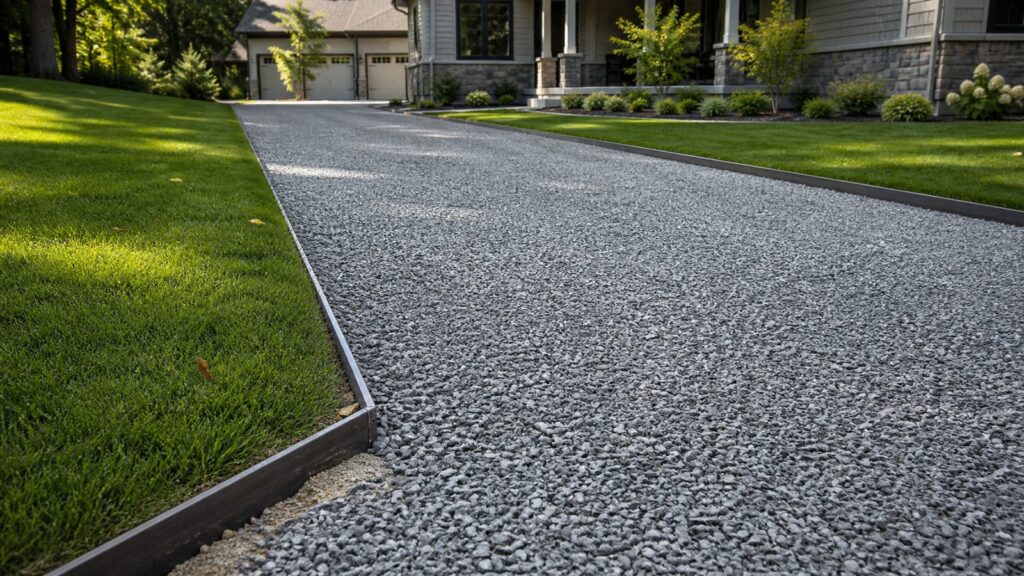
The best edging for a gravel driveway is usually a mechanically anchored edge, not a thin decorative border. For most residential driveways, heavy steel or aluminum edging gives the best balance of clean appearance, durability, and cost. Concrete curbing is the strongest long-term option. Stone, cobblestone, granite, or Belgian block is the premium choice when curb appeal and tire resistance matter. Pressure-treated timber can work on budget or rural drives, but it will not last as long. Lightweight plastic edging is usually the wrong product for a working driveway.
On our job sites, we treat driveway edging as part of the driveway structure. A good edge controls lateral gravel movement, protects the lawn, defines the driving surface, and helps the finished gravel stay compacted. A bad edge flexes, pops up, catches tires, interferes with snow removal, or fails because the driveway base underneath it was never built correctly.
If you want the short answer: choose steel or aluminum for a crisp residential driveway, concrete for heavy use and maximum containment, stone or cobble for a high-end look, timber for a lower-cost rural edge, and gravel grids plus edging for slopes or repeated rutting. The right choice depends on traffic, slope, drainage, soil, snowplowing, and whether the driveway meets a public street, sidewalk, curb, or apron.
As an Amazon Associate I earn from qualifying purchases.
What Gravel Driveway Edging Has To Do
Gravel driveway edging has a harder job than landscape bed edging. A flower bed border mainly separates mulch from turf. A driveway edge has to resist the sideways pressure of compacted stone, turning tires, delivery trucks, trailers, freeze-thaw movement, washouts, mower wheels, and sometimes snowplow blades.
That is why many driveway edging failures are not really material failures. They are base failures. If edging is set on loose soil and gravel is dumped around it, even a decent product will lean or move. If the driveway has poor drainage, water softens the edge and the gravel starts to migrate. If rounded pea gravel is used at the edge, it rolls outward under load. If the gravel is never compacted in lifts, the edge takes pressure that the stone base should have absorbed.
#1 Best Overall

- 𝐅𝐥𝐞𝐱𝐢𝐛𝐥𝐞 & 𝐄𝐚𝐬𝐲 𝐭𝐨 𝐈𝐧𝐬𝐭𝐚𝐥𝐥: Each panel measures 40" (L) × 5" (H), including 3" underground stakes for strong anchoring, leaving 2" visible above ground for a clean, low-profile border. The hammer-in design makes installation fast and effortless—perfect for creating neat, professional-looking edges without digging.
- 𝐃𝐮𝐫𝐚𝐛𝐥𝐞 𝐆𝐚𝐥𝐯𝐚𝐧𝐢𝐳𝐞𝐝 𝐒𝐭𝐞𝐞𝐥 𝐂𝐨𝐧𝐬𝐭𝐫𝐮𝐜𝐭𝐢𝐨𝐧: Made from high-quality galvanized steel, this 33ft landscape edging (10-pack) is built to withstand outdoor conditions, providing long-lasting durability and rust resistance for your garden, yard, or flower beds.
- 𝐒𝐞𝐜𝐮𝐫𝐞 & 𝐒𝐭𝐚𝐛𝐥𝐞 𝐃𝐞𝐬𝐢𝐠𝐧: Comes with 11 stakes, ensuring strong anchoring in soil and stability against shifting over time. Ideal for maintaining defined garden edges and pathways.
- 𝐒𝐥𝐞𝐞𝐤 𝐁𝐥𝐚𝐜𝐤 𝐅𝐢𝐧𝐢𝐬𝐡 𝐟𝐨𝐫 𝐌𝐨𝐝𝐞𝐫𝐧 𝐀𝐩𝐩𝐞𝐚𝐥: The powder-coated black steel adds a stylish, modern touch to your outdoor landscaping while blending seamlessly with various garden styles.
- 𝐕𝐞𝐫𝐬𝐚𝐭𝐢𝐥𝐞 𝐆𝐚𝐫𝐝𝐞𝐧 𝐁𝐨𝐫𝐝𝐞𝐫 𝐒𝐨𝐥𝐮𝐭𝐢𝐨𝐧: Perfect for creating crisp, clean separations between lawns, flower beds, pathways, and patios. Easily cut or bend to fit curves, corners, and custom garden designs.
A functional gravel driveway edge should do four things. First, it should be anchored into compacted material, not just pushed into topsoil. Second, it should sit slightly above the finished gravel surface, usually about 1/2 inch to 1 inch, so stone does not roll over it. Third, it should be low and smooth enough that tires, pedestrians, mowers, and plows are not damaged by it. Fourth, it should continue through weak points such as garage slabs, gates, culverts, walkways, sidewalks, and apron transitions.
For most driveways, the edge should be installed after excavation and subgrade prep but before the final top layer of gravel. That sequence lets the installer set the finished height correctly and lock the edging into the compacted base.
Best Edging Options For Gravel Driveways
There is no single best material for every gravel driveway. The best edge for a flat suburban drive is not always the best edge for a sloped rural drive with delivery trucks and snow removal. The comparison below reflects what we would consider for a typical US home in 2026.
| Edging type | Best use | Typical installed cost in 2026 | Main advantage | Main drawback |
|---|---|---|---|---|
| Steel or aluminum | Clean residential edges, straight or gentle curves | $8-$15 per linear foot in straightforward conditions | Crisp, strong, low-profile edge | Needs proper staking and base support |
| Concrete curbing | High containment, slopes, frequent traffic | $12-$30 per linear foot | Longest-lasting, very stable | Higher cost, more permanent |
| Stone, cobble, granite, Belgian block | Premium homes, visible front drives, tire-resistant borders | $20-$45+ per linear foot | Excellent curb appeal and impact resistance | Labor-intensive installation |
| Pressure-treated timber | Budget rural drives, informal properties | $8-$15 per linear foot when properly pinned | Lower cost, simple appearance | Rot, heave, and joint movement over time |
| Plastic landscape edging | Light landscape borders only | Often cheap material, about $0.50-$3.50 per linear foot before labor | Low upfront material cost | Too flexible for most driveway loads |
| Gravel grids with perimeter edging | Slopes, rutting, repeated gravel migration | Varies by grid type, prep, and gravel depth | Stabilizes the whole surface | Still needs a restrained edge and good drainage |
Steel Or Aluminum Edging
For many homeowners, metal edging is the best all-around answer. Steel and aluminum create a sharp, modern line, work well on straight runs and gentle curves, and can be installed without the bulk of concrete or stone. A properly installed metal edge is especially useful where a driveway meets lawn, planting beds, walkways, or a clean gravel parking pad.
The key word is properly. Thin landscape edging is not the same as driveway-grade metal edging. For a working gravel driveway, we prefer heavier-gauge metal, deeper profiles, and close stake spacing at curves, transitions, and high-impact areas. Stakes should be driven into compacted base material, not loose fill. On curves, tighter stake spacing helps stop the edge from flattening out or creeping under gravel pressure.
Quick wins for a faster PC:
Repair Windows errors before they cause bigger problemsFix Now →Scan for outdated or missing drivers - takes under a minuteDriver Scan →Clear out junk files and repair common Windows errorsFree Scan →Metal edging usually performs best when the driveway has a compacted base of crusher run, road base, or similar angular aggregate, with a finished top layer that locks together. If a client wants loose rounded decorative stone right against a metal edge, we explain that the edge will have to work harder because rounded gravel behaves more like marbles than interlocking aggregate.
Concrete Curbing
Concrete curbing is the heavy-duty choice. It is the best option when containment matters more than flexibility: long driveways, sloped drives, frequent traffic, heavier vehicles, visible front approaches, and properties where the driveway edge is part of the finished architecture.
Concrete edging can be poured in place, extruded, or installed as precast curb units depending on the project. Professional residential concrete curbing commonly runs about $12-$20 per linear foot, while broader construction-priced concrete edging can land around $13.37-$30.08 per linear foot in 2026 depending on local labor, forming, finish, access, and site prep.
Concrete is not automatically better if the drainage is wrong. Water trapped behind or beneath a curb can soften the driveway edge, create frost heave in cold climates, or wash fines out of the base. We usually want a crown, cross-slope, swale, drain, culvert, or other drainage plan before setting permanent concrete borders.
The Tool Desk
Outbyte PC Repair FREEClear out junk files and repair common Windows errorsFree Scan →Outbyte Driver Updater FREEScan for outdated or missing drivers - takes under a minuteDriver Scan →Stone, Cobblestone, Granite, Belgian Block, Or Fieldstone
Stone edging is the premium natural option. Granite block, cobblestone, Belgian block, and well-set fieldstone all handle vehicle contact better than plastic or thin edging. They also look substantial, which matters on front-facing driveways where the border is part of the home’s curb appeal.
Rank #2

- 𝐀𝐛𝐨𝐮𝐭 𝐭𝐡𝐞 𝐄𝐝𝐠𝐢𝐧𝐠: Enhance your garden with our 6-pack landscape edging set, providing 20 ft of total coverage when connected. Each panel measures 40" L x 8" H, creating clean, defined borders while helping keep grass and weeds out for a neat, well-maintained look.
- 𝐃𝐮𝐫𝐚𝐛𝐥𝐞 𝐆𝐚𝐥𝐯𝐚𝐧𝐢𝐳𝐞𝐝 𝐒𝐭𝐞𝐞𝐥 𝐌𝐚𝐭𝐞𝐫𝐢𝐚𝐥: Crafted from rust-resistant galvanized steel, this lawn edging is built to withstand harsh weather conditions. Its durable construction ensures long-lasting performance and maintains its aesthetic appeal, making it an ideal choice for outdoor use and low-maintenance landscaping
- 𝐅𝐥𝐞𝐱𝐢𝐛𝐥𝐞 & 𝐁𝐞𝐧𝐝𝐚𝐛𝐥𝐞 𝐃𝐞𝐬𝐢𝐠𝐧: Our steel garden edging is highly flexible, allowing you to easily shape it to follow the curves of your lawn, flower beds, or landscaping features. Its sturdy build ensures it retains its form over time, providing a reliable solution for your garden design needs.
- 𝐐𝐮𝐢𝐜𝐤 & 𝐄𝐚𝐬𝐲 𝐈𝐧𝐬𝐭𝐚𝐥𝐥𝐚𝐭𝐢𝐨𝐧: Featuring a front-and-back interlocking system, this edging offers hassle-free assembly. The 4-inch sharp teeth easily penetrate the soil for a secure fit, creating a stable garden border. Simply position the edging and tap it into place—no need for complicated tools or steps.
- 𝐕𝐞𝐫𝐬𝐚𝐭𝐢𝐥𝐞 𝐋𝐚𝐧𝐝𝐬𝐜𝐚𝐩𝐢𝐧𝐠 𝐔𝐬𝐞: Perfect for more than just garden borders, this 8-inch landscape edging kit is versatile enough for outlining pathways, separating zones, or building raised garden beds. Elevate your garden design effortlessly with this adaptable garden border kit.
The cost is mostly labor. Stone edging requires excavation, bedding, alignment, cutting, hauling, and often concrete haunching on the outside edge where tires may ride close. For a clean, durable installation, each stone needs a stable base and consistent reveal above the gravel. Premium stone or cobble edging can easily exceed $20-$45 per linear foot when the work is detailed or access is tight.
Stone is a good fit when the driveway edge will be visible every day and the owner wants the border to look intentional for decades. It is usually overkill for a long farm lane, a temporary parking area, or a driveway where drainage and base reconstruction should consume the budget first.
Pressure-Treated Timber
Pressure-treated 4×4, 6×6, or landscape timber edging can be practical on budget driveways, rural properties, and informal parking areas. It is relatively fast to install and gives a defined edge without the cost of concrete or stone.
Free tools Windows power users keep installed
One-click scans. No signup required.
Timber must be pinned. We use long spikes or rebar, stagger joints, and avoid leaving unsupported butt joints where a compactor or tire can open the border. The timber should sit on compacted base, not soft soil. On curves, timber is limited unless it is segmented, which creates more joints and more points of movement.
The tradeoff is lifespan. Even treated wood is vulnerable to rot, moisture, frost heave, insects in some regions, and movement over time. It can be the cheapest way to edge a gravel driveway, but it is rarely the best long-term value for a formal front drive.
Plastic Edging
Plastic edging is common in landscape beds, but we do not recommend lightweight plastic as functional gravel driveway edging. It can flex under lateral pressure, pop up during freeze-thaw cycles, crack from impact, and deform when tires ride the edge. Snowplow blades and plastic edging are also a poor match.
There are heavier plastic and composite products that perform better than bargain rolls, but the homeowner should still compare them against metal or concrete before committing. If the driveway carries full-size trucks, trailers, RVs, delivery vehicles, or frequent turning movements, plastic is usually the weak link.
Gravel Grids
gravel stabilization grids are not edging, but they can be part of the solution. They help reduce rutting, gravel migration, and washboarding by confining stone across the driveway surface. They are especially useful on slopes, parking pads, and areas where tires turn repeatedly.
Grids still need a restrained perimeter. Without an edge, the grid field can lose gravel at the sides, and the boundary can unravel over time. Most grid systems also need a prepared subgrade, geotextile fabric where soil separation is needed, compacted base, and the right gravel cover. A grid placed over weak, wet, unprepared soil will not perform like a properly built driveway.
Cost To Edge A Gravel Driveway In 2026
Driveway edging is priced by linear foot, and the total adds up quickly because most driveways need edging on both sides. A 100-foot-long by 10-foot-wide driveway needs about 200 linear feet of edging if both sides are bordered. A $6 per linear foot difference changes the job by about $1,200 before taxes, demolition, drainage corrections, or minimum trip charges.
For functional gravel driveway edging in 2026, a practical installed budget is often $8-$15 per linear foot for anchored metal or timber in straightforward conditions, $12-$30 per linear foot for concrete curbing, and $20-$45 or more per linear foot for stone or cobble. Basic landscape edging may be advertised lower, but driveway work usually requires stronger materials, more excavation, better staking, and more careful base preparation.
Do these 3 things before closing this tab:
1Scan for outdated or missing drivers - takes under a minute2Clear out junk files and repair common Windows errors3Fix the driver behind crashes, sound loss and screen glitchesMaterial-only numbers can be misleading. Plastic may cost roughly $0.50-$3.50 per linear foot before labor. Rubber may run about $1.50-$4. Wood commonly falls around $2.50-$7. Brick may be $2.50-$6.50. Metal can be $5-$11. Stone ranges widely, roughly $3-$21.50 before labor. Concrete material may look inexpensive at $3-$8 per linear foot, but installed concrete curbing often costs much more because of forming, finishing, equipment, and labor.
The gravel itself also affects the budget. Bulk gravel and crushed stone in 2026 commonly range from about $10-$75 per ton depending on stone type, quarry distance, delivery, and local market. Road base or crusher run is often quoted around $18-$50 per ton and is usually a better structural layer than decorative rounded gravel. A complete gravel driveway installation can range widely, from light resurfacing prices near the low single digits per square foot to more complete installations with excavation, base prep, drainage, and finish stone that reach several dollars per square foot or more.
Rank #3

- Long-Lasting Galvanized Steel: Made from high-quality galvanized steel with a rust-resistant coating, this metal landscape edging built to resist fading, cracking, and rusting. It withstands all weather conditions, providing long-term durability for any outdoor environment.
- Flexible & Bendable: This yard edging is both flexible and durable. It can be easily bent to suit any shape—whether your garden is square, round, or irregular—without causing any damage, offering a tailored fit for your landscape design.
- Easy Installation: Installing this metal is a breeze! Simply interlock the pieces at the edges for a quick and easy setup that saves you time and effort. (Note: We recommend wearing gloves during installation.
- Versatile for Multiple Applications: Ideal for creating garden fences, defining borders along roadsides, or separating various outdoor zones. This galvanized steel garden edging not only adds a neat structure to your outdoor space but also serves as a decorative element to enhance your landscape’s aesthetic appeal.
- What You’ll Receive: Each set includes 5 metal flowerbed edging borders, 1 pair of installation glove, and 1 instruction manual. The extended spiked design ensures easy installation by helping the barrier penetrate the ground with less effort. Spend more time enjoying your garden and less time maintaining it!
Major cost drivers include linear footage, old border removal, soil condition, slope, drainage corrections, curves, edging height, stone weight, freight, local labor rates, access for equipment, and whether the work touches a sidewalk, public curb, public right-of-way, or driveway apron.
How High Should Gravel Driveway Edging Be?
Most gravel driveway edging should finish slightly above the gravel surface, often about 1/2 inch to 1 inch. That small reveal helps contain loose stone without creating a curb that catches tires or becomes a trip hazard. On a formal concrete curb, the reveal may be higher, but the driveway layout must account for vehicle doors, tire paths, plows, drainage, and pedestrian movement.
Too low is ineffective. Gravel rolls over the edge, mower wheels drag stone into turf, and the driveway widens over time. Too high creates a different problem. Tires can scrape, snowplows can catch, pedestrians can trip, and water can be trapped on the driveway surface if there is no outlet.
At garage slabs, sidewalks, gates, and aprons, the edge height should be planned carefully. These are common failure points because the driveway transitions from flexible gravel to hard surfaces or public infrastructure. A clean edge that disappears at the apron may look fine on day one, but it often becomes the exact spot where gravel starts migrating into the street or lawn.
The Base Matters More Than The Border
If the base is weak, edging cannot save the driveway. A good gravel driveway starts with excavation to remove organic material and soft spots. The subgrade should be shaped and compacted. On clay, silt, wet soil, or weak subgrade, geotextile fabric can separate soil from stone and reduce pumping. The base should be built with angular, well-graded aggregate that compacts tightly.
Angular crushed stone, crusher run, road base, and #57 stone perform better near the edge than pea gravel because angular particles interlock. Rounded gravel looks clean but moves easily under tires, especially at edges and slopes. If a homeowner wants decorative rounded stone, we often recommend using it as a thin finish layer over a stronger compacted base, not as the whole driveway structure.
PC Slower Than It Used to Be?
A free scan shows the junk files, broken settings and background clutter dragging Windows down - then fixes them in one click.Free scan · Windows 10 & 11Outdated Drivers Are Slowing You Down
One free scan finds every outdated or missing driver and matches the right update for your exact hardware.Free scan · exact hardware matchCompaction should happen in lifts. Dumping the full gravel depth at once and tracking it in with a pickup is not the same as building a driveway. A typical driveway may use several inches of compacted base, placed and compacted in manageable layers. The exact depth depends on soil, drainage, climate, and traffic, but the principle is consistent: the edge should restrain a compacted structure, not hold back a loose pile.
Drainage is just as important. A gravel driveway needs somewhere for water to go. That may mean a crown down the center, cross-slope to one side, shallow swales, culverts, trench drains, or regrading near the edge. On slopes, edging alone cannot hold a poorly drained gravel surface. Water moving across or under the drive will carry fines away, loosen the base, and push stone toward the low side.
Best Edging By Driveway Situation
Flat Suburban Driveway
For a flat or gently sloped residential driveway with normal passenger vehicles, steel or aluminum edging is usually the best balance. It provides a clean line, holds gravel in place, and does not dominate the look of the house. If the driveway is highly visible and the budget allows it, stone or concrete can upgrade the appearance.
Sloped Driveway
For a sloped driveway, prioritize drainage and stabilization first. Concrete curbing, stone edging with haunching, or gravel grids with a restrained perimeter are stronger choices than light metal or timber alone. The steeper the slope, the more important it is to stop water from running down the wheel paths.
What’s actually slowing this PC down?
Pick the symptom - the matching free tool is one click away.
Rank #4

- Rust-Resistant Galvanized Steel: Crafted from durable galvanized steel, our lawn edging is built to withstand various weather conditions and resist rust, ensuring long-lasting performance. This material maintains its aesthetic appeal over time, offering a reliable and low-maintenance solution for outdoor spaces.
- Seamless Connection Design: Our steel edging features a seamless connection that eliminates gaps, resulting in uniform lines and a polished look. Perfect for enhancing the visual appeal of flowerbeds, pathways, and paver edges, it adds a sophisticated touch to any garden.
- Easy Installation: Installing our 6-pack metal landscape edging kit is simple and straightforward. Use a rubber mallet to secure the connectors, creating a sturdy and stable border. No special tools or advanced skills are needed, making it ideal for DIY enthusiasts and professionals alike.
- Versatile Landscaping Applications: This 6-inch landscape edging kit is versatile enough for various landscaping tasks. Ideal for outlining pathways, defining different garden zones, or constructing raised beds, it easily adapts to your outdoor design needs.
- Flexible & Bendable: Our steel garden edging is flexible and bendable, allowing you to effortlessly shape it to fit the curves of your lawn, flower beds, or other landscaping features. Its robust construction ensures it maintains its form over time, providing a dependable solution for all your garden design projects.
Driveway With Snowplowing
Snowplowing changes the edging decision. High, sharp, or poorly marked edging can be damaged by plow blades. Metal edging should be low-profile and firmly anchored. Concrete should be finished with plow exposure in mind. Stone borders should be substantial and set consistently. In snow regions, we often recommend driveway markers for the first winter so the plow operator can see the edge before the gravel is fully settled and familiar.
Driveway Used By Trucks, RVs, Or Trailers
Heavy vehicles increase edge pressure, especially on curves and tight turns. Concrete curbing or stone block edging is usually better than thin metal or plastic. If metal is used, it should be heavy-gauge with closer staking. The driveway width and turning radius may matter more than the edging material; if tires constantly ride the edge, even a strong border will take abuse.
Rural Or Long Driveway
For long rural drives, cost per foot becomes the deciding factor. Timber may be reasonable near parking areas, gates, or landscaped sections, while the rest of the lane may rely on proper grading, ditches, crown, and periodic maintenance instead of full-length edging. Edging every foot of a long drive can be expensive, so it is often better to target problem zones first.
Independent reader supportYour contribution helps us test, update, and keep practical guides available for everyone.When To DIY Vs When To Hire A Pro
A handy homeowner can DIY simple edging on a short, flat driveway if the base is already solid, drainage is working, and the material is manageable. Metal edging and timber edging are the most realistic DIY options. A small project might take a weekend with basic excavation tools, a string line, stakes, a level, a hand tamper or rented plate compactor, and delivery of the right gravel.
Recommended Free Tools
DIY becomes risky when the driveway needs regrading, drainage correction, culvert work, concrete, stone cutting, heavy block handling, or work near a public sidewalk or curb. It also becomes less practical when the driveway is long. Two hundred linear feet of edging sounds simple until you account for excavation, base prep, alignment, staking, compaction, hauling, and cleanup.
Hire a pro when the driveway has a slope, soft or wet soil, repeated rutting, washouts, heavy vehicle use, tight curves, snowplow exposure, or a public apron. A contractor should be looking at subgrade, aggregate type, water movement, edge restraint, compaction, and transitions. If the quote only says “install edging” without addressing base and drainage, ask more questions.
For concrete curbing and premium stone edging, professional installation is usually worth it. The material cost is too high to justify a weak base or poor alignment. A crooked cobble edge or cracked concrete curb is expensive to fix.
Permits, Safety, And Right-Of-Way Notes
Edging inside your private property often does not require a permit, but rules change when the work touches a public curb, sidewalk, driveway apron, drainage ditch, culvert, or right-of-way. Many US cities and towns regulate curb cuts, driveway aprons, sidewalk crossings, and work near public streets. Some require permits, inspections, bond paperwork, licensed contractors, or specific concrete details.
Before changing the edge where your driveway meets the street, check your local building department, public works department, HOA, or county road authority. Do not assume a small edging project is exempt if it changes drainage, narrows a sidewalk, alters a curb opening, or places hard material in the right-of-way.
Safety is practical. Wear eye protection when cutting metal, stone, or concrete. Use gloves when handling steel edging, treated lumber, block, and rebar. Call 811 before digging stakes, pins, or excavation near utilities. Keep edging low enough and visible enough to avoid trip hazards. If the driveway is plowed, mark the edge before winter.
Common Mistakes We See With Gravel Driveway Edging
The most common mistake is choosing thin plastic because it is cheap and expecting it to perform like a structural restraint. It may look fine after installation, but tires, freeze-thaw movement, plows, and lateral gravel pressure usually expose the weakness.
Best Value

- Do it once, do it Right! Edge Right is the ultimate hammer-in edging. Instead of cheap plastics it's comprised of heavy duty 16-gauge COR-TEN steel.
- Worried about damage from your weed eater? Don't be! Edge Right can take unlimited abuse.
- Edge Right develops a rust patina over time to give a handsome modern look. (It can be sealed too!)
- Uses COR-TEN steel in order to be more malleable for use on curves in your landscape.
- The COR-TEN weathering steel can last well over 100 years.
The second mistake is installing edging on uncompacted soil. The border moves because the ground beneath it moves. The edge should be tied into the driveway base, and the gravel should be compacted in lifts. If the base is loose, the edge becomes a retaining wall for a poorly built driveway.
The Tool Desk
Outbyte Driver Updater FREEScan for outdated or missing drivers - takes under a minuteDriver Scan →Outbyte PC Repair FREERepair Windows errors before they cause bigger problemsFix Now →The third mistake is setting the height wrong. Edging that is buried too low does not contain gravel. Edging that sits too high becomes a tire edge, trip edge, mower obstacle, or plow hazard.
The fourth mistake is ignoring drainage. If water runs down the driveway edge or ponds against the border, the gravel will migrate and the base will weaken. On slopes, edging should be paired with grading, swales, drains, or grids where needed.
The fifth mistake is stopping the edging at transitions. Gravel often escapes at garage slabs, sidewalks, culverts, gates, and aprons. Those details need to be carried through, not treated as afterthoughts.
Our Recommendation
For most US homeowners, the best gravel driveway edging is heavy steel or aluminum installed into a compacted base with angular gravel. It is clean, durable, moderately priced, and appropriate for many residential driveways. If the driveway is steep, heavily used, or expected to look finished for decades, concrete curbing is the stronger choice. If the home calls for a premium natural edge, granite, cobblestone, Belgian block, or fieldstone can be excellent when installed over a proper base. Timber is acceptable for budget and rural applications. Plastic should usually stay in the landscape bed category.
Do these 3 things before closing this tab:
1Repair Windows errors before they cause bigger problems2Fix the driver behind crashes, sound loss and screen glitches3Clear out junk files and repair common Windows errorsThe bigger point is that edging is only one part of the system. A lasting gravel driveway needs proper excavation, geotextile where soil conditions call for it, compacted angular aggregate, drainage, correct finish height, and continuous restraint at transitions. When those pieces are handled correctly, the edging does its job quietly for years instead of becoming the part of the driveway you keep repairing.
Frequently Asked Questions
What is the best edging for a gravel driveway?
For most homes, heavy steel or aluminum edging is the best all-around choice. Concrete curbing is best for heavy-duty containment, slopes, and long service life. Stone or cobble is best for premium curb appeal, while timber is a budget option.
How much does gravel driveway edging cost in 2026?
A practical installed budget is about $8-$15 per linear foot for anchored metal or timber, $12-$30 per linear foot for concrete curbing, and $20-$45+ per linear foot for stone or cobble, depending on site conditions and labor.
Can I use plastic landscape edging for a gravel driveway?
Lightweight plastic edging is usually not a good choice for a functional gravel driveway. It can flex, pop up, crack, or fail under vehicle loads, freeze-thaw movement, plow contact, and lateral gravel pressure.
Windows Errors? Fix Them Before They Spread
Repair common Windows errors and clear accumulated junk for a smoother, more stable PC - no reinstall needed.Free scan · no reinstallOutdated Drivers Are Slowing You Down
One free scan finds every outdated or missing driver and matches the right update for your exact hardware.Free scan · exact hardware matchHow high should gravel driveway edging be?
Most edging should sit about 1/2 inch to 1 inch above the finished gravel surface. That is high enough to contain stone but low enough to reduce tire damage, trip hazards, mower issues, and snowplow conflicts.
What is the cheapest way to edge a gravel driveway?
Pressure-treated landscape timbers or 4×4/6×6 timbers pinned with rebar or long spikes are often the cheapest functional option. They cost less than concrete or stone but are more vulnerable to rot, heave, and movement.
Do I need a permit to add gravel driveway edging?
Edging fully inside private property often does not require a permit, but work near a public curb, sidewalk, driveway apron, culvert, drainage ditch, or right-of-way may require local approval. Check with your city, county, HOA, or public works department before changing those areas.
Quick Recap
Product prices and availability are accurate as of the date/time indicated and are subject to change. Any price and availability information displayed on Amazon at the time of purchase will apply.

