Quick wins for a faster PC:
Repair Windows errors before they cause bigger problemsFix Now →Fix the driver behind crashes, sound loss and screen glitchesFind Drivers →Clear out junk files and repair common Windows errorsFree Scan →Yes, you can build an electrostatic loudspeaker yourself—but a reliable, full-range pair with genuinely high-end performance is not a beginner speaker project. The most sensible starting point is a small panel, a midrange/treble-only design, or a documented partial kit paired with conventional or powered bass. Full-size panels add difficult problems in high-voltage safety, diaphragm tensioning, insulation, transformer bandwidth, bass output, dispersion, and measurement.
How an electrostatic loudspeaker works
An electrostatic loudspeaker (ESL) does not use a conventional voice coil, magnet, cone, spider, or former. Its motor is a charged, tensioned diaphragm suspended between two stationary stators.

As an Amazon Associate I earn from qualifying purchases.
- Diaphragm: an extremely thin plastic film coated or treated so it can hold a static charge. It must be tensioned evenly.
- Stators: two rigid, perforated conductive panels on either side of the diaphragm. They carry the audio signal and must be electrically insulated from the moving film.
- Spacers or spars: structural elements that set the diaphragm-to-stator clearance and limit travel.
- Bias supply: a high-voltage DC source that charges the diaphragm.
- Audio transformer: a step-up transformer that converts the amplifier’s output into balanced, high-voltage stator drive.
- Frame and protection: the structure that keeps the sandwich rigid while preventing accidental contact with energized parts.
With a fixed bias on the diaphragm and opposite-polarity audio applied to the stators, electrostatic attraction and repulsion move the film and produce sound. MartinLogan’s explanation of the architecture is a useful primary reference: electrostatic ESL theory.
The Tool Desk
Outbyte Driver Updater FREEFix the driver behind crashes, sound loss and screen glitchesFind Drivers →Outbyte PC Repair FREEClear out junk files and repair common Windows errorsFree Scan →Why build one?
The attraction is legitimate. A very low-mass diaphragm can produce exceptionally clear midrange and treble, while the large radiating surface can create expansive imaging and an open presentation. ESLs are dipoles: they radiate from both the front and rear, which can sound unusually spacious when the room and placement cooperate.
#1 Best Overall
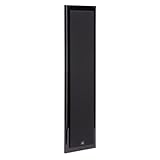
- AMT driver for Precise accurate detail with lightnight fast response to compliment Electrostatic Speakers.Frequency response 110–25,000 Hz ±3dB
- Beautiful Hi-Gloss black finish
- Superb imaging for Stereo and the movie enthusiast.
Those benefits are not automatic. Uneven tension, poor coating, flexible stators, transformer limitations, or an unsuitable crossover can produce noise, uneven response, narrow dispersion, low sensitivity, and frequent arcing. The result can be an interesting experiment without being a high-end loudspeaker.
The engineering problems that matter
Bass is mainly an area and excursion problem
A diaphragm can reproduce a low-frequency signal electrically without producing useful bass acoustically. Deep bass at realistic sound-pressure levels requires radiating area and displacement. A small panel may sound excellent through the midrange and treble but run out of excursion, transformer headroom, or maximum SPL in the bass.
Separate three questions:
- Electrical extension: does the signal reach the low frequency?
- Acoustic output: can the panel produce that frequency in the room?
- Maximum bass SPL: can it do so without excessive excursion, transformer saturation, amplifier stress, or arcing?
This is why practical floorstanding ESLs are commonly hybrids. MartinLogan’s current ElectroMotion ESL, for example, combines an electrostatic panel with a conventional woofer.
Dispersion narrows as panels grow and frequency rises
A large flat panel tends to beam at higher frequencies. The listening window may be narrow, and small changes in toe-in or listening position can alter the tonal balance. Possible remedies include narrower sections, segmentation, curvature, separate drive zones, microperforated stators, or a smaller panel width.
Curvature can broaden useful horizontal coverage, but it is not a magic shape. MartinLogan’s Curvilinear Line Source is a commercial implementation with carefully controlled geometry; an arbitrary curve will not necessarily provide the same result.
The amplifier sees a difficult load
An ESL is substantially capacitive, and the transformer changes the impedance and phase behavior seen by the amplifier. A high wattage rating alone does not establish compatibility. The amplifier must tolerate the particular speaker’s reactive load and voltage demand.
Use the exact manual for any commercial model. MartinLogan’s ElectroMotion ESL manual illustrates why product-specific amplifier guidance matters. For a DIY design, measure impedance magnitude and phase rather than assuming a conventional amplifier will be comfortable.
Recommended Free Tools
Arcing is a destructive fault
Arcing may result from inadequate spacing, damaged insulation, contamination, conductive debris, a wrinkled or slack diaphragm, excessive bias, transformer overshoot, or excessive audio voltage. It can puncture the diaphragm and damage stator insulation. Repeated arcs are not normal operation.
MartinLogan says its production stators are arc-tested to 10,000 volts. That is a manufacturer-specific production figure, not a universal DIY target, but it demonstrates the margin and quality control involved in commercial panels: MartinLogan production overview.
High voltage: understand the risk before building
There are several different voltages to keep distinct:
- DC bias voltage on the diaphragm.
- AC audio voltage on the stators.
- Peak-to-peak voltage across the stators.
- Available current and stored energy in the supply and panel.
MartinLogan describes approximately 2,500–3,500 volts at the diaphragm surface for its ESL product family; that is not a universal DIY specification. DIYAudio discussions sometimes cite roughly 50 volts per mil of diaphragm-to-stator spacing as a rule of thumb, but this is community guidance, not a safety standard or design recipe: DIYAudio ESL building discussion.
What’s actually slowing this PC down?
Pick the symptom - the matching free tool is one click away.
Do not improvise a mains-connected kilovolt supply from an unverified circuit. Use an enclosed, current-limited supply with fusing, bleeder resistors, a verified discharge path, insulated wiring, strain relief, and covers or interlocks. Use a correctly rated high-voltage probe and meter; a normal oscilloscope probe must never be attached to a kilovolt node. Treat the panel as energized until it has been independently measured discharged. Mains-side construction and compliance should be handled by someone qualified to do it safely.
Choose a realistic project scope
| Project | Best for | Main compromise |
|---|---|---|
| Small full-range or mid/high panel | Learning film handling, tensioning, bias, and transformer basics | Limited bass and maximum SPL |
| ESL panel plus conventional woofer | The best balance of performance and risk | Crossover, phase, and directivity integration |
| Large full-range dipole | Experienced builders following a proven design | Large structure, difficult transformer, bass and arcing risk |
| Curved or segmented panel | Builders pursuing dispersion control and advanced performance | More difficult jigs, electronics, and measurements |
| Partial or assembled kit | Anyone wanting to avoid designing every high-voltage subsystem | Less freedom and possible vendor dependence |
For a first serious project, choose a mid/high panel and add a conventional woofer or powered subwoofer. A powered bass section can reduce amplifier stress and lets you solve the panel’s strengths without forcing it to perform a job it is poorly suited to do.
Rank #2
Building the panel sandwich
Stators
Perforated metal is rigid and acoustically open, but sharp edges must be controlled and the entire assembly must be insulated. Wire stators can offer high open area but are difficult to keep parallel and accurately aligned. Conductive film or foil is light but mechanically vulnerable.
Do not judge a stator only by percentage open area. Hole size and pattern, edge geometry, insulation thickness, rigidity, and diaphragm clearance all affect both sound and electrical safety.
Do these 3 things before closing this tab:
1Repair Windows errors before they cause bigger problems2Fix the driver behind crashes, sound loss and screen glitches3Clear out junk files and repair common Windows errorsDiaphragm film and coating
The film must be thin, stable, tensionable, and capable of holding a reasonably uniform charge. Commercial manufacturers use controlled coating and bonding processes. MartinLogan describes a PET diaphragm approximately 0.0005 inch thick as one production example, not a universal DIY requirement: commercial ESL construction.
Work in a clean, low-dust area. Inspect for wrinkles, pinholes, coating voids, contamination, and damaged edges. The coating should have appropriate resistive behavior and long-term chemical compatibility; a random anti-static spray or conductive paint that merely appears conductive is not a validated diaphragm treatment.
Tensioning
Tension affects resonance, bass response, distortion, panel matching, long-term sag, wrinkles, and the possibility of stator contact. “Pull it tight” is not a repeatable method.
Use a dedicated small stretching fixture first. Depending on the film and design, options include mechanical clamps, frame stretching before bonding, controlled thermal tensioning, or measured tension/deflection. A prototype fixture is inexpensive compared with replacing a full-size diaphragm. DIY builders consistently identify accurate spacing and repeatable tensioning as major differences between a panel that merely makes sound and one that performs well.
Transformer and bias-supply choices
The audio transformer
The transformer must provide suitable bandwidth into the panel’s capacitive load, withstand high peak voltage, avoid saturation, and keep leakage inductance low enough for the intended response. Its requirements depend on panel capacitance, area, spacing, target SPL, amplifier, segmentation, and crossover.
A transformer that looks acceptable at 1 kHz may lose bass or treble, distort, or produce excessive voltage peaks elsewhere. A conventional mains transformer should not be assumed suitable as an audio transformer. The specialist discussion at DIYAudio’s ESL transformer thread covers why voltage rating, leakage inductance, and bandwidth matter.
- Buy an ESL-specific transformer: the safest and most predictable route, though it constrains the design and costs more.
- Adapt a documented design: reasonable for an advanced builder if the original panel assumptions and insulation requirements are preserved and the result is measured.
- Wind one from scratch: maximum control but a poor first subproject because bandwidth, insulation breakdown, and distortion are easy to get wrong.
The bias supply
The supply must be quiet, stable, current-limited, fused, enclosed, and designed to discharge safely. Ripple can modulate the diaphragm charge and produce noise. More available current is not automatically better; limiting fault current is part of the protection strategy.
Keep mains, low-voltage control, and high-voltage sections separated. Use connectors and measurement points that cannot be touched accidentally, and document a discharge procedure before applying power.
Free tools Windows power users keep installed
One-click scans. No signup required.
Segmentation and crossover design
Dividing a large panel into independently driven sections can improve directivity control, reduce the burden on each transformer, and make woofer integration more manageable. The cost is additional transformers or channels, crossover parts, wiring, and level and phase matching.
A conventional crossover cannot simply be copied. The ESL’s impedance is frequency-dependent and strongly reactive, while transformer coupling adds another layer of behavior. Measure the completed panel and design the crossover from its actual acoustic and electrical response.
Flat versus curved panels
| Flat | Curved | |
|---|---|---|
| Advantages | Easier fabrication, measurement, and reproduction; simpler frames | Potentially broader horizontal coverage and a less restrictive listening window |
| Disadvantages | More high-frequency beaming and placement sensitivity | Harder stator forming, diaphragm tensioning, and mechanical consistency |
Room placement and dipole behavior
Plan an ESL as a dipole, not as a conventional box speaker. Start with left-right symmetry, equal listening height, and enough distance from the front wall to allow the rear radiation to interact predictably with the room. Adjust toe-in and distance by measurement and listening rather than adopting a universal distance.
Rank #3

- Folded Motion Tweeter "squeezes" air and requires almost 90% less excursion than the typical 1" dome tweeter, drastically minimizing distortion while providing a lightning fast response time
- Elegant yet understated styling with a flawless high-gloss, piano black finish, subtle curves, and a signature perforated grille
- The innovative Folded Motion Tweeter is engineered with a large surface area (8-times that of a typical 1" dome tweeter) to create clear, highly dynamic and precise sound
- Convenient push-style speaker terminals and curved inserts help guide speaker wire effortlessly into place, and accept banana plugs in addition to bare wire.
- Flexible design allows horizontal or vertical installation.
Front-wall, side-wall, floor, and ceiling reflections all matter. A panel that sounds thin close to a wall may sound balanced farther into the room, while a small room may make a large dipole difficult to place. Hybrid systems also require subwoofer or woofer phase and level alignment.
A safe commissioning sequence
- Define the target: listening distance, target SPL, lowest useful panel frequency, area, crossover point, amplifier, room, geometry, and budget.
- Build one small prototype: validate coating, electrical connection, tensioning, spacers, stator rigidity, bias, transformer operation, and arc margin.
- Inspect before high voltage: confirm centering, clearance, insulation, frame rigidity, clean edges, and absence of conductive debris.
- Test the bias system separately: use a current-limited dummy load, rated probe, enclosed supply, and verified discharge measurement.
- Test at minimum audio level: use short, attended tests and monitor for hiss, crackle, corona, or arcs. Shut down immediately if arcing occurs.
- Measure before tuning: record impedance, phase, response, noise, resonance, sensitivity, and off-axis behavior.
- Add bass only after the panel is stable: set a safe panel low-frequency limit, select a suitable woofer, choose an initial slope, measure acoustic phase, align delay, and verify realistic-SPL operation.
Measurements you should not skip
- Impedance magnitude and phase.
- On-axis and off-axis frequency response.
- Panel sensitivity, noise floor, and harmonic distortion.
- Transformer frequency response and bias-voltage stability.
- Arcing behavior at conservative test levels.
- Left/right matching.
- Crossover phase and acoustic summation.
- Nearfield, farfield, and in-room bass behavior.
A calibrated measurement microphone and audio interface are useful for acoustic work, but they do not replace high-voltage test equipment. Use a properly rated high-voltage probe, suitable insulation or hipot equipment, an impedance analyzer or safe test rig, protective resistors, dummy loads, and a current-limited test amplifier.
Common failure modes
Immediate arcing
Check spacing, contamination, insulation, bias level, transformer wiring and ratio, sharp stator edges, and loose conductive material. Power down, discharge, inspect under magnification, and do not resume until the cause is known.
Low output
Check bias voltage, bias connections, transformer wiring, stator shorts, coating behavior, amplifier connection, and excessive series resistance. Test the bias and transformer independently using safe procedures.
Hiss or buzz
Possible causes include bias ripple, poor grounding, corona, contaminated insulation, incorrect transformer referencing, and amplifier instability into a capacitive load. Isolate bias, transformer, amplifier, and mechanical sources; compare with the audio input muted.
Outdated Drivers Are Slowing You Down
One free scan finds every outdated or missing driver and matches the right update for your exact hardware.Free scan · exact hardware matchWindows Errors? Fix Them Before They Spread
Repair common Windows errors and clear accumulated junk for a smoother, more stable PC - no reinstall needed.Free scan · no reinstallThin bass
Measure panel and room response separately. Check area, dipole cancellation, transformer low-frequency performance, crossover alignment, excursion limits, and placement. More amplifier power cannot overcome an acoustic displacement limit.
Uneven response or mismatched speakers
Inspect tension, stator pattern, frame flex, coating uniformity, and panel resonance. Measure both speakers and swap electronics methodically to isolate a panel, transformer, crossover, or amplifier fault. Do not use DSP to hide a serious mechanical defect.
Cost reality
The real budget includes more than film and wood:
- Diaphragm film, coating materials, adhesives, and replacements.
- Stators, spacers, insulation, frames, fasteners, and protective grilles.
- ESL transformers and bias supplies.
- Crossover components, amplifier channels, and conventional woofers or subwoofers.
- Jigs, high-voltage probes, measurement equipment, and safety hardware.
- Shipping, failed prototypes, replacement parts, and your time.
DIY can be cheaper than a high-end commercial speaker, but it is not automatically cheaper than a used commercial pair or a partial kit. MartinLogan’s displayed prices range from $2,799.98 per pair for the ElectroMotion ESL to $119,999.98 per pair for the Neolith; prices vary by region, tax, finish, shipping, dealer, and availability. Audiostatic lists its MD i at €2,990 per pair ex works, with shipping quoted separately. These are market examples, not direct performance comparisons.
Kit, restoration, or commercial speaker?
A partial kit is often the best compromise. ER Audio’s ESL IV page describes an assembled kit with tested electronics and lists additional ready-to-install panels at AUD $895 each, while directing buyers to request current kit pricing: ER Audio ESL IV.
Restoration may be more rational than a ground-up build when you already own a classic ESL. ElectroStatic Solutions lists restoration and replacement services, including a displayed $14,995-per-pair price for one ESL-2812X offering effective April 1, 2026; eligibility and core requirements are service-specific: ElectroStatic Solutions pricing.
- Build from scratch if learning, experimentation, and customization are the goal—and you have the safety and measurement skills.
- Buy a kit if you want to build the structure while avoiding the most hazardous electrical design work.
- Restore used ESLs if you have a rebuildable pair and value the original design.
- Buy a commercial hybrid if you want predictable performance, support, and conventional bass.
- Build conventional high-efficiency speakers if high dynamics, easy amplification, and simpler service matter more than the ESL presentation.
Is it worth building?
It is worth building an electrostatic loudspeaker when the project itself is part of the goal and you can accept failed films, careful high-voltage work, extensive measurement, and room-placement compromises. It is not the sensible route if the only objective is the most reliable high-end sound per dollar.
For most experienced DIY audio builders, the strongest path is a small prototype followed by a mid/high electrostatic panel and powered or conventional bass. That scope preserves the clarity and imaging that make ESLs compelling while keeping the largest engineering risks—deep bass, huge panels, difficult transformers, and unforgiving dispersion—under control.
Quick Recap
Product prices and availability are accurate as of the date/time indicated and are subject to change. Any price and availability information displayed on Amazon at the time of purchase will apply.

