Free tools Windows power users keep installed
One-click scans. No signup required.
Some links on this page are affiliate links: if you buy through them we may earn a commission, at no extra cost to you.
The best dog fence is not simply the best-looking fence. It is the fence that matches your dog’s behavior, your yard conditions, your local code, and your budget. A calm older dog may do well with a 4-foot open fence. A young athletic dog, a climber, a digger, or a reactive dog near a busy sidewalk may need a 6-foot privacy fence, a reinforced bottom edge, stronger gates, or a dedicated dog run.
For most homeowners, a professionally installed dog fence in 2026 lands somewhere around $2,000 to $8,000, with many full-yard projects near $4,700. General residential fence installation commonly falls around $6 to $50 per linear foot, with many projects near $23 per linear foot, depending on material, height, terrain, gates, and labor market. Premium vinyl privacy fencing can run roughly $45 to $82 or more per linear foot installed, while wood commonly falls around $20 to $50 per linear foot installed. Chain-link and wire options can cost less, but they need the right details to work safely for dogs.
As an Amazon Associate I earn from qualifying purchases.
On our job sites, the fence failures we see are rarely mysterious. Dogs go under loose bottoms, squeeze through wide pickets, climb chain-link, launch from patio furniture, nose open weak latches, or exploit a sagging gate. The ideas below are written from that practical angle: what each fence is good for, what it costs, and where it can fail if the details are wrong.
Quick Decision Guide: Match the Fence to the Dog
| Dog or Yard Issue | Best Fence Direction | Key Specs to Consider |
|---|---|---|
| Large jumpers | Wood, vinyl, composite, or steel privacy-style fence | 6 feet minimum for many large dogs; 7 to 8 feet or inward topper for athletic breeds where allowed |
| Diggers | Any sturdy fence with buried barrier or L-footer | 12 to 24 inch buried mesh or outward apron covered with soil, gravel, or edging |
| Climbers | Smooth privacy panels or narrow vertical pickets | Avoid chain-link and horizontal rails on the dog side |
| Reactive dogs | Solid privacy fence or screened chain-link | Reduce sightlines to sidewalks, alleys, neighboring dogs, and traffic |
| Small dogs or puppies | Puppy pickets, tight pickets, vinyl privacy, or mesh-backed rails | Gaps around 3 inches or less; no open space under gates |
| Large rural yards | Welded wire, cattle panels, split-rail with mesh, or hybrid fencing | Strong corners, braced gates, and a bottom detail that resists digging |
| Renters or temporary needs | portable dog run or temporary no-dig panels | Best for supervised use; check lease and local rules |
| Curb appeal | Wood, vinyl, composite, ornamental steel, or hybrid layout | Use premium material at street-facing sides and lower-cost secure fencing elsewhere |
What to Check Before You Build
Before posts go in the ground, call 811. Utility locating is not optional. Gas, electric, communications, irrigation, and private lines can run exactly where a fence post looks convenient. We also check property lines, easements, HOA requirements, and local fence height rules before ordering material.
#1 Best Overall
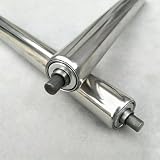
- ✅ Complete Size Specification & Heavy-Duty Load Capacity – Package includes 2 Pack premium steel rollers with multi-size options to match diverse usage needs. Roller Diameter 25mm(1.0 inch) with 8mm shaft supports 5-40kg/10-88lbs load; 38mm(1.5 inch) roller fits 15-65kg/40-130lbs load; 50mm(2 inch) roller with 12mm(1/2 inch) shaft holds 25-80kg/50-170lbs weight perfectly.
- ✅ Premium Stainless Steel Build for Long-Lasting Durability – Crafted from high-quality stainless steel material, these steel roller conveyor parts feature excellent rust-resistant, waterproof, wear-proof and smooth surface properties. Built heavy-duty to withstand frequent long-term use, they operate with ultra-smooth rotation, minimal vibrations and no stuck jitter.
- ✅ Effortless Spring Press-in Mounting for Fast Installation – Equipped with innovative spring press-in mounting mechanism, these heavy-duty conveyor rollers support tool-free quick assembly. You only need to simply push the spring in or pull it out from the other side to firmly fix the roller into the conveyor frame, no complex operation required.
- ✅ Ultra Low Noise & Stable Smooth Operation – Adopting powerless passive rolling design, these steel rollers work without electric drive, producing extremely low friction and sliding sound during operation. It effectively reduces noise interference for operators, ensuring quiet, stable and reliable item transfer. Fitted with flexible wheels for smooth movement, they perfectly fit precise working scenarios of saw, bender and wood processing.
- ✅ Wide Versatile Uses for Multiple Scenarios – These multi-functional steel rollers serve as ideal conveyor replacement rollers and roller stand accessories, widely applicable for woodworking roller stand, saw stand, material stand roller, table belt conveyor and bender equipment. They also work perfectly as expandable fence rollers, fence kit parts, sheet and wood transfer rollers, as well as unloading & loading rollers for boat, dock, kayak and sports bike tires.
Many cities allow common backyard fences without a permit up to a certain height, often around 6 feet, but rules vary. Corner lots, front yards, pool barriers, retaining walls, alleys, and visibility triangles can change the answer. Some jurisdictions require permits for taller fences, masonry walls, or fences near public right-of-way. If your dog fence is part of a pool enclosure, the latch, gate swing, climbability, and height may be regulated more strictly.
Also look at the yard itself. Sloped grades create triangular gaps under panels. Soft soil invites digging. Frost depth affects post setting in cold climates. Privacy panels catch wind and need proper post size, depth, spacing, and concrete. A dog fence is an outdoor structure, not just a decorative border.
21 Dog Fence Ideas for Different Yards and Dogs
1. Six-Foot Wood Privacy Fence
A 6-foot wood privacy fence is the standard answer for many suburban dog yards because it solves several problems at once: height, privacy, reduced barking triggers, and curb appeal. Cedar, pressure-treated pine, and redwood are common choices. Installed costs often run about $20 to $50 per linear foot, with many full residential projects landing around $3,000 to $9,000 depending on footage and gates.
For dogs, we prefer vertical boards with minimal gaps, posts set correctly for local frost conditions, and no horizontal rails exposed on the dog side if the dog climbs. Wood needs maintenance. Plan on cleaning and staining or sealing on a recurring cycle, often every 2 to 4 years depending on sun, moisture, and product.
2. Vinyl Privacy Fence
Vinyl privacy fencing is a clean, low-maintenance option for homeowners who want a solid visual barrier without staining. In 2026, installed vinyl commonly runs roughly $45 to $82 or more per linear foot, with many projects around $55 per foot depending on style and region.
For reactive dogs, vinyl works well because it blocks sightlines. For climbers, the smooth surface is harder to scale than chain-link or rail-style fencing. The tradeoff is cost and wind loading. Tall solid panels need proper post installation, especially in open yards where wind can push hard on a long fence run.
3. Chain-Link Fence With Bottom Tension Wire
Chain-link is durable, familiar, and usually less expensive than full privacy fencing. Installed pricing varies widely, but current estimates often fall from about $10 to $40 or more per linear foot, while detailed 2026 estimates place many chain-link installations around $29 to $45 per linear foot.
For dogs, the bottom detail matters. A loose chain-link bottom is an invitation to push under. Use bottom tension wire, a bottom rail, buried mesh, or a dig guard. Chain-link is not ideal for climbers because the mesh acts like a ladder. It also does not block visual triggers unless you add slats or screening.
4. Black Vinyl-Coated Chain-Link
Black vinyl-coated chain-link is a better-looking version of standard galvanized chain-link. It blends into landscaping, resists corrosion better, and works well along rear or side property lines where full privacy is not needed. Installed black chain-link often runs around $10 to $34 per linear foot, with a 150-foot project commonly around $1,500 to $4,800.
Use it for calm dogs, larger back lots, and budget-conscious projects. Avoid it for dogs that climb or react aggressively to pedestrians, dogs, or traffic unless you add screening.
5. Welded-Wire and T-Post Fence for Large Yards
For rural properties or large lots, welded wire on T-posts or wood posts can cover more ground at a lower cost than privacy fencing. It is useful when you need containment over a long perimeter and do not need a formal street-facing look.
Choose wire height based on the dog, not just the landscape. Many large dogs need 5 to 6 feet. Small dogs need tight mesh and low ground clearance. Corners and gate posts should be stronger than the line posts because that is where tension and movement concentrate.
6. Cattle-Panel Fence
Cattle panels are rigid welded panels, often 16 feet long, mounted to wood or metal posts. They create a clean ranch-style look and hold their shape better than light wire. They are a good fit for large yards, gardens, and modern farmhouse designs.
Check the grid spacing before using cattle panels for small dogs or puppies. Some panels have openings that are too large near the top or bottom. If a dog can get its head through, choose a different panel or add smaller mesh on the lower portion.
7. Aluminum Fence With Puppy Pickets
Aluminum fencing gives a clean ornamental look and does not rust like untreated steel. For small dogs, ask for puppy pickets, which add tighter spacing along the bottom portion of the fence. That lower section is often the difference between a fence that looks good and one that actually contains a small pet.
Aluminum is not a privacy fence. It works best for calm dogs and yards where visibility is acceptable. Watch the bottom gap on slopes and under gates.
8. Ornamental Steel With Narrow Pickets
Steel is stronger than aluminum and can be a good fit for large dogs when the design uses narrow vertical pickets. It gives a more formal look for front-facing areas or high-value homes.
The weak points are usually cost, corrosion if the finish is damaged, and spacing. Keep picket gaps tight for small dogs. For jumpers, height still matters. A beautiful 4-foot ornamental fence will not stop an athletic dog that can clear it from a running start.
What’s actually slowing this PC down?
Pick the symptom - the matching free tool is one click away.
9. Split-Rail Fence With Welded-Wire Backing
Split-rail alone is not a dog fence. With welded-wire backing, it becomes a practical option for larger yards where a rustic appearance fits the property. The rail gives structure and style; the wire does the containment.
This is a strong hybrid choice for rural or semi-rural homes. Use small enough mesh for the dog, fasten it securely, and treat the bottom edge like any other dog fence if digging is a concern.
Rank #2
- ✅ Complete Size Specification & Heavy-Duty Load Capacity – Package includes 2 Pack premium steel rollers with multi-size options to match diverse usage needs. Roller Diameter 25mm(1.0 inch) with 8mm shaft supports 5-40kg/10-88lbs load; 38mm(1.5 inch) roller fits 15-65kg/40-130lbs load; 50mm(2 inch) roller with 12mm(1/2 inch) shaft holds 25-80kg/50-170lbs weight perfectly.
- ✅ Premium Stainless Steel Build for Long-Lasting Durability – Crafted from high-quality stainless steel material, these steel roller conveyor parts feature excellent rust-resistant, waterproof, wear-proof and smooth surface properties. Built heavy-duty to withstand frequent long-term use, they operate with ultra-smooth rotation, minimal vibrations and no stuck jitter.
- ✅ Effortless Spring Press-in Mounting for Fast Installation – Equipped with innovative spring press-in mounting mechanism, these heavy-duty conveyor rollers support tool-free quick assembly. You only need to simply push the spring in or pull it out from the other side to firmly fix the roller into the conveyor frame, no complex operation required.
- ✅ Ultra Low Noise & Stable Smooth Operation – Adopting powerless passive rolling design, these steel rollers work without electric drive, producing extremely low friction and sliding sound during operation. It effectively reduces noise interference for operators, ensuring quiet, stable and reliable item transfer. Fitted with flexible wheels for smooth movement, they perfectly fit precise working scenarios of saw, bender and wood processing.
- ✅ Wide Versatile Uses for Multiple Scenarios – These multi-functional steel rollers serve as ideal conveyor replacement rollers and roller stand accessories, widely applicable for woodworking roller stand, saw stand, material stand roller, table belt conveyor and bender equipment. They also work perfectly as expandable fence rollers, fence kit parts, sheet and wood transfer rollers, as well as unloading & loading rollers for boat, dock, kayak and sports bike tires.
10. No-Dig Panel Fence
No-dig panels use stakes or surface-driven posts instead of traditional post holes. They can work for light-duty boundaries, small dogs, garden separation, or temporary layouts. They are usually faster to install than a full post-and-concrete fence.
Do not oversell them. No-dig fencing is not the first choice for strong large dogs, heavy impact, soft soil, or escape artists. If you can rock the panel by hand, a determined dog may eventually work it loose.
The Tool Desk
Outbyte PC Repair FREEClear out junk files and repair common Windows errorsFree Scan →Outbyte Driver Updater FREEScan for outdated or missing drivers - takes under a minuteDriver Scan →11. Temporary Portable Dog Run
A portable dog run is useful for renters, puppies, recovery after surgery, travel, or homes where the permanent fence project is still being planned. Panels can be moved, expanded, or removed without committing to a full perimeter.
Use portable runs for supervised time unless the system is specifically designed and anchored for unsupervised outdoor use. Add shade, water, and a clean surface. A 6-by-10-foot run may be fine for short breaks, but it is not a substitute for exercise.
12. Dedicated Side-Yard Dog Run
When fencing the entire yard is too expensive or impractical, a side-yard dog run can be the smarter build. It uses a smaller footprint, often along a garage or side setback, with secure fencing, a gate, and a surface that drains well.
We like this approach for narrow urban lots and homes with landscaping that should not become a dog path. Plan for at least 4 feet of clear width where possible, more for large dogs, and avoid creating a muddy trench. Gravel, artificial turf systems, concrete with drainage, or compacted stone can all work when detailed correctly.
Recommended Free Tools
13. Dig-Proof Skirt or L-Footer Retrofit
If the existing fence is mostly good but the dog digs under it, add a dig-proof bottom. A common approach is an L-footer: welded wire or hardware cloth attached to the bottom of the fence and laid outward along the ground 12 to 24 inches, then covered with soil, gravel, mulch, or edging.
You can also bury a vertical barrier below the fence line. Avoid exposed sharp wire edges. On our projects, we walk the finished line by hand and at dog-eye level to catch snags, curled mesh, or gaps under gates.
14. Coyote rollers or Inward-Angled Toppers
For dogs that jump, climb, or pull themselves over the top, a standard fence may need a top control. Coyote rollers make it harder for an animal to gain purchase at the top rail. Inward-angled toppers can also help, where code and HOA rules allow them.
These are specialty details, not decoration. Check local height rules before adding anything above an existing fence. A 6-foot fence with a topper may be treated differently than a 6-foot fence alone.
Do these 3 things before closing this tab:
1Clear out junk files and repair common Windows errors2Scan for outdated or missing drivers - takes under a minute3Repair Windows errors before they cause bigger problems15. Privacy Screen or Slats for Reactive Dogs
If your dog fence-runs and barks at every walker, dog, bicycle, or delivery truck, the issue may be visibility. Chain-link privacy slats, mesh screen, reed screening, or framed privacy inserts can reduce stimulation without replacing the entire fence.
Screening adds wind load. A chain-link fence that was stable as an open mesh may need stronger posts or bracing once it catches wind. For permanent upgrades, solid wood, vinyl, or composite panels are usually cleaner than a patchwork of lightweight screens.
16. Double-Gate Airlock
Escape artists often do not beat the fence. They beat the human at the gate. A double-gate airlock creates a small vestibule so one gate can close before the next one opens. This is especially useful near driveways, alleys, side yards, and homes with children or frequent deliveries.
Use self-closing hinges where appropriate, a lockable latch, and enough space for a person to step in comfortably with a leash or trash bin. For wood gates, install a steel frame or anti-sag kit, especially on wide openings.
Quick wins for a faster PC:
Fix the driver behind crashes, sound loss and screen glitchesFind Drivers →Clear out junk files and repair common Windows errorsFree Scan →Scan for outdated or missing drivers - takes under a minuteDriver Scan →17. dog window or Bubble Panel
A dog window, porthole, or bubble panel gives a curious dog a controlled view through a solid fence. Used carefully, it can reduce frustration for some dogs because they can see a small area without pacing the whole fence line.
This is not the right detail for every dog. For reactive dogs, a viewing bubble may make barking worse. Install it at the correct height, use durable materials, and make sure the cutout does not weaken the panel.
18. Landscape-Buffered Fence Line
Landscaping can make a dog fence safer and better looking. A buffer of shrubs, ornamental grasses, raised edging, or gravel can keep dogs away from the fence line, reduce digging, and soften the view from inside the yard.
Choose pet-safe plants and leave room for maintenance. Do not place boulders, benches, firewood stacks, planters, or retaining wall blocks where they become launch platforms near the fence.
Crashes, No Sound, or Screen Glitches?
Random freezes, missing sound and display glitches usually trace back to one bad driver. Find and replace yours safely.Free scan · under a minuteWindows Errors? Fix Them Before They Spread
Repair common Windows errors and clear accumulated junk for a smoother, more stable PC - no reinstall needed.Free scan · no reinstall19. Composite Privacy Fence
Composite fencing gives the solid screening of wood with lower routine maintenance. It is a good fit for homeowners who want privacy, color stability, and a more finished appearance than basic wood.
Expect it to cost more than standard wood in many markets. It still needs proper structure, especially on tall privacy runs. For dogs, its strengths are the smooth face, limited gaps, and visual barrier.
20. Masonry or Stone Wall With Secure Gate
A masonry, block, brick, or stone wall is the most permanent option on this list. It can provide privacy, noise reduction, security, and strong containment. It also brings more cost, engineering, drainage, and permitting questions than most fence types.
The gate becomes the critical weak point. Use quality hinges, a lockable latch, a tight bottom clearance, and a frame that will not sag. In some areas, masonry walls require permits or engineering, especially when tall or near property lines.
21. Hybrid Fence Design
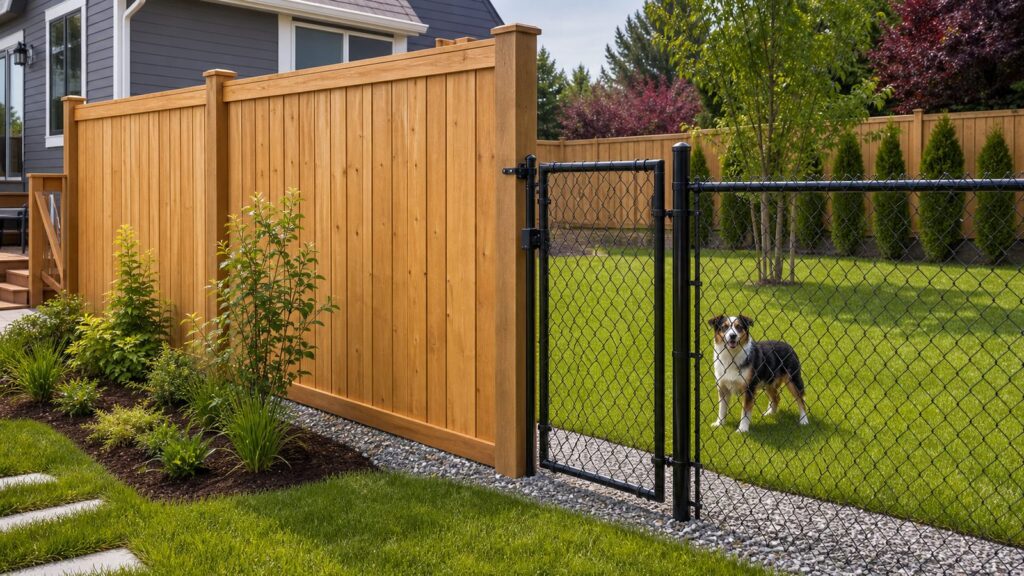
A hybrid fence uses different materials in different parts of the yard. This is often the best real-world solution. Use a 6-foot privacy fence along the street, sidewalk, or neighbor’s dog run; use black chain-link, welded wire, or split-rail with mesh along rear service areas; then add a dedicated dog run if the full yard cannot be made secure.
Rank #3

- 1. RUSTPROOF STAINLESS CONTACT SURFACE: Unlike ordinary galvanized-coated rollers, the part that touches your cargo is polished stainless steel, which sheds rain, humidity and salt air without rust or pitting and glides smoothly over kayak and canoe hulls without scuffing or scratching them; the galvanized axle and brackets keep weight and cost down for year-round indoor/outdoor service.
- 2. 120 LB RATED, QUIET AND LOW-VIBRATION: Built for a 120-pound load where rival 10-inch rollers rate only 100 LB, each rigid roller spins freely with zero wobble, minimal vibration and low friction, so lumber, coolers, bikes and boats move with light push force and stable, fatigue-free handling.
- 3. TOOL-FREE QUICK-RELEASE AXLE: A spring-loaded axle on one end compresses by hand, so each roller pops in or out of its bracket in seconds with no wrench or pin. The pre-assembled galvanized bracket has slotted mounting holes to screw straight onto a workbench, saw horse, rack, wall, trailer rail or fence line, with slight adjustability for fast one-person setup and changes.
- 4. EXACT 1.5 x 10 INCH SIZE WITH FULL DIMENSIONS: Roller measures 1.5 inch in diameter and 10 inch between-frame (BF, 25.5 cm); each galvanized bracket is 11 inch long, 3.14 inch tall and 1.5 inch wide (28 x 8 x 4 cm) with slotted mounting holes for adjustable positioning, standard sizing that lines up with most gravity conveyor frames, outfeed roller stands, benchtop roller tables and fence-top builds right out of the box.
- 5. ONE KIT, ENDLESS BUILDS: Deploy the pair as table saw or band saw outfeed rollers, a benchtop roller stand, kayak/canoe/boat-launching and dock helpers, bike and truck loading rollers, garage/warehouse/factory transfer rollers, or fence-top rollers that stop cats, dogs and coyotes from jumping or climbing over. Pack of 2 rollers with galvanized brackets and spring axles; mounting bolts not included.
This approach puts the budget where it matters most. The rule is simple: every section still has to meet the dog’s containment needs. A premium front fence does not help if the back corner has a 7-inch gap under a loose panel.
Independent reader supportYour contribution helps us test, update, and keep practical guides available for everyone.Dog Fence Cost Guide for 2026
Cost depends on linear footage first. A small 100-foot enclosure and a 300-foot full perimeter are different projects, even if they use the same material. Gates, grade changes, demolition, rocky soil, post depth, fence height, coatings, and local labor rates can move the price quickly.
| Fence Type | Typical 2026 Installed Cost | Best Use | Watchouts |
|---|---|---|---|
| Wood privacy | $20-$50 per linear foot | Privacy, jumpers, reactive dogs | Staining, warping, chewing, bottom gaps |
| Vinyl privacy | $45-$82+ per linear foot | Low maintenance, clean appearance, visual screening | Higher upfront cost, wind load |
| Chain-link | About $10-$40+ per linear foot; detailed estimates around $29-$45 | Budget containment, rear yards, large runs | Climbable, no privacy, needs bottom reinforcement |
| Black chain-link | $10-$34 per linear foot | Less visible open fencing | Still climbable and see-through |
| Wire or electric acreage fence | Often $400-$2,500 for smaller acreage applications | Large properties and low-cost boundaries | May not be adequate for unsupervised pet containment |
| Composite or masonry | Often premium pricing | Long-term curb appeal and privacy | Higher cost, structural detailing, possible permits |
For a tight budget, spend first on the secure perimeter, strong posts, good gates, and dig or jump controls. Decorative caps, upgraded colors, lattice accents, and landscape lighting can come later. A pretty fence with a weak gate is not a dog fence.
Free tools Windows power users keep installed
One-click scans. No signup required.
Details That Make or Break a Dog Fence
Height
For many medium and large dogs, 6 feet is the practical starting point. Some athletic breeds may need 7 to 8 feet or an inward-angled topper where allowed. Do not measure only from average grade. Measure from the highest launch point inside the yard, including slopes, steps, retaining walls, furniture, and stacked materials.
Bottom Clearance
The bottom 6 to 12 inches of a fence deserve as much attention as the top. Keep ground gaps tight, especially under gates. On uneven grade, rack panels, step panels carefully, or fill gaps with a durable bottom board, curb, mesh, or graded soil that drains.
Gates and Hardware
Gates are the most common failure point. Use properly sized posts, through-bolted hinges where appropriate, latch hardware mounted where the dog cannot nose it open, and an anti-sag kit or steel frame on wide wood gates. For frequent-use gates, self-closing hinges and a lockable latch are worth the cost.
Post Setting and Drainage
Fence posts must be set for your soil, frost depth, height, and wind exposure. Privacy panels need more structure than open wire because they catch wind. Poor drainage around posts shortens fence life, especially with wood. We avoid burying untreated wood components directly in wet soil and we slope concrete crowns so water drains away from posts.
Windows Errors? Fix Them Before They Spread
Repair common Windows errors and clear accumulated junk for a smoother, more stable PC - no reinstall needed.Free scan · no reinstallOutdated Drivers Are Slowing You Down
One free scan finds every outdated or missing driver and matches the right update for your exact hardware.Free scan · exact hardware matchWhen to DIY and When to Hire a Pro
DIY can make sense for a small welded-wire enclosure, a portable run, a short no-dig panel layout, privacy slats, or an L-footer retrofit on an existing fence. A capable homeowner with basic tools can often handle those projects over a weekend, especially on level ground.
Hire a pro when the fence is tall, long, street-facing, subject to HOA review, near utilities, on a steep slope, or built with heavy gates, vinyl privacy panels, masonry, steel, or composite. Also hire help when the dog is a serious escape risk and failure has real consequences. Professional installation is not just about speed; it is about layout, post depth, gate alignment, drainage, material selection, and code compliance.
For a typical full-yard professional fence, expect planning and estimating to take a few days to a few weeks depending on surveys, HOA approvals, and permits. Physical installation may take 1 to 4 days for many residential wood, vinyl, or chain-link projects once materials are ready, with larger or more complex work taking longer.
Maintenance Checklist for Dog Fences
Walk the fence at least twice a year and after major storms or freeze-thaw cycles. Look for leaning posts, loose fasteners, lifted mesh, warped boards, cracked vinyl, rust, sharp wire ends, and gate movement. Trim vegetation so it does not push panels apart or hide damage.
Quick wins for a faster PC:
Repair Windows errors before they cause bigger problemsFix Now →Fix the driver behind crashes, sound loss and screen glitchesFind Drivers →Clear out junk files and repair common Windows errorsFree Scan →Wood fences need cleaning and stain or sealer maintenance. Vinyl needs washing and inspection for cracked rails or loose posts. Chain-link needs rust checks, tension checks, and repairs where the bottom edge lifts. Gates need hinge adjustment, latch testing, and bottom clearance checks. After installation, walk the inside perimeter at dog-eye level. That lower view reveals gaps, climb points, exposed edges, and launch platforms that are easy to miss while standing.
Final Recommendation
If you want the safest all-around dog fence for a typical suburban yard, start with a 6-foot wood, vinyl, or composite privacy fence, then reinforce the bottom if your dog digs and upgrade the gate hardware. If cost or acreage makes that unrealistic, use a hybrid design: privacy where visibility matters, chain-link or welded wire where it does not, and a dedicated dog run where full-yard fencing is not practical.
The right fence is the one your dog cannot casually defeat. Choose the material for the yard, but design the height, bottom, gates, and sightlines for the animal that will test it every day.
Frequently Asked Questions
What is the best type of fence for dogs?
For many homes, a 6-foot wood, vinyl, or composite privacy fence is the best all-around choice because it provides height, blocks visual triggers, and has a smooth face that is harder to climb. Calm dogs may do fine with chain-link, aluminum, or split-rail with welded wire if the bottom and gate details are secure.
How tall should a fence be for a large dog?
A 6-foot fence is a common practical minimum for many large dogs. Athletic jumpers may need 7 to 8 feet, an inward-angled topper, or removal of launch points such as benches, retaining walls, firewood stacks, and landscape boulders near the fence.
What is the cheapest way to fence a yard for dogs?
Chain-link, welded wire, and split-rail with mesh are usually cheaper than full privacy fencing. The best budget strategy is often a hybrid fence: use privacy panels near streets or neighbors and lower-cost secure fencing along rear or less visible property lines.
How do you stop a dog from digging under a fence?
Install a buried vertical barrier or an outward-facing L-footer made from welded wire or hardware cloth. A 12- to 24-inch apron covered with soil, gravel, mulch, or edging can block digging while reducing exposed sharp edges.
Is chain-link fencing good for dogs?
Chain-link can work well for calm dogs and budget-conscious yards, but it is climbable and does not block visibility. For dogs that dig, add bottom tension wire, a bottom rail, buried mesh, or a dig guard. For reactive dogs, add screening or choose a privacy fence.
How much does a dog fence cost in 2026?
Most installed dog fence projects commonly fall around $2,000 to $8,000, with many near $4,700. By linear foot, general residential fence installation often ranges from about $6 to $50, depending on material, height, gates, terrain, labor, permits, and security upgrades.
Quick Recap
Product prices and availability are accurate as of the date/time indicated and are subject to change. Any price and availability information displayed on Amazon at the time of purchase will apply.

