The best DIY grow LED light is not the one with the highest advertised wattage. It is the one that delivers the right daily light dose evenly across the canopy, while keeping LED boards, drivers, wiring, and mounting hardware cool and safe.
Start with the crop, growing area, photoperiod, and target DLI. Then calculate the required PPFD and PPF, choose a distributed LED layout, match the driver correctly, and verify the finished fixture with measurements. For a standard footprint, a commercial fixture may be cheaper and safer; DIY is most valuable when you need unusual dimensions, modularity, or hands-on control.
As an Amazon Associate I earn from qualifying purchases.
What “designing a better sun” really means
Sunlight is broad-spectrum, intense, variable, and naturally distributed across a large area. A grow light does not need to reproduce sunlight exactly. The practical goal is to deliver enough photosynthetically useful photons, evenly across the canopy, at an acceptable electrical, thermal, and financial cost.
Recommended Free Tools
That means the design priorities are:
- Crop and growth stage
- Growing area
- Target daily light integral (DLI)
- Average and edge PPFD
- Photoperiod
- Complete-fixture efficacy
- Uniformity
- Spectrum
- Thermal management
- Electrical and environmental safety
Do not begin by asking how many watts you need. Wattage is a consequence of the photon target and the efficiency of the complete system.
#1 Best Overall

- NOTE: The product stand needs to be pressed down by the flower pot to be stable. Not wireless style. 2 Installation Methods: Specially designed plant light for indoor plants, which can be inserted in the soil or stand for lighting.Unique and easy to assemble and disassemble.
- 3 Lighting Modes and 10 Brightness: The full spectrum plant grow lights offers 10 levels by pressing the button. 3 lighting spectrum “white light, warm white and red, Mix Lighting”. you have more options to meet different illumination requirements.
- Timer Adjustment: This small halo grow light have set up timer with 3 modes cycle timing function which stay on for 3H, 9H, 12H. When keeping power, it can automatically turn on and off every day according your settings.
- Height and Angle Adjustment: The pole of grow lights can telescope up and down to accommodate different plants. Provide the right amount of light intensity. Rotate 90 degrees the pipe and height can be up to 26 in, which more plants will be covered.
- Widely Used: This plant halo grow light also stylish decoration for any home space, and with color box. Suitable for all types of locations such as hangings, floor planters and more. the gardeners and plant lovers tending to their plants and vegetables.
The five measurements that matter
PPFD: light arriving at the canopy
Photosynthetic photon flux density, or PPFD, measures photosynthetically relevant photons arriving at a square metre each second. It is expressed in μmol/m2/s. A PPFD reading is a measurement at a particular location and height—not a complete description of a fixture.
DLI: the daily dose
Daily light integral (DLI) is the total amount of photosynthetically active light received over 24 hours. The governing relationship is:
DLI = PPFD × hours of light × 0.0036Therefore:
Average PPFD = target DLI ÷ (hours of light × 0.0036)Extension guidance gives broad planning categories of approximately 5–10 mol/m2/day for low-light plants, 10–20 for medium-light plants, 20–30 for high-light plants, and 30–50 for very-high-light plants. These are not universal prescriptions: species, growth stage, temperature, water, nutrition, CO2, and genetics all affect the useful target. See Oklahoma State University Extension’s grow-light guidance.
Do these 3 things before closing this tab:
1Repair Windows errors before they cause bigger problems2Fix the driver behind crashes, sound loss and screen glitches3Clear out junk files and repair common Windows errorsPPF: the fixture’s total photon output
Photosynthetic photon flux (PPF) is the total useful photon output of the fixture, expressed in μmol/s. Once you know the average PPFD and illuminated area:
Required PPF = average PPFD × area in square metresEfficacy: photons per electrical joule
Fixture efficacy is expressed in μmol/J. It connects photon output to electricity:
Electrical watts ≈ required PPF ÷ fixture efficacyUse complete-fixture efficacy where available. LED-package efficacy is not the same as fixture efficacy after driver losses, wiring, thermal losses, optics, dimming, and ageing. The U.S. Department of Energy explains that LEDs can offer strong photosynthetic photon efficacy and spectrum control compared with older technologies, but the actual result depends on the entire lighting system. Read the DOE indoor-horticulture lighting overview.
Lumens, lux, CCT, and CRI
Lumens and lux describe light as weighted for human vision. They can be useful for ordinary room lighting but are poor primary comparison tools for grow fixtures. Colour temperature (CCT) describes the appearance of white light, while colour-rendering index (CRI) describes how colours appear to people. Neither is a plant-growth score. Compare grow lights using PPF, PPFD maps, DLI, and fixture efficacy instead. UNH Extension and Iowa State Extension explain these distinctions.
What’s actually slowing this PC down?
Pick the symptom - the matching free tool is one click away.
Work a design example before buying parts
Suppose the canopy occupies a 2 × 4-foot rectangle and the target is an illustrative 15 mol/m2/day over a 16-hour photoperiod.
Rank #2
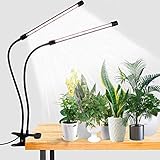
- 6000K White Light - equipped with 10 Red + 74 White LEDs, this growing Lamp is similar to the full-spectrum sunlight at noon,that is professionally designed for indoor garden plants.Moreover, its color rendering index is as high as 95, the light is soft and flicker-free, which is very suitable for reading lamp
- Timer Function & Multiple Settings - this plant spotlight offer the timer function with 3 options that is 4Hrs or 8Hrs or 12Hrs, it is based on a 24 hour cycle from the time you set the timer.For example,when keeping power ON, if you select 8 Hrs,it will turns ON for 8 hours per 24 hours.The other two timer settings are the same.
- Easy to Install - with flexible Gooseneck & strong clamp,it allows you to place the growth light in any direction to provide the best lighting angle for your plants,meet the cover around the plant.Powered by USB or AC Power Plug
- High Efficiency LED Lamp - as for LED power draw this seedling lights just comsume about 10 w and is equivalent to a 50 watts Halogen Bulb.Estimately monthly cost roughly $2 in electricity (12 hours a day). It is a great gift if you growing some small house plants.
- 【365 Days Warrantty】GooingTop service team offer 365 days warrantty and 24h friendly customer service. If there are ever any issues about the product, please feel fre e to contac t us and we will send you a new replacement.
Convert the area:
0.6096 m × 1.2192 m = 0.743 m2Calculate average PPFD:
15 ÷ (16 × 0.0036) ≈ 260 μmol/m2/sCalculate approximate PPF:
260 × 0.743 ≈ 193 μmol/sAt a hypothetical complete-fixture efficacy of 2.5 μmol/J:
193 ÷ 2.5 ≈ 77 WThe 77-W figure is an idealised average-output estimate, not a universal recommendation for a 2 × 4-foot space. Real designs need headroom for edge losses, thermal derating, driver losses, mounting height, ageing, and the uniformity required by the crop. The calculation framework is supported by Virginia Cooperative Extension and Oklahoma State Extension.
Choose the LED architecture
Linear strips and bars
Strips and bars work well on shelves, racks, seedling benches, microgreen shelves, and long rectangular footprints. Several emitters spread light across the area, reducing hot spots and making replacement or expansion straightforward.
Quick wins for a faster PC:
Scan for outdated or missing drivers - takes under a minuteDriver Scan →Clear out junk files and repair common Windows errorsFree Scan →Fix the driver behind crashes, sound loss and screen glitchesFind Drivers →The trade-offs are more connections, more exposed wiring, and the need to verify that the strip is designed for the chosen voltage. High-output strips still need proper aluminium heat spreading; “strip” does not mean “no heatsink.”
Quantum boards and large panels
Boards provide high output from a compact assembly and can simplify mechanical mounting. Their main risks are concentrated heat and a strong centre hot spot when a small board is mounted close to the plants. Horticulture Lighting Group’s quantum-board explanation illustrates the distributed mid-power LED approach.
COBs and high-power emitters
COBs and point emitters suit experimental or directional designs, but they create higher local heat density and are less forgiving of incorrect current or heatsinking. For a first build, multiple bars or boards are generally easier to make uniform and thermally stable than a few powerful point sources.
Choose a useful spectrum, not a colourful parts list
A practical general-purpose fixture usually starts with broad white LEDs, optionally supplemented by deep-red LEDs near the 660-nm region. A white base makes it easier to inspect foliage for pests, chlorosis, nutrient problems, and tissue damage than a purple red-blue fixture.
- Broad white: a straightforward base for many growth stages and comfortable visual inspection.
- Blue-heavy: may support more compact morphology, but is not automatically superior.
- Red-heavy: can supply useful photons efficiently, but may provide poor visual inspection and undesirable morphology when used alone.
- Deep red: a potentially useful supplemental channel, best controlled rather than added indiscriminately.
- Far-red: can influence shade-avoidance and flowering responses; treat it as a specific experiment, not a guaranteed upgrade.
- UV: introduces additional exposure and safety concerns and should not be included casually.
More colours do not automatically produce better growth. Quantity, uniformity, photoperiod, canopy temperature, and plant response usually matter more than a complex spectrum with no measurement plan. Iowa State Extension discusses mixing warm- and cool-white light to create a broader usable spectrum in its supplemental-light guide.
Rank #3
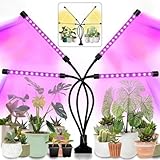
- 🌻Efficient LED Combination: This LED lamp has grow lights made up of 80 efficient growing LEDs ( 32 red lights, 12 blue lights,20 yellow lights and 16 white lights). It meets the conditions of plant growth without sunlight. 1--Full Spectrum(380nm-800nm): Suitable for all plants to root and sprout. 2--Red(660nm)+BLUE(460nm) Spectrum: for blooming and fruits. 3--Red+Blue+Full Spectrum: A mix of Red+Blue+Warm White is best to fuel the growth of your plants.
- 🌻Upgraded Auto ON/OFF Timer: Plant grow lights come with the circular memory timer function allows to automatically turn on/off every day according to your settings: 3H(Blue)/9H(Green)/12H(Red). Which requires no manual operation and takes good care of your plants when you on work or vacation.(Please note: The timer needs to be reset if the grow light is powered off.)
- 🌻10 Dimmable Modes: Our grow lamps provides 10 dimmable modes to suit varied stages of plant growth. It has 10 levels of light intensity and has 3 spectral modes to meet different stages of plant-growing needs.
- 🌻Visible Quality and Adjustable: The LED grow lights have a USB connector which makes it convenient to connect in your office or home to USB or AC power plug (includes adapter). The 4-head light has a 360-degree flexible gooseneck made from quality tubing to keep a fixed position. The metal clamp allows the lamp to be placed anywhere in your home or office.
- 🌻Scientific Heat Dissipation Design: Indoor LED grow light is backed by an aviation-grade heat sink powered by a temperature control unit. This improved heat sink efficiently dissipates the heat generated by the lamp to the atmosphere.
Design for uniformity, not peak PPFD
A fixture with a spectacular centre reading and weak corners is poorly suited to a flat canopy. Spread the emitting area with multiple bars or boards, increase mounting height where appropriate, use cross-lighting when useful, and keep the canopy level.
When reviewing a manufacturer’s PPFD map, check the measurement height, footprint, input wattage, measurement grid, and whether the reported value is an average or only a centre reading. The University of Missouri Extension recommends using a PPFD map or measuring the corners and centre with a quantum sensor.
For a DIY validation grid, measure at least the four corners, four edge midpoints, the centre, and several points over the actual canopy. Calculate the average, then compare the highest and lowest values. A useful average with severe edge-to-centre variation may still produce uneven plants.
Free tools Windows power users keep installed
One-click scans. No signup required.
Thermal design is part of the light design
Almost all electrical input that does not leave the room as photons eventually becomes heat. LEDs may send less infrared radiation directly toward the plants than some older lamps, but a powerful LED fixture still heats the growing room.
Use the board or strip manufacturer’s specified thermal path, a flat aluminium heat spreader or adequate heatsink, correct thermal interface material, and airflow around the heatsink. Mount the driver separately when practical so driver heat does not add to the LED board’s thermal load.
After the fixture reaches steady temperature, check the hottest board, driver case, wire connections, and enclosed connectors with a contact thermometer, thermocouple, or appropriately used infrared thermometer. Do not rely on briefly touching the fixture. A fan cannot compensate for poor thermal contact, insufficient metal, or an overdriven board.
Match the driver and wiring carefully
This is the highest-risk part of a DIY grow-light project. If you are not comfortable reading LED datasheets and working safely around mains electricity, buy a complete certified fixture or have the mains portion assembled and inspected by a qualified professional.
The Tool Desk
Outbyte Driver Updater FREEScan for outdated or missing drivers - takes under a minuteDriver Scan →Outbyte PC Repair FREERepair Windows errors before they cause bigger problemsFix Now →Constant-current versus constant-voltage
- Constant-current drivers are used with LED strings or boards designed to operate at a specified current.
- Constant-voltage power supplies are used with strips or modules that include their own current limiting or regulation.
Never connect a bare constant-current LED board to a generic constant-voltage adapter. A visually similar strip may use a different topology.
Rank #4

- FULL SPECTRUM & NATURAL LIGHT: A19 full spectrum grow light appears 4000K white to eyes but has a red/blue light spectrum. Same as natural sun shine, perfect for tomatoes, cucumbers, peppers, leafy greens and herbs at all growth stages.
- HIGH BRIGHTNESS & ENERGY SAVING: A19 LED plant grow light bulbs deliver 180-degree 1000LM bright light output. Use High Lumen LED Chips equivalent to 100w traditional light bulb while consumes only 11 watts, saving 90% of your electricity bill.
- HIGHER EFFICIENCY: LED grow bulb with high light transmission improves plant absorption more effectively. Balanced lighting of full spectrum wavelength can give your plants more light with a high output PPF of 25 micromoles per second.
- LONGER LIFESPAN: LED sun light bulbs with low heat generated, suitable temperature for your plants. Use Plastic & Aluminium material to build the cooling system with better heat dissipation. Up to 25,000 hours lifespan.
- NATURAL HOME LIGHT COLOR: Unlike those purple or reddish grow bulbs, our indoor 4000K LED grow light bulbs show off your indoor garden without harsh or unsightly lighting, providing a pleasing, natural light, temperature that integrates well with any decorative aesthetic.
For a series string, total forward voltage is approximately the sum of the modules’ forward voltages. Parallel strings require appropriate current sharing, matching, wiring, and protection; a failure in one branch can change current in the others. Do not treat casual parallel wiring as automatically safe.
For a DC system:
Power = voltage × currentFor an AC estimate:
Input current ≈ electrical watts ÷ input voltageThe real input also depends on driver losses and power factor. A 300-W fixture will not necessarily draw exactly 2.5 A from a 120-V circuit in every operating condition.
Mains wiring requires listed components, strain relief, suitable overcurrent protection, grounding where required, insulated terminals, and a protected enclosure. Keep drivers and mains connections outside splash zones, use drip loops, protect connections from condensation, and use GFCI protection where required or appropriate. UL Solutions identifies moisture, photobiological exposure, and the growing environment as specific horticultural-lighting concerns; UL’s horticultural-lighting guidance and UL 8800 information provide relevant safety context.
Build and test in this order
- Define the canopy rectangle, crop, growth stage, photoperiod, and provisional DLI.
- Calculate average PPFD, required PPF, and an initial power range.
- Choose a distributed layout with dimming headroom.
- Confirm every board or strip’s voltage, current, polarity, and thermal requirements.
- Mount the LED modules to suitable aluminium with the correct thermal interface.
- Install the driver independently where practical; do not suspend it from LED wiring.
- Add protected wiring, strain relief, connectors, fuses or other required protection, dimming, and timer control.
- Inspect polarity, terminal security, insulation, grounding, and mechanical stability.
- Test without plants. Check dimming, timer operation, power draw, connector temperature, driver temperature, and heatsink temperature after warm-up.
- Map PPFD across the canopy with a suitable quantum sensor.
- Calculate measured DLI using the average canopy PPFD:
DLI = average PPFD × hours × 0.0036- Adjust mounting height, dimming, spacing, or photoperiod, then observe plant response before increasing intensity again.
Lower-cost meters can be useful for relative comparisons when used consistently, but calibration and spectral response matter. A meter that performs acceptably under broad white LEDs may be less reliable under a narrow red-blue spectrum. See Iowa State’s measurement guidance.
Independent reader supportYour contribution helps us test, update, and keep practical guides available for everyone.DIY versus buying a finished fixture
DIY is a strong choice for custom dimensions, shelf integration, modular repairs, separate driver placement, unusual spectrum control, reuse of materials, or learning. It is a weak choice when you prioritise certification, warranty, quick installation, documented performance, and minimal electrical risk.
Compare the complete DIY cost—not just the LED boards—with the commercial fixture price:
DIY cost = light engine + driver + aluminium + thermal materials + wiring
          + protection + dimming + hardware + measurement + time
For ordinary 2×2, 2×4, 3×3, and 4×4-foot footprints, mass-produced fixtures can be cheaper once parts, shipping, troubleshooting, and labour are counted.
Crashes, No Sound, or Screen Glitches?
Random freezes, missing sound and display glitches usually trace back to one bad driver. Find and replace yours safely.Free scan · under a minuteWindows Errors? Fix Them Before They Spread
Repair common Windows errors and clear accumulated junk for a smoother, more stable PC - no reinstall needed.Free scan · no reinstall| Option | Best for | Main advantage | Main drawback |
|---|---|---|---|
| DIY strips or bars | Shelves and unusual footprints | Custom geometry | More wiring and thermal work |
| DIY quantum board | Experienced builders | Compact high output | Driver and heat complexity |
| Spider Farmer SF1000D | Small areas | Finished, low-cost fixture | Limited customisation |
| Spider Farmer SF2000 | 2×4-style areas | Complete moderate-cost light | Verify actual performance data |
| Spider Farmer GlowBar | Shelves and stands | Linkable distributed bars | May lack output for high-light crops |
| Mars Hydro SP3000 | 2×4-style canopies | Ready-made bar layout | Less flexible than DIY |
Official vendor pages showed the following price signals around August 18, 2026, subject to sales, region, and availability: Spider Farmer listed the SF1000D at $55.99, the SF2000 at $145.99, and the SF4000 at $259.99; Mars Hydro listed the SP3000 at $189.99 on sale. These are product-specific comparisons, not universal area rules. See the Spider Farmer SF series and Mars Hydro SP3000 pages.
Best Value

- 72 LED Full Spectrum, 380nm-800nm – Built with 72 super bright LEDs covering the full 380nm-800nm spectrum: 36 white 5000K, 28 warm white 3000K, 6 red and 2 blue. This grow light for indoor plants delivers the wavelengths your plants need year-round, supporting every stage from seedling to bloom — even in rooms with little natural sunlight.
- Height Adjustable 13.7"-61.1" – The telescopic pole extends from 13.7" to 61.1", so you can raise the halo as your plant grows and keep it at the right distance. Fully extended, the wide light disc covers a larger area and reaches several plants grouped together. The pointed stake pushes straight into the soil of your planter — no tools, no mounting.
- 10-Level Dimmable 10%-100% – Ten brightness settings let you dial in the right intensity for each plant, from a soft 10% glow for low-light species to full 100% for sun-hungry plants. Use the +/- buttons on the inline controller to switch levels in seconds, so you can adjust as your plant's needs change through the season.
- 8/12/16H Auto Timer, Long Cord – Set the built-in timer to 8, 12 or 16 hours and the light turns on and off on the same schedule every day — hands-free, no need to unplug or re-plug. The long cord reaches outlets across the room, so you can place this plant light for indoor plants in a dark corner, hallway or windowless office. Note: if power is cut, reset the timer.
- 5V Low Voltage & Safe for Long-Hour Use – Runs on 5V low voltage via USB, so it won’t get hot to the touch and is safe to leave on for long hours. UL-listed and CE-compliant for added safety and reliability. The inline controller gives you one-touch dimming, timer and on/off — plug and play, no tools needed. Confirm before ordering: this is a plug-in light, not battery or wireless.
Commercial strip kits may be a useful middle ground. Spider Farmer’s GlowBar 2FT system is designed for distributed shelf or supplemental lighting, while a complete Mars Hydro tent kit may make more sense than DIY when the tent and ventilation system are also needed.
Troubleshooting the finished light
Plants are leggy
Check measured PPFD, photoperiod, fixture height, and edge readings. Insufficient light is one possibility, but temperature, genetics, and airflow also matter.
Leaves bleach or develop edge damage
Reduce PPFD or increase distance gradually and check canopy temperature, water supply, nutrition, and airflow. High light can increase plant demand rather than simply improving growth.
Growth is uneven
Map the canopy. A high centre and weak edges indicate insufficient emitting area, poor spacing, excessive proximity, or a need for cross-lighting.
The driver shuts down or output falls after warm-up
Check driver loading, dimming compatibility, ventilation, LED-board temperature, and connector temperature. Thermal protection may indicate an undersized or incorrectly operated system.
The fixture flickers
Check driver compatibility, dimmer type, loose connections, timer switching, and minimum-load requirements. Disconnect power before inspecting wiring.
PPFD is unexpectedly low
Confirm the meter’s suitability and calibration, measurement height, dimmer setting, driver output, actual wall power, and whether the array is losing output at temperature.
Quick Recap
DIY grow-light preflight checklist
- Crop, growth stage, canopy area, and photoperiod are defined.
- DLI and average PPFD targets are written down.
- Required PPF is calculated from the actual area.
- Complete-fixture efficacy—not only diode efficacy—is being used for estimates.
- The array is distributed enough to cover edges.
- LED boards, strips, driver, dimmer, and wiring use compatible electrical topologies.
- Aluminium and thermal interface materials are adequate.
- Driver, mains wiring, connectors, and power strips are protected from water.
- Grounding, strain relief, overcurrent protection, and GFCI requirements are addressed.
- Temperature and power draw are checked after warm-up.
- PPFD is measured across the canopy, not only at the centre.
- Measured average PPFD is converted into delivered DLI.
- Plant response is monitored before intensity is increased.
Product prices and availability are accurate as of the date/time indicated and are subject to change. Any price and availability information displayed on Amazon at the time of purchase will apply.




