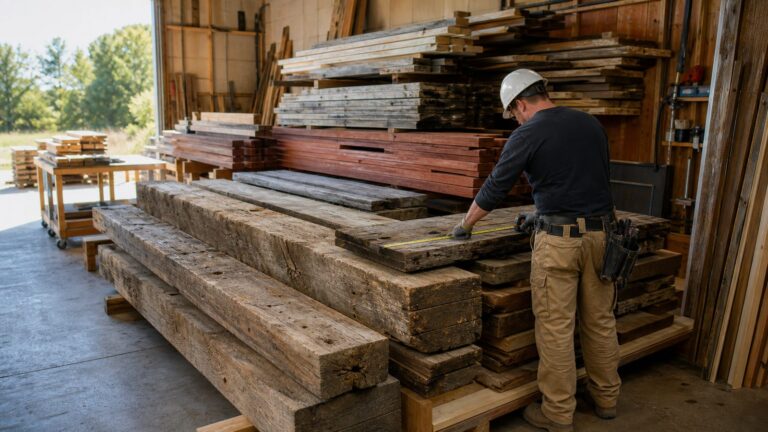
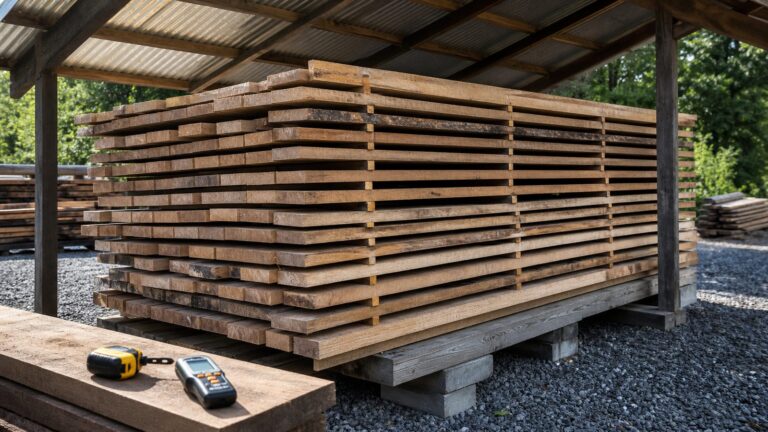
There is no universal winner between concrete, wood and steel. Cement is only the binder used to make concrete; the fair comparison is between complete structural systems designed for the same loads, building use, location, schedule and service life. Concrete may cost more or less than alternatives depending on local labor, materials, transport, equipment and detailing. Its compressive strength and durability can be valuable, while wood and steel may offer advantages in weight, speed, adaptability or availability. Compare equivalent designs and local bids rather than relying on a single material price or strength number.
Start with the right materials: cement is not concrete
Cement is a hydraulic binder. When mixed with water, it forms a paste that binds fine and coarse aggregates. Concrete is the resulting composite of cement, water and aggregates, often with chemical admixtures or supplementary cementitious materials (SCMs). The mixture can be placed while flowable and then hardens into a durable mass.
As an Amazon Associate I earn from qualifying purchases.
Wood and steel are usually discussed as structural systems rather than as direct substitutes for a bag of cement. A meaningful comparison therefore considers the entire assembly: foundations, frames, floors, walls, roof, connections, fire protection, finishes, transportation, erection and future maintenance. A concrete frame, a light wood frame and a steel frame can all satisfy a design brief, but they do so with different spans, weights, connection details, construction sequences and exposure risks.
Crashes, No Sound, or Screen Glitches?
Random freezes, missing sound and display glitches usually trace back to one bad driver. Find and replace yours safely.Free scan · under a minuteWindows Errors? Fix Them Before They Spread
Repair common Windows errors and clear accumulated junk for a smoother, more stable PC - no reinstall needed.Free scan · no reinstall“Cheapest” and “strongest” are incomplete questions until the building element, performance requirement, test method and time horizon are specified.
#1 Best Overall

- QUICK SETTING: Sets in 20 minutes
- VERSATILE: Indoor, and outdoor use
- EASY TO USE: Ready to use! Just add water, mix, and use!
- MULTIPLE SURFACES: Handrails, bolts, poles, fixtures, and more
- PRACTICAL SIZE: 10 pound bag saves your back while providing plenty of cover
Cost: why a universal ranking does not work
Installed cost changes with location, date, design, labor productivity, material availability, transport distance, equipment, site access and the scope included in the estimate. A material that is inexpensive at the supplier may require expensive formwork, cranes, fire protection, skilled trades or longer financing time. Conversely, a higher material invoice can be offset by repetition, durability or reduced maintenance.
What the available comparison actually shows
An American Cement Association report summarized a comparison of a four-story multifamily building using several structural systems in multiple cities. Wood framing was used as a base, and the cost periods were December 2016, May 2017 and September 2017. In that study, most concrete alternatives fell between 5% below and 20% above the wood or steel frame cost. The report explicitly noted that material and labor prices vary by place and time.
Those figures are historical, study-specific industry-reported results—not a current quote, a national average or a prediction for a particular project. They cannot establish that concrete is generally cheaper or more expensive than wood or steel in 2026.
The Tool Desk
Outbyte Driver Updater FREEScan for outdated or missing drivers - takes under a minuteDriver Scan →Outbyte PC Repair FREERepair Windows errors before they cause bigger problemsFix Now →Build an apples-to-apples estimate
Request competing estimates for the same drawings, specifications and performance requirements. Ask each estimator to identify the assumptions behind:
- Materials, grades, strengths, waste allowances and delivery distances.
- Labor classifications, crew productivity, overtime and prevailing-wage requirements.
- Formwork, shoring, reinforcement, connectors, anchors, fire protection and finishes.
- Equipment, temporary works, crane or pump time, winter protection and site logistics.
- Design fees, testing, inspections, permits, insurance and contingency.
- Construction duration, financing exposure, maintenance, repair and expected replacement.
Compare the total installed system, not the price of cement, lumber or steel alone. A lifecycle estimate should show when maintenance or replacement costs occur; a nominally cheaper frame is not necessarily cheaper over the building’s service life.
Cost questions to put in writing
- Define the building type, floor area, number of stories, spans, loads, fire rating and target service life.
- Obtain at least two local estimates for each feasible structural system using identical scope.
- Separate structure from finishes and building services so a difference in cladding or interior fit-out does not masquerade as a frame-cost difference.
- Price schedule risk: include curing, weather protection, inspection hold points, fabrication lead times and potential redesign.
- Run sensitivity cases for labor rates, material escalation, transport interruptions and a delayed opening.
Strength is a test result tied to a use case
Concrete strength is commonly expressed as compressive strength measured at 28 days. Where SCMs contribute more slowly, specifications sometimes use 56- or 90-day acceptance ages. The stated age matters: a 28-day value and a 90-day value are not interchangeable.
Rank #2

- FOR EASY REPAIRS — It's the ideal concrete patch repair mix, neatly fixing cracks and spalls so your property looks like new. It's even textured for a more seamless blend with the existing structure
- TOUGH AND DURABLE — Formulated to avoid shrinking or cracking, the ready-to-use premixed cement patch offers good adhesion and high strength so your slabs, walls & walkways/sidewalks perform as good as ever
- EASY CLEANUP — Sika concrete patch is acrylic-based, so once application is done, it cleans up using only water. No need for special cleaners and chemicals
- GREEN — It follows regulations concerning the use of volatile organic compounds (VOC), helping to keep the air we breathe cleaner and fresher
- A BREEZE TO USE — Minimal prep is required, since it comes premixed. Just use a putty or trowel to spread where repairs are needed. It takes only a few hours to set and about a day for a full cure
It is also misleading to place a concrete compressive-strength value beside a wood or steel number and declare a winner. The materials are tested on different properties and in different structural roles. A design may be governed by compression, tension, bending, shear, buckling, vibration, connection capacity, fire exposure or serviceability rather than by one headline strength value.
Do these 3 things before closing this tab:
1Clear out junk files and repair common Windows errors2Fix the driver behind crashes, sound loss and screen glitches3Repair Windows errors before they cause bigger problemsQuestions that make a strength comparison meaningful
- What load? Identify gravity, wind, seismic, impact, vibration and accidental loads, including combinations required by the applicable code.
- What function? A column, slab, shear wall, beam, truss, bearing wall and connection have different governing checks.
- What test and age? Record specimen type, test standard, curing condition and acceptance age.
- What geometry? Section size, span, slenderness, reinforcement, bracing and restraint can dominate capacity.
- What connection? Bolts, welds, screws, plates, embeds and hold-downs often control the system rather than the base material.
- What limit state? Check strength, deflection, cracking, vibration, fatigue, creep, shrinkage and robustness where relevant.
Concrete can deliver high compressive capacity and stiffness, but its performance depends on mixture proportions, placement, consolidation, curing and crack control. Wood performance depends on species or engineered product, moisture, defects, duration of load and connections. Steel performance depends on grade, section shape, buckling restraint, connection design, corrosion protection and temperature. The engineer must compare complete designs under the same assumptions.
Early-age and later-age decisions
Concrete that contains slag cement, fly ash, natural pozzolans or other SCMs may develop strength more slowly. That can affect form-stripping, reshoring, post-tensioning, traffic opening or commissioning dates even when later-age performance meets the design requirement. Specify the acceptance age and construction milestones together; do not solve a schedule problem by silently changing the required strength criterion.
Durability and exposure often decide the material
Durability is the ability of a system to retain required performance under its actual environment and maintenance plan. The relevant threats differ by site and use:
- Moisture: detailing, drainage, vapor control, drying potential and repeated wetting can be more important than nominal material strength.
- Freeze-thaw: saturated concrete needs an exposure-appropriate mixture and air-void system; wood assemblies need water management and drying.
- Corrosion: reinforcing steel, structural steel, fasteners and embedded hardware require protection appropriate to chlorides, humidity and chemicals.
- Fire: required resistance, compartmentation, protection thickness, charring behavior, penetrations and inspection must be designed as a system.
- Pests and biological decay: wood assemblies require species selection, separation from ground moisture, drainage and inspection where exposure warrants.
- Chemical or industrial exposure: sulfate, acids, deicing salts and process chemicals can change the concrete mixture and protection strategy.
A durable design is not obtained by labeling one material “maintenance-free.” Specify exposure classes, protective details, inspection intervals, repair methods and a realistic service-life objective.
Environmental performance depends on boundaries
Concrete contains energy- and emissions-intensive cement, but environmental comparisons cannot be settled by a single upfront embodied-carbon value. An Environmental Product Declaration (EPD) quantifies impacts under defined product-category rules, declared units and lifecycle stages. One EPD may stop at the factory gate; another assessment may include transport, construction, use, maintenance, replacement and end of life.
Rank #3

- HIGH-YIELD POLYMER: Revolutionize your projects with our potent synthetic polymer, an instant adhesive that delivers up to 20 times the yield of traditional cement mix. Ideal for a broad range of applications, including concrete repair and cement crack repair, this bauer-endorsed product ensures efficiency and effectiveness, surpassing conventional solutions and saving time and resources.
- VERSATILITY IN APPLICATION: From driveway crack filler to tile repair, our polymer serves as a universal solution. Whether fixing chips in concrete or laying down tiles, this crack concrete repair adhesive is your go-to. It's great for cementing blocks or repairing steps, walls, and walkways, making every project simpler with its all-encompassing application.
- READY-TO-USE CONVENIENCE: Eliminate the guesswork and errors of traditional cement mix with our ready-to-use polymer. This instant adhesive simplifies concrete and cement crack repair, allowing for immediate application without the hassle of mixing. Ideal for quick and efficient repairs, it ensures the great consistency for both small fixes and major renovations.
- EFFICIENT AND WASTE-REDUCING PACKAGING: Our polymer, a superior repair solution, comes in resealable packaging, ensuring no waste for your next job. This durable, easy-to-transport package means unused concrete crack repair remains viable, promoting sustainability and reducing environmental impact. Choose efficiency with our thoughtfully designed product.
- COMMITMENT TO DIVERSITY: By selecting our Certified Minority Business Enterprise (MBE) product, you choose more than just a high-quality instant adhesive for concrete repair. You support diversity within the industry, contributing to the empowerment of minority businesses. Our polymer, ideal for concrete crack repair and tile repair, exemplifies our dedication to quality and diversity.
Compare functionally equivalent products using aligned declared units and geographic and production representativeness. For a building, whole-life analysis may need to include:
- Raw-material extraction and manufacturing.
- Transport to the site and energy used during construction.
- Expected service life, repairs, resurfacing, repainting and replacement cycles.
- Operational effects where mass, insulation or durability changes energy use.
- Demolition, recovery, recycling, reuse and disposal.
An upfront product result does not establish whole-building or whole-life superiority. A lighter system may reduce foundations and transport; a more durable system may avoid repeated replacement. Those effects must be quantified for the project rather than assumed.
What the cement sector’s current guidance says
Portland-limestone cement (PLC) contains 5%–15% limestone. The American Cement Association states that replacing portland cement with PLC in a concrete mixture can reduce the mixture’s carbon footprint by up to 10%. That is the association’s stated potential, not a guaranteed result for every plant, mixture or project.
Free tools Windows power users keep installed
One-click scans. No signup required.
The association also identifies blended cements and SCMs—including slag cement, fly ash, natural pozzolans and possible calcined clays or shales—as ways to reduce clinker content. A changed mixture must be evaluated for fresh properties, hardened properties, strength development, durability and other application-specific requirements.
In a December 2024 announcement, PCA President and Chief Executive Officer Mike Ireland said: “The definition of ‘low carbon’ is becoming increasingly subjective, with little attention paid to either upstream and downstream impacts or short-term and long-term strength, durability, and resiliency concerns,”. This is an industry-association position, not an independent cross-material finding. The same announcement quoted PCA Senior Vice President of Sustainability Rick Bohan: “The best catalysts to reach net zero that are at hand today are alternative fuels and lower-carbon cements.” That statement is likewise an attributed industry view.
On October 5, 2026, the association announced a consolidated cementitious-materials product-category rule covering cement, slag cement and SCMs; publication was announced on October 6, 2026. A consolidated rule can improve consistency between declarations, but project teams still need to confirm the declared unit, geography, lifecycle modules and product applicability before comparing EPD results.
Rank #4

- This item Rockite expansion cement 15 min 1 lb
- Used for hardware, glue
- The product is manufactured in United States
- Model number: 10001
Construction constraints: availability and sequencing matter
A structural system can be technically excellent and still be a poor choice if the local supply chain or site cannot support it. Evaluate:
- Local capability: contractors, finishers, welders, carpenters, inspectors and engineers familiar with the system.
- Material lead time: ready-mix capacity, aggregate sources, reinforcement, engineered wood, sections, connectors and protective products.
- Site access: truck turning, pump reach, crane setup, laydown, storage and neighborhood restrictions.
- Weather: cold-weather protection, hot-weather placement, rain exposure, drying time and wind limits.
- Sequence: fabrication, erection, curing, inspections, temporary bracing and when following trades can begin.
- Tolerances and rework: prefabrication can reduce site labor but makes early coordination more important.
Concrete may require formwork, reinforcement placement, consolidation, curing and strength verification before loading. Wood can provide rapid enclosure with lightweight components but demands careful moisture management and connection installation. Steel can span efficiently and be erected quickly when fabrication and erection logistics are reliable, while fire protection and corrosion control add scope.
A decision framework for a real project
Use this sequence with the structural engineer, architect, contractor and owner:
- Define the brief. Record location, occupancy, stories, spans, loads, fire and acoustic targets, energy goals, design life, completion date and expansion needs.
- Screen feasible systems. Eliminate options that cannot meet code, height, fire, vibration, site-access or availability constraints.
- Design equivalent schemes. Use the same grid, floor area, performance targets and level of detailing for concrete, wood and steel options that remain feasible.
- Verify structural performance. Compare governing limit states, connections, serviceability, durability detailing and construction-stage stability—not isolated material properties.
- Price installed work. Obtain local bids with identical inclusions, exclusions, schedule assumptions and contingencies.
- Model lifecycle effects. Include maintenance, repair, replacement, inspection, financing delay and end-of-life assumptions.
- Check environmental evidence. Align EPD rules, declared units, geography and lifecycle modules; document any assumptions not covered by the declarations.
- Test proposed mixtures or products. Confirm fresh behavior, strength at the specified age, durability and compatibility with the actual placement and curing plan.
- Run sensitivity analysis. Test changes in labor, transport, material escalation, schedule and service-life assumptions.
- Document the decision. State why the selected system meets technical, cost, schedule, environmental and maintenance objectives better than the alternatives.
Common comparison mistakes
- Calling cement “concrete” and comparing a binder price with a complete structural assembly.
- Using the 2016–2017 multifamily study as a current market quote.
- Comparing concrete compressive strength with an unrelated wood or steel property without matching test basis and structural role.
- Treating a 28-day requirement as interchangeable with a 56- or 90-day requirement when SCMs slow strength development.
- Assuming PLC or an SCM substitution automatically preserves every fresh, hardened and durability property.
- Ranking materials from a factory-gate carbon number while ignoring transport, maintenance, replacement and end of life.
- Ignoring connections, fire protection, foundations, temporary works and site logistics in a “material” comparison.
- Choosing a system before confirming local labor, suppliers, inspection capacity and weather constraints.
Further technical reading
For detailed concrete applications, standards, specifications and test methods, the American Cement Association points readers to Design and Control of Concrete Mixtures. Verify the edition and availability before purchasing, and use the project’s governing code and engineer-of-record requirements for design decisions.
The practical conclusion
Concrete is often attractive where stiffness, mass, fire resistance, durability or robust foundations are priorities. Wood can be compelling where low weight, rapid enclosure, local carpentry capacity and adaptable framing fit the project. Steel can be advantageous for long spans, prefabricated erection and constrained footprints, provided fire and corrosion strategies are addressed. None of those advantages is universal.
The defensible choice is the system that satisfies the same structural and durability requirements at the lowest whole-life cost and impact that can be demonstrated with local prices, project-specific engineering, aligned environmental data and a credible construction plan.
Quick Recap
Product prices and availability are accurate as of the date/time indicated and are subject to change. Any price and availability information displayed on Amazon at the time of purchase will apply.