Some links on this page are affiliate links: if you buy through them we may earn a commission, at no extra cost to you.
If you want luna moths in your garden, do not start by shopping for nectar flowers. Start with trees.
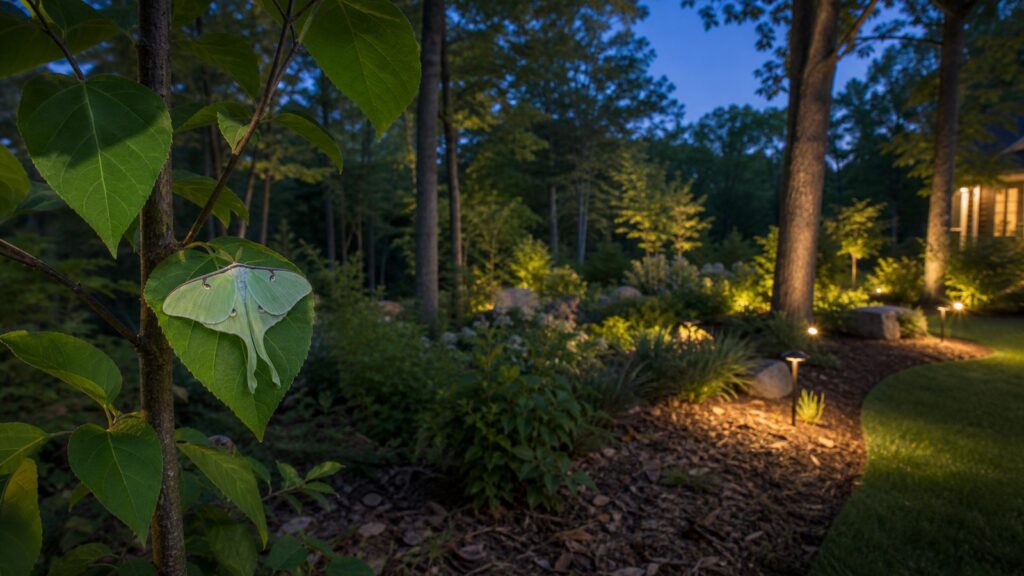
The luna moth, Actias luna, is one of the most recognizable moths in North America: pale green wings, long tails, and a wingspan that can reach roughly 3 to 4.5 inches. But the adult moth is only the short final act. Adult luna moths have nonfunctional, vestigial mouthparts. They do not eat nectar, fruit, sap, or garden flowers. They live for about a week on energy stored from the caterpillar stage, mate, lay eggs, and die.
As an Amazon Associate I earn from qualifying purchases.
That changes the whole design. A flower-heavy butterfly garden may support plenty of pollinators, but it will not reliably attract luna moths unless the property also supports their caterpillars. The practical goal is to build host-tree habitat: native deciduous trees and large shrubs, protected from broad-spectrum insecticides, paired with loose leaf litter, darker nights, and a woodland-edge layout.
On our job sites, the yards that have the best wildlife value are rarely the over-cleaned ones. They are the properties where the tree placement, drainage, lighting, mulch beds, and maintenance plan all work together. A luna moth garden is not messy by default. It is a deliberately built edge habitat.
Popular on Amazon

- 🌳 3 WHITE WALNUT (BUTTERNUT) TREES Includes three live white walnut saplings (Juglans cinerea), a native hardwood tree known for producing rich, edible nuts.
- 🌱 BARE ROOT FOR STRONG TRANSPLANT SUCCESS Shipped with exposed root systems to promote healthy establishment and faster adaptation when planted in soil.
- 🥜 EDIBLE NUT PRODUCING TREE Produces flavorful walnuts ideal for baking, cooking, or wildlife attraction once mature.
- 🌿 GREAT FOR LANDSCAPING & CONSERVATION Perfect for large yards, food forests, and native planting projects. Supports wildlife and long-term tree growth.
- 🌿 BEAUTIFUL CANOPY Butternut trees typically grow 40–60 feet tall with a spread of 30–50 feet at maturity, forming a broad, open canopy. Adequate spacing is important to accommodate long-term growth.
What Luna Moths Need From a Garden
A luna moth-friendly garden needs four things: the right host plants, low pesticide pressure, a safe place for cocoons, and nighttime conditions that do not confuse nocturnal insects.
Luna moths are native across much of eastern North America. Their timing depends on climate. In northern states, adults are most often seen from about May through July, usually with one generation per year. In warmer southern areas, they may have two or three broods, with activity stretching roughly from March through September.
Do these 3 things before closing this tab:
1Clear out junk files and repair common Windows errors2Fix the driver behind crashes, sound loss and screen glitches3Repair Windows errors before they cause bigger problemsTheir natural habitat is deciduous hardwood forest and forest edge. A suburban yard can work if it borrows that structure. Think of a layered planting zone instead of a single ornamental bed: canopy or small trees, an understory shrub layer, native ground-layer plants, leaf-litter pockets, and a darker no-spray area set away from constant foot traffic.
The most common mistake is treating luna moths like monarch butterflies. Monarchs need milkweed as a larval host and also visit nectar flowers as adults. Luna moth adults do not feed. For them, the host tree is the real attraction.
Plant Host Trees, Not Just Flowers
Luna moth caterpillars feed on the leaves of several deciduous trees and large shrubs. Host use varies by region, so the best approach is to plant two or three locally appropriate species rather than betting the whole garden on one tree.
Commonly cited luna moth host plants include hickory, walnut, sweetgum, persimmon, birch, white oak, red maple, willow, beech, alder, hazelnut, pecan, wild cherry, and sumac. Not every one belongs in every yard. A sweetgum may be a strong choice in one region and a poor fit in another. A black walnut may support wildlife but create placement issues because of juglone sensitivity and falling nuts. A willow can be valuable but should not be jammed beside a foundation, septic field, or buried utility run.
Recommended Free Tools
Good Host-Tree Strategy
For a typical residential lot, we would rather see a homeowner plant three smaller, well-placed host trees than one oversized specimen dropped into the wrong location. Smaller trees establish more reliably, cost less, and let you build the rest of the landscape around mature size instead of current size.
A practical planting plan might use one canopy tree, one smaller understory tree, and one large shrub or thicket-forming plant. For example, depending on your region, that could be a white oak or hickory as the long-term anchor, a persimmon or wild cherry as the mid-size wildlife tree, and sumac or hazelnut along the edge. In a wetter area, red maple, birch, alder, or willow may fit better. In drier or more alkaline sites, the plant list should change.
Before you buy, confirm the species is native or regionally appropriate for your state and soil. Local extension offices, native plant societies, and reputable native nurseries are better sources than national plant lists when you are choosing exact species.
Placement Rules We Use in the Field
Tree placement is where construction judgment matters. A tree that is beautiful at 8 feet tall can become a maintenance problem at 45 feet if it was planted too close to the house.
Keep large canopy trees far enough from structures to respect their mature spread. As a rough field rule, if a tree is expected to develop a 40-foot canopy, do not plant it 6 feet from the foundation and hope pruning will solve the problem. Keep mature limbs clear of roofs, siding, overhead service lines, driveways, and chimney paths. Avoid planting over buried utilities, septic lines, drainage pipe, or right against retaining walls.
Also watch water. Luna moth habitat should not interrupt drainage. If a yard already has swales, downspout extensions, French drains, or a low area that carries stormwater, preserve that flow. Trees and planting beds can improve stormwater uptake, but only if the grading still moves water away from the house.
Design the Yard Like Woodland Edge
A luna moth garden does not need to look abandoned. The best version is a clean, intentional border that behaves like a forest edge.
Start with a zone at least 8 to 12 feet deep if you have the space. A 4-foot strip can hold plants, but it will not function as well as a layered habitat. Along a rear fence, side yard, drainage edge, or transition to nearby woods, build depth: taller host trees toward the back or open side, shrubs in the middle, and native perennials or sedges at the front.
Quick wins for a faster PC:
Scan for outdated or missing drivers - takes under a minuteDriver Scan →Repair Windows errors before they cause bigger problemsFix Now →For a small suburban property, even a 100 to 200 square foot habitat bed can help. For a larger property, a 300 to 800 square foot no-spray woodland-edge zone gives you more room for tree spacing, leaf retention, and plant diversity.
A Practical Layered Layout
A strong layout includes five working parts:
- Canopy or host tree: white oak, hickory, birch, red maple, sweetgum, walnut, or another locally suitable host.
- Understory tree or large shrub: persimmon, wild cherry, hazelnut, sumac, alder, or regionally appropriate alternatives.
- Ground layer: native sedges, grasses, ferns, and flowering perennials that stabilize soil and support other insects.
- Leaf-litter pocket: a designated area where leaves remain through winter.
- Dark/no-spray zone: the portion of the yard where lighting, mosquito sprays, and aggressive cleanup are restricted.
Edges matter. A crisp mowed border, stone edge, steel edging, or defined mulch line tells neighbors and HOAs that the area is designed, not neglected. In stricter neighborhoods, that visual cue can be the difference between a habitat garden and a violation notice.
Leave Room for Cocoons and Winter Survival
Luna moth caterpillars spin thin cocoons, often wrapped in leaves. In many yards, the next generation gets removed during fall cleanup. Leaves are blown, bagged, hauled away, or shredded before pupae have a chance to finish development.
You do not need to leave the entire property under leaves. Designate a leaf-litter pocket under or near host plants. A 4-by-8-foot area is enough to start. On larger properties, multiple pockets totaling 100 square feet or more are better.
Keep the leaf layer loose, not packed into a wet mat against siding or wood trim. Leaves can be tucked behind shrubs, under trees, or inside a naturalized bed. Keep them away from foundation vents, basement windows, stairwells, and wood-framed structures. A 12- to 18-inch clearance from the house is a sensible minimum for moisture and pest management.
Delay heavy cleanup until spring. If the yard needs to look tidy, remove leaves from turf, walkways, patios, and drainage inlets, then move some of those leaves into the habitat bed. Do not run every leaf through a mower if your goal is overwintering moth survival.
Change Outdoor Lighting Before Moth Season
Artificial light at night can disrupt nocturnal insects, including moths. For luna moths, the lighting plan is just as important as the planting plan.
The worst setup is a bright, cool-white fixture aimed across the yard or uplighting host trees. It may look dramatic, but it turns the habitat into a visual trap. A better setup uses fewer fixtures, warmer color, shielding, and controls.
The Tool Desk
Outbyte PC Repair FREEClear out junk files and repair common Windows errorsFree Scan →Outbyte Driver Updater FREEScan for outdated or missing drivers - takes under a minuteDriver Scan →Use warm-white or amber lamps, ideally 2700K or lower when available. Aim fixtures downward. Shield them so the bulb is not visible from across the yard. Put lights on motion sensors, timers, or smart controls. Turn off unnecessary decorative lighting during moth flight season, especially from dusk through the first half of the night.
If you are installing a patio, walkway, retaining wall, or outdoor kitchen, decide on the moth-friendly lighting layout before the hardscape is built. It is cheaper to plan conduit, transformer location, switch legs, and fixture spacing during construction than to retrofit after pavers, walls, or planting beds are finished.
Lighting Cost Expectations
Small DIY changes are inexpensive. Swapping bulbs, adding timers, or using a small warm-color kit may run about $100 to $500. A professionally installed low-voltage landscape lighting system commonly costs $100 to $150 or more per fixture, and full residential systems often land around $2,000 to $6,000 depending on transformer size, wiring runs, controls, fixture quality, and site access.
A moth-friendly design may actually reduce fixture count. The money should go into good placement, shielding, warmer lamps, and controls instead of lighting every tree from below.
What’s actually slowing this PC down?
Pick the symptom - the matching free tool is one click away.
Avoid Sprays That Kill the Habitat You Built
If you plant host trees and then spray them with broad-spectrum insecticide, you have built a trap, not a habitat.
Luna moth caterpillars need clean foliage. Broad-spectrum insecticides, mosquito barrier sprays, systemic insecticides, and poorly timed treatments can kill caterpillars directly or contaminate the leaves they eat. This is especially relevant for mosquito services that spray shrubs, fence lines, and tree foliage on a recurring schedule.
Also popular on Amazon

- Grow your own Oregon White Oak (Quercus garryana), the only native oak species in British Columbia, Washington, and northern Oregon!
- Seed-grown on California's Redwood Coast
- Transplanting and care instructions included
- Trees can provide a natural barrier against high winds, temperatures, noise pollution and soil erosion, all while benefiting local air quality, wildlife and property values — a Jonsteen seedling will only grow in value and beauty!
Put the rule in writing if you use a maintenance company: no broad-spectrum sprays on host trees or habitat beds; no mosquito barrier applications in the moth zone; retain designated leaves through winter; delay major cleanup until spring; manage pests by hand or with targeted methods where practical.
Luna moth caterpillars usually do not cause meaningful landscape damage. If you find one on a host tree, do not treat it like an outbreak. A few chewed leaves are the point of the garden.
What It Costs to Build a Luna Moth-Friendly Garden in 2026
The cost depends on whether you are planting a few saplings yourself or integrating habitat into a broader landscape project with grading, irrigation, lighting, and hardscape. The numbers below are realistic 2026 planning ranges for U.S. residential work.
| Project item | Typical 2026 cost range | What drives the price |
|---|---|---|
| DIY host-tree planting | About $50 and up for small saplings | Tree size, species, nursery source, soil amendments, mulch, staking, delivery |
| Professionally planted tree | Commonly $150-$1,500 per tree; semi-mature trees often about $540-$680 | Caliper size, access, equipment, warranty, delivery distance, soil conditions |
| Large specimen tree installed | About $1,500-$3,000+ per tree | Tree size, machine access, crane or loader needs, aftercare requirements |
| Native plant understory bed | About $4.50-$12 per sq ft for basic landscaping; $5-$20 per sq ft for fuller plant-heavy work | Plant density, bed prep, edging, mulch, irrigation, weed pressure |
| Native plant material | Roughly $6 per sq ft for retail-sale quart/gallon plants at about 1 plant per sq ft | Container size, plugs vs gallons, seed mix use, species availability |
| Installed mulch bed | About $1-$3 per sq ft | Mulch type, edging, delivery minimums, bed cleanup, total square footage |
| Landscape design | Roughly $5-$45 per sq ft for design-intensive work, or flat fee pricing | Site measurements, planting plan detail, revisions, hardscape coordination |
| Moth-friendly lighting changes | DIY: about $100-$500; professional systems often $2,000-$6,000 | Fixture count, transformer size, wiring, controls, shielding, trenching access |
For a modest DIY project, a homeowner might spend $250 to $900 on two or three small host trees, mulch, compost, a few shrubs, and warm replacement bulbs. For a professionally installed 200 square foot habitat bed with several woody plants, mulch, edging, and basic soil prep, $1,500 to $4,000 is a more realistic planning range. If the project includes mature trees, irrigation changes, drainage correction, or a full lighting system, the budget can move into the $5,000 to $15,000 range quickly.
The long-term value is not only the moth. Host trees also add shade, stormwater uptake, curb appeal, cooling, privacy, and habitat for birds and other beneficial wildlife.
Independent reader supportYour contribution helps us test, update, and keep practical guides available for everyone.When to DIY and When to Hire a Pro
DIY works well when the project is small, the site is simple, and you are planting young trees or shrubs. If you can dig a proper planting hole, keep the root flare visible, water consistently for the first two growing seasons, and protect the bed from mowers and string trimmers, you can build a useful luna moth habitat without a large crew.
PC Slower Than It Used to Be?
A free scan shows the junk files, broken settings and background clutter dragging Windows down - then fixes them in one click.Free scan · Windows 10 & 11Outdated Drivers Are Slowing You Down
One free scan finds every outdated or missing driver and matches the right update for your exact hardware.Free scan · exact hardware matchHire a professional when tree placement affects structures, drainage, utilities, hardscape, slopes, retaining walls, irrigation, or outdoor lighting. Also bring in help if you are planting large-caliper trees, working near overhead or underground utilities, correcting compacted soil, or designing within HOA restrictions.
Good DIY Scope
- Planting small saplings or container-grown native shrubs.
- Creating a 100 to 200 square foot native bed along a fence or rear property edge.
- Changing cool-white bulbs to warm or amber lamps.
- Adding plug-in timers or motion controls to existing fixtures.
- Creating a designated leaf-litter pocket away from the foundation.
Better Professional Scope
- Planting semi-mature or specimen trees that require equipment.
- Designing around patios, retaining walls, drainage swales, or utilities.
- Installing low-voltage lighting with buried wire and transformers.
- Coordinating irrigation zones for new trees and native beds.
- Preparing HOA submittals, site sketches, or phased planting plans.
Permits, HOA Rules, and Site Constraints
Most simple garden planting does not require a permit, but do not assume every landscape change is exempt. Local rules can apply to irrigation, street trees, right-of-way planting, drainage changes, retaining walls, grading, protected trees, and work near easements.
If you live in an HOA community, review the plant list, bed edging rules, height limits, and maintenance language before installing a naturalized area. A moth garden is easier to approve when the plan looks intentional: defined borders, named plant species, mature heights, mulch type, and a clear note that leaves will be retained only inside designated habitat zones.
For city lots, check sight-line requirements near driveways and corners. Keep shrubs and low trees from blocking visibility. Avoid planting large trees under overhead utility lines. Call 811 before digging, even for landscape work. Utility marking is free in most areas and prevents expensive mistakes.
Free tools Windows power users keep installed
One-click scans. No signup required.
Maintenance Plan for the First Three Years
The first three years decide whether the habitat establishes or turns into a weed patch. A young tree is not self-sufficient just because it is native.
Water new trees deeply during dry spells. A typical young tree often needs 10 to 15 gallons per week during hot, dry weather, adjusted for rainfall, soil type, and species. Keep mulch 2 to 3 inches deep over the root zone, but pull it back from the trunk so it does not touch the bark. Avoid mulch volcanoes.
Weed the bed regularly in the first two seasons. Invasive vines and aggressive weeds can smother young shrubs and make the area harder to defend with neighbors or an HOA. Replace failed plants quickly so bare soil does not become a weed nursery.
Do structural pruning while trees are young. It is cheaper to correct crossing branches, weak attachments, and low limbs early than to wait until the tree is large. Keep mower damage away from trunks with mulch rings or bed edges.
By year three, the garden should need less intervention. The trees will still be young, but the understory should be filling in, the leaf-litter pockets should be established, and the lighting and spray rules should be routine.
How Long Until Luna Moths Show Up?
Expect a slow payoff. Luna moth attraction depends on nearby populations, the surrounding tree canopy, your region, weather, pesticide pressure, and how mature your host plants are. A newly planted 3-foot sapling is not the same habitat as a 25-foot established tree.
If you already live near hardwood woods or a mature tree corridor, you may see results sooner. If your property is isolated in a heavily treated subdivision, it may take years. That does not mean the project failed. You are building the conditions that make the yard useful over time.
When you do see luna moths, document them rather than capturing them. A photo submitted to iNaturalist or a local community science group is more useful than handling the insect. Adult luna moths have a short reproductive window, and the best thing you can do is leave them alone.
Free tools Windows power users keep installed
One-click scans. No signup required.
Bottom Line
To attract luna moths, build habitat for the caterpillar, not a nectar bar for the adult. Plant two or three regionally appropriate host trees or large shrubs, keep the foliage pesticide-free, leave protected leaf litter for cocoons, and make the yard darker at night with shielded, warm, downward-facing lights.
The best luna moth garden is a well-built woodland edge. It respects mature tree size, drainage, utilities, maintenance access, and neighborhood rules. Done right, it gives you more than a chance at seeing a spectacular moth. It gives the property shade, structure, stormwater value, and a healthier landscape that improves with age.
Frequently Asked Questions
What plants attract luna moths to a yard?
The best plants are larval host trees and large shrubs, not nectar flowers. Good candidates include regionally appropriate hickory, walnut, sweetgum, persimmon, birch, white oak, red maple, willow, beech, alder, hazelnut, pecan, wild cherry, and sumac.
Do adult luna moths eat nectar or flowers?
No. Adult luna moths have nonfunctional mouthparts and do not feed. They live briefly on stored energy from the caterpillar stage, so flowers alone are not a reliable way to attract them.
Will luna moth caterpillars damage my trees?
Usually no. Luna moth caterpillars may chew some leaves, but they are not typically a serious landscape pest. Avoid treating them with insecticide if your goal is to support luna moths.
How should I change outdoor lighting to help luna moths?
Turn off unnecessary lights, use motion sensors or timers, choose warm-white or amber lamps, shield fixtures downward, and avoid uplighting host trees during moth season.
When is luna moth season?
In northern parts of their range, luna moths are most often seen from about May through July. In warmer southern areas, activity can run roughly March through September with multiple broods.
Do I need a permit to create a luna moth garden?
Simple planting often does not require a permit, but local rules may apply to street trees, irrigation, grading, drainage changes, retaining walls, protected trees, and HOA-controlled landscapes. Call 811 before digging.
Quick Recap
Product prices and availability are accurate as of the date/time indicated and are subject to change. Any price and availability information displayed on Amazon at the time of purchase will apply.

