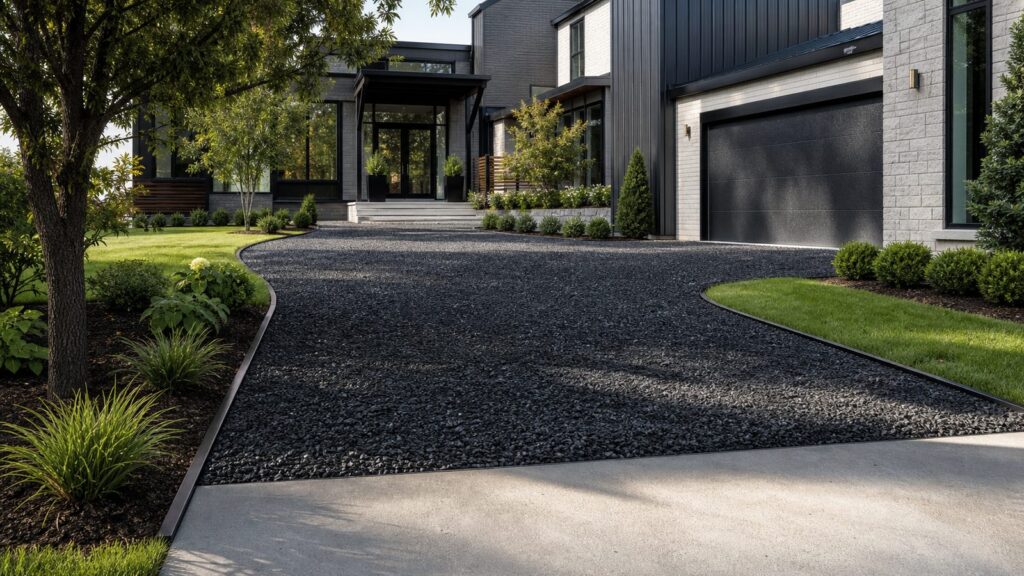
A black gravel driveway can look clean, architectural, and expensive without the cost of poured concrete or pavers. The mistake is treating it like a color choice only. On our job sites, the driveways that hold up are designed around stone shape, base depth, drainage, compaction, and containment first. The color comes after that.
For 2026, most gravel driveways in the U.S. fall somewhere between $1 and $10 per square foot installed. A simple spread-and-grade job may be near $1 to $3 per square foot. A full-depth professional installation with excavation, geotextile fabric, compacted base layers, grading, and delivery commonly lands around $4 to $10 per square foot. Specialty black aggregate such as basalt, black granite, or trap rock usually costs more than standard gray crushed stone because quarry availability and trucking distance drive the price.
The best black gravel for a driveway is usually angular crushed stone, not smooth decorative pebbles. Look for crushed basalt, black granite, trap rock, dark crusher run, or recycled asphalt millings depending on the look and budget. For most residential driveways, the top layer should be around 5/8 inch to 3/4 inch angular stone over a properly compacted base. Thin black gravel over soil is a short-term cosmetic fix, not a driveway.
As an Amazon Associate I earn from qualifying purchases.
Recommended Free Tools
Before You Pick a Black Gravel Driveway Design
Black gravel is not one product. It can mean crushed basalt, black granite, trap rock, black limestone, lava rock, recycled asphalt, dark chip seal, or polished decorative pebbles. Some are driveway-grade. Some belong in landscape beds only.
Our first recommendation is simple: order samples before buying truckloads. View them dry, wet, dusty, and in direct sun. Many black stones read deep black when wet but charcoal gray when dry. Fine dust can lighten the surface after a few weeks of traffic. If your house has white siding or pale concrete borders, that color shift matters.
#1 Best Overall

- 5OZ High Density & Durable Woven PP Material: This landscape fabric has 1415 Sq.ft large coverage area, length: 108ft/33m, width: 13ft/4m.This weed cloth can be easily cut to meet various needs such as driveway stabilization, gardening, agriculture, and drainage. Made of woven PP material and 5OZ high density, this driveway fabric has great durability and easily conforms to uneven surfaces.
- 600 LBS Tensile Strength: This geotextile fabric features 600 LSB high strength, making it more capable of bearing weight and stress. This heavy duty landscaping fabric can also increase the bearing capacity of the soil, making it more resistant to support heavy loads or structures. You can lay gravel, stones, and big rocks on it to increase the stability and flatness of the road and prolong its service life.
- Improve Soil Environment & Eco-Friendly: This woven landscape fabric can prevent soil erosion to enhance the stability of the soil. Besides, our driveway fabric underlayment for gravel can also prevent weeds and impurities from soil erosion, and provide a favorable growth environment for plants by keeping the soil moist and breathable. This commercial grade landscape fabric helps thrive plant growth and development and protects the environment, leading to healthier and more productive plants.
- Excellent Breathablity: This weed barrier fabric with great breathability allows water and air to pass through it easily without washing away the soil, thus having excellent breathability to conserve soil moisture, improve soil quality and maintain the stability of the soil.
- Versatile Applications: The geotextile fabric under gravel is perfect for construction projects and gardening planting works, such as road stabilization, riprap, retaining walls, artificial grass, vegetable patch, flower bed, gardening weed mat, ground cover, road fabric for driveway pathway, drainage fabric for french drains, greenhouse, weed control fabric, weed blocker fabric, patio lawn fabric, weed mat, garden fabric, riprap filter fabric, etc.
For a typical residential driveway, a durable section often includes:
- Excavated and compacted subgrade, with soft organic soil removed.
- Geotextile fabric where the soil is clay, wet, silty, or unstable.
- 4 to 8 inches of compacted crushed-stone base, often larger aggregate below the surface layer.
- 2 inches of premium black top stone, usually 5/8 inch to 3/4 inch angular gravel.
- Crown or cross-slope so water leaves the driveway instead of sitting in the wheel paths.
Using premium black stone only for the top 2 inches is usually the smart budget move. There is rarely a good reason to pay for decorative black aggregate throughout the entire depth unless the budget is generous and the local material price is unusually favorable.
| Black or Dark Material | Best Use | Driveway Performance | Color Expectation | Cost Tier |
|---|---|---|---|---|
| Crushed black basalt | Modern driveways, top dressing, parking pads | Excellent when angular and properly graded | Often charcoal dry, darker when wet | High |
| Black granite | Premium residential entries | Excellent hardness and durability | Black to dark gray depending on quarry | High |
| Trap rock | Rustic or heavy-use drives | Very strong, good lock-up when crushed | Dark gray, blue-black, or charcoal | Medium to high |
| Black lava rock | Landscape borders and accents | Poor to fair for vehicle areas; can crush and scatter | Dark, textured, porous | Medium |
| Recycled asphalt millings | Long rural drives and practical charcoal surfaces | Good when graded and compacted correctly | Charcoal black, less decorative | Low to medium |
| Polished black pebbles | Decorative strips and garden details | Poor for drive lanes; rounded stones migrate | Glossy black when clean | High |
1. Crushed Black Basalt for a Modern Driveway
Crushed black basalt is one of the cleanest looks for a contemporary home. It pairs well with flat-roof architecture, dark window frames, board-formed concrete, stucco, fiber cement siding, and steel edging. The key is to use crushed angular basalt, not rounded river rock.
For the wearing course, we typically want 5/8 inch or 3/4 inch crushed basalt. Smaller 1/4 inch to 3/8 inch basalt can look refined near walkways, but it may track more under tires and shoes. For the base, use a less expensive compactable aggregate rather than paying for black basalt through the full section.
Build Notes
A reliable basalt driveway section might use 6 inches of compacted crushed base with 2 inches of black basalt top stone. On weak soils, add geotextile fabric between the subgrade and base. If the driveway is more than 50 feet long, pay close attention to drainage breaks so runoff does not build speed and wash the surface.
Basalt is usually a premium option. Expect the total installed driveway to fall closer to the $4 to $10 per square foot range when excavation, base, fabric, trucking, and compaction are included. The basalt itself may be only one line item, but delivery can become expensive if the nearest quarry is far away.
Best for: modern homes, short to medium driveways, front-entry parking pads, and homeowners who want a crisp dark surface.
Maintenance level: moderate. Plan on occasional raking, spot filling, and top-dressing every few years depending on traffic and storm exposure.
2. Black Granite with Steel Edging
Black granite gives a driveway a polished but tough appearance. It is harder than many decorative stones and works well where the driveway is part of the front elevation. When paired with steel edging, the result is sharp and controlled instead of loose and unfinished.
The best specification is angular crushed black granite in the 5/8 inch to 3/4 inch range. Avoid polished black pebbles in drive lanes. They look good in photos, but rounded stones do not lock together, and they roll under tires.
Free tools Windows power users keep installed
One-click scans. No signup required.
Edging Details That Matter
Steel edging should be properly staked and set low enough that it contains gravel without becoming a trip hazard or snowplow obstacle. For most residential applications, a top edge roughly flush with the finished gravel surface is easier to maintain than a raised lip. If snow removal is common, discuss plow height and edge exposure before installation.
Black granite with steel edging is not the cheapest driveway idea. Installed pricing often sits in the upper half of the gravel range, especially when the driveway needs excavation and a compacted base. For a 600-square-foot driveway, a full professional installation might run roughly $2,400 to $6,000 at $4 to $10 per square foot. A simple refresh over an existing stable base may cost less.
Best for: urban and suburban homes, modern farmhouse exteriors, dark trim packages, and high-visibility front drives.
Maintenance level: moderate. Steel edging reduces migration, but the surface still needs periodic leveling and replenishment.
What’s actually slowing this PC down?
Pick the symptom - the matching free tool is one click away.
3. Trap Rock for a Rustic Dark Driveway
Trap rock is a strong, dark crushed stone often found in blue-black, gray-black, or charcoal tones. It is less glossy than some decorative black aggregates, which can be a benefit on wooded, rural, or traditional properties. It looks natural instead of overly designed.
For driveways, trap rock should be crushed and angular. A 3/4 inch top layer is a practical choice for vehicles. If the supplier offers dense graded aggregate or crusher-run-style trap rock, it may compact more tightly than clean decorative stone.
Where Trap Rock Performs Well
Trap rock works well for longer drives, heavier vehicles, and sites where the homeowner wants durability more than a pure black finish. It is also a good candidate for sloped approaches if combined with proper grading and stabilization.
We would not install trap rock over an unprepared muddy lane and expect it to last. For a durable build, excavate soft material, compact the subgrade, use geotextile where needed, place a larger base layer, and finish with the dark top aggregate. If the drive crosses a drainage path, solve that with a swale, culvert, or drain before placing finish gravel.
The Tool Desk
Outbyte Driver Updater FREEScan for outdated or missing drivers - takes under a minuteDriver Scan →Outbyte PC Repair FREEClear out junk files and repair common Windows errorsFree Scan →Cost is usually medium to high depending on local availability. If trap rock is quarried nearby, it may be more economical than imported black granite or basalt. If it has to travel a long distance, trucking can erase that advantage.
Rank #2

- 【5OZ Driveway Fabric】-Our 5 Ounce Heavy Duty Geotextile made from High-Quality Polyethylene Material,tear-resistant, sturdy and durable.
- 【Large Geotextile Fabric】- Our commercial-grade driveway fabric is Length: 115FT,Wide:13FT, 5oz.,High-quality fabrics have significant advantages,such as high elasticity and durability.
- 【Excellent Permeable Textile】- The woven geotextile fabric is highly permeable and breathable, without worries about water pooling. It is ideal for french drains, garden planting, and landscaping,to provide convenience on the driveways.
- 【Safety and Sturdiness】-800 LBS Tensile Strength,The underlayment fabric is high-strength and stretchable with a large weight capacity. Will last many years and stands up to the toughest conditions,You can lay gravel, stones, big rocks on it to increase the stability and flatness of the road and prolong its service life.
- 【Wide Applications】-Can be used for many different projects including Landscaping, geotextile fabric is perfect for construction projects, Erosion Control,such as road stabilization, riprap, retaining walls, animal stables, patio landscaping, etc.
Best for: rural homes, wooded properties, long driveways, and understated dark surfaces.
Maintenance level: low to moderate with a good base; higher on slopes or poorly drained soils.
4. Black Gravel Ribbon Driveway with Concrete Tire Strips
A ribbon driveway uses two hard tire strips with gravel, turf, or planting between and around them. For a black gravel version, light concrete tire strips create strong contrast while the black stone keeps the surface from looking plain.
Crashes, No Sound, or Screen Glitches?
Random freezes, missing sound and display glitches usually trace back to one bad driver. Find and replace yours safely.Free scan · under a minutePC Slower Than It Used to Be?
A free scan shows the junk files, broken settings and background clutter dragging Windows down - then fixes them in one click.Free scan · Windows 10 & 11Typical tire strips are around 18 to 24 inches wide each. The spacing depends on the vehicles using the drive, but a common overall driveway width is 9 to 12 feet. For larger trucks or frequent deliveries, wider is better. Tight ribbon driveways look elegant but can be annoying if daily vehicle alignment has to be perfect.
Practical Specification
Use concrete strips for the wheel paths and compacted black gravel between and outside the strips. The gravel areas still need a real base, especially where tires may turn off the concrete. A 2-inch black gravel top layer over compacted base is usually enough for the visual field if the concrete carries most of the load.
This design can cost more than a standard gravel drive because it includes formwork, concrete, reinforcement, and finish work. It may still cost less than a full-width concrete driveway because there is less concrete area. Budget depends heavily on local concrete pricing, access, and whether drainage or excavation is needed.
Best for: modern homes, garden-forward properties, guest entries, and driveways where appearance matters as much as function.
Quick wins for a faster PC:
Fix the driver behind crashes, sound loss and screen glitchesFind Drivers →Clear out junk files and repair common Windows errorsFree Scan →Maintenance level: moderate. Gravel can collect against concrete edges, and the strips should be kept clear for clean vehicle paths.
5. Black Gravel in a Permeable Stabilizer Grid
If the driveway ruts, spreads, or sits on a slope, black gravel in a cellular stabilizer grid is worth considering. The grid holds the aggregate in place while still giving the surface a gravel appearance. It is especially useful for parking pads, turnarounds, trash-truck areas, and sloped sections.
Installed geogrid or stabilized gravel systems commonly run around $2 to $8 per square foot in 2026 depending on grid type, gravel depth, traffic load, and base preparation. That does not mean every grid driveway is cheap. If excavation, drainage, and base reconstruction are required, the complete installed cost can still land in the broader $4 to $10 per square foot driveway range.
Use Angular Stone, Not Rounded Gravel
The grid cells should be filled with clean angular stone sized to the grid manufacturer’s recommendations. For many residential systems, that means aggregate around 3/8 inch to 5/8 inch. Oversized stone may sit proud of the grid. Rounded stone can shift and feel unstable.
On our job sites, grids are most useful where the owner wants the look of gravel but the traffic pattern is predictable and repetitive. Without stabilization, repeated turning movements create low spots. With a grid and proper base, the surface is much more resistant to rutting.
Best for: sloped drives, parking pads, tight turnarounds, and high-use residential areas.
Maintenance level: low to moderate. The grid reduces migration, but the surface may need occasional top-up where aggregate settles.
6. Black Gravel Courtyard or Parking Pad
A black gravel courtyard gives a property a finished arrival space without paving the whole area in concrete or asphalt. This works well for U-shaped drives, guest parking, detached garages, and rural homes with a larger forecourt.
The design challenge is scale. A big black gravel area can look flat or hot if there is no border, planting, lighting, or grade control. Break up the surface with concrete bands, paver aprons, stone borders, or planting islands. Keep turning paths generous enough for real vehicles. A practical residential parking bay is often about 9 by 18 feet per vehicle, with more room needed for doors, circulation, and backing.
Drainage Comes First
Courtyards collect water if they are graded like a bowl. A gravel surface is not a substitute for drainage design. The surface should shed water to a swale, drain inlet, rain garden, or stable outlet. Crowns and cross-slopes matter. Puddles, edge ruts, and washouts usually mean the driveway is trapping water or discharging it too fast in the wrong place.
For larger parking pads, plan for a compacted base and possible geotextile fabric. If the pad will support delivery trucks, dumpsters, trailers, or RVs, increase the base depth and use a heavier aggregate structure. The visual black stone can still be limited to the top layer.
Rank #3

- HEAVY DUTY ROAD FABRIC: Our woven polypropylene fabric is a true 4 oz, ensuring superior strength and durability for driveway and road stabilization. Don't settle for lighter weights when you can have the best.
- EASY INSTALLATION: Save time and money with our driveway barrier fabric. We stock a variety of sizes to minimize scrap, allowing you to cut one single piece to exact dimensions, making installation a breeze. NOTE: Due to shipping restrictions, this size shiped folded
- LONG-LASTING PERFORMANCE: Our heavy-duty road / Driveway fabric is built to withstand the toughest conditions and will last for many years. It is dimensionally stable and made to last up to 50 years if properly buried, providing you with lasting results.
- VERSATILE APPLICATIONS: Our polypropylene geotextile fabric has countless uses. Whether it's construction underlayment, gravel roads, sidewalks or driveway underlayment, paver and retaining wall projects, ground cover, weed barrier, or construction projects, our fabric delivers outstanding performance.
- SUPERIOR QUALITY: Choose Super Geotextile for the highest quality products on the market. We take pride in offering superior quality materials that are reliable, durable, and designed to meet your specific needs.
Best for: guest parking, garage courts, rural entries, and properties with room for a defined arrival area.
Do these 3 things before closing this tab:
1Clear out junk files and repair common Windows errors2Scan for outdated or missing drivers - takes under a minute3Repair Windows errors before they cause bigger problemsMaintenance level: moderate. Large gravel fields need periodic grading, weed control, and edge cleanup.
7. Black Gravel with Light Paver or Belgian Block Borders
Black gravel looks best when the edge is intentional. A light paver, concrete curb, limestone block, or Belgian block border gives the driveway contrast and keeps the surface from bleeding into lawn or planting beds.
This is one of the most reliable ways to make a gravel driveway look designed instead of temporary. The border also helps with maintenance because it reduces stone migration. For a front driveway, border restraint is often worth the cost.
How to Size the Border
For light-duty residential edges, pavers or blocks should be set on a compacted base, not just pressed into soil. Where vehicles may cross the edge, the border needs a stronger base and proper restraint. A common driveway width is 10 to 12 feet for a single lane, but wider aprons and flares are useful near the street and garage.
Recommended Free Tools
Use black basalt, granite, or trap rock as the top gravel and choose a border color that contrasts without looking busy. Pale gray concrete, buff pavers, or natural stone block all work. Avoid borders that are too high if snowplows, trailers, or low-clearance cars use the drive.
Best for: front-yard driveways, traditional homes, modern farmhouse properties, and any driveway visible from the street.
Maintenance level: low to moderate. Edging reduces spread, but the gravel surface still needs occasional raking and top-dressing.
8. Charcoal Recycled Asphalt or Dark Tar-and-Chip for Long Drives
For long rural driveways, premium black basalt or granite can become expensive fast. A 1,000-square-foot driveway at $4 to $10 per square foot is already $4,000 to $10,000. A longer farm or estate drive can exceed that before adding culverts, clearing, or drainage work.
That is where recycled asphalt millings or dark tar-and-chip can make sense. They are not the same as decorative black gravel, but they can create a charcoal surface that is more practical for long runs.
Recycled Asphalt Millings
Asphalt millings are reclaimed from old asphalt pavement. When spread, graded, and compacted, they can create a darker, tighter surface than loose gravel. Performance varies by material quality, installation method, climate, and traffic. Millings are often a practical choice where the goal is dust control and durability at a lower cost than premium stone.
Dark Tar-and-Chip
Tar-and-chip, also called chip seal, uses a liquid asphalt binder with stone chips embedded into the surface. Angi’s 2026 figures cite tar-and-chip projects around $360 to $2,900, averaging about $1,600, but the real cost depends on driveway size, existing base condition, and local contractor availability. It is more of a bound surface than a loose gravel drive.
Best for: long rural drives, secondary access roads, farm lanes, and budget-conscious projects where charcoal color is acceptable.
Maintenance level: low to moderate. Millings may need regrading. Tar-and-chip may need future resealing or resurfacing depending on wear.
2026 Black Gravel Driveway Cost Guide
The installed cost of a black gravel driveway depends less on the color and more on the full scope. A contractor pricing a real driveway is looking at excavation, subgrade condition, base depth, drainage, aggregate type, trucking distance, equipment access, edging, stabilization, and finish grading.
| Project Type | Typical 2026 Cost | What It Usually Includes |
|---|---|---|
| Simple gravel refresh | $1-$3 per sq ft | Spreading and grading new gravel over a stable existing driveway |
| Full-depth gravel driveway | $4-$10 per sq ft | Excavation, base layers, compaction, finish gravel, grading, and delivery |
| Standard residential project averages | $1,500-$1,800 common averages | Varies widely by size and scope; many basic projects fall in this range |
| 100 ft x 10 ft pro-installed drive | $4,000-$10,000 | Typical larger professional installation with base preparation |
| Gravel material alone | $30-$100 per ton | Aggregate only; specialty black stone is often higher than basic crushed stone |
| Delivery and site prep | $150-$6,200 | Clearing, grading, old material removal, drainage fixes, and truck access |
| Stabilized gravel grid | $2-$8 per sq ft installed | Grid system plus gravel, depending on base and traffic requirements |
For budgeting, measure the driveway length and width first. A 12-foot-wide by 50-foot-long driveway is 600 square feet. At $4 to $10 per square foot, that is roughly $2,400 to $6,000 for a full professional gravel installation. At 12 feet by 100 feet, the same scope becomes 1,200 square feet, or roughly $4,800 to $12,000.
Specialty black aggregate can be worth it on short, visible driveways. For long drives, use the premium material selectively at the entry, parking court, or final approach to the house.
Do these 3 things before closing this tab:
1Clear out junk files and repair common Windows errors2Fix the driver behind crashes, sound loss and screen glitches3Repair Windows errors before they cause bigger problemsDrainage, Base Depth, and Stabilization
A gravel driveway should shed water. It should not rely on water disappearing straight down through the surface. In real weather, fines clog voids, soils saturate, and runoff follows the easiest path. If that path is down the wheel track, the driveway will rut.
Rank #4

- High Permeability Geotextile Fabric : Groweco geotextile fabric is highly permeable and breathable.Let the water and air to drain to the soil, maintaining soil moisture.The woven structure design of road fabric will let air and water through to preserve soil moisture levels without blocking water on the road surface
- Premium Driveway Fabric - 4oz heavy duty woven geotextile fabric.This premium durable commercial-grade driveway fabric heavy duty is 100% Virgin Polypropylene Material,tear-resistant, sturdy and durable
- Easy to install: Our commercial grade landscape fabric is easy to maneuver. Simply cut the ground cover with scissors and lay down where needed. Our landscape fabric weed cloth could also use for vegetable path, farm greenhouse ground cover .you can unroll and paving it easily
- Driveway Fabric Underlayment for Gravel:Woven Geotextile Fabric can last many years and stands up to the toughest conditions,You can lay gravel, stones, big rocks on it to increase the stability and flatness of the road and prolong its service life
- Multiple Purposes:Large Geotextile Fabric could be used in a wide range of applications, including as an underlayment for soil stabilization, commercial grade driveway fabric, French drain fabric,underlayer for artificial grass,landscaping,construction projects, gravel pathways and driveways. It is also widely used as weed barrier landscape fabric for garden farm and greenhouse
Good gravel driveway drainage usually includes one or more of the following:
- Crown: A slight high point in the center so water drains to both sides.
- Cross-slope: A consistent slope toward one side where water has a stable outlet.
- Swales: Shallow side channels that move water without eroding the drive.
- Culverts: Pipes under the driveway where roadside or ditch flow must pass through.
- French drains: Useful where groundwater or uphill seepage is entering the driveway base.
- Geotextile fabric: Helps separate soft soil from the stone base so the gravel does not sink into mud.
- Geogrid or cellular confinement: Helps control rutting on slopes, turnarounds, and parking areas.
For a light residential driveway on firm soil, total gravel depth may be around 6 to 8 inches. On weak soil, wet areas, or heavier vehicle routes, more base depth may be needed. The top black gravel layer is commonly around 2 inches. More is not always better; too much loose surface stone can feel unstable and spread under tires.
Permits and Safety Checks Before You Build
Permit requirements vary by city, county, state highway agency, and HOA. Do not assume a gravel driveway is exempt because it is not concrete. Permits are often triggered by work in the right-of-way, curb cuts, apron changes, culverts, stormwater discharge, or a new connection to a public road.
The Tool Desk
Outbyte Driver Updater FREEFix the driver behind crashes, sound loss and screen glitchesFind Drivers →Outbyte PC Repair FREEClear out junk files and repair common Windows errorsFree Scan →A practical pre-construction checklist includes:
- Right-of-way permit: Required in many places when work touches the public roadway or sidewalk area.
- Driveway connection permit: State highways often have their own rules. PennDOT’s 2026 residential driveway permit application and inspection fee is listed at $25 for connections to state highways.
- Curb cut or apron approval: Common in towns and subdivisions.
- Culvert approval: Required where ditch flow crosses the driveway.
- Stormwater or erosion control review: More likely on slopes, near wetlands, or on larger disturbed areas.
- HOA approval: Often controls color, width, edging, and surface type.
- 811 utility marking: Call before excavation so buried utilities are located.
- Width and turnaround requirements: Fire access, emergency vehicles, and local codes may control layout.
Local fees can vary widely. Concord, Massachusetts, for example, lists right-of-way permit fees from $50 to $200 and driveway permit ranges up to $1,200 for looped driveways. Your local authority is the only source that matters for your address.
When to DIY vs When to Hire a Pro
A DIY gravel refresh can make sense if the existing driveway is structurally sound, drains well, and only needs a new surface layer. If you are adding 1 to 2 inches of black gravel over a stable base, have room for delivery, and can spread and rake safely, the project is approachable for a capable homeowner.
Hire a pro when the driveway needs excavation, base reconstruction, culverts, drainage correction, geotextile installation, geogrid, heavy compaction, or work near a public road. Also hire a pro for steep slopes, long drives, poor soils, or any area used by delivery trucks, trailers, or emergency vehicles.
The biggest DIY failure we see is adding decorative stone to a driveway that already has a drainage or base problem. New black gravel may look good for a few weeks, then the same potholes and ruts return. If water sits on the drive after a storm, fix the grade and drainage before buying finish stone.
Maintenance Expectations for Black Gravel
Black gravel is not maintenance-free. It needs less formal repair than concrete cracking or asphalt resurfacing, but it still moves. Expect periodic raking, pothole filling, weed control, edge cleanup, and top-dressing.
Traffic volume, slope, rainfall, freeze-thaw cycles, snowplowing, and soil type determine the schedule. A well-built residential driveway may need light touch-ups once or twice a year and a new top-dressing every few years. A steep rural drive with heavy runoff may need grading after major storms.
Dark gravel also shows certain messes more clearly. Pale dust, tan soil, leaves, grass clippings, and tire tracking can stand out against black stone. In hot climates, dark surfaces absorb more heat. If the driveway borders a pool deck, play area, or frequently used barefoot path, think carefully before choosing the darkest material available.
Best Overall Recommendation
For most homeowners who want a true black gravel driveway, the best balance is a properly built crushed-stone base with 2 inches of angular black basalt, black granite, or trap rock on top, contained by steel, concrete, paver, or stone edging. Use geotextile fabric where the soil is weak or wet, and use a stabilizer grid where traffic turns, parks, or climbs a slope.
Quick wins for a faster PC:
Scan for outdated or missing drivers - takes under a minuteDriver Scan →Clear out junk files and repair common Windows errorsFree Scan →Fix the driver behind crashes, sound loss and screen glitchesFind Drivers →If the driveway is long and cost matters more than a premium black finish, consider dark crusher run, recycled asphalt millings, or tar-and-chip. If the project is mainly visual, spend the premium black aggregate where people actually see it: the apron, front approach, parking court, or garage entry.
The driveway should be designed first as a small road and second as a design feature. When the base, drainage, and containment are right, black gravel can look sharp and perform for years. When those basics are skipped, the color will not save the driveway.
Frequently Asked Questions
What is the best black gravel for a driveway?
The best black gravel is angular crushed stone, usually black basalt, black granite, trap rock, or a dark crusher-run material. For most residential top layers, 5/8 inch to 3/4 inch angular gravel works better than smooth black pebbles because it locks together under vehicle traffic.
How much does a black gravel driveway cost in 2026?
Most U.S. gravel driveways cost about $1 to $10 per square foot installed in 2026. Simple spread-and-grade work may be $1 to $3 per square foot, while full-depth professional installations with excavation, base, fabric, grading, compaction, and delivery commonly run $4 to $10 per square foot.
Does black basalt gravel stay black when dry?
Not always. Many black basalt products look dark charcoal or gray-black when dry and much deeper black when wet. Dust, fines, sunlight, and quarry variation all affect the final appearance, so review samples dry, wet, dusty, and in direct sun before ordering a full load.
Is black lava rock good for driveways?
Black lava rock is usually better as a landscape accent than a main driveway surface. It is porous and lightweight compared with crushed driveway stone, and it can break down or scatter under vehicle traffic. Use angular basalt, granite, trap rock, or compactable dark aggregate for the drive lanes.
Do I need a permit for a gravel driveway?
You may need a permit if the driveway connects to a public road, changes a curb cut or apron, crosses a ditch, requires a culvert, affects stormwater flow, or is controlled by an HOA. Permit rules and fees vary locally, so check your city, county, state highway agency, and HOA before excavation.
How do you keep black gravel from washing out or spreading?
Use angular stone, compacted base layers, proper crown or cross-slope, stable drainage outlets, and edging. On slopes or turning areas, add geogrid or cellular stabilization. Washouts usually come from drainage and grading problems, not just the gravel itself.
Free tools Windows power users keep installed
One-click scans. No signup required.
Quick Recap
Product prices and availability are accurate as of the date/time indicated and are subject to change. Any price and availability information displayed on Amazon at the time of purchase will apply.

